

CNLawBlog is an independent online publication that publishes informational articles across law, business, technology, finance, education, health, real estate, lifestyle, gaming, and other practical subjects. Despite the word “Law” in its name, the current CNLawBlog.com website is not limited to legal content, nor does it present itself as a law firm, court, government agency, or official legal database. Its main purpose is to make complex or useful topics easier for general readers to understand.
I reviewed the current website, its About page, editorial policy, content categories, recent articles, and publishing information. What I found is more nuanced than many online descriptions suggest: CNLawBlog began with a strong legal identity, but today it operates more like a broad digital knowledge publication.
What Is CNLawBlog Today?
CNLawBlog.com describes itself as an independent digital publication founded in August 2018. According to its current About page, the publication was created to make useful information clearer, more accessible, and easier to understand for readers from different backgrounds.
That description matters because search results can give a very different impression.
Some pages on the internet describe CNLawBlog as a dedicated Chinese law resource. Others describe it as a general legal education website. The actual CNLawBlog.com homepage, however, currently features a much wider mix of subjects, including finance, artificial intelligence, gaming, lifestyle, consumer information, and legal topics.
In practical terms, I would describe CNLawBlog as a multi-category informational website with legal roots rather than a specialist legal publication.
Its own published material also reveals how the brand has evolved. A March 2026 article on the site described CNLawBlog primarily as a platform for corporate law, civil law, criminal law, legal updates, and case studies. Yet its current About page describes a much broader editorial scope.
That difference is worth knowing if you are researching the site today.
Why the Name CNLawBlog Causes Confusion
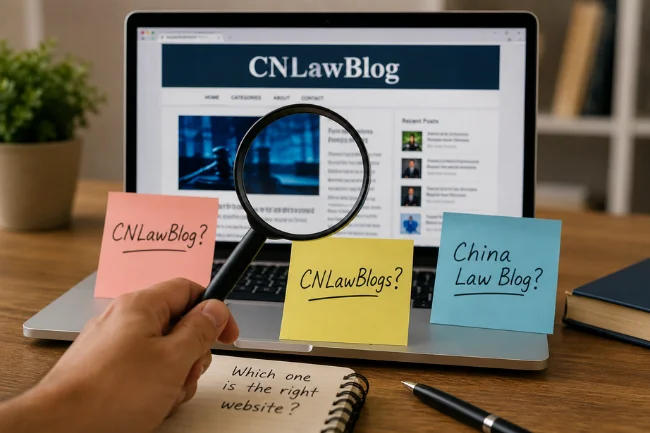
The name naturally sounds as though it should refer to a blog about law in China.
That assumption is understandable, but it can lead readers to the wrong website.
There are several similarly named online resources, and they are not necessarily related. One separate domain, CNLawBlogs.com, focuses specifically on Chinese business law, compliance, data privacy, intellectual property, company formation, and related topics.
There is also the long-established China Law Blog published by the international law firm Harris Sliwoski. That publication focuses on practical Chinese law and international business issues and is associated with named attorneys, including Dan Harris.
Here is the distinction I would make:
| Publication | Main Focus | What Readers Should Know |
|---|---|---|
| CNLawBlog.com | Law, technology, business, finance, health, education, lifestyle, gaming and general topics | Independent multi-topic digital publication |
| CNLawBlogs.com | Chinese law, compliance, PIPL, IP and business issues | Separate website focused much more heavily on China-related law |
| China Law Blog by Harris Sliwoski | China law and international business | Law-firm publication written by practicing international attorneys |
The safest habit is simple: check the exact domain instead of assuming that similar names represent the same organization.
What Kind of Content Does CNLawBlog Publish?
The current publication covers a considerably broader range of subjects than its name suggests.
Law and Legal Information
Legal content remains visible on the site.
Recent and existing topics include personal injury, wrongful death, renters’ rights, DUI representation, insurance claims, workplace matters, legal procedures, and law-firm marketing. The site has also published broader explanations of corporate law, civil law, criminal law, contracts, compliance, and legal rights.
This content can be useful for introductory research, particularly when a reader needs plain-language background before examining a more authoritative legal source.
It should not, however, be confused with individualized legal advice.
Business and Finance
CNLawBlog also publishes business and financial material.
Recent examples include medical-equipment financing, Treasury yields, Federal Reserve interest-rate expectations, online loans, entrepreneurship, consumer finance, and business decision-making.
For a reader, this means the site functions more like a general knowledge publication than a traditional legal blog.
Technology and Digital Trends
Technology is another noticeable content area.
The publication has covered edge AI, data sovereignty, software development, online platforms, digital privacy, and tutorials. An article published in July 2026, for example, examined how edge AI can move processing from centralized cloud infrastructure toward local devices.
This wider technology coverage is one reason I would avoid describing CNLawBlog today as a law-only website.
Health, Education, Lifestyle and Other Topics
The current About page also lists health and wellness, education, home improvement, real estate, lifestyle, gaming, consumer information, and general practical guides among its subject areas.
Its homepage reflects that variety, with material ranging from screen-time habits to Elden Ring gaming content.
For searchers who discover the site through one legal article, that broader editorial model may come as a surprise.
How I Evaluated CNLawBlog
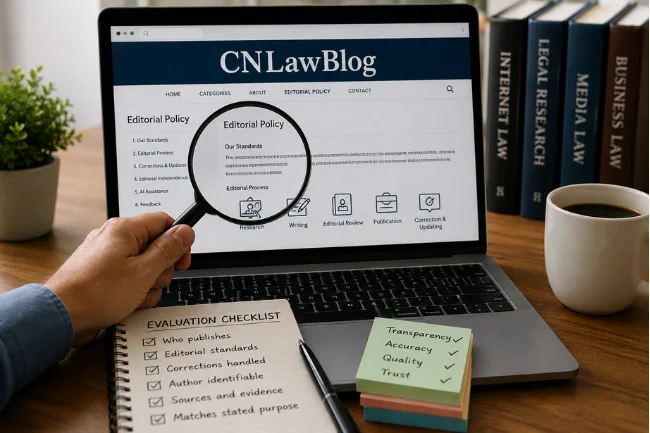
When I evaluate an informational website, I do not judge it only by its design or by how confidently its articles are written.
I look at who publishes the material, whether the website explains its editorial standards, how corrections are handled, whether authors are identifiable, what sources support important claims, and whether the site’s stated purpose matches what it actually publishes.
CNLawBlog does several useful things in this area.
Its Editorial Policy explains that articles may go through research, writing, editorial review, publication, correction, and later updating. The policy says reviews consider factual consistency, readability, organization, formatting, and overall quality. It also states that outdated or inaccurate material may be corrected when problems are identified.
The site further acknowledges the use of modern digital tools in parts of its editorial workflow while stating that published articles receive human review.
Those are useful transparency signals.
They are not, by themselves, proof that every individual article is correct.
Is CNLawBlog Reliable?
My view is that CNLawBlog can be useful as a starting point for general information, but reliability should be judged article by article.
That distinction becomes especially important with legal, financial, medical, and other high-impact topics.
Positive Trust Signals
The website publishes an About page explaining its mission and editorial scope.
It also maintains an editorial policy covering research, reviews, corrections, updates, editorial independence, and reader feedback.
Readers can therefore see more about the site’s publishing process than they can on many anonymous content websites.
The publication also encourages readers to report inaccurate or outdated information.
Areas Where Readers Should Be More Careful
One limitation I noticed is author transparency.
Many current posts are attributed to “Jamie,” but the visible archive and pages I reviewed do not provide the same level of detailed professional credentials that I would expect from a specialist legal, medical, or financial publication.
That does not automatically make the content inaccurate. It simply means the reader should not treat a byline alone as evidence of professional expertise.
The site also accepts guest posts. Its submission page says contributors may include one or two relevant dofollow links and that submissions are manually reviewed.
Guest contributions are common across digital publishing, but they make source evaluation particularly important. Before relying on a page, I would check who wrote it, what evidence is cited, whether there is a commercial relationship, and whether authoritative sources confirm its most important claims.
CNLawBlog vs. an Official or Specialist Source
The most useful way to approach CNLawBlog is to understand what type of source it is.
| Research Need | CNLawBlog May Help With | Better Source for Final Verification |
|---|---|---|
| Understanding a topic for the first time | Plain-language explanations and background | Specialist reference if accuracy is critical |
| Legal question | General legal awareness | Government source, statute, court material or licensed lawyer |
| Financial decision | General education and terminology | Regulator, official financial institution or qualified adviser |
| Medical or health question | Background reading | Government health authority or qualified healthcare professional |
| Technology topic | Concepts, trends and introductory explanations | Technical documentation, standards bodies or primary research |
| China-specific legal issue | Only after checking the exact article and domain | Official Chinese sources or specialist China-law professionals |
This distinction does not make general informational websites useless.
I often use broad publications to understand terminology, identify issues I need to research, or get enough context to ask better questions. The mistake is treating introductory information as the final authority.
How to Use CNLawBlog Safely and Effectively
I recommend using a simple verification process whenever an article could influence an important decision.
Check the Publication Date
Legal rules, financial conditions, software, regulations, medical guidance, and technology can change rapidly.
An article that was accurate two years ago may no longer reflect current requirements.
Look for Primary Sources
If a page discusses legislation, regulation, statistics, medical guidance, financial policy, or technical specifications, follow the evidence where possible.
Government agencies, official regulators, courts, statutes, academic papers, and original documentation generally provide stronger verification than another blog repeating the same claim.
Check the Author
Look beyond the name.
Ask whether the author has relevant professional experience, credentials, published expertise, or first-hand knowledge of the subject.
Separate Education From Advice
A general article can explain how an issue normally works.
It cannot know the facts of your specific legal dispute, financial position, health history, contract, business structure, or jurisdiction.
CNLawBlog itself states that its informational content is not a substitute for professional legal advice.
Confirm the Exact Website
This is unusually important with CNLawBlog because similarly named websites appear in search results.
If somebody recommends an article or “CNLawBlog,” check the full domain before assuming which publication they mean.
Why So Many Articles Online Describe CNLawBlog Differently
This was one of the most interesting things I found while researching the name.
A noticeable number of third-party pages describe CNLawBlog as a Chinese legal resource even though CNLawBlog.com’s current site presents itself as a multi-topic publication. Other pages treat the term as though it refers to one universally recognized legal brand. Current search results show that neither assumption is safe.
Part of the problem is likely semantic.
“CN” is commonly associated with China, while “law blog” sounds self-explanatory. A writer who does not verify the actual domain can easily build an entire description from the name itself.
That is precisely why first-party verification matters.
I would trust the site’s current homepage, About page, editorial policy, visible archives, and actual published articles more than a third-party description that simply repeats what other search results say.
Who Is CNLawBlog Best For?
CNLawBlog is most suitable for readers who want accessible introductory material rather than specialist professional advice.
That may include students exploring unfamiliar concepts, business owners building basic awareness, consumers researching a topic, general readers following technology or finance, and people trying to understand terminology before moving to more authoritative sources.
Its broad scope can be convenient because readers can explore several subject areas on one website.
At the same time, that breadth means I would evaluate expertise at the article level rather than assuming the entire publication has specialist authority in every category it covers.
Frequently Asked Questions About CNLawBlog
What is CNLawBlog?
CNLawBlog.com is an independent digital publication covering law, business, technology, finance, health, education, real estate, lifestyle, gaming, and other informational topics.
Is CNLawBlog a law firm?
No. CNLawBlog presents itself as an independent informational publication rather than a law firm, court, government agency, or legal-advice service.
Is CNLawBlog only about Chinese law?
No. The current CNLawBlog.com website publishes material across many legal and non-legal categories, although similarly named websites may focus specifically on Chinese law.
Is CNLawBlog reliable?
It can be useful for background research, but important legal, medical, financial, or regulatory claims should be confirmed through qualified experts and authoritative primary sources.
Is CNLawBlog the same as China Law Blog?
No. China Law Blog is a separate publication associated with international law firm Harris Sliwoski and focuses heavily on Chinese law and international business.
Final Thoughts on CNLawBlog
CNLawBlog is easier to understand once you separate its name from assumptions about what the name should mean.
Today, CNLawBlog.com is best viewed as an independent, multi-topic digital publication with a significant legal-information component. It can be useful for learning the basics of a subject, discovering terminology, and identifying questions worth researching further.
For anything involving legal rights, money, health, compliance, or other high-stakes decisions, I would use it as the beginning of the research process rather than the end.
If you find a useful CNLawBlog article, read it for context, check its author and date, follow its evidence, and verify important claims against primary or professionally qualified sources before acting.

Noah Sterling is a technology research writer with 8+ years of experience covering emerging technologies, software trends, digital tools, and innovation. He creates practical, research-based articles to help readers understand the evolving technology landscape.


