Personal growth is often associated with major life changes: starting a new career, ending an unhealthy relationship, overcoming a fear, or becoming a completely different version of yourself.
But growth usually begins somewhere smaller.
It may start when you notice that you react defensively to criticism. Perhaps you realize that you keep repeating the same relationship pattern. Or maybe you simply begin asking yourself a question you have avoided for years: Why do I keep doing this?
Self-discovery can be difficult because people have blind spots. We can spend hours thinking about our lives without gaining much clarity. We may confuse overthinking with self-reflection or repeat the same explanations without questioning whether they are actually true.
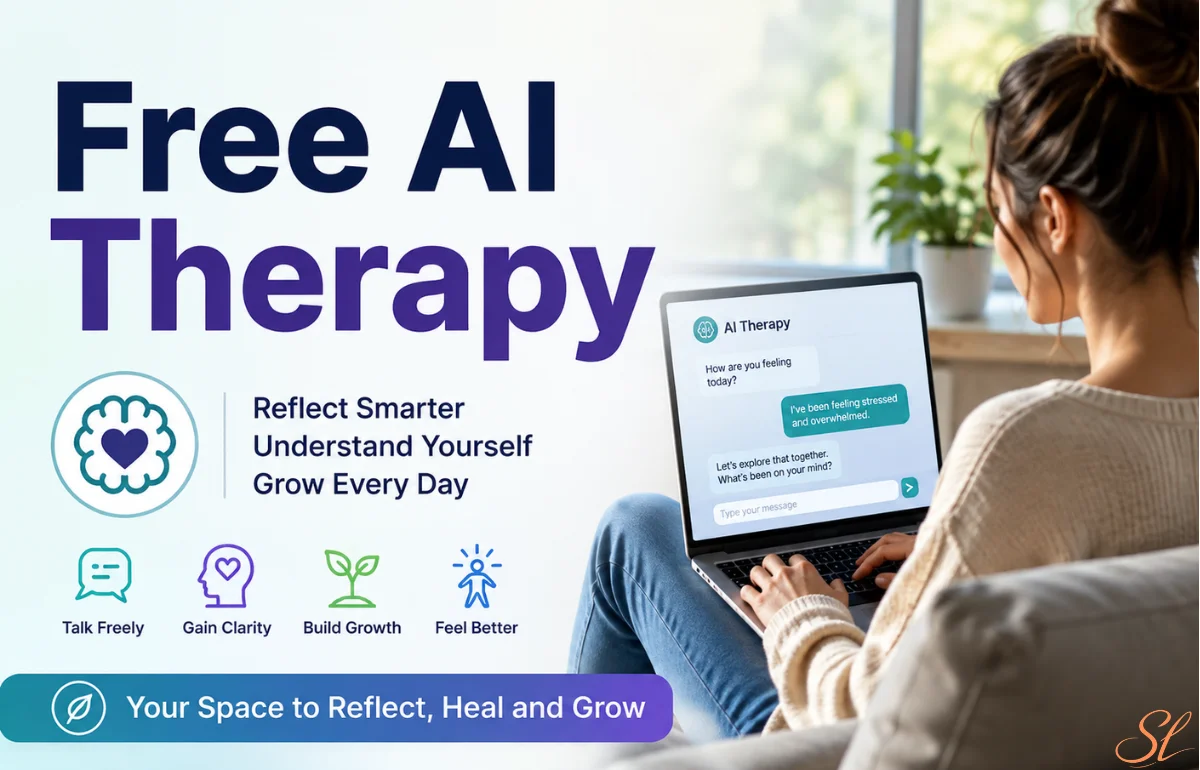
This is one reason some people are beginning to use free AI therapy tools as part of their personal growth routine. AI can provide a space to put thoughts into words, reflect on everyday experiences, identify possible patterns, and explore questions that may otherwise remain unanswered.
However, AI is not a replacement for psychotherapy or professional mental health care. The American Psychological Association advises against relying on generative AI chatbots as substitutes for qualified mental health treatment, although purpose-built tools may sometimes provide supportive benefits.
Used with realistic expectations, though, AI can become a useful tool for one important part of personal development: learning to understand yourself better.
Personal Growth Starts With Self-Awareness
Before people can change a behavior, they usually need to recognize it.
Self-awareness is more than simply thinking about yourself. Someone can replay an embarrassing conversation for hours and still learn nothing from it.
Useful reflection asks better questions:
- Why did this affect me so strongly?
- What was I expecting?
- What assumptions did I make?
- Is this a pattern I have experienced before?
- What part of my reaction was within my control?
- What would I like to do differently next time?
Conversational AI can help guide this process.
Instead of writing a journal entry and stopping there, a person can continue exploring the experience through questions. AI may summarize what the person has said, ask for clarification, or suggest another perspective.
The AI is not uncovering a secret truth about the user. Ideally, it is helping the person slow down and think more carefully about their own experiences.
Why AI Can Make Self-Reflection Easier

Honest self-reflection is not always easy.
People may avoid examining uncomfortable thoughts because writing them down makes them feel more real. Others simply do not know where to begin.
A conversational format can reduce that pressure.
Instead of staring at a blank journal page, someone might write:
“I keep feeling frustrated with my life, but I don’t know exactly why.”
From there, they can explore what has been happening. Work pressure, relationships, financial concerns, unrealistic expectations, or exhaustion may gradually become part of the conversation.
Putting vague experiences into words can make them easier to examine.
For personal growth, the most useful AI conversation may not be the one that provides a quick answer. It may be the one that helps someone ask a question they would not have considered on their own.
What Does Research Say About AI Mental Health Support?
Research into AI mental health tools is expanding, although the evidence is still developing.
A 2025 systematic review and meta-analysis published in the Journal of Medical Internet Research reviewed 26 studies and analyzed 14 randomized controlled trials involving 6,314 participants. Researchers found a small-to-moderate statistically significant effect in reducing negative mental health outcomes, although the studies varied substantially and the number of high-quality randomized trials remained limited.
Another 2025 systematic review published in World Psychiatry examined 160 studies of AI mental health chatbots published between 2020 and 2024. The researchers found that large language model-based chatbots were growing rapidly, accounting for 45% of new studies in 2024. However, only 16% of studies involving these newer systems had undergone clinical efficacy testing.
The takeaway is important.
Not every AI chatbot should be considered therapy.
Some purpose-built tools show promising results, but many generative AI systems have not been rigorously tested as mental health interventions.
For personal growth, however, AI does not necessarily need to function as clinical treatment to be useful. Reflection, journaling, goal exploration, and emotional awareness are different from diagnosing or treating a mental health condition.
How Free AI Therapy Can Support Self-Discovery

Personal growth often involves recognizing patterns that initially seem disconnected.
For example, someone might believe they are simply “bad at relationships.” After reflecting on several experiences, they may notice something more specific: they tend to withdraw whenever they feel disappointed because they fear that expressing frustration will lead to rejection.
That realization does not solve the problem immediately.
But it creates a better starting point.
Instead of thinking, I’m bad at relationships, the person can ask:
Why do I withdraw when I feel hurt, and what could I do differently?
Free AI therapy tools may support this process in several ways.
1. Helping You Put Emotions Into Words
Sometimes people know they feel “off” without understanding why.
An AI conversation can encourage them to describe the experience more precisely. Are they frustrated, disappointed, anxious, embarrassed, resentful, or simply exhausted?
Naming emotions does not automatically solve them. However, clearer language can make reflection easier.
2. Helping You Notice Recurring Themes
Over time, people may repeatedly discuss similar concerns: fear of disappointing others, workplace stress, relationship conflict, difficulty setting boundaries, or a tendency to overthink.
Those recurring themes can become useful areas for reflection.
However, there is an important psychometric limitation.
A conversational pattern is not the same as a psychological assessment.
From a psychometrician’s perspective, meaningful psychological conclusions require reliable measurement, evidence of validity, appropriate interpretation, and often repeated observations over time. An AI-generated observation should therefore be treated as a question to explore, not as a diagnosis or definitive personality label.
3. Challenging Automatic Assumptions
People often make broad conclusions when they are stressed:
- “Everyone is disappointed in me.”
- “I always fail.”
- “If I say no, people won’t like me.”
AI can encourage users to examine these assumptions.
What evidence supports the belief? Are there exceptions? Could another explanation be possible?
This type of questioning overlaps with cognitive approaches used in psychology, although a general AI conversation should not automatically be considered cognitive behavioral therapy.
A Psychometrician’s View: Real Insight Takes Time
A psychometrician would likely encourage people to distinguish between a powerful realization and a reliable pattern.
Imagine that you have one difficult conversation with your manager and conclude, I have a serious problem with authority figures.
That may be true.
Or it may simply reflect a stressful day.
A more careful approach is to observe the pattern over time.
Ask yourself:
- When does this reaction happen?
- Does it occur with everyone or only certain people?
- What usually happens before it?
- Are there exceptions?
- Does the pattern change depending on stress or circumstances?
AI can help organize these observations, but users should test insights against real life.
If you think criticism triggers defensiveness, notice what happens the next few times someone gives you feedback.
Do you become defensive every time? Only when you are tired? Only when the feedback feels unfair?
This turns self-discovery into something more useful than a single emotional realization.
Turning Overthinking Into Reflection

One potential benefit of AI is helping people move from repetitive thinking toward more structured reflection.
Rumination often repeats the same question:
“Why did I say that? That was so embarrassing.”
Reflection asks something different:
“Why am I still thinking about that conversation? What am I afraid happened? Is there anything I can actually do now?”
The goal is not to eliminate uncomfortable thoughts. It is to understand whether thinking about them is helping.
AI can support this shift by asking structured questions and encouraging users to consider alternative perspectives.
However, users should avoid turning AI into a source of endless reassurance.
Repeatedly asking, “Do you think they hate me?”, may provide temporary comfort without addressing the underlying uncertainty.
A healthier use of AI is to explore the fear rather than repeatedly asking the chatbot to remove it.
A Simple Way to Use AI for Personal Growth
You do not need a complicated routine.
Start with one real experience
Instead of asking, “How can I improve my life?”, try:
“I felt unusually upset after receiving feedback at work today. Help me think through why.”
Specific experiences usually lead to more useful reflection.
Ask for questions, not just answers
Try asking:
- What questions should I ask myself?
- What patterns might be worth exploring?
- What information could I be missing?
- What is another possible interpretation?
This keeps you involved in the process.
Look for patterns over time
After several weeks, review what keeps appearing.
Are the same conflicts happening repeatedly? Do certain situations consistently trigger stress? Are you avoiding the same types of decisions?
Patterns are often more meaningful than isolated experiences.
Turn insight into action
Personal growth requires more than awareness.
If you notice that you avoid difficult conversations, experiment with one small change. Express a concern directly instead of withdrawing.
Then reflect on what happened.
Know the Limitations
AI can sound confident and empathetic, but it can still misunderstand context, provide inaccurate information, or reinforce unhelpful beliefs.
The American Psychological Association warns that general-purpose AI chatbots may lack the clinical validation and safeguards necessary for mental health treatment.
AI should not be used as a substitute for professional help when someone is experiencing persistent symptoms, significant emotional distress, trauma-related difficulties, or thoughts of self-harm.
Privacy also matters. Before sharing sensitive information, users should understand how a platform stores and processes personal conversations.
The Best Role for AI in Personal Growth

The healthiest role for free AI therapy may be surprisingly simple.
Not as a guru.
Not as someone who knows you better than you know yourself.
And not as a replacement for human relationships or professional care.
Instead, AI can serve as a tool that helps you pause long enough to pay attention.
It can help you put experiences into words, explore different perspectives, and identify questions worth considering. It may also help you recognize patterns that you can test and explore in everyday life.
The technology becomes most valuable when it supports your own judgment rather than replacing it.
Final Thoughts
Personal growth rarely comes from finding the perfect answer.
More often, it begins when you start asking better questions.
Free AI therapy can support personal growth and self-discovery by making reflection more accessible. It can provide a space to organize thoughts, explore emotional patterns, challenge assumptions, and become more intentional about everyday decisions.
But meaningful self-understanding takes time.
From a psychometric perspective, one conversation does not define a personality, reveal a diagnosis, or explain an entire life. Real patterns become clearer through repeated observation and reflection.
Use AI to explore, but keep your judgment.
Use it to generate questions, but test insights against real life.
And when you need clinical care, seek support from a qualified mental health professional.
At its best, AI is not there to tell you who you are.
It can simply help you become curious enough to find out for yourself.

Emily Carter is a personal growth writer with 9 years of experience creating practical content about confidence, mindset, productivity, habits, goal setting, and self-improvement. She focuses on helping readers build positive routines, develop self-awareness, and make meaningful changes through simple, actionable strategies.