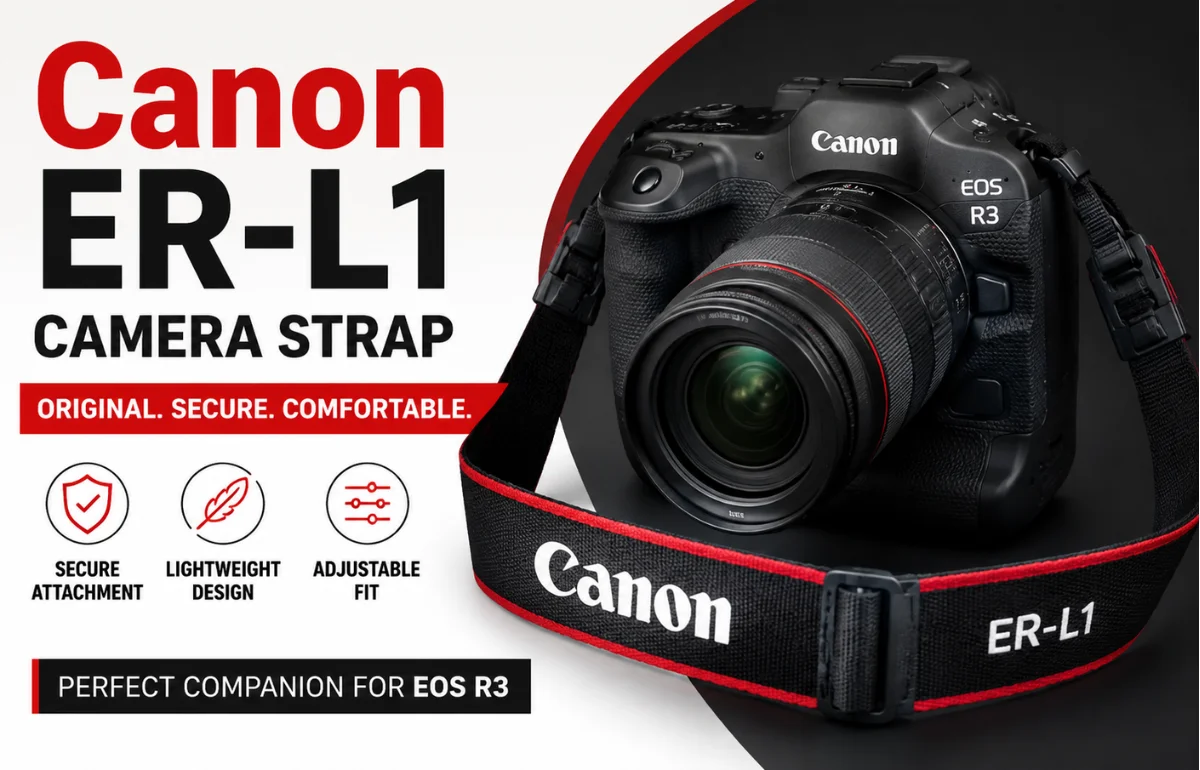
The Canon ER-L1 Camera Strap is Canon’s adjustable neck-and-shoulder strap that attaches to the camera’s two strap lugs, measures about 1.38 inches wide, and uses a conventional buckle-and-webbing design rather than quick-release clips. Canon includes the ER-L1 in the EOS R3 box, so replacement buyers are usually looking for the original factory-style strap, while other Canon owners may be checking whether it will fit their camera. In practical terms, it is a simple, lightweight carrying strap: secure when threaded correctly, easy to adjust, and less bulky than a padded sling. It suits photographers who value an original Canon accessory and straightforward operation, but it can feel basic when carrying a heavy camera-and-lens combination for several hours.
Canon ER-L1 Camera Strap at a Glance
The ER-L1 is a simple accessory, yet product listings often leave buyers with unanswered questions. Here are the useful facts in one place.
| Specification | Canon ER-L1 details |
|---|---|
| Intended camera | Canon EOS R3 |
| Product type | Adjustable neck/shoulder camera strap |
| Canon part number | 4898C001 |
| Main strap width | About 1.38 inches / 3.51 cm |
| Lug-strap width | About 3/8 inch |
| Attachment | Threads through the camera’s strap lugs |
| Quick release | No |
| Color | Black with red accents and Canon branding |
| Included with EOS R3 | Yes |
| Current Canon U.S. status | Discontinued; dealer stock may remain |
Canon lists the Strap ER-L1 among the items supplied with the EOS R3. An authorized retailer identifies it as part number 4898C001 and reports the width, lug attachment, adjustable design, and lack of a quick-release mechanism. Canon U.S. currently labels the standalone strap discontinued and no longer available through its own store. What the ER-L1 Is Designed to Do
The Canon EOS R3 strap performs three jobs: it keeps the camera attached to your body, lets you carry it without gripping it constantly, and preserves the original-equipment appearance.
I see the ER-L1 as a traditional camera strap rather than a modern carry system. There are no anchor clips, rapid sling adjusters, or thick shoulder pads. That simplicity can be useful. Fewer removable parts mean fewer pieces to misplace, and a correctly threaded lug strap is difficult to detach accidentally.
You can carry the camera around your neck, rest it on one shoulder, or wear it diagonally if the adjusted length and your body size allow. It is not purpose-built as a cross-body sling, however, so it will not reposition as smoothly as a dedicated sliding strap.
Build, Width, and Everyday Comfort
The main band is approximately 1.38 inches wide. That spreads pressure better than a thin cord-style strap while remaining easy to pack in a camera bag. Does not create long-session comfort. Padding, edge softness, surface grip, clothing, camera balance, and total kit weight all affect how a strap feels.
My practical rule is to judge a strap with the heaviest setup you regularly carry, not with the camera body alone. A stock strap may feel fine with a compact prime and noticeably less comfortable with a large zoom.
Where the ER-L1 Works Best
The strap makes sense for short walks, press or event assignments with frequent camera handling, and photographers who keep the lens supported with one hand.
It is less convincing for all-day hiking, carrying a heavy lens unsupported, or wearing the camera against bare skin in hot weather. A padded shoulder strap, harness, or sling may distribute weight more comfortably in those situations.
Canon ER-L1 Compatibility: What Fits and What Is Official
The ER-L1 is officially associated with the EOS R3 because Canon supplies it with that camera. That does not automatically mean it can only be used on the R3.
The strap connects through conventional camera lugs, so it may physically fit other bodies whose openings accept the approximately 3/8-inch attachment webbing. Retailer Q&A has confirmed examples including the EOS R8 and EOS 6D Mark II, but Canon does not present the ER-L1 as a universal strap for every EOS model. Separating compatibility into three levels:
| Compatibility level | Meaning |
|---|---|
| Official pairing | Canon supplies or markets the strap for that camera; the EOS R3 belongs here |
| Confirmed physical fit | A reliable seller or direct test confirms the webbing passes through the lugs |
| Likely fit | The camera has similar lugs, but the combination has not been verified |
This distinction prevents a common mistake: confusing “it threads through the lug” with “Canon designed it for that model.” Before using a replacement strap, inspect the lug width, buckle routing, stitching, and webbing condition.
Will It Fit Canon DSLR Cameras?
It may fit DSLR bodies with compatible lugs, and at least one major retailer confirms the EOS 6D Mark II. That does not establish universal DSLR compatibility. Camera, check that the strap tail passes through the lug without folding sharply or rubbing against a damaged edge. Security depends on correct threading and healthy webbing, not simply getting the end through the opening.
How to Attach the Canon ER-L1 Correctly
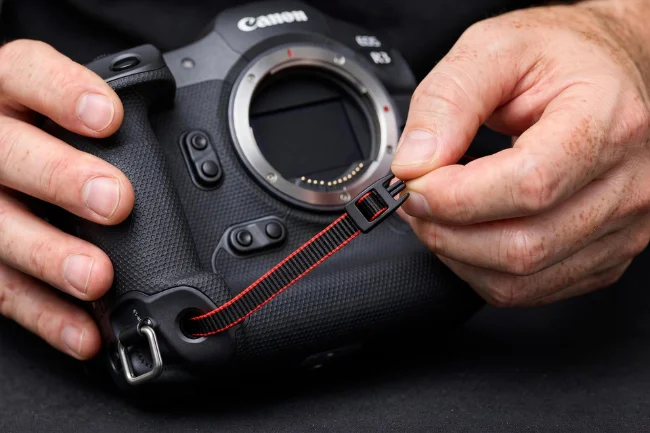
Canon’s EOS R3 instructions say to pass the strap end through the strap mount from the bottom, route it through the buckle, and pull the strap to remove slack. Camera on a stable surface.
2. Feed one narrow strap end upward through the first lug.
3. Route the webbing through the plastic buckle and back through the retaining path.
4. Repeat the same routing on the opposite side.
5. Match the left and right lengths, then pull firmly on both sides.
6. Lift the camera only a few inches above a soft surface for the first test.
7. Recheck the buckles after your first outing.
Do not leave an extremely short tail beyond the buckle. Extra webbing creates a visible safety margin and makes gradual movement easier to notice.
A Safety Check Many Buyers Overlook
Pinch the webbing below each lug and tug downward while watching the buckle. The strap should not creep. Inspect the section that bends through the metal lug for fraying, whitening, cuts, or hardened edges.
This quick check is more useful than judging the strap by its branded center section because wear usually develops first at contact points.
ER-L1 Versus Padded and Quick-Release Straps
The ER-L1 favors simplicity and original Canon styling. Aftermarket systems usually compete on comfort, speed, or modularity.
| Feature | Canon ER-L1 | Padded neck strap | Quick-release sling |
|---|---|---|---|
| Original Canon appearance | Yes | Usually no | Usually no |
| Padding | Basic | Moderate to substantial | Varies |
| Quick removal | No | Usually no | Yes |
| Shoulder comfort | Moderate | Strong | Strong |
| Fast repositioning | Basic | Basic | Strong |
| Packs small | Yes | Less easily | Varies |
| Best use | Factory replacement | Longer carrying sessions | Active shooting and frequent removal |
I would choose the ER-L1 when originality, low bulk, and a permanent connection matter most. A padded alternative is better when pressure relief is the priority. For tripod or gimbal work, quick-release anchors are often more convenient.
Quick-release hardware also requires inspection. Anchors wear, and connectors must lock fully. A traditional strap avoids those moving parts, although it takes longer to remove.
Is the Canon ER-L1 Good for Heavy Lenses?
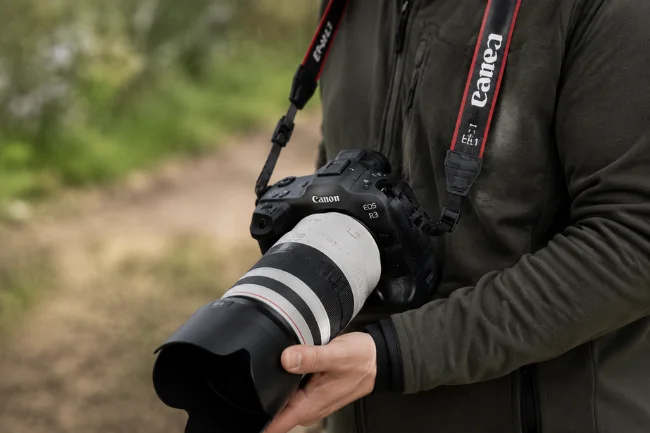
A large lens can make the system front-heavy even when the strap remains secure. This is a balance issue as much as a strap-strength issue.
For short periods, the ER-L1 works well as backup while one hand supports the lens. For long walks with a heavy telephoto, I prefer a system that supports the load at an approved lens foot or spreads it across the shoulder or torso.
Do not attach a strap to a lens foot unless the lens maker or mounting accessory supports that method. Improvised attachment points can loosen or place stress where it was not intended.
Buying the ER-L1 in 2026
Canon U.S. lists the ER-L1 as discontinued and no longer available from its online store. At the time of checking, an authorized dealer still showed new stock at roughly $30, so availability now depends on remaining inventory. Prices and stock can change. rt number 4898C001 as well as the product name. That reduces confusion with similarly branded Canon straps.
For used units, request close photographs of both narrow ends, the buckles, stitching, and areas that touch the camera lugs. Cosmetic wear on the wide band matters less than cuts, glazing, pulled stitching, or frayed attachment webbing.
How to Identify the Correct Strap
A genuine listing should identify the item as ER-L1, show Canon branding with black-and-red styling, and describe a conventional adjustable lug strap. The ER-L1 has no quick-release system and does not carry an embroidered camera-model name. When a seller uses only generic photos or describes an “ER-L1 style” product without a Canon part number, that may be a compatible replacement rather than the original accessory.
Who Should Buy It?
The Canon ER-L1 Camera Strap is a sensible choice for an EOS R3 owner replacing a lost, damaged, or worn original. It also suits collectors, resale-conscious owners who want the factory accessory, and photographers who prefer a permanently attached strap.
It may work on another compatible Canon body, but I would buy it only after verifying the lug fit. The Canon logo alone is not a strong reason to accept less comfort or functionality than your shooting style requires.
Skip it when you need thick padding, instant removal, dedicated cross-body sliding action, or support for an especially heavy setup during long walks.
Care and Maintenance
If the strap becomes damp from rain or sweat, let it air-dry fully away from direct heat. Do not store a wet strap pressed against the camera finish.
Inspect both attachment ends regularly. Replace the strap when the narrow webbing is cut, badly frayed, stiffened, or slipping through a correctly routed buckle. A replacement strap costs far less than the equipment it supports.
Final Verdict
The Canon ER-L1 is a straightforward original strap for the EOS R3 and photographers who value secure lug attachment, Canon styling, and low bulk. Its 1.38-inch width is practical, installation is conventional, and there are no quick-release parts to manage.
Its limits are basic comfort, no rapid-release feature, uncertain model-by-model compatibility beyond confirmed examples, and shrinking availability. Check your camera lugs, compare the strap with your heaviest lens setup, and inspect remaining stock carefully before buying.
Frequently Asked Questions
Is the Canon ER-L1 Camera Strap included with the EOS R3?
Yes. Canon includes the Strap ER-L1 as part of the EOS R3 camera package contents.
What cameras is the Canon ER-L1 Camera Strap compatible with?
The Canon ER-L1 is officially designed for the Canon EOS R3. Some retailers also confirm that it physically fits models such as the EOS R8 and EOS 6D Mark II, but buyers should verify compatibility before purchase.
Does the Canon ER-L1 have quick-release clips?
No. The ER-L1 uses a traditional lug-mounted strap design and attaches directly through the camera’s strap mounts.
How wide is the Canon ER-L1 Camera Strap?
The main strap is approximately 1.38 inches (3.51 cm) wide, with a lug attachment width of about 3/8 inch.
Is the Canon ER-L1 Camera Strap discontinued?
Canon U.S. currently lists the standalone ER-L1 as discontinued, although some authorized retailers may still have remaining inventory.
Does the Canon ER-L1 have an EOS R3 logo embroidered on it?
No. The ER-L1 features Canon branding but does not have a specific camera model name embroidered on the strap.
You May Also Read: TVLIO: Ultimate Guide to Features, Pricing & Safety

Noah Sterling is a technology research writer with 8+ years of experience covering emerging technologies, software trends, digital tools, and innovation. He creates practical, research-based articles to help readers understand the evolving technology landscape.