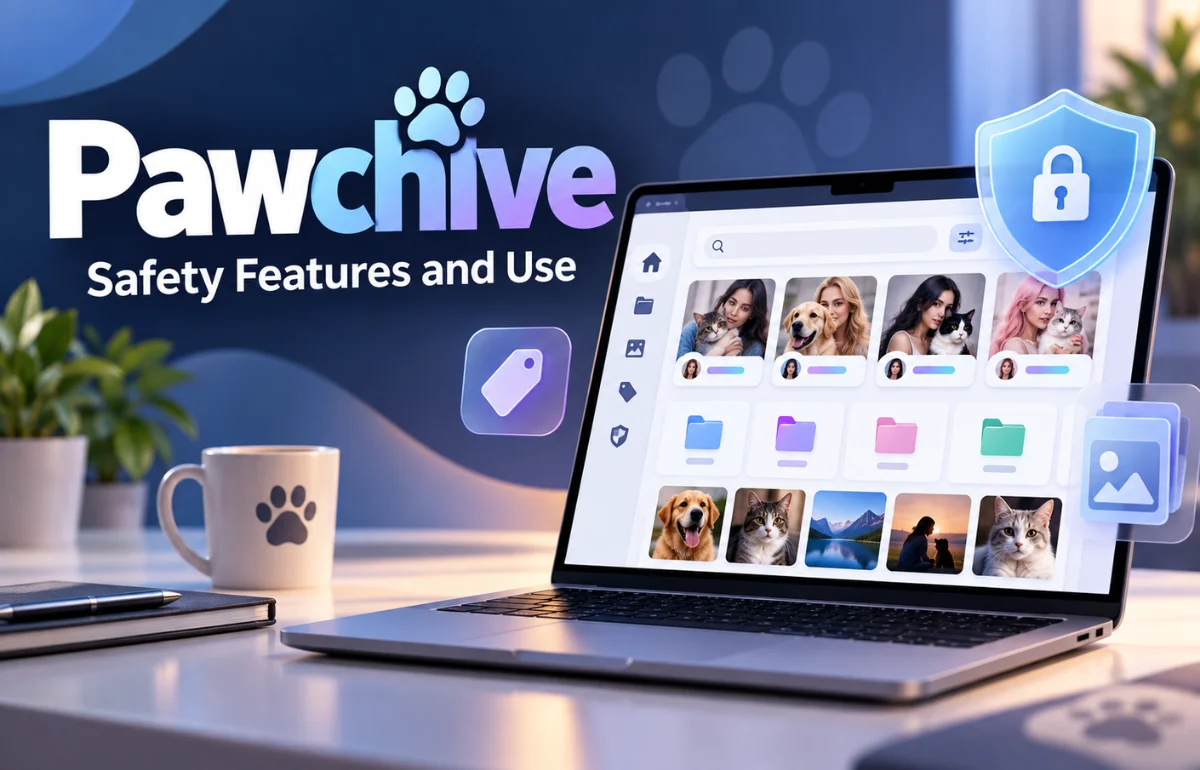
Pawchive is a public creator-content archiving platform designed to collect, organize, search, and display material associated with subscription-based creator services. The current Pawchive site describes itself as a public archiver based on Kemono and specifically lists Patreon, Pixiv Fanbox, and Discord. Content is contributed by users rather than appearing automatically from every creator account.
In simple terms, Pawchive works like a searchable community archive. Instead of visiting multiple creator platforms separately, users can search creator profiles, browse archived posts, explore tags, look up files by hash, and follow recently updated material from one interface.
That definition also explains an important limitation: Pawchive should not be treated as a complete or real-time copy of Patreon, Fanbox, Discord, Kemono, or any other platform. What appears in the archive depends heavily on what has actually been contributed and successfully stored.
What Is Pawchive Used For?
The easiest way I find to understand Pawchive is to think of it as a combination of a searchable library catalog and a community-maintained archive.
Users generally arrive with one of two intentions. Some already know the creator they want to find. Others want to browse archived posts, tags, popular content, recent updates, or random creators.
Pawchive’s current navigation reflects those behaviors. It provides dedicated areas for creator search, recent creators, random discovery, post search, popular posts, direct messages, tags, hash lookup, favorites, and an importer.
The archive itself is separate from the original creator platforms. Finding a Patreon creator inside Pawchive, for example, does not mean Patreon operates or endorses the archived page.
That distinction matters because people searching for a “Patreon archive” or “Kemono alternative” sometimes assume these services are officially connected. They are not simply alternative interfaces for the original subscription websites.
How Pawchive Works
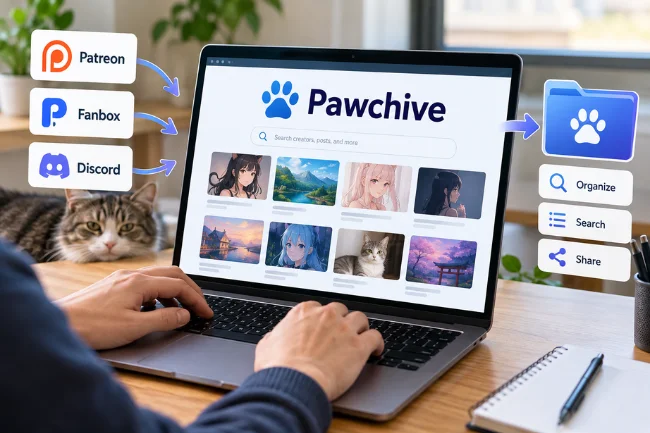
Pawchive follows a contributor-driven archiving model.
Instead of automatically crawling every creator on the internet, contributors provide access to content they are legitimately able to view through supported services. Pawchive’s system can then process eligible material and organize it inside the public archive.
The platform itself states that contributors upload content so it can be shared, searched, and organized.
This structure explains why one creator may have a very complete archive while another has only a few posts.
It also explains why recent content may appear quickly for one account but remain missing for another. An archive can only contain material that has reached it.
Pawchive Is Better Described as Continuously Updated
I would avoid describing Pawchive as a truly real-time service.
Its community and administrator updates show that imports are actively processed, but the availability of individual posts depends on contributors, infrastructure, processing queues, storage, and the original platform.
For example, official Pawchive community updates have discussed Fanbox imports being resumed, network-capacity limitations, hardware upgrades, file migration, and temporary import interruptions.
“Continuously updated” is therefore more accurate than “real-time archive.”
Main Pawchive Features
Pawchive offers more than a basic creator search box. Its navigation suggests that discovery and organization are major parts of the platform.
Creator Search
Users can search for specific creators instead of browsing thousands of unrelated posts.
There are also recent and random creator options, which can help when someone is researching newly updated accounts or simply exploring the archive.
Post Search
Post search works at the content level rather than only at the creator level.
This is especially useful when someone remembers a title, subject, phrase, or other identifying information but does not remember exactly which creator published it.
Tags and Popular Content
Tags group related material into browsable categories.
Popular and random-post sections provide another discovery path for people who are not looking for a specific account.
Hash Lookup
One of Pawchive’s more technical features is file hash lookup.
A cryptographic file hash acts like a digital fingerprint. If the platform has indexed a matching file, a hash can potentially help identify where that exact file appears in the archive.
This is more precise than searching by filename because filenames can easily be changed while the underlying file remains identical.
Favorites and Accounts
Pawchive includes account registration and a favorites section. Its current interface also contains account-related areas for keys and DM review.
Favorites make the platform more useful for repeat visitors because users do not have to rediscover the same creator pages each time.
Importing
The importer is what allows contributors to add eligible creator material.
This feature is also where users should pay the greatest attention to account security, which I will discuss later.
| Pawchive feature | Main purpose | Why it matters |
|---|---|---|
| Creator search | Find archived creator profiles | Faster than browsing posts manually |
| Post search | Search individual archived posts | Useful when the creator is unknown |
| Tags | Group related content | Improves content discovery |
| Recent updates | Find recently changed creator pages | Helps identify newer archive activity |
| Hash lookup | Search using a file fingerprint | Can identify an exact indexed file |
| Favorites | Save creators or content | Useful for repeat visits |
| Importer | Contribute supported material | Helps expand archive coverage |
Which Platforms Does Pawchive Support?
This is one area where the available information needs careful wording.
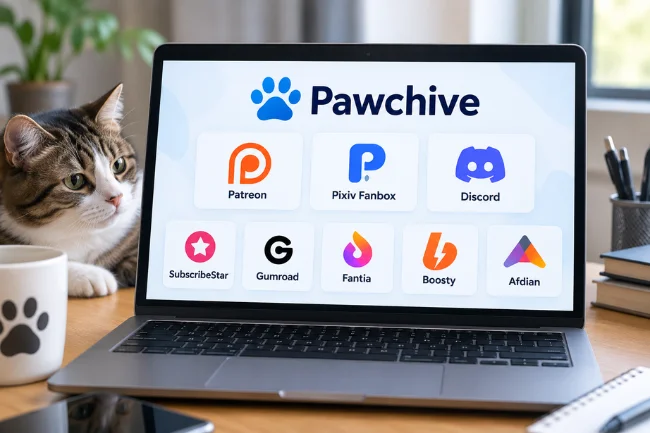
Pawchive’s active homepage currently describes the archive as being for Patreon, Pixiv Fanbox, and Discord.
However, its current importer documentation references authentication for Patreon, Fanbox, SubscribeStar, Gumroad, Fantia, Boosty, Afdian, and Discord.
I would not interpret that difference as proof that every one of those services has full public archive support.
A more responsible reading is that Pawchive’s importer-related infrastructure or documentation has a broader scope than the three services currently highlighted on the homepage. The platform is relatively young, so its public feature set and documentation may still be evolving.
That discrepancy is worth knowing because many articles simply repeat one platform list without checking the actual Pawchive pages.
Why Some Pawchive Posts or Files May Be Missing
A creator appearing in search results does not guarantee that every post and attachment is available.
Third-party developer discussions around Pawchive have documented “pending” or missing posts where archive metadata exists but associated files have not yet been fully imported. Developers integrating Pawchive support have also warned that the platform is still being populated.
That creates an important difference between metadata and stored content.
A page might know that a post existed while still lacking its complete images, videos, attachments, or other files.
For users, that means a missing file is not automatically evidence that search is broken.
The content may simply never have been contributed, may still be awaiting processing, or may no longer be obtainable from the original source.
Pawchive vs. Kemono
Pawchive is frequently described online as a Kemono alternative, but calling it the “official successor to Kemono” goes further than the available evidence supports.
Pawchive itself says that it is “based on Kemono.” Community discussions generally describe it as an independently developed alternative rather than a formal continuation of the original project.
The visual and functional similarities are easy to understand. Both follow a community-archive model and organize creator material around profiles and posts.
Their databases, infrastructure, coverage, and development should still be treated separately.
| Area | Pawchive | Kemono |
|---|---|---|
| Basic model | Community-powered public creator archive | Community-powered public creator archive |
| Relationship | Describes itself as based on Kemono | Older archive that inspired similar services |
| Publicly highlighted sources | Patreon, Fanbox, Discord at the time of review | Historically listed a broader set of creator platforms |
| Archive completeness | Still being populated; missing content is possible | Larger historical archive, but availability can vary |
| Creator/post discovery | Search, recent, random, tags and related tools | Similar creator and post browsing model |
| Data relationship | Separate archive | Separate database and infrastructure |
Older archived Kemono pages listed Patreon, Fanbox, Discord, Fantia, Afdian, Boosty, Gumroad, SubscribeStar, and DLsite, showing why longtime Kemono users may notice differences in current platform coverage.
I would therefore treat Pawchive as an alternative archive, not as a guaranteed one-to-one replacement.
Is Pawchive Safe?
There is no responsible way to give Pawchive a universal “safe” or “unsafe” label.
Security changes over time, different Pawchive-branded domains exist, third-party scanners produce different ratings, and the risk of simply viewing a webpage is different from the risk of giving a service authentication credentials.
One third-party scan of pawchive.pw dated September 28, 2026 reported no detections from 91 checked threat engines, although the same analysis emphasized that the domain was relatively new.
That is useful evidence, but a clean automated scan is not a permanent guarantee.
The Importer Deserves More Caution Than Normal Browsing
This is the security distinction I would pay the most attention to.
Pawchive’s importer documentation says that contributors supply session credentials or authentication tokens so the system can access material from accounts to which those users are subscribed. Its documentation also describes token-based importing for Discord.
Session credentials should be treated as sensitive account secrets.
Anyone considering an importer on any third-party archive should understand what access the credential grants, how it can be revoked, and what could happen if that credential were exposed.
From a risk perspective, these are very different activities:
| Activity | Relative exposure | Main concern |
|---|---|---|
| Browsing public archive pages | Lower | Malicious ads, redirects, tracking or unsafe downloads |
| Creating an archive account | Moderate | Password reuse and stored account information |
| Downloading files | Moderate to high | File integrity and unknown attachments |
| Providing external session credentials | Highest | Access to another online account |
I would also use a unique password for any archive account rather than recycling a password used for email, Patreon, Discord, banking, or another important service.
Domain Confusion Is Another Risk
Pawchive has used more than one domain.
The currently accessible archive I verified operates at pawchive.pw, while its contact page uses email addresses under pawchive.st. Its Telegram channel has previously announced both pawchive.st and pawchive.pw during periods of domain disruption.
At the same time, other websites use Pawchive branding.
I would therefore verify the current domain through the project’s established communication channels instead of assuming that any website containing “Pawchive” in its domain name is the same service.
There is another account-management detail worth knowing. Pawchive’s current contact page says it does not process password-reset or account-deletion requests in the conventional way and tells users to replace a password and log out instead.
That is a more limited account-management model than users may expect from a mainstream consumer platform.
Copyright, Creator Rights, and Terms of Service
Pawchive also raises questions that are not purely technical.
Creator membership platforms exist partly so artists, writers, developers, performers, and other creators can restrict certain work to paying supporters. Republishing subscription-only material without authorization can create copyright, contractual, and platform-policy issues.
The exact legal position depends on the material, permissions, jurisdiction, and circumstances, so the mere fact that something appears in a public archive does not establish that redistribution is authorized.
I think this distinction is especially important for researchers and casual visitors: technical accessibility and legal permission are two different things.
When possible, the original creator’s official page remains the best source for current releases, membership benefits, licensing information, corrections, and direct financial support.
Who Might Find Pawchive Useful?
Pawchive will make the most sense to users interested in searching or studying an archive rather than simply following one creator’s official feed.
It can be useful for locating creator profiles, checking whether a specific post has been archived, identifying material through a file hash, or exploring how community-maintained creator archives are organized.
Researchers studying digital preservation, online creator economies, community archives, or platform migration may also find the project interesting because it shows both the strengths and weaknesses of decentralized contribution.
Its biggest strength is discoverability.
Its biggest weakness is dependency on contributors and infrastructure.
If nobody contributes a particular creator or file, the search interface cannot create that missing material on its own.
What Makes Pawchive Different From a Normal Content Platform?
A conventional creator platform manages the relationship between creators and their audiences.
Pawchive primarily manages archived copies and associated metadata.
That difference affects almost everything: content ownership, update speed, moderation, availability, reliability, account security, and the relationship between users and creators.
It also explains why Pawchive can sometimes show old information, incomplete posts, unavailable files, or uneven coverage between creators.
I would judge it as an archive, not as a replacement for the original publishing platform.
Final Take on Pawchive
Pawchive is best understood as a young, community-powered creator-content archive built around the same general concept popularized by Kemono. It provides creator search, post discovery, tags, favorites, hash lookup, importing, and other archive-oriented tools while relying on contributors to expand its database.
Its usefulness is real, but so are its limitations. Coverage can be incomplete, domains can change, account and importer security deserve careful attention, and publicly accessible content can still carry copyright or terms-of-service concerns.
If you plan to explore Pawchive, start by verifying the current domain, treat downloads cautiously, keep your important account credentials separate, and remember that an archive is not the same thing as the creator’s official page.
Frequently Asked Questions About Pawchive
What is Pawchive?
Pawchive is a community-powered public archive that organizes creator content and currently highlights Patreon, Pixiv Fanbox, and Discord material.
Is Pawchive a Kemono alternative?
Yes, Pawchive is commonly used as a Kemono-style alternative, although it is a separate archive and should not be assumed to contain Kemono’s complete database.
Is Pawchive safe to use?
Normal browsing and supplying account session credentials carry very different risks. Users should verify the current domain, avoid password reuse, and treat importer credentials as sensitive.
Why is content missing on Pawchive?
Some creators, posts, or attachments may not have been contributed or fully imported yet, so creator metadata can sometimes exist without every associated file.
Does Pawchive support Patreon and Fanbox?
Yes. Pawchive’s current homepage explicitly lists Patreon and Pixiv Fanbox, along with Discord, although importer documentation references additional services as well.

Noah Sterling is a technology research writer with 8+ years of experience covering emerging technologies, software trends, digital tools, and innovation. He creates practical, research-based articles to help readers understand the evolving technology landscape.