AmCoder is an India-focused software-engineering learning platform built around a structured roadmap rather than a collection of disconnected coding tutorials. Its public learning path starts with computer science foundations, then connects problem-solving, data structures and algorithms, databases, APIs, frontend and backend development, system design, version control, collaboration tools, and interview communication. In simple terms, AmCoder is designed to help learners understand how the pieces of software engineering fit together, not merely memorize syntax or jump from one fashionable framework to another.
That distinction is the main reason the platform caught my attention. In my review of AmCoder’s public material, I found that its strongest idea is not “learn more technologies.” It is “learn them in an order that makes the next topic easier to understand.”
Why AmCoder Exists in a World Already Full of Coding Courses
Anyone learning software development in 2026 has the opposite of an information shortage. There are free videos, paid bootcamps, documentation sites, coding challenges, AI tutors, GitHub repositories, university lectures, and thousands of short courses.
The difficult part is deciding what deserves attention first.
A beginner may be told to learn DSA for interviews, React for jobs, Python for AI, SQL for databases, Git for teamwork, system design for senior roles, and cloud platforms for deployment. All of that advice can be valid, yet it can still leave the learner with no mental model of how the subjects connect.
AmCoder’s public positioning addresses that specific problem. It presents software engineering as a connected journey: first understand computing, then learn to solve problems, then understand how applications store and exchange data, then build software, and finally reason about larger systems and professional workflows.
When I assess a technical learning roadmap, I use one practical test: does each stage answer a question created by the previous stage? AmCoder does this better than a random playlist model. If a student understands memory and processes, operating systems become less mysterious.
If databases and APIs make sense, backend development has context. If backend, frontend, storage, and traffic are already familiar, system design stops sounding like a list of interview buzzwords.
What Does AmCoder Teach?
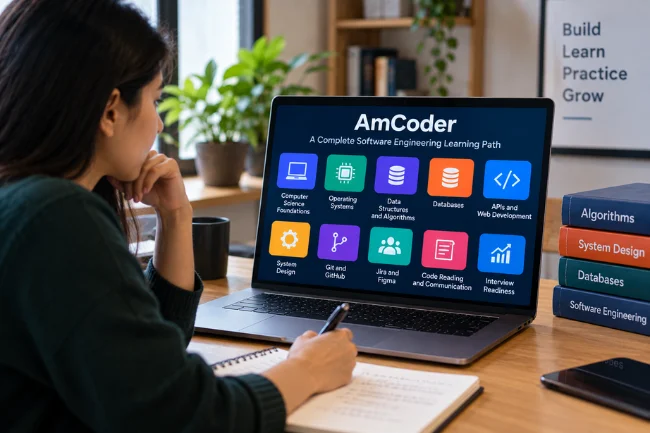
The official AmCoder roadmap describes a broad path from computer-science fundamentals to engineering practice. It references the history and meaning of computation, hardware and software, operating systems, UNIX, instructions, memory, processes, algorithms, data structures, databases, APIs, application development, system design, Git and GitHub, Jira, Figma, code reading, communication, and interview readiness.
That is a wider scope than a language-specific course.
| Learning area | What the learner is trying to understand | Why it matters later |
|---|---|---|
| Computer-science foundations | Computation, hardware, software, operating systems, memory, processes | Gives context for performance, programs, and system behavior |
| Problem solving and DSA | Algorithms, arrays, stacks, queues, trees, graphs, efficiency | Builds reasoning skills used in coding and technical interviews |
| Data and backend concepts | Storage, relational databases, SQL, APIs, server-side logic | Explains where application data lives and how services communicate |
| Frontend development | Browsers, JavaScript, interface behavior, application state | Connects what users see with the systems behind it |
| System design | Responsibilities, boundaries, scale, traffic, caching, load balancing, failure | Develops architectural thinking beyond one code file |
| Engineering toolkit | Git, GitHub, Jira, Figma, code reading, communication | Reflects how software is planned, reviewed, and shipped in teams |
The table also reveals something easy to miss: AmCoder is not just teaching “coding.” Its roadmap is closer to a map of software engineering literacy.
Foundations Before Frameworks
Many people begin with a framework because frameworks produce visible results quickly. That can be motivating, but it can also create fragile knowledge.
A learner may know how to start a React project without understanding what the browser is doing. Someone may know how to copy an API request without understanding the client-server relationship. A beginner may use a database library while having only a vague idea of schemas, queries, and persistence.
AmCoder’s foundation-first approach tries to reduce that gap.
I like this sequencing because abstractions become more useful when you know what they are hiding. You do not need to become a hardware engineer before writing web applications, but knowing that software runs through processes, uses memory, performs I/O, and depends on operating-system behavior gives later concepts somewhere to “attach” in your mind.
Data Structures and Algorithms as Thinking Tools
DSA is often marketed as an interview hurdle. That is too narrow.
Arrays, queues, stacks, trees, graphs, searching, sorting, and complexity are ways to reason about how information is organized and what operations are expensive. The interview benefit is real, but the larger value is learning to compare solutions instead of stopping at “the code works.”
A useful roadmap should therefore connect DSA to engineering decisions. When a learner asks why a queue is suitable for a job-processing system, why a tree helps hierarchical data, or why an algorithm slows dramatically as input grows, the subject becomes practical rather than ceremonial.
That is the direction AmCoder appears to be aiming for.
Databases, APIs, and the Missing Middle
One of the most common gaps I see in beginner learning plans is the space between “I can write code” and “I understand an application.”
Real applications usually need data storage, retrieval, validation, authentication, communication between components, and predictable interfaces. Databases and APIs sit in this middle layer.
This is where a structured path becomes valuable. SQL makes more sense when the learner understands what persistent data is for. APIs make more sense when there is a clear client and server.
Backend code becomes easier to reason about when the learner can see how a request travels from an interface to business logic and then to storage.
My own editorial reading of AmCoder’s curriculum is that this “connection layer” may be more valuable than any individual topic on the list.
What Makes AmCoder Different From a Typical Coding Tutorial Site?
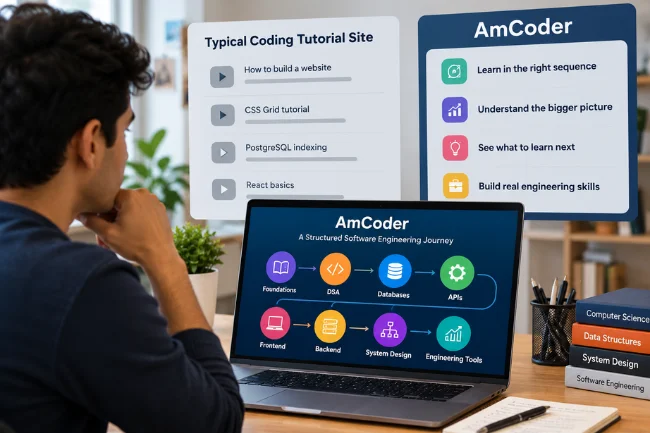
The clearest difference is sequence.
A tutorial site can be excellent at answering “How do I build this?” AmCoder’s stated philosophy is closer to “Why does this exist, what should I learn before it, and what does it unlock next?” Its website explicitly frames the experience as a longer software-engineering journey rather than a crash course.
That does not automatically make it better for every learner.
If you already know exactly what you need—for example, you want a two-hour refresher on CSS Grid or a focused PostgreSQL indexing lesson—a broad roadmap may be slower than a targeted resource.
But for someone repeatedly switching between tutorials and feeling unsure what to learn next, structure can be more valuable than volume.
A Roadmap Is Not the Same as Mastery
This is an important distinction.
A roadmap can show the correct direction, but it cannot replace practice. Watching lessons on algorithms does not create algorithmic intuition. Reading about Git does not teach you how to resolve a messy merge conflict.
Understanding what an API is does not automatically teach error handling, authentication, retries, versioning, or debugging.
If I were using AmCoder as my primary learning map, I would pair every major stage with output: small programs, database exercises, API projects, code reviews, Git branches, debugging sessions, and eventually a complete application.
That is how a roadmap becomes evidence of skill rather than a checklist of consumed content.
The Most Useful Hidden Feature: A Dependency Map for Learning
Here is the part I think deserves more attention.
Software engineering topics have dependencies, just like software packages do. Learners often struggle because they study an advanced concept before installing the “mental dependencies” it requires.
For example, system design becomes easier after you understand servers, databases, APIs, traffic, and failure. Backend architecture benefits from knowing how requests, processes, and persistence work, while interview explanations improve when you understand trade-offs rather than memorized definitions.
AmCoder’s real value proposition, as I read it, is this dependency-aware order.
That is useful even for people who never complete every part of the platform. A learner can use the sequence as a diagnostic tool.
If system design feels impossibly abstract, the problem may not be system design itself; the learner may need stronger foundations in networking, databases, APIs, or backend behavior.
AmCoder and Software-Engineering Interview Preparation
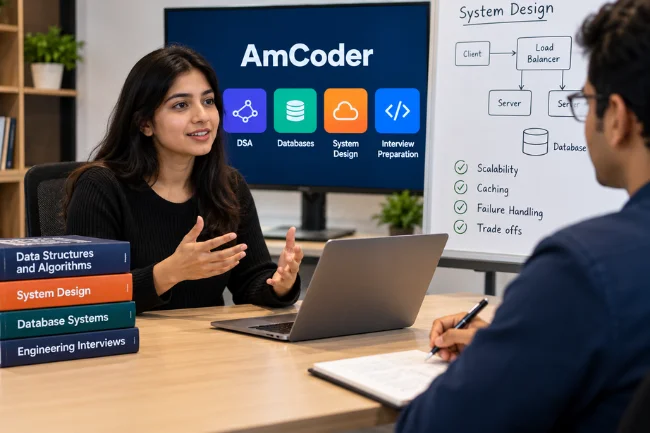
AmCoder mentions being able to explain ideas confidently in interviews, but its public framing is broader than a collection of interview questions.
That is a sensible direction because strong technical interviews often test explanation as much as recall.
Suppose an interviewer asks why you chose a queue, how you would reduce database load, or what happens when traffic increases tenfold. A memorized definition can start the answer, but it rarely finishes it.
You need to discuss constraints, alternatives, failure cases, and trade-offs.
The same applies to behavioral technical discussions. Reading someone else’s code, using version control, working from a design, and communicating decisions all mirror real engineering work more closely than solving isolated coding puzzles.
I would still supplement AmCoder with role-specific interview practice. A frontend candidate, backend candidate, data engineer, and mobile developer will face different expectations. The roadmap can provide the base; targeted practice should prepare the final mile.
Who Is AmCoder Best Suited For?
AmCoder appears best suited to beginners and early-stage developers who feel overwhelmed by disconnected advice.
It may also be useful for self-taught programmers who can already build small projects but suspect they have gaps in computer-science fundamentals, databases, architecture, or engineering workflow.
A third group is students preparing for software-engineering careers. The platform’s emphasis on understanding, system design, Git/GitHub, Jira, Figma, reading code, and explaining decisions aligns with skills that sit around programming in real teams.
More experienced engineers may find parts of the early roadmap too basic. For them, AmCoder may work better as a gap-checking framework than as a start-to-finish curriculum.
What AmCoder Is Not: Avoid the Name Confusion
This keyword has an unusual search problem. Several unrelated technology businesses use names that look almost identical.
The education platform discussed in this article is AmCoder at AmCoder.in. It should not be automatically confused with AmCodr IT Solutions, AmcoderZ Infotech, or AmCoder Technologies.
| Name | Main focus | Identifying detail |
|---|---|---|
| AmCoder (AmCoder.in) | Software-engineering education | Structured learning path for aspiring engineers in India |
| AmCodr IT Solutions | IT and software-development services | Ahmedabad-based company that says it was established in 2016 |
| AmcoderZ Infotech | Custom software and digital solutions | Offers web, mobile, healthcare, BLE, and IoT development |
| AmCoder Technologies | Software development | Separate company profile associated with Monterrey, Mexico |
AmCodr’s official site describes web, mobile, and website development services and says the company was established in 2016. AmcoderZ’s official site describes mobile, web, custom software, healthcare, BLE, and IoT work. AmCoder Technologies is separately listed as a software-development company headquartered in Monterrey.
This distinction matters for users and publishers. Mixing reviews, addresses, founders, apps, pricing, or services from these organizations can turn an otherwise polished article into misinformation.
How I Would Use AmCoder Effectively
I would treat AmCoder as the spine of a learning plan, not the entire body.
For every concept, I would follow a simple cycle: understand the idea, explain it in my own words, build something that uses it, break that thing deliberately, fix it, and document what I learned.
For each stage, I would create a small piece of evidence: a data-structure implementation, a database schema, an API, a Git-based project, or a simple architecture diagram. That turns passive familiarity into active competence.
I would also keep a “why” notebook: Why does caching help here? Why is this data relational? Why choose a queue? Questions like these push learning toward engineering judgment.
What to Check Before Depending on AmCoder as Your Main Platform
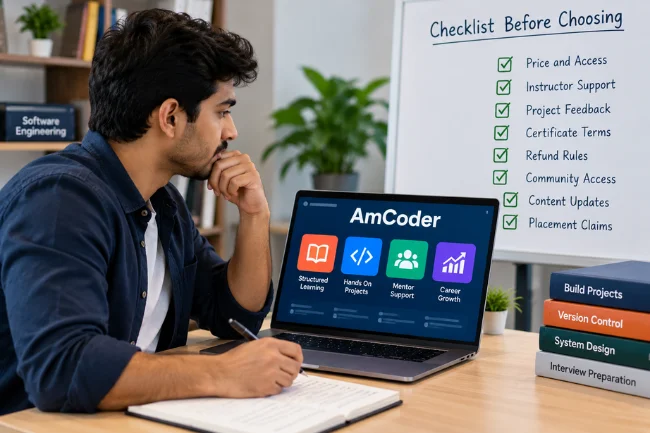
The public roadmap is clear about educational direction, but some practical buying and outcome questions are not equally clear in the publicly indexed information I reviewed.
Before paying for, enrolling in, or depending heavily on any learning platform, I would verify the current price, access period, instructor or mentor support, project feedback, certificate terms, refund rules, community access, content-update policy, and any placement or job-outcome claims directly from the official source.
I would also ask a simple question: what proof will I have at the end?
A strong learning experience should ideally leave you with more than completed lessons. You should be able to point to code, projects, technical explanations, architecture decisions, Git history, and problems you solved independently.
That evidence matters more than a long list of watched modules.
Is AmCoder Worth Exploring?
For a learner whose main problem is confusion about what comes next, yes, AmCoder is worth exploring.
Its most compelling idea is not novelty. Computer-science foundations, DSA, databases, APIs, frontend development, backend development, system design, Git, and collaboration tools already exist across countless resources.
The value comes from placing them into a coherent engineering story.
That can save a learner from a common trap: collecting technologies without building a mental model.
I would not judge AmCoder only by the number of topics it covers. I would judge it by whether its explanations, exercises, projects, feedback, and support help learners move from “I have heard of this” to “I can use it and explain why.”
Final Take
AmCoder is best understood as a structured software-engineering learning platform for people who want a clearer path through computer science, programming, application development, system design, and professional engineering tools. Its foundation-first philosophy can be especially useful for beginners who are tired of jumping between unrelated tutorials.
If you are considering it, start by comparing the public roadmap with your own skill gaps. Pick one weak area, study it, build something around it, and test whether the platform helps you explain the concept more clearly than before. That is a better measure of learning value than simply finishing another course.
Frequently Asked Questions
What is AmCoder?
AmCoder is a software-engineering learning platform at AmCoder.in that organizes computer-science, coding, development, system-design, and engineering-workflow topics into a structured learning path.
Is AmCoder suitable for beginners?
Yes. Its public roadmap begins with foundational computer-science concepts before moving into algorithms, application development, system design, and team tools.
What subjects does AmCoder cover?
Its published path includes computing foundations, DSA, databases, APIs, frontend and backend concepts, system design, Git/GitHub, Jira, Figma, code reading, and communication.
Can AmCoder help with software-engineering interviews?
It can support interview readiness by strengthening concepts and explanation skills, but role-specific coding, behavioral, and system-design practice should still be added.
Is AmCoder free, and does it provide certificates or placements?
The publicly indexed official information I reviewed does not clearly establish universal pricing, certification, or placement terms, so check the current official AmCoder information before making a decision.

Noah Sterling is a technology research writer with 8+ years of experience covering emerging technologies, software trends, digital tools, and innovation. He creates practical, research-based articles to help readers understand the evolving technology landscape.