
GPTHuman AI is an online AI writing platform that rewrites existing text to make it sound more natural and offers tools for generating and assessing content. Its main product, an AI humanizer, changes wording, sentence structure, and tone. In simple terms, you give it a draft, and it suggests a different version. The service markets its output as harder for AI detectors to identify, but that claim needs careful interpretation.
I see its most useful role as an editing aid for writers who already understand their subject. It can help with expression, while the writer remains responsible for the substance. Here, I examine the service at gpthuman.ai, its documented features, current prices, and the checks I would make before publishing a rewrite.
How GPTHuman AI Works
According to its help center, GPTHuman uses a generative rewriting process that can adjust vocabulary, sentence construction, transitions, and rhythm together. The company does not publicly disclose its proprietary model architecture or training recipe.
That distinction matters when reading reviews. Describing what the software changes is reasonable; claiming to know precisely how its underlying model works requires evidence.
Consider a stiff sentence such as, “The implementation of regular content updates facilitates improved reader comprehension.” An editor could write, “Updating the article regularly helps readers understand what has changed.”
That is my illustrative edit, rather than a GPTHuman test result. It shows the kind of improvement worth seeking: a clearer subject, a concrete action, and an understandable benefit.
My assessment here comes from reviewing public documentation, not running a paid product benchmark. I would want a representative sample of actual outputs before making claims about consistency or time saved.
Features That Matter for Everyday Writing

Tone and Rewriting Controls
The published instructions list Standard, High School, College, and PhD tone options, alongside Professional, Balanced, and Enhanced rewriting modes. Professional is described as staying closer to the source, while Enhanced makes greater changes.
I would choose settings around the reader’s knowledge. A beginner buying software needs familiar language and concrete explanations. A specialist audience may need precise terminology, even when that makes a sentence slightly longer.
Labels such as “PhD” describe a writing style. They do not establish academic expertise or make an unsupported argument more credible.
Document Import and Output Scores
GPTHuman’s instructions describe pasting text or importing Word and PDF files. After processing, the tool displays Human, Readability, and Similarity scores.
The company’s explanation of those scores is more useful than a promise of perfect writing. Human Score reflects patterns associated with humanlike text within its scoring system; it is not the probability that a person wrote the passage. Similarity compares the rewrite with your input, while readability concerns ease of reading. None confirms factual accuracy.
I would read the output before looking at those numbers. Otherwise, a reassuring score can make an awkward sentence easier to overlook.
Language Support and API Access
While checking the official pages, I found different language totals: the homepage advertises 80 languages, while the pricing page lists more than 50. I would confirm support for my specific language before subscribing.
For developers, GPTHuman offers API access. Its help center states that API credits are purchased separately and cannot be exchanged with web subscription credits.
For an agency building an automated workflow, that separation belongs in the budget from the beginning.
GPTHuman AI Pricing and Usage Limits
The public pricing page displayed the following figures when checked on October 27, 2026. All amounts are in US dollars. Annual figures show the advertised monthly equivalent and yearly total.
| Plan | Monthly billing | Annual billing | Monthly allowance | Maximum per output |
|---|---|---|---|---|
| Free | $0 | $0 | 300-word trial | 300 words |
| Starter | $15 | $8.25 equivalent; $99 yearly | 25,000 words | 1,000 words |
| Plus | $25 | $14 equivalent; $168 yearly | 60,000 words | 1,500 words |
| Unlimited | $49 | $26 equivalent; $312 yearly | Unlimited, subject to abuse guardrails | 2,500 words |
The annual equivalent is not a monthly payment option. Check the billing interval and final checkout amount before purchasing.
I also found a documentation mismatch worth checking: the trial help article lists 100,000 monthly credits for Plus, while the pricing page advertises 60,000 words. Those pages do not describe the allowance consistently, so I would ask support to confirm it.
Why Revision Volume Changes the Value
The help center says re-humanizing text uses additional credits. That makes the number of revision attempts relevant to your buying decision.
For illustration, ten 1,000-word articles represent 10,000 words before additional passes. Two equally long passes through every article would mean roughly 20,000 words of processing. This is a planning example, not a verified billing simulation.
I would track how much output survives my final edit. A generous allowance has limited value if I keep replacing the results manually.
For a more practical measure, I would divide the subscription cost by the number of words I actually approve for publication. In a hypothetical month, a $15 subscription producing 10,000 usable words costs $1.50 per 1,000 approved words, before my editing time.
If only 5,000 words are usable, that figure doubles. This calculation helps me compare a writing subscription with my existing editing process without treating every generated word as a benefit.
I would record review time as well. Saving ten minutes during generation offers little advantage if checking the rewritten claims adds twenty minutes afterward. A small trial log can reveal that tradeoff before an annual commitment.
Can GPTHuman AI Bypass AI Detectors

There is no sound basis for promising that every rewrite will pass every detector.
GPTHuman’s homepage advertises an undetectability guarantee and a free rewrite if content is flagged. However, its terms explicitly acknowledge that external tools may still classify its output as AI-generated and state that human classification cannot be guaranteed.
I would read that as a service claim with limitations, rather than evidence of universal detection avoidance.
Turnitin also states that its English AI detector includes capabilities aimed at identifying AI paraphrasing and bypasser tools. It acknowledges possible misclassification and says the report should not be the sole basis for adverse action against a student.
These limitations cut both ways. A flagged passage does not prove misconduct, and an unflagged passage does not establish human authorship.
For a useful comparison, I would want the exact input, complete output, selected settings, detector version or test date, and unsuccessful attempts. A screenshot of one favorable score leaves too much unanswered.
Humanizing Paraphrasing and Manual Editing Compared
These approaches overlap, but I would choose between them based on the problem in the draft. The table describes their typical purposes rather than measured performance rankings.
| Approach | Main purpose | Useful when | Review still needed |
|---|---|---|---|
| AI humanizer | Reshape wording, rhythm, and tone | A coherent draft sounds mechanical | Meaning, accuracy, and voice |
| Paraphrasing tool | Express a passage differently | Wording needs another formulation | Attribution and semantic accuracy |
| Grammar checker | Suggest spelling and grammar corrections | The argument works but needs proofreading | Context and accepted terminology |
| Manual editing | Revise using subject knowledge and judgment | Claims or structure need substantial work | Sources and editorial approval |
For example, a repetitive introduction may benefit from rewriting. A comparison missing the most relevant competitor needs additional research. Changing its vocabulary will not fill that gap.
My first question would be whether the draft has a language problem or an information problem. That answer often determines whether another tool is worth opening.
How I Would Evaluate a Rewrite Before Publishing
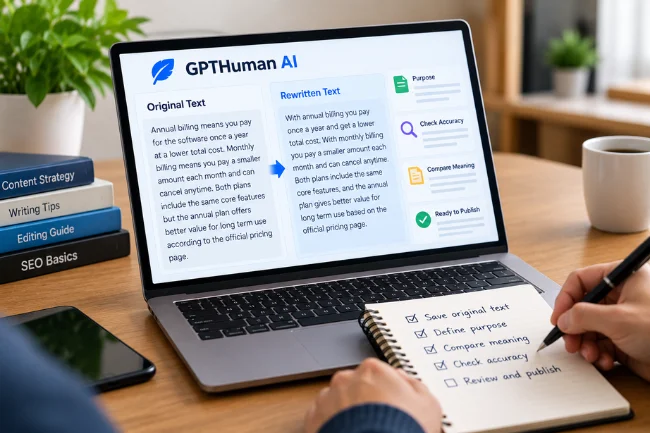
Start With a Representative Passage
I would use the trial on a passage that resembles my real workload. An easy introductory paragraph tells me little about how the tool handles a passage containing product names, qualifications, and a source citation.
Before submitting it, I would save the original and write down its purpose in one sentence. For example: “Help a beginner understand the difference between annual billing and monthly billing.”
Then I would compare the rewrite against that purpose. If it sounds friendlier but makes the payment schedule less clear, I would reject the change.
Check Whether the Claim Has Changed
GPTHuman’s own documentation warns about meaning drift, including altered numbers, missing qualifications, and inaccurate technical substitutions. It also says a high Similarity Score cannot guarantee preserved meaning.
Here is an example I created to make the risk concrete. Suppose the original says, “The plan may reduce editing time for short drafts.” A rewrite saying, “The plan reduces editing time,” removes both the uncertainty and the limitation.
I would underline each factual claim in the original, then find its equivalent in the rewrite. Any claim that disappears or becomes stronger needs attention. This is particularly useful when fluent wording makes a change easy to miss.
Read the Article as a Whole
Short sections can sound fine individually and still produce an uneven article. I would check whether the introduction promises the same thing the body delivers, whether headings follow a sensible order, and whether terms remain consistent.
I would also read the text aloud. If a sentence requires a second breath or sounds unlike something I would say to the intended reader, I would edit it directly.
There is little reason to spend another generation attempting to fix a sentence I can improve in a few seconds.
Is GPTHuman AI Useful for SEO in 2026

It may help improve the readability of a draft, but search visibility depends on considerably more than wording.
Google’s guidance on generative AI content emphasizes accuracy, quality, and relevance. It warns that generating many pages without adding user value may violate its scaled content abuse policy.
For AI Overviews and AI Mode, Google says established SEO practices remain relevant and no special additional optimization is required. A page must be indexed and eligible to appear with a snippet, and inclusion is not guaranteed.
I would therefore assess a humanized article by the reader’s task. Does a pricing review explain the billing commitment? Does a tutorial solve the actual problem? Does a comparison explain the tradeoff that changes the purchase decision?
Where E E A T Comes From
Google describes E-E-A-T as experience, expertise, authoritativeness, and trustworthiness. Its guidance clarifies that E-E-A-T itself is not a specific ranking factor.
For this topic, I would demonstrate trust through dated prices, direct sources, and an honest account of what I checked. If I later ran product tests, I would publish their method and complete results.
Adding a first-person pronoun cannot create experience. A useful personal observation needs an actual event behind it, such as the documentation discrepancies I found during this research.
Originality, Privacy and Responsible Use
Rewriting Does Not Supply New Evidence
A passage can use fresh wording while repeating the same unsupported idea. I would assess originality by asking what the reader learns that the source draft did not already explain.
An original calculation, a clearly labeled example, or a documented observation can add value. None requires pretending to have discovered information that nobody else has published.
When another person’s research supports a claim, I would preserve the attribution through every rewrite. Changing the sentence does not remove the need to identify where the information came from.
Check Data Handling Before Uploading
GPTHuman’s published privacy policy says it collects submitted content and may use content to improve or train its models. It describes an account setting for opting out of training use.
Before uploading a client draft, I would check the current policy and account settings, and confirm that I have permission to submit it. For an initial evaluation, I would use public or invented sample material without confidential details.
Follow the Rules for the Work
The company’s responsible-use policy prohibits concealing unauthorized AI assistance and fabricating research, citations, or personal experiences. It identifies clarity improvements and revision of a user’s own writing as potential responsible uses, subject to applicable rules.
I would check a client’s brief or publisher’s policy before editing. Knowing what assistance is allowed also prevents wasted work on a draft that cannot be accepted.
My Recommendation Before Subscribing
GPTHuman AI is worth evaluating when you have sound material that needs help with expression. I would start with the free trial, compare one representative passage against its original, and measure the editing effort that remains.
Before paying, confirm the current allowance and billing terms. Subscribe only if the output consistently helps you produce clearer, accurate writing for your readers.
Frequently Asked Questions
What is GPTHuman AI used for?
GPTHuman AI is used to rewrite drafts into more natural language and offers content generation and assessment tools.
Is GPTHuman AI free?
It offers a limited trial with 300 free credits and no credit card requirement; continued higher-volume use requires a paid plan.
Can GPTHuman AI bypass Turnitin?
No universal result is guaranteed. GPTHuman’s terms acknowledge that external detectors may still flag its output.
Does GPTHuman AI preserve the original meaning?
It is designed to retain meaning, but changes can occur. I would compare factual claims and qualifications before using a rewrite.
Is GPTHuman AI good for SEO content?
It may help with wording, but useful information, verified claims, and sound SEO practices still determine an article’s publishing quality.

Noah Sterling is a technology research writer with 8+ years of experience covering emerging technologies, software trends, digital tools, and innovation. He creates practical, research-based articles to help readers understand the evolving technology landscape.