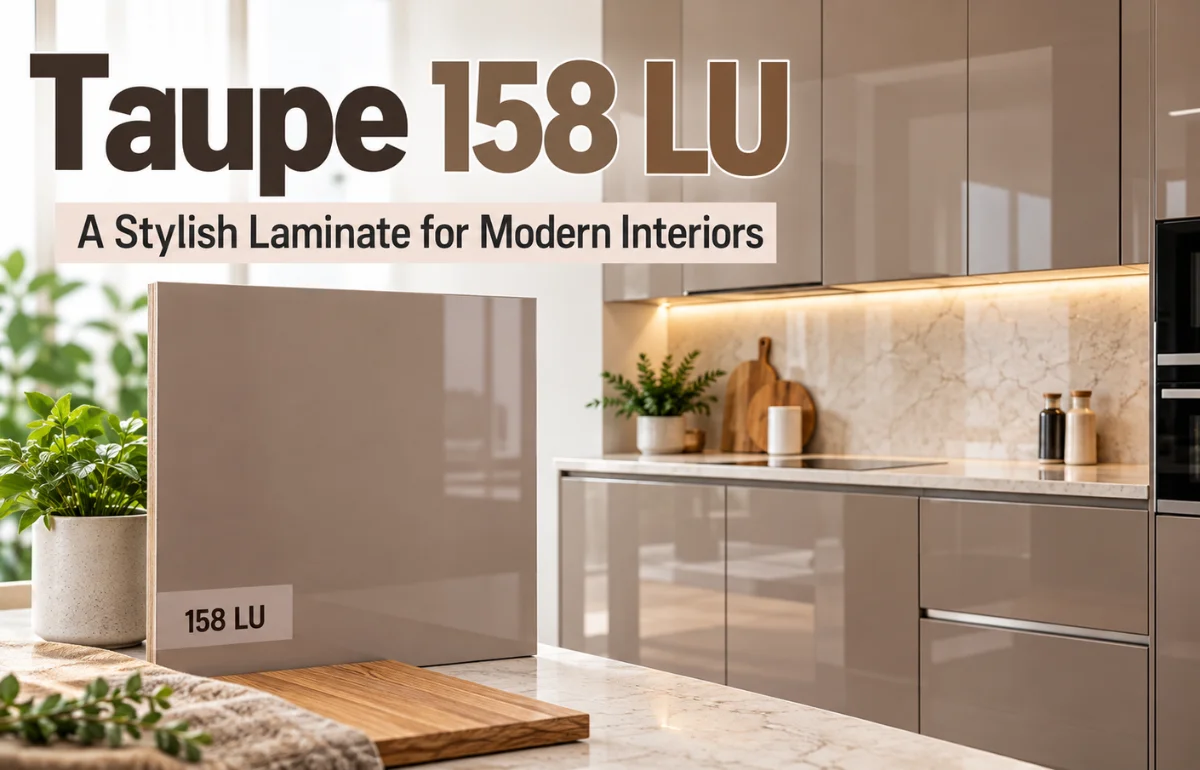
Taupe 158 LU is a solid-color decorative laminate from CenturyLaminates, part of CenturyPly’s Lucida high-gloss collection. Its design code is 158 LU: “158” identifies the taupe shade, while “LU” identifies the Lucida finish. The manufacturer lists it as a 1 mm-thick laminate supplied in an 8 × 4 ft sheet, primarily for furniture and interior surfaces such as kitchen shutters, wardrobes, wall units, and cabinetry. It offers the understated gray-brown character associated with taupe, combined with a reflective finish. In plain terms, Taupe 158 LU is a surface material that a fabricator bonds to a suitable board; it is not a paint, a ready-made cabinet, or a structural board on its own.
I like the balance it offers between stark white and dark gray. Still, lighting, the supporting board, and edge treatment matter as much as the catalog image.
What Does the Code Taupe 158 LU Actually Mean?
The code becomes clear once you separate its three parts.
- Taupe is the shade name. In interior design, taupe generally describes a muted mix of brown and gray, although its appearance changes with light and neighboring colors.
- 158 is CenturyLaminates’ shade identifier. It is not an RGB value, a paint formula, or a universal color standard.
- LU refers to Lucida, CenturyLaminates’ glossy laminate collection. It does not mean that every product with the number 158 has the same texture or appearance.
The official Taupe 158 LU listing places it in the Lucida Solids range. That last word matters. You’re choosing a uniform decorative color rather than a printed wood grain, marble vein, or other patterned design.
I would use the full code with a dealer or carpenter to avoid an unwanted substitution.
Taupe 158 LU Specifications at a Glance
Here are the product details worth confirming before any design decisions or price negotiations.
| Specification | Taupe 158 LU detail | Why it matters |
|---|---|---|
| Manufacturer | CenturyLaminates by CenturyPly | Identifies the catalog and supplier |
| Collection | Lucida, Solids | High-gloss appearance in a solid shade |
| Design code | 158 LU | Helps prevent substitutions |
| Nominal thickness | 1 mm | Determines the laminate skin thickness, not total cabinet thickness |
| Standard sheet size listed | 8 × 4 ft | Approximately 32 sq ft before cutting waste |
| Catalog reference | Page 24 on the current product page | Useful when checking a physical sample book |
| Matching edge-band reference | REHAU 110163 in CenturyLaminates’ lookbook | Starting point for matching exposed edges |
Check the CenturyLaminates lookbook, then inspect a physical sample: screens cannot reliably show gloss or undertone.
What the Technical Test Figures Tell Me
For its 1 mm laminates, the manufacturer’s technical table reports surface-wear resistance above 400 revolutions, scratch resistance of 3 N, and a pass for dry heat at 180°C. These are controlled test outcomes, not guarantees against damage.
I wouldn’t put a hot pan directly on the laminate; a trivet is cheaper than replacing damaged furniture. A metal key can also mark a glossy panel despite its tested scratch resistance.
Finished furniture also depends on the substrate, adhesive, sealed edges, and installation quality.
What Color Is Taupe 158 LU in a Real Room?
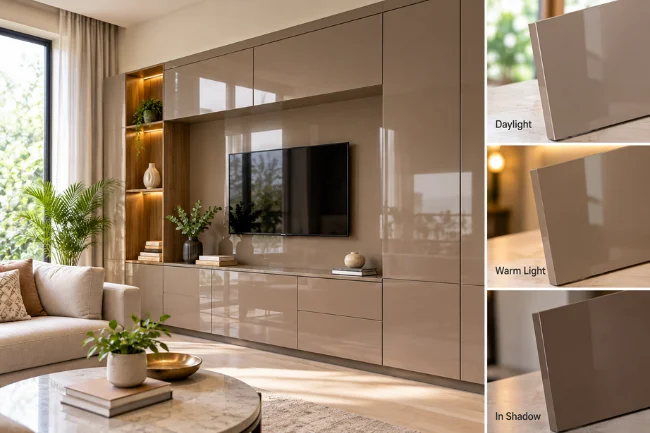
Taupe sits between brown and gray, making it useful where white feels clinical and dark brown feels heavy. Lucida’s reflective surface can look lighter near a window and deeper in shadow.
I would call it calm and warm-leaning, but that’s an aesthetic impression, not a measured value. I found no official HEX, RGB, RAL, or light-reflectance value for this laminate; online “exact matches” deserve skepticism.
Why Lighting Changes the Look
Light temperature, viewing angle, and surrounding colors all change the impression.
Warm lighting can emphasize taupe’s brown side; cool daylight may highlight gray. A vertical wardrobe reflects the room differently from a horizontal tabletop.
I would hold the sample upright against the wall, then lay it beside the floor or counter. Inspect it in daylight and under your actual evening lights, not just showroom spotlights.
A Sample Check I Would Do Before Approving the Shade
I would tape a reasonably large sample to the cabinet location for a day, avoiding adhesives that could damage the wall. From a normal standing distance, I’d check whether it looks too dark, too reflective, or unexpectedly pink or gray beside the existing finishes. Then I’d look at it from the doorway, where most people first see the room.
Photographs can help compare layouts, but I wouldn’t rely on photos for final color approval. Phone cameras automatically adjust white balance and exposure, which can make the same taupe sample look different in two pictures. If the project has several rooms, repeat the test in each one rather than assuming the color will behave identically throughout the house.
Colors and Materials That Work With It
I like taupe beside warm oak, off-white walls, and brushed metal hardware. The wood adds texture and the wall keeps the scheme airy.
Charcoal accents, cream stone-look counters, and muted sage textiles also deserve consideration. These are suggestions, not factory-matched sets; compare real samples.
Why the Lucida Finish Matters
The finish is one reason people search for this exact code rather than the word “taupe.” CenturyLaminates describes Lucida as a 1 mm high-gloss range with a smooth, mirror-like look and resistance to scuffs, stains, and abrasion.
Gloss can brighten a compact room and make uninterrupted cabinet fronts look sleek. It still won’t suit every household.
Reflections can reveal uneven door alignment, fingerprints, and cleaning streaks. If possible, I would inspect a full-size finished panel, not only a sample card.
Resistance Is Not the Same as Invulnerability
Lucida offers impact, scuff, stain, and moisture resistance, but that doesn’t make an assembled board waterproof. Water can enter an unprotected joint and damage the core.
It is not interchangeable with acrylic, glass, or painted MDF; those differ in repair, edge detailing, and wear. Lucida still needs care.
Some retailers label the same code “texture” or “lustre.” Trust the manufacturer code and physical sample over marketplace categories.
Where Can You Use Taupe 158 LU?
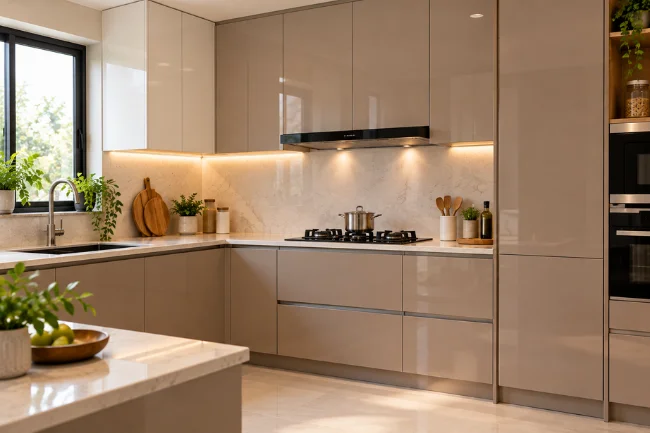
Its neutral character makes the shade useful across several rooms.
Kitchen Cabinets and Tall Units
Taupe can warm up kitchen shutters, pantry doors, and tall cabinets, especially alongside light stone-look surfaces.
In a small kitchen, I would try light upper cabinets and taupe below. Larger spaces can accommodate a continuous taupe storage wall.
Protect sink-side seams, cut edges, and the core around appliances. A heat-resistance test is not permission for unshielded appliance heat.
Wardrobes and Bedroom Furniture
Taupe 158 LU can suit full-height wardrobes, bedside drawers, and dressing units without competing with bedding or artwork. I’d add warm wood or a matte accent to break up reflections.
For wardrobes opposite windows, check potential glare before ordering.
TV Units, Wall Panels, and Study Furniture
On TV walls, taupe can support wooden slats or shelving. I would position glossy panels to avoid screen glare.
In a study, it suits storage fronts; for a desk, I’d compare a less reflective option under task lighting.
Reception Areas and Retail Interiors
Reception desks, display units, and meeting-room cabinets are other possibilities. For high traffic, I would prioritize protected corners, replaceable panels, and easy cleaning.
Taupe 158 LU vs Other Lucida Neutral Shades
These related Lucida colors offer useful alternatives. The descriptions are design impressions, not measured color matches.
| Lucida shade | General color direction | Where I would consider it |
|---|---|---|
| Taupe 158 LU | Muted gray-brown neutral | Warm contemporary cabinets and wardrobes |
| Beige 163 LU | More overtly beige | Soft, warm interiors with cream accents |
| Silver Grey 225 LU | Cooler gray appearance | Crisp, modern gray-and-white schemes |
| Graphite Grey 238 LU | Darker charcoal-gray direction | Contrast cabinetry and statement panels |
With cool gray flooring, I would sample taupe and silver gray together. Warm taupe may add balance or clash with a blue-gray undertone.
Sellers may list shade 158 with different suffixes. Always specify LU if Lucida gloss is the look you want.
Installation Details That Make or Break the Result
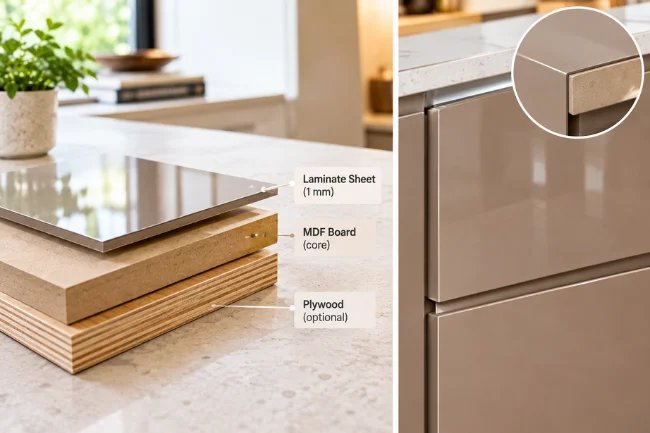
The visible sheet is only one part of the finished panel.
Choose the Right Base Board
Fabricators bond laminate to suitable plywood, MDF, or another engineered core. The 1 mm surface thickness says nothing about total shutter thickness or moisture performance.
For kitchens, specify the core, water protection, and appliance clearances in writing.
Match the Edges, Not Just the Front
CenturyLaminates’ lookbook associates Taupe 158 LU with REHAU edge-band code 110163. I would still compare the strip against the sheet because their sheen can differ.
Ask for a sample corner showing the band and joint. To me, that small mock-up is more useful than a polished rendering.
Plan Sheets Around Real Cut Sizes
An 8 × 4 ft sheet has roughly 32 sq ft of gross area, but cuts, trimming, and offcuts reduce usable coverage.
For example, 90 sq ft of finished faces against three sheets’ 96 sq ft gross leaves little cutting margin. I would ask the fabricator for a cut layout and waste allowance.
Discuss Both Sides of the Panel
I would also ask the installer how the reverse side of each door or panel will be finished. Cabinet doors are not just decorative fronts; they must stay properly balanced and stable through changes in indoor humidity. The appropriate backing or balancing treatment depends on the board and fabrication method.
There is no reason to assume that buying an attractive front laminate automatically includes a matching inner face. State whether you want the same taupe shade inside, a coordinated neutral, or another finish. That small design decision affects material quantities, cost, and what you see whenever the cabinet is open.
Confirm the Same Batch and Finish
Record the full code, size, quantity, and batch. Keep a labeled offcut in case replacement material differs subtly later.
How I Would Clean and Maintain This Laminate
High-gloss surfaces reward gentle, regular cleaning. The manufacturer’s maintenance guidance recommends soft cloths and mild cleaners while avoiding abrasive materials and harsh chemicals.
I would dust with microfiber, wipe spills with a soft damp cloth, and dry the surface. Mild diluted soap can help with greasy fingerprints; remove its residue afterward.
Avoid steel wool, scouring pads, abrasive powder, strong solvents, and acidic cleaners. Ask the supplier before applying a stronger treatment to stubborn marks.
Keep sharp tools and hot cookware off the face, and never leave water pooled at joints.
Price, Availability, and What to Check Before Buying
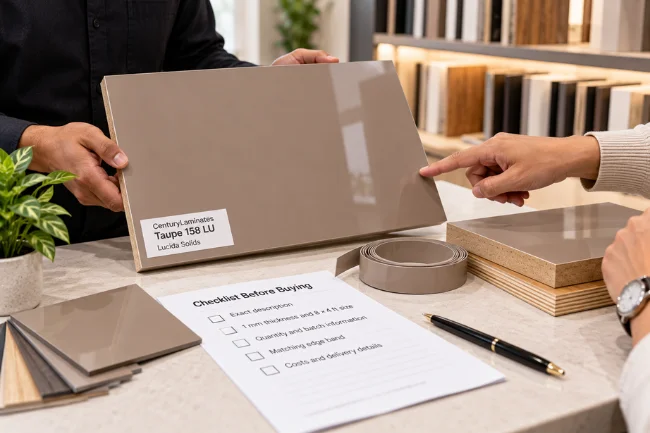
There is no reliable universal “Taupe 158 LU price.” Dealer, city, quantity, delivery, and installation terms all affect a current quote.
Some sellers mark their own stock unavailable; that doesn’t establish a manufacturer-wide discontinuation. Confirm locally with an authorized dealer.
Before paying, I would ask for five details in writing:
- The exact description: CenturyLaminates Taupe 158 LU, Lucida Solids.
- The stated 1 mm thickness and 8 × 4 ft sheet size.
- The quantity, batch information, delivery date, and return policy.
- The proposed matching edge band, including its product code and finish.
- Separate costs for sheets, substrate, adhesive, fabrication, delivery, and fitting.
Check the manufacturer’s label, retain a sample, and record the approved finish in the work order.
Is a Lower Quote Always Better?
Not in my view. Two quotes might use the same visible laminate but very different core boards, adhesives, edge strips, and hardware. A cheap quote that leaves those items unspecified is difficult to compare fairly with one that details the complete assembly.
I’d ask each contractor to quote against the same written material schedule. That makes differences visible: perhaps one includes matching edges and installation, while another charges separately. It also helps prevent a last-minute switch to a different “taupe” product because the exact code was never documented.
Common Mistakes I Would Avoid
First, don’t choose from a phone screen. I would inspect the physical gloss before approving a full kitchen.
Second, check existing floors and walls. Neutrals can clash with other neutrals.
Third, don’t expect premium laminate to fix weak substrate, poor edge sealing, or misaligned shutters.
Finally, resistance claims are not absolute guarantees. Fabrication and care remain essential.
Frequently Asked Questions About Taupe 158 LU
1. What is Taupe 158 LU used for?
It is a CenturyLaminates Lucida decorative sheet used on suitable furniture and interior panels, including kitchen cabinets, wardrobes, TV units, and storage fronts.
2. Is Taupe 158 LU matte or glossy?
It belongs to the Lucida high-gloss collection. Check a physical sample to judge the exact reflection and surface appearance.
3. What is the thickness and size of Taupe 158 LU?
CenturyLaminates lists a nominal thickness of 1 mm and a standard sheet size of 8 × 4 ft, equivalent to roughly 32 sq ft before cutting.
4. Which edge band matches Taupe 158 LU?
The CenturyLaminates lookbook references REHAU code 110163. Verify the actual strip’s color and sheen against the laminate before fabrication.
5. Is Taupe 158 LU waterproof and scratch-proof?
No. The Lucida range has tested resistance to moisture-related exposure and scratching, but joints, core boards, and the glossy surface still need protection.
My Final Take
Taupe 158 LU is worth considering if you want a warm, understated cabinet color with a polished Lucida finish. Its real strength is balance: it can soften a modern interior without fading into plain cream or becoming as severe as dark charcoal.
I would decide with an original sample, matching edge band, and clear fabrication specifications in hand. Compare them under your room lights and request a written quote before committing. That preparation makes a more satisfying finished interior.

Olivia Parker is a home improvement research writer with 8+ years of experience covering home design, renovation ideas, maintenance tips, and practical living solutions. She creates easy-to-follow content to help readers make informed decisions about improving their homes.