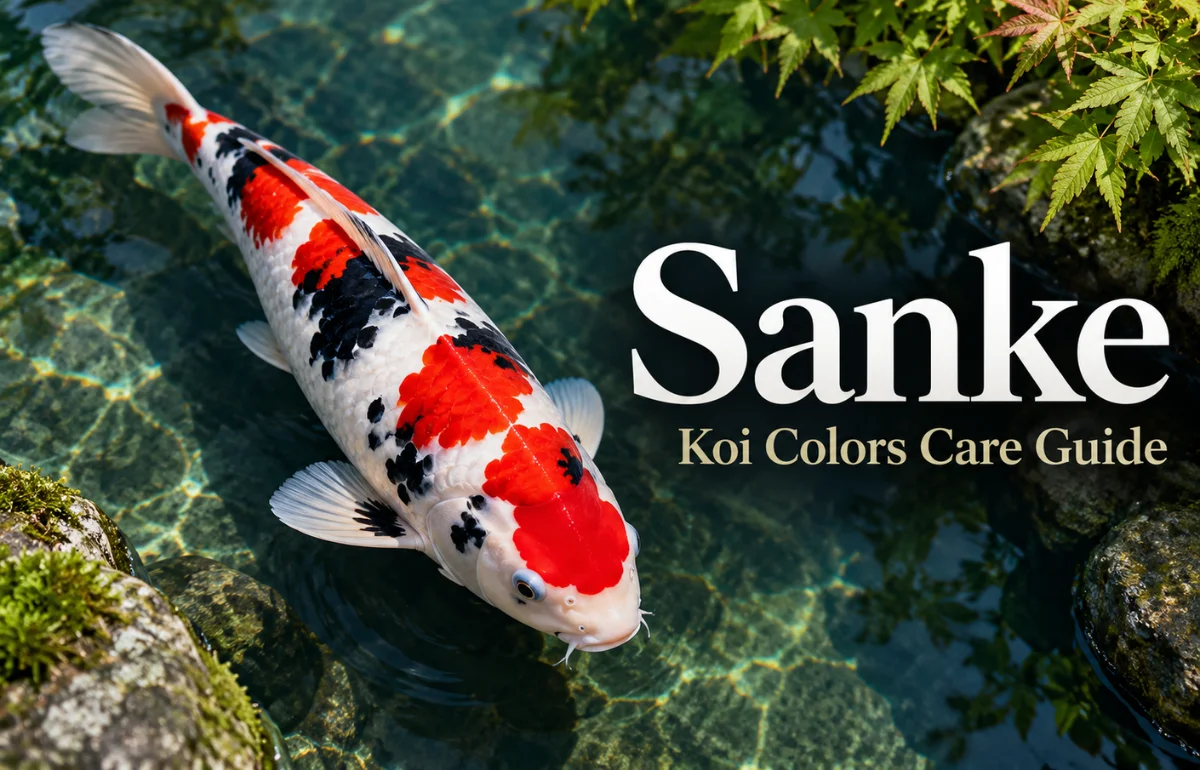
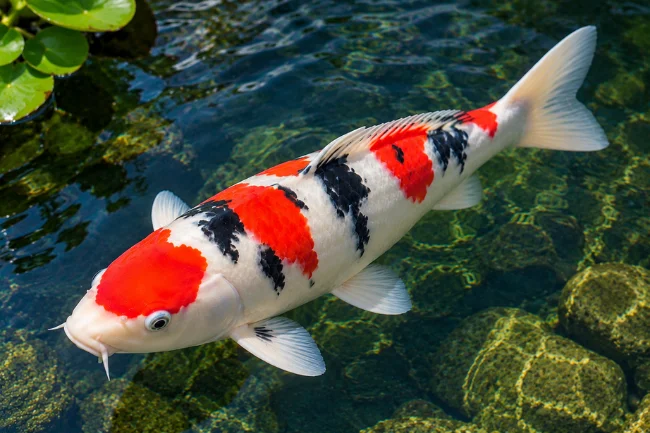
Sanke is a Japanese ornamental koi variety recognized by three colors: a white base, red patches, and black markings. Its full name is Taisho Sanke, also called Taisho Sanshoku, meaning a three-colored koi associated with Japan’s Taisho era. A classic Sanke has red and black patterns across its white body, with little or no black on the head. It belongs to the Gosanke, the three celebrated koi varieties that also include Kohaku and Showa.
Unlike a separate fish species, Sanke is a selectively bred color variety of ornamental carp. If you’re trying to identify one, choose one for your pond, or understand why some are prized more highly than others, the arrangement and quality of those colors tell only part of the story.
I find Sanke particularly interesting because its beauty depends on restraint. The black is meant to support the red-and-white design, not swallow it. Once you know what to look for, the difference becomes surprisingly easy to appreciate.
Where Does Sanke Come From?
The variety developed in Japan during the early twentieth century and became associated with the Taisho period (1912–1926). Breeders refined red-and-white koi by selecting fish that also displayed desirable black markings.
Over generations, they developed the cleaner, more deliberate three-color patterns associated with Taisho Sanshoku today.
You may see different dates and individuals credited with the first Sanke. Early examples, recognition at exhibitions, and the establishment of a stable breeding line are not necessarily the same event, so I would be cautious about treating one year as an undisputed birthday.
Sanke sits alongside Kohaku and Showa in the Gosanke, sometimes called the Big Three of koi appreciation. This is a traditional grouping of varieties, not a claim that other koi are inferior.
Its popularity comes from how clearly it displays the qualities enthusiasts value: body shape, healthy-looking skin, and a balanced pattern that can be enjoyed from above.
How to Identify a Sanke Koi
The White Base: Shiroji
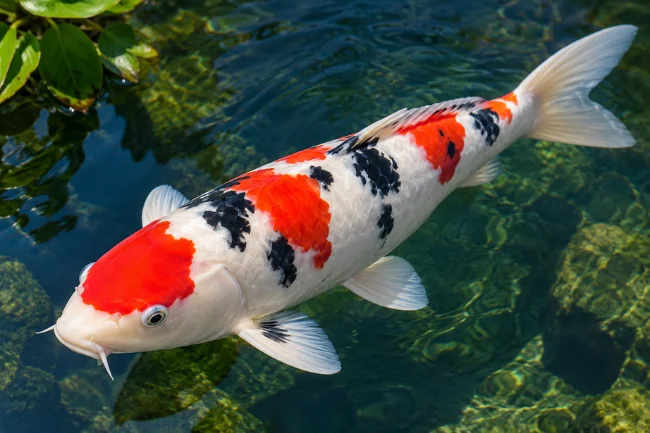
A Sanke should look like a white koi carrying red and black markings. That white background is called shiroji.
Clear, bright white gives the other colors room to stand out, especially around the shoulders and between pattern elements.
I would never judge whiteness from a heavily edited dealer photo alone. Lighting, water tint, and camera settings can make ordinary skin look brilliant. Natural-light video is more useful than a single oversaturated picture.
The Red Pattern: Hi or Beni
The red areas are called hi or beni. They often form substantial patches across the head and back, creating the fish’s main visual structure.
In a pleasing Sanke, the red is reasonably consistent in depth, with defined boundaries and enough open white to avoid a crowded appearance.
A perfectly symmetrical pattern is not required. I look instead for visual balance: does one end seem much heavier than the other, or does the design lead my eye naturally from head to tail?
A strong red pattern should still be attractive before the black is considered.
The Black Markings: Sumi
Sumi is the black pigment that distinguishes Sanke from Kohaku.
On a traditional Sanke, black often appears as separate, glossy accents toward the upper body. A marking near the shoulder can make the whole fish look more complete, but there is no universal number or size of spots that guarantees quality.
Keepers sometimes distinguish tsubo-zumi, black on white skin, from kasane-zumi, black overlapping a red patch.
Both may appear on Sanke, although clean black against white often creates a particularly striking contrast.
The Head and Fins
The usual identification clue is a head free of black. Red and white are welcome on the head; prominent black tends to suggest Showa instead.
I treat this as a useful traditional guideline, not an infallible biological rule. Individual fish and modern breeding lines can blur the distinction.
Some Sanke also display fine black stripes through the pectoral fin rays, known as tejima.
These differ from the concentrated black at the base of the fins, called motoguro, commonly associated with Showa. Not every fish expresses these features clearly.
Sanke vs. Showa vs. Kohaku: What Is the Difference?
These three koi varieties are easy to confuse in photographs, especially when the fish are young.
The simplest approach is to examine how black contributes to the overall design, not just count colors.
| Feature | Sanke | Showa | Kohaku |
|---|---|---|---|
| Main colors | White, red, black | Black, red, white | White, red |
| Visual foundation | White with red pattern and black accents | Traditionally black-based, with bolder three-color structure | White with red pattern |
| Black on head | Traditionally absent | Common, but not universal | Absent |
| Typical black pattern | Separate spots, mainly on upper body | Larger areas may wrap around the sides | None |
| Pectoral fin clue | Sometimes black ray stripes | Sometimes black at fin bases | Usually no black pattern |
Modern Showa can carry extensive white, while some Sanke develop relatively heavy black. That is why no single feature should determine identification in a borderline case.
I would check the head, body markings, fins, and breeder’s variety classification together.
A quick mental shortcut helps: picture a Kohaku with additional black accents, and you are close to the classic Sanke look.
Picture black playing a more structural role, and you may be looking at Showa.
What Makes a High-Quality Sanke?
Body Shape Comes Before Pattern
An impressive pattern cannot fully compensate for poor body conformation.
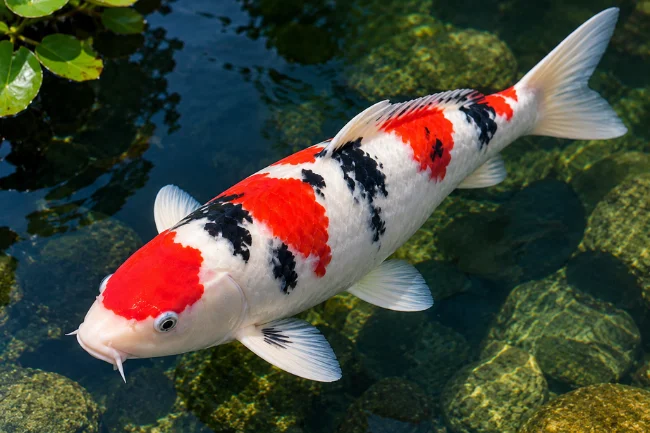
A well-proportioned koi has a straight body, balanced head and fins, good breadth through the shoulders, and a smooth taper toward the tail.
It should swim evenly, without awkward tilting or difficulty maintaining position.
Koi judges regularly place body conformation and skin quality above decorative pattern details.
I think that is a useful lesson for ordinary pond owners too: buy a sound fish, not just a pretty photograph.
Skin Quality and Color Depth Matter
Look for a healthy sheen, clean white areas, consistent red, and black markings with good definition.
The borders between colors should generally appear intentional rather than muddy, although young koi may still be developing.
A koi with fewer but better-placed black accents may be more attractive than one covered in irregular dark marks.
More pigment is not automatically more quality. Equally, a slight variation in pattern does not make a healthy pond fish a poor choice.
Balance Is More Valuable Than a Formula
Online descriptions sometimes suggest a fixed percentage of white, red, and black.
I would not use that as a buying rule. Two fish can have similar color coverage yet create very different impressions because of where those colors fall.
For a practical assessment, imagine dividing the fish lengthwise into three sections.
Check whether the front, middle, and tail each contribute to the design without being overcrowded. Then view the fish as a whole.
This is a visual exercise, not an official judging standard, but it can expose an unbalanced pattern quickly.
How Sanke Colors Change as the Fish Grows
One reason young Sanke are difficult to evaluate is that the black markings may develop gradually.
A juvenile can show bluish or grayish-looking areas beneath the skin that later become more visible sumi. Other markings can shift in appearance as the body grows and the skin matures.
Red patches can also stretch as the fish gets larger, and their edges may become more or less defined.
Genetics, age, nutrition, water conditions, and individual development all play a role. No dealer can honestly promise that every mark on a small fish will finish exactly as expected.
Here is the distinction I find most useful: a photo shows current appearance, not guaranteed future quality.
If I were comparing two young Sanke at different prices, I would value documented breeder lineage and a recent unedited video more than predictions about invisible black spots.
For your own records, photograph the fish from above under similar lighting every few months.
Note the date, approximate length, and water conditions. A consistent photo history makes gradual changes easier to judge and can help separate normal pigment development from sudden health-related changes.
Popular Sanke Varieties and Pattern Styles
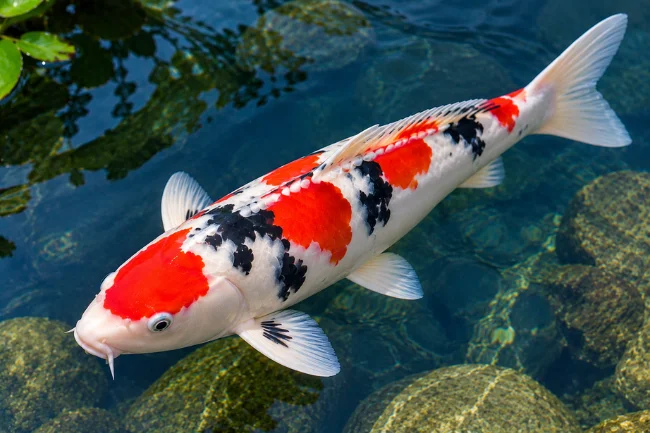
Sanke is not limited to one scale type or red pattern. Several descriptions appear in breeder listings.
Doitsu Sanke
Doitsu Sanke have few or no ordinary body scales, sometimes with a line of larger scales along the back or sides.
The smoother skin makes color boundaries especially visible, although irregular scaling may affect show assessment.
Gin Rin Sanke
Gin Rin Sanke carry reflective scales that sparkle in sunlight.
This effect comes from the scales, not from adding another pigment color.
I like the way the shine can lift a pond display, although reflections may make detailed patterns harder to judge in photographs.
Tancho Sanke
A Tancho Sanke has one distinct red mark on the head, with no other red on the body, plus black body markings.
It is often discussed separately from an ordinary multi-patch Sanke because of its distinctive head-centered design.
Maruten Sanke
Maruten Sanke also have a separate, rounded red mark on the head, but unlike Tancho, they carry additional red elsewhere on the body.
Confusing Tancho and Maruten is a common mistake when reading koi listings.
Sanke Koi Care: Pond Conditions That Actually Matter
Sanke need the same fundamental care as other koi.
Their elegant coloring does not make them more suitable for a small aquarium or exempt them from the demands of keeping large carp.
Adults can grow to roughly 60–75 cm or more under favorable conditions, so pond space needs to account for future size, not purchase size.
I would prioritize a generously sized, well-filtered pond with stable temperature, protection from predators, and enough room for normal swimming.
As a planning reference, the Ornamental Aquatic Trade Association recommends ponds of about 4,500 liters or more for larger pond fish such as koi; actual capacity depends on stocking, filtration, depth, and climate.
Water Quality Targets
| Water factor | Practical target or approach |
|---|---|
| Ammonia | Zero on a routine pond test |
| Nitrite | Zero on a routine pond test |
| pH | Generally around 6.5–8.5, with stability essential |
| Nitrate | Keep low; investigate rising trends |
| Oxygen | Provide continuous circulation and aeration |
| Temperature | Manage seasonal changes; avoid sudden swings |
| Chlorine/chloramine | Treat replacement tap water before it reaches fish |
These are broad care guidelines, not a substitute for measuring your own pond.
pH, temperature, and alkalinity affect how harmful ammonia becomes, so testing one number in isolation can be misleading.
A clear pond may still contain dissolved waste.
I recommend checking ammonia, nitrite, pH, and other relevant parameters regularly, especially after adding fish, changing feed, or cleaning equipment.
Biological filtration is essential because beneficial bacteria process waste; washing all filter media in untreated tap water can damage those colonies.
Feeding Through the Seasons
Koi are omnivores. A reputable, nutritionally complete koi feed is a sensible foundation, with portions adjusted to water temperature, appetite, and filtration capacity.
Feed only what the fish consume promptly rather than allowing pellets to decay.
As water cools, digestion and appetite slow.
Seasonal feeding advice varies by conditions and feed formulation; the Ornamental Aquatic Trade Association notes that feeding may be inappropriate when water drops below about 8°C.
I would use a pond thermometer rather than the calendar and seek experienced local guidance for extreme heat or winter conditions.
Health Checks and Quarantine
Observe the fish during feeding.
Clamped fins, flashing against objects, surface gasping, ulcers, unusual isolation, or a sudden loss of appetite deserve attention.
Test water first, because poor conditions can mimic or worsen disease. If symptoms continue, consult a qualified aquatic veterinarian instead of experimenting with medications.
New koi should be quarantined in a properly equipped separate system before entering an established collection.
Koi Organisation International discusses observation periods of four to six weeks as a biosecurity practice.
A healthy-looking newcomer can still introduce a problem, so skipping quarantine to save time is a risky bargain.
How to Choose a Sanke Before You Buy
I would start with the seller, not the fish’s advertised grade.
Ask where it was bred, how long it has been held, whether it has been quarantined, and whether the seller can show current video.
Labels such as “premium” or “AAA” have little meaning without a consistent grading system.
Next, watch the fish swim.
Does it move steadily? Are both pectoral fins working normally? Is the body straight and free from obvious sores?
Then assess the three-color pattern from above, because koi are traditionally appreciated from that viewpoint.
If you are choosing between a costly young fish with a speculative future and a modestly priced fish you already enjoy looking at, remember that you are buying a living animal, not a guaranteed investment.
Patterns can change, costs continue after purchase, and potential is never assured.
A practical decision filter is to ask three questions in order: Is the koi healthy? Can my pond support its adult size? Would I still like it if the black pattern developed differently?
If the answer to any is no, I would keep looking.
Common Mistakes When Keeping Sanke
The most frequent mistake is selecting for color while overlooking husbandry.
An overloaded pond can make a beautiful Sanke vulnerable to poor water quality, regardless of its pedigree.
Another is assuming black on the head automatically disqualifies every Sanke or that black below the lateral line always proves a fish is Showa.
Traditional patterns guide identification, but exceptions and modern breeding make simplistic rules unreliable.
Finally, avoid chasing quick color improvements with heavy feeding or unverified supplements.
Good pigmentation depends substantially on genetics and long-term conditions. Consistent nutrition, clean water, and patient observation will serve the fish better than dramatic short-term fixes.
Final Thoughts
Sanke brings together white, red, and black in a design that rewards close observation.
I would choose one for sound body shape, healthy skin, balanced markings, and trustworthy breeding history before worrying about perfection.
If you are considering your first Sanke, check your pond’s capacity and water tests, then compare several fish in natural-light video before making a decision.
Frequently Asked Questions About Sanke
What does Sanke mean in koi fish?
Sanke is the shortened name for Taisho Sanke or Taisho Sanshoku, a three-colored Japanese koi with white, red, and black markings.
What is the difference between Sanke and Showa?
Sanke generally has a white-based appearance with separate black accents and a clean head; Showa often has bolder black markings, including on the head.
Can Sanke koi change color as they age?
Yes. Black sumi can emerge or change, and red patterns may look different as the fish grows; the exact outcome is not predictable.
How big do Sanke koi grow?
A mature Sanke may reach roughly 60–75 cm or more, depending on genetics, space, nutrition, water quality, and age.
Are Sanke koi suitable for beginners?
They can be, provided the keeper has a properly sized, established pond and understands filtration, water testing, seasonal feeding, and quarantine.

Olivia Parker is a home improvement research writer with 8+ years of experience covering home design, renovation ideas, maintenance tips, and practical living solutions. She creates easy-to-follow content to help readers make informed decisions about improving their homes.