
Oronsuuts is a romanized form of the Mongolian expression орон сууц (oron suuts), meaning housing, a dwelling, or a place to live. In everyday urban conversation, it often refers to an apartment, but the term is broader than one kind of building. It can describe residential accommodation ranging from an apartment unit to a private home, and Mongolia’s housing law even includes traditional gers in its definition. If you encounter Oronsuuts in a Mongolian property listing, the context usually tells you whether someone is selling an apartment, discussing a housing development, or referring to accommodation generally.
That distinction matters. A modern apartment in Ulaanbaatar and a ger on the outskirts may both be homes, yet they offer very different experiences of heating, water, maintenance, and access to services. Here is how the term works in real language and real housing decisions.
What Does Oronsuuts Mean in Mongolian?
The standard Mongolian spelling is орон сууц, written as two words in Cyrillic. You’ll also encounter the Latin-letter version oron suuts and the joined spelling oronsuuts in English-language searches. The joined form is convenient online, but it should not be mistaken for the standard Mongolian spelling.
The parts of the expression help explain its meaning. Oron can refer to a place or living space; suuts means a dwelling or residence. The Mongolian explanatory dictionary defines орон сууц as a place to live. Its meaning is therefore closer to “residential housing” than to a single architectural style.
As I checked the dictionary against Mongolia’s housing legislation, I noticed an important detail: conversational usage and legal usage need not be identical. In a city property advertisement, the term may strongly suggest an apartment. In the housing law, it reaches further and explicitly includes homes and gers. Both uses can be correct within their contexts.
Is Oronsuuts the Same as Bair?
Not exactly. The Mongolian word байр (bair) can mean an apartment or accommodation, but it also has wider uses such as a place or position. Oron suuts more specifically directs attention toward residential housing. In casual speech, however, people may use the words in overlapping situations.
That is why I would translate a complete phrase, rather than replace every occurrence with “apartment.” A housing policy document, an estate agent’s advertisement, and a conversation about someone’s home can require different English wording.
Useful Mongolian Housing Phrases
Learning a handful of related expressions makes real listings easier to understand. Шинэ орон сууц refers to new housing or a new apartment, while орон сууцны үнэ means housing or apartment price. Орон сууц түрээслэх concerns renting residential property, and орон сууц худалдах concerns selling it.
You may also see түрээс for rent, худалдах for sale, and м² or м.кв for square meters. These details give you more practical information than a machine-translated headline that simply says “home.” For an unfamiliar listing, check the transaction type, area, location, and photographs before assuming what is offered.
Which Types of Homes Count as Oron Suuts?
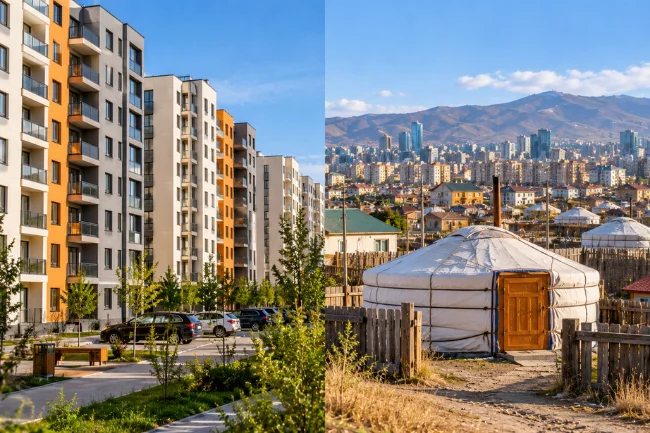
Mongolia has no single housing model. Urban apartment blocks, detached houses, and portable gers coexist, sometimes within a relatively short distance of one another. The country’s housing law uses a broad definition encompassing public and private residential buildings, homes, and gers.
A ger is the traditional round, felt-covered Mongolian dwelling often called a yurt in English. It is associated with mobile pastoral life, but gers also serve as permanent homes in settlements around cities. A ger district, meanwhile, is a neighborhood category; not every household there lives in a ger. Many occupy detached houses within fenced plots.
| Housing type | Typical characteristics | Practical consideration |
|---|---|---|
| Apartment in a multi-story building | Separate dwelling unit; often shared entrances and managed utilities | Confirm heating, building management, and monthly charges |
| Detached private house | Standalone structure; potentially more outdoor space | Check insulation, access roads, water, sanitation, and land documents |
| Traditional ger | Circular, potentially movable dwelling with flexible interior space | Understand the heating source, water arrangements, and site conditions |
| House or ger in a ger district | Located on an individual plot in a low-density settlement | Services vary sharply from one street or plot to another |
I prefer this classification to a simple “traditional versus modern” comparison. It avoids implying that a ger is not legitimate housing, or that every apartment is automatically comfortable. Housing quality depends on construction, services, maintenance, and affordability, not merely the shape of a roof.
Why Oronsuuts Matters in Ulaanbaatar
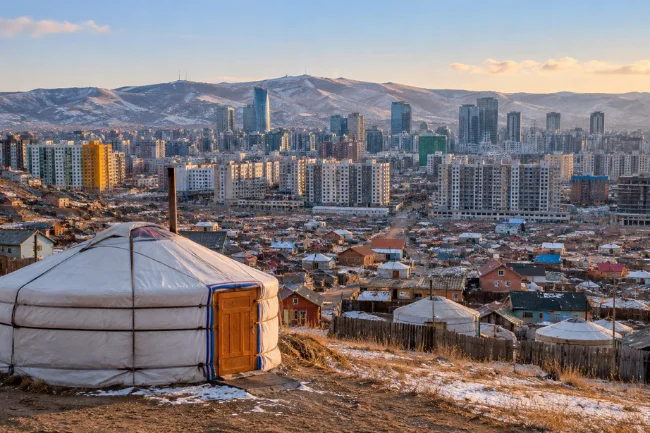
Ulaanbaatar shows why one housing word can cover such different realities. Much of the central urban area contains apartments connected to utility networks. Beyond that core are extensive ger districts, where detached houses and gers occupy lower-density plots and access to services can vary considerably.
The Asian Development Bank has documented the difficulty of extending roads, piped water, sanitation, and heating across these neighborhoods. Its project descriptions also explain how rapid urban growth placed pressure on existing infrastructure. These conditions are not uniform: two homes in the same broad district can have very different service arrangements.
Apartment Buildings and Connected Services
In many established apartment areas, residents can rely on district heating, piped water, electricity, and wastewater networks. That convenience is especially significant during Mongolia’s long, cold winters. Yet a connection on paper does not guarantee a trouble-free experience in a particular building.
I would still ask whether hot water is reliable, whether windows seal properly, and who responds to heating or plumbing problems. An attractive lobby cannot answer those questions. Nor can a photograph show the noise from an adjacent road or the actual winter temperature of a corner apartment.
Ger Districts Are More Than Gers
The name can be misleading to outsiders. A ger district may contain traditional dwellings, brick houses, shops, workshops, and newer construction. Some households enjoy more private outdoor space than apartment residents, but certain plots lack the same networked services found in central buildings.
Winter heating is a particularly consequential difference. Where households depend on solid fuels rather than cleaner, well-managed systems, heating can add cost and contribute to seasonal air pollution. I would avoid calling every ger district identical or treating relocation into an apartment as the only possible improvement. Upgrading services where people already live is another important part of the discussion.
What Is Everyday Apartment Living Like?
An urban apartment can make everyday routines simpler. A resident may have running water, indoor sanitation, predictable building access, and shops or public transport nearby. Families often value the proximity of schools and workplaces, while people living alone may appreciate a compact home with less outdoor upkeep.
The compromises are familiar to apartment residents worldwide: neighboring noise, limited storage, parking pressures, and decisions about shared spaces. In Mongolia, however, cold-weather performance adds another layer to the choice. Window quality, insulation, stairwell condition, and the dependability of heating can matter as much as floor area.
Shared Building Responsibilities
Buying an apartment does not mean you are responsible only for the space behind your front door. Entrances, roofs, lifts, stairwells, and other common property need maintenance. Mongolia has a legal framework governing associations of apartment owners and shared property, so management arrangements deserve attention before a purchase.
I would ask what the recurring building fee covers, whether major repairs are planned, and how complaints are handled. These questions can reveal whether a lower advertised price might come with higher ongoing costs or persistent inconvenience.
How Much Does Oronsuuts Cost in 2026?

There is no single price for housing in Mongolia. City, neighborhood, building age, floor area, utility access, and property condition all matter. Even two apartments with identical layouts can be priced differently because one offers better transport links or a more desirable building.
For a dated reference point, Mongolia’s National Statistics Office figures, reported by the economic and commercial office of China’s embassy in September 2026, put average new-apartment prices in August 2026 at approximately 4.77 million Mongolian tögrög (MNT) per square meter. Existing apartments averaged about 4.78 million MNT per square meter. The reported housing price index was 7.2% higher than a year earlier.
These figures are broad statistical benchmarks, not quotes for a particular home, and should not be used to estimate every district or building. Asking prices and final transaction prices may also differ. For a real search, I would compare several recent listings of similar size and condition within the same neighborhood.
What Changes the Total Housing Budget?
The purchase price or monthly rent is only the first number to check. Heating, electricity, water, management fees, commuting costs, furnishing, and repairs affect what a home actually costs to live in.
| Cost or concern | When renting | When buying |
|---|---|---|
| Upfront payment | Deposit and advance rent, as agreed | Purchase funds, possible financing and transaction costs |
| Monthly outgoings | Rent, utilities, and agreed service charges | Financing payments if applicable, utilities, and building fees |
| Repair responsibility | Clarify duties in the lease | Budget for in-unit repairs and shared-property contributions |
| Documents to verify | Landlord identity, authority to rent, written terms | Registered ownership, possible encumbrances, and transaction documents |
| Flexibility | Usually easier to relocate at the end of a lease | Greater stability but less flexibility to move quickly |
I recommend keeping these categories separate when comparing homes. A cheaper property farther from work may not remain cheaper after daily travel, winter energy use, and unexpected maintenance are included.
Renting or Buying: What Should You Check First?
For renters, the immediate task is to understand what is being offered. Is the apartment furnished? Does the advertised payment cover utilities? How much notice is required before leaving? Are pets or additional occupants allowed? Written answers can prevent disputes later.
Buyers face a different set of risks. Property photographs and attractive marketing descriptions cannot prove legal ownership, an absence of debts or encumbrances, or the condition of building systems. Before paying a substantial sum, verify documents through appropriate official channels and obtain local legal or professional assistance where necessary.
My Five-Point Winter-Ready Housing Check
I use this practical checklist to think beyond the surface appeal of a listing. It is useful even when a property is viewed during warmer months:
- Heating: Ask what supplies the heat, whether it is included in recurring fees, and how residents handle outages or unusually cold days.
- Water and sanitation: Test taps and drainage where possible, and confirm whether the home has dependable hot water and a connected sewer system.
- Building envelope: Inspect window seals, exterior walls, signs of condensation, and visible dampness. These clues can matter more in winter than decorative finishes.
- Access: Consider road conditions, public transport, lighting, and the realistic trip to work or school during snow and heavy traffic.
- Paperwork: Match the address and floor area to the documents, confirm who has authority to transact, and read every payment or maintenance obligation.
A viewing is not a professional structural inspection, and this checklist is not legal advice. It is a way to ask better questions before committing money to a home that looks suitable only in photographs.
Can Green Housing Improve the Future of Oronsuuts?
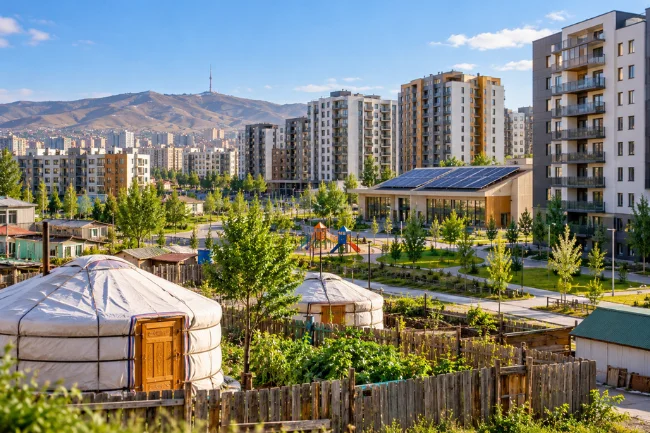
Mongolia’s housing discussion is not limited to building more apartments. It also concerns how homes are heated, how neighborhoods connect to services, and whether new housing remains affordable to existing residents.
One significant initiative is the Ulaanbaatar Green Affordable Housing and Resilient Urban Renewal Sector Project supported by the Asian Development Bank. Its stated targets include delivering 10,000 affordable green housing units and redeveloping 100 hectares of ger areas into eco-districts. These are project goals, not a claim that all units have already been completed.
The proposed approach connects housing with energy efficiency, public facilities, infrastructure, and neighborhood development. That is a useful shift. A well-insulated apartment without affordable access to work, transport, and shops is not necessarily a successful housing solution.
I also think preservation of choice matters. Improving water, sanitation, and cleaner heating for existing neighborhoods can be valuable alongside new construction. The best outcome is not a city where every home looks alike, but one where more people can live safely and comfortably in a home they can afford.
Common Misunderstandings About Oronsuuts
The first misunderstanding is that the word names a particular apartment brand or technology platform. In ordinary Mongolian, it is a housing expression, not a proprietary concept. A website may use it as a name, but that does not change its underlying linguistic meaning.
The second is that only modern multi-story apartments qualify. Everyday real estate usage often emphasizes apartments, yet the country’s housing-law definition is wider and includes gers. A third misconception is that living in a ger district always means living in a ger without any amenities. Actual housing types and service connections differ by plot and neighborhood.
Finally, an apartment labeled “modern” is not automatically energy efficient or well managed. I would look for verifiable construction details, service arrangements, and condition rather than trust the adjective alone.
Conclusion
Oronsuuts is a useful doorway into understanding Mongolia, because the word connects language, homes, urban change, and everyday decisions. It can mean housing broadly while referring to apartments in common city settings. Knowing the difference helps you interpret property listings and compare living conditions more accurately.
If you are researching a particular home, start with the correct Mongolian search terms, compare its winter services and full costs, and verify the listing’s documents before making a commitment. A little context turns an unfamiliar word into genuinely useful information.
Frequently Asked Questions
What does Oronsuuts mean in English?
It means housing, dwelling, or residential accommodation. In many urban property listings, it refers specifically to an apartment.
How is Oronsuuts written in Mongolian?
It is written орон сууц in Mongolian Cyrillic, normally as two separate words: oron suuts.
Is a traditional Mongolian ger considered Oronsuuts?
Yes, in the broad legal meaning of housing. Mongolia’s housing law includes gers alongside residential buildings and other homes.
Is Oronsuuts only used in Ulaanbaatar?
No. It is a Mongolian housing term used beyond the capital, although Ulaanbaatar provides many familiar urban examples.
What should I check before renting an Oronsuuts apartment?
Confirm the landlord’s authority, lease terms, deposit, utility costs, heating reliability, and the property’s condition before paying.

Olivia Parker is a home improvement research writer with 8+ years of experience covering home design, renovation ideas, maintenance tips, and practical living solutions. She creates easy-to-follow content to help readers make informed decisions about improving their homes.