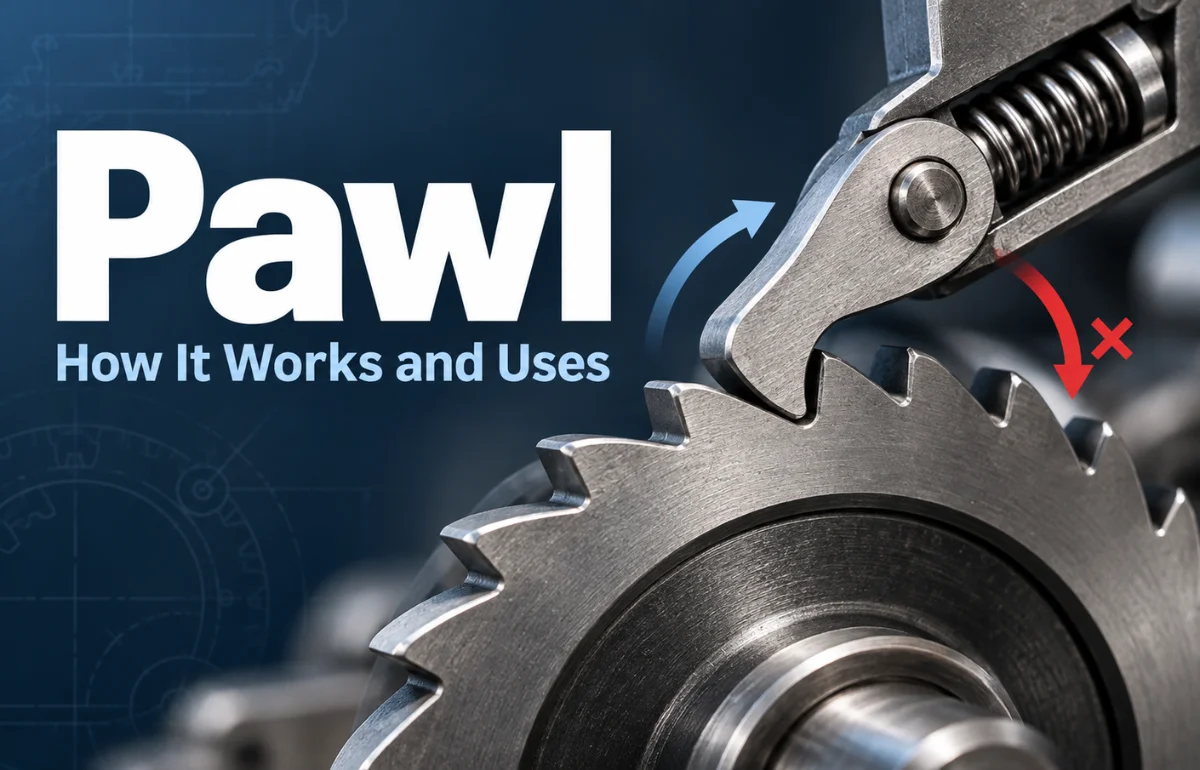
A pawl is a small mechanical catch, usually shaped like a pivoting arm, that engages a toothed wheel or bar to control movement. In a typical ratchet and pawl mechanism, it lets the teeth pass in one direction but catches against them when the motion reverses. This simple action can hold a load, stop unwanted backward rotation, or move machinery forward in small increments.
Pawls appear in ratchet wrenches, winches, lifting equipment, bicycle freehubs, and automatic-transmission parking systems. Although a spring often keeps the catch close to the teeth, the shape and strength of the contacting parts are what make reliable locking possible.
Understanding that distinction explains how a pawl works, why it sometimes fails, and what to check before relying on one.
What Is a Pawl Used For?
The main purpose of a pawl is to make movement selective. Instead of allowing a shaft, wheel, or sliding part to move both ways freely, the mechanism permits movement in a chosen direction or holds a selected position.
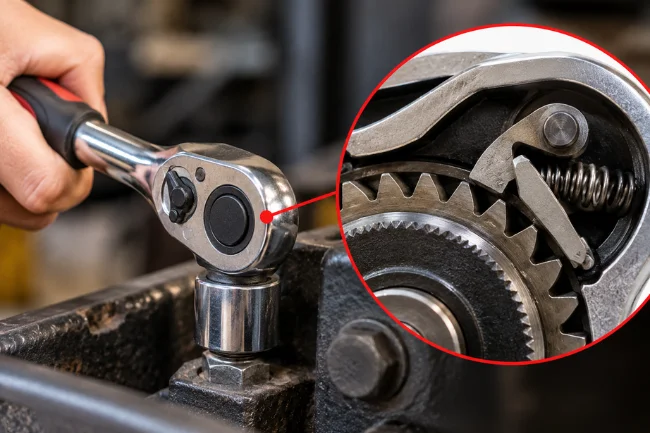
Think about tightening a bolt with a ratcheting socket wrench. The handle can return without undoing the progress made on the previous stroke. Inside the tool, a pawl engages teeth to transmit force during the working stroke and permits relative movement during the return stroke.
In a hoist, a related arrangement helps prevent a raised load from running backward.
I find it helpful to separate three jobs that are often described as one: preventing reverse motion, holding a stationary position, and driving a wheel forward one tooth at a time. They can use similar-looking components, but each job creates different demands on the mechanism.
Main Parts of a Ratchet and Pawl Mechanism
A pawl rarely works alone. Its performance depends on the parts around it and on how forces move between them.
| Component | What it does | Why it matters |
|---|---|---|
| Pawl | Engages a tooth or notch | Transmits driving force or resists reverse movement |
| Ratchet wheel or rack | Provides repeated teeth along a circular or straight path | Determines engagement positions and permitted motion |
| Spring or other bias | Encourages the pawl to return to engagement | Helps prevent missed teeth during normal operation |
| Pivot, pin, or guide | Controls the pawl’s movement | Keeps the tip aligned and carries reaction forces |
| Housing or frame | Supports the assembly | Provides a path for forces to reach the structure |
| Release or selector | Withdraws or repositions the pawl when provided | Allows controlled unlocking or a change of direction |
The ratchet is usually the toothed part, while the pawl is the catch that meets it.
People sometimes call the whole assembly a “ratchet,” which is understandable in everyday conversation but less useful when identifying a fault or ordering a replacement component.
How Does a Pawl Work?
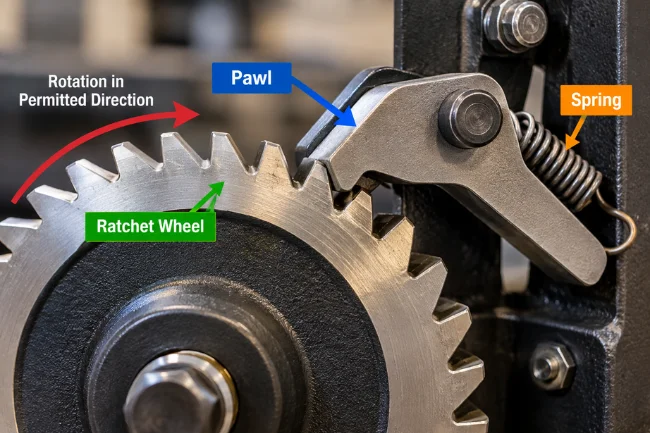
1. The teeth move in the permitted direction
Picture a wheel with uneven, saw-like teeth. Each tooth has a ramped side and a more abrupt locking side.
As the wheel turns in its free direction, the ramp gently pushes the pawl away from the wheel. After the tooth passes, the pawl returns toward the next gap.
That repeated lifting and settling often produces the clicking sound associated with ratchets. The noise is a result of contact, not the mechanism’s primary purpose.
2. Reverse motion brings the catch against a locking face
When the wheel tries to turn back, the steep tooth face meets the pawl tip.
The pawl transfers the resisting force through its body, pivot or support, and housing. If the geometry and components are suitable for the load, backward movement stops after the available clearance is taken up.
The precise permitted direction depends on tooth orientation and pawl placement. A ratchet is not automatically clockwise-only or counterclockwise-only.
3. Some pawls drive rather than merely hold
An advancing or driving pawl can push a ratchet wheel through part of a revolution as a lever moves.
A separate holding pawl may then prevent the wheel from returning while the driving lever resets. Carnegie Mellon University’s mechanism notes describe this two-pawl arrangement and its dependence on tooth geometry.
Common Types of Pawls
Holding or locking pawl
A holding pawl is designed primarily to resist unwanted movement. It may sit against a ratchet wheel as a winch or hoist operates. Its essential job is to catch securely when the driven part attempts to move backward.
For these applications, load capacity and safe release matter far more than a pleasant clicking sound.
Driving or feed pawl
A driving pawl actively advances a wheel or toothed strip. It is common in hand-operated ratchet systems and mechanical feed arrangements.
The pawl must engage quickly, deliver force through a working stroke, and disengage or slide back without reversing the output.
Reversible pawl
A reversible ratchet changes its effective drive direction through a switch, selector, or rearranged pawl position.
This is familiar in socket wrenches. The design must provide positive engagement in the selected direction rather than simply allowing a pawl to float between positions.
Multiple-pawl mechanism
Some assemblies use two or more pawls for different roles or staggered engagement.
The arrangement can reduce the angle before the next tooth catches, and it may improve load distribution when designed for that purpose.
Parking pawl
A parking pawl is a vehicle-specific locking component that engages a parking gear associated with the transmission’s output.
When Park is selected and the mechanism is engaged, it resists drivetrain rotation and helps prevent vehicle movement.
Follow the manufacturer’s parking-brake instructions, especially on slopes. SAE International research highlights parking-pawl durability demands.
Where Are Pawls Used in Everyday Life?
Hand tools and ratchet wrenches
In a ratcheting wrench or screwdriver, the internal mechanism transmits torque in the selected working direction while allowing the handle to move back without rotating the fastener backward.
A selector often reverses that function.
Winches, hoists, and lifting devices
Pawls can act as anti-reverse devices or form part of a load-holding system.
They are especially consequential here because failure may allow dangerous movement. Equipment ratings and approved operating instructions must determine what the mechanism can safely hold.
Bicycle freehubs
In many bicycle freehubs, small pawls engage ratchet teeth when the rider pedals, connecting the driven part to the wheel. During coasting, the mechanism permits relative movement.
Not every bicycle hub uses pawls; some use other clutch or ratchet architectures. Park Tool’s freehub service reference describes a common pawl-and-spring configuration.
Industrial indexing and positioning
A feed mechanism may use a pawl to advance a wheel one increment per stroke.
This is helpful where motion must be repeated in defined steps, although backlash and overtravel must be managed when accurate positioning is required.
Straps, reels, and adjustment devices
Ratchet strap tensioners, some fishing reels, and adjustable latching products use pawl-like catches for one-way control or position retention.
Their designs differ, so similar clicking sounds should never be treated as evidence of identical strength or function.
Pawl vs. Ratchet vs. Other Locking Mechanisms
These terms are sometimes used interchangeably, but they refer to different ways of controlling movement.
| Mechanism | How it controls motion | Typical strength or limitation |
|---|---|---|
| Pawl | A catch engages teeth or notches | Provides discrete engagement; depends on strong contact geometry |
| Ratchet assembly | Combines toothed element and engaging mechanism | Permits one-way or intermittent motion with some engagement clearance |
| Detent | A ball, pin, or catch settles into a recess | Often locates positions rather than providing heavy-duty locking |
| One-way clutch | Uses wedging or other clutch action to transmit torque in one direction | Can engage without pronounced tooth-by-tooth clicking, depending on design |
| Friction brake | Uses friction to resist relative movement | Can hold or slow movement but depends on available friction and braking capacity |
I use one practical question to distinguish them: is the device meant to locate a position, transmit force, stop reverse motion, or slow something down?
A pawl can serve several of those purposes, but it should not be assumed to perform all of them equally well.
What Makes a Pawl Strong and Reliable?
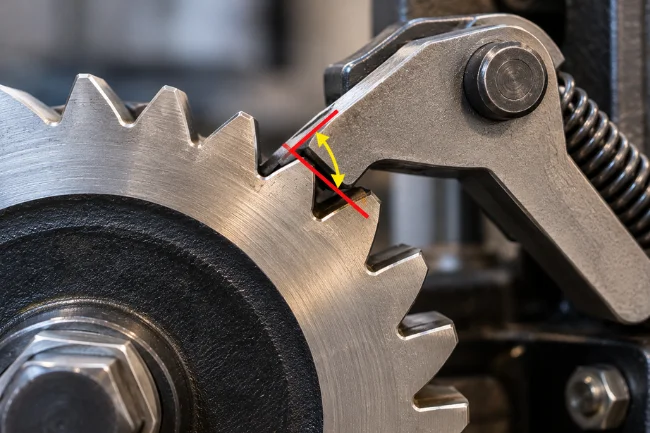
Tooth shape and contact angle
The angle between the pawl and the locking tooth determines whether load tends to keep the parts engaged or push them apart.
A stronger spring cannot reliably correct a locking geometry that forces the pawl to climb out under load.
Material, hardness, and wear resistance
Industrial pawls often use steel because the tip must resist repeated contact and the body must withstand force.
Surface hardening can improve tooth durability, but the entire component still needs appropriate toughness and manufacturing quality.
For example, KHK’s published ratchet-pawl specifications include induction-hardened steel parts. That is a product-specific illustration, not a universal material requirement. Other applications may use different materials.
Tooth count, clearance, and backlash
Tooth spacing affects how far a wheel may move before a pawl meets the next locking face.
For an evenly spaced circular ratchet with N teeth, the nominal angular tooth pitch is 360° divided by N.
A 24-tooth wheel has a 15° tooth pitch; a 36-tooth wheel has a 10° pitch.
A finer pitch can reduce the interval between available engagement points, but actual lost motion also depends on pawl position, clearance, and geometry. Making teeth smaller without considering strength may create a different problem.
Spring force and engagement speed
The spring normally helps the pawl follow the teeth and return to engagement.
Too little bias may cause missed engagement at speed; excessive force can increase friction, noise, and wear.
The spring is generally not intended to serve as the primary structural element resisting a locked load.
Shock loading and support strength
A pawl that survives a steady load may suffer damage when a moving wheel strikes it suddenly.
The tip, tooth root, pin, mounting bracket, and surrounding frame all deserve attention. Even a perfectly shaped pawl cannot protect a mechanism supported by a cracked bracket.
Common Pawl Problems and What They Suggest
When a ratchet begins to skip or feel inconsistent, the most visible part is not necessarily the part that caused the trouble.
I prefer to look at the behavior first and then inspect the full mechanism rather than immediately replacing the pawl.
| Symptom | Possible cause | Sensible next action |
|---|---|---|
| Pawl skips under load | Rounded teeth, damaged tip, poor alignment, or overload | Stop using it; inspect and repair to manufacturer requirements |
| Engagement is delayed | Weak spring, debris, sticky pivot, or excessive clearance | Inspect the return action and condition of mating parts |
| Clicking becomes rough or irregular | Wear, contamination, damaged teeth, or inadequate lubrication | Check the specified cleaning and lubrication procedure |
| Release lever becomes difficult to move | Load pressing on the tooth, binding, or damaged linkage | Do not force it; make the equipment safe before servicing |
| Mechanism suddenly becomes unusually quiet | Pawl may not be engaging, or the design may simply be quieter | Confirm operation using the manufacturer’s approved checks |
Noise alone cannot diagnose a fault. Dependable assessment combines condition, movement, and manufacturer criteria.
How to Inspect and Maintain a Pawl
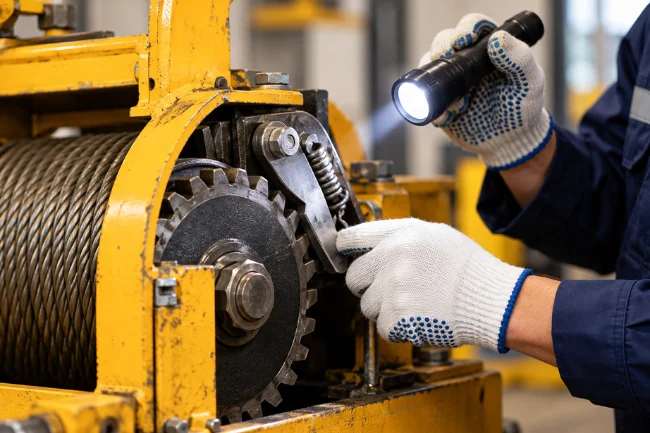
Start with a safe, unloaded mechanism
Before inspection, isolate the equipment from unexpected movement and remove or independently secure any applied load according to the manufacturer’s procedure.
Never lift a holding pawl away from a loaded ratchet just to see whether it releases.
On lifting equipment, this is a safety-critical issue rather than a routine adjustment. The US Occupational Safety and Health Administration specifically identifies ratchets and pawls among the parts requiring attention for wear and distortion in applicable pull-lift inspections.
Examine engagement surfaces
Look for chipped, cracked, rounded, or unevenly worn teeth and pawl tips.
Check whether the pawl seats properly, without hanging at the edge of a tooth. Also examine the pivot, spring, guides, fasteners, and housing for looseness, corrosion, or damage.
Clean and lubricate as specified
Dirt can keep a pawl from seating, while unsuitable grease may interfere with small spring-loaded parts.
Check the manual before lubricating. Some assemblies need specific lubricants; others are not meant to be dismantled.
Verify the action without improvising a load test
Use the manufacturer’s approved functional check to confirm free movement in the intended direction and dependable engagement in the locking direction.
Do not use body weight, a suspended load, or an improvised torque test to prove that a repaired pawl is safe.
If damage or unreliable engagement is found, remove the equipment from service until it has been evaluated and repaired appropriately.
How to Choose the Right Pawl for an Application
The right design depends on more than matching the visible tooth shape.
I would start with the intended job: holding a static load, resisting backdrive, transmitting intermittent motion, or providing reversible hand-tool operation.
Then consider force, shock, speed, tooth pitch, allowable backlash, direction, available space, and environmental conditions.
Replacement selection also requires matching dimensions, pivot arrangement, tooth profile, material specifications, and the original equipment manufacturer’s instructions.
A pawl that fits into the housing but contacts the tooth at the wrong angle is not an equivalent part.
One easily missed point is that pawls sold for reverse-motion prevention are not always intended to drive or index a wheel.
KHK, for instance, states that certain catalog pawls are for preventing reverse rotation rather than feeding or indexing. The specific duty matters as much as the basic shape.
Frequently Asked Questions About Pawls
What is a pawl in simple terms?
A pawl is a mechanical catch that engages teeth or notches to stop movement, hold a position, or help move a mechanism in controlled increments.
What is the difference between a pawl and a ratchet?
The pawl is the engaging catch; the ratchet usually refers to the toothed wheel or the complete one-way movement assembly.
Why does a ratchet pawl make a clicking noise?
The click commonly occurs as the pawl moves over a tooth and settles into the next gap during permitted movement.
Can a pawl stop movement in both directions?
A conventional one-way pawl normally blocks one direction. Other designs can use selectors, additional catches, or locking arrangements to control both directions.
What causes a pawl to slip?
Common causes include worn teeth, a damaged pawl tip, misalignment, poor engagement, excess loading, or a problem with the pivot or spring.
Final Thoughts
A pawl is a small component with an outsized responsibility: it decides when movement is allowed and when it must stop.
The most reliable designs combine suitable tooth geometry, sound support, controlled engagement, and regular inspection.
If you are selecting or troubleshooting one, begin with its specific function and operating load, then consult the equipment manufacturer’s specifications before making a repair or replacement decision.

Noah Sterling is a technology research writer with 8+ years of experience covering emerging technologies, software trends, digital tools, and innovation. He creates practical, research-based articles to help readers understand the evolving technology landscape.