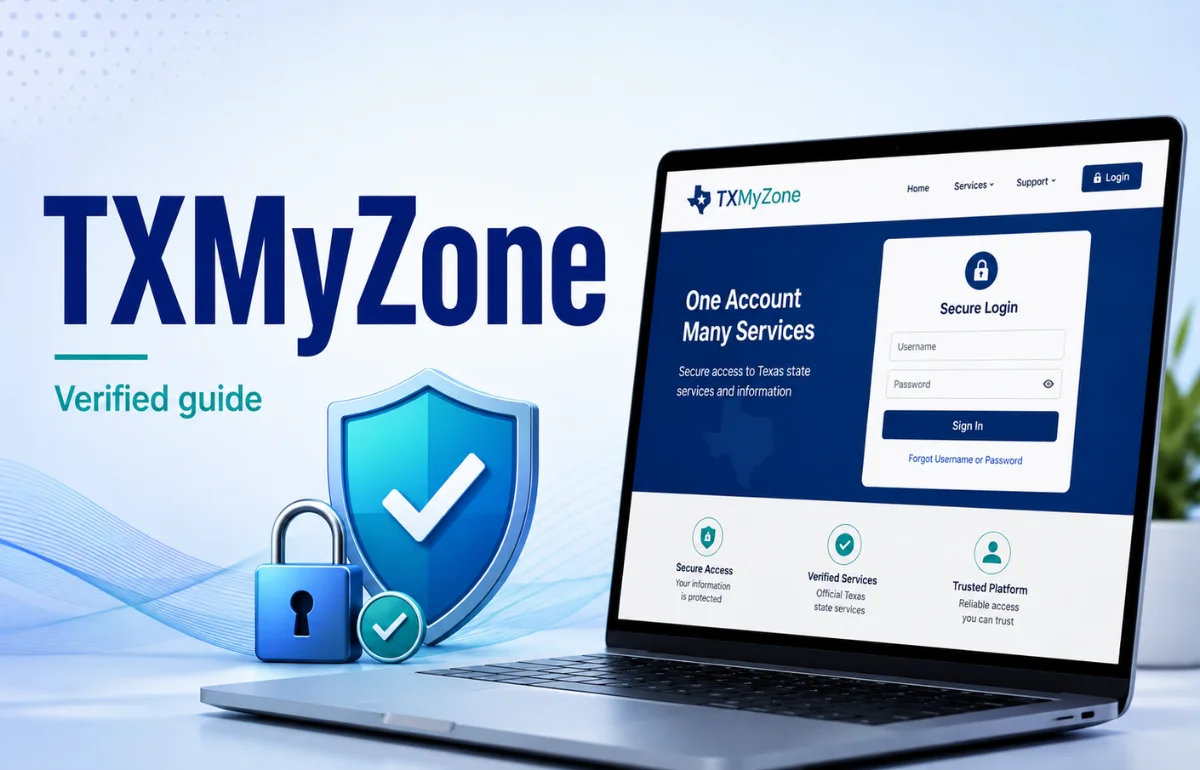
TXMyZone is best understood as a content website that publishes guides across education, technology, business, health, travel, and lifestyle. The site calls itself a “resource blog,” with a stated interest in course management, graduation planning, school schedules, students, and parents. Yet unrelated articles also describe TXMyZone as a student portal, social network, productivity system, or transaction platform.
Based on my review, those product descriptions should not be treated as confirmed features. First identify the exact website or service being referenced, then verify its official access point before creating an account or sharing information.
What Is TXMyZone?
At the time of my review, the clearest first-party description comes from txmyzone.com itself. Its homepage and About section call TXMyZone a resource blog.
The site says it helps readers with subjects such as course management, graduation plans, and schedule selections, although its current content also covers food, skincare, fashion, travel, technology, health, business, and other general-interest categories.
The public TXMyZone pages I reviewed function primarily like editorial pages: they display articles, categories, an author name, search tools, contact information, and website policies.
That differs from a conventional student system built around an identified institution, secure login, account recovery, role-based access, and student-record documentation.
The confusion comes from articles using the name for different ideas. One TXMyZone page calls it a student portal with grades, schedules, dashboards, quizzes, and teacher communication.
A competitor article describes a local social network for neighbors, events, volunteers, and business contacts. The reviewed pages do not support either description with a working demonstration, named institution, public portal, or linked documentation.
Why Are There So Many Different Definitions?
The term has several online definitions but no consistently documented product identity. Later articles may repeat earlier descriptions without tracing them to a primary source.
I noticed four recurring descriptions during my research:
| Online description | Typical claims | What I could verify |
|---|---|---|
| Resource blog | Articles about education and broad consumer topics | The official website directly describes itself as a resource blog |
| Student portal | Grades, schedules, assignments, dashboards, and teacher communication | These features are described in an article, but I found no public demonstration on the reviewed pages |
| Community network | Local groups, profiles, messaging, meetups, and friendships | A third-party article makes these claims without linking to a functioning platform |
| Productivity or transaction tool | Personalization, integrations, workflows, tracking, or payments | These descriptions vary across third-party websites and should not be assumed to refer to one verified service |
The practical lesson is simple: TXMyZone may refer to the website, an article concept, or a private system that is not publicly documented.
The name alone is not enough to identify what a user is being asked to access.
What Content Can You Find on the TXMyZone Website?
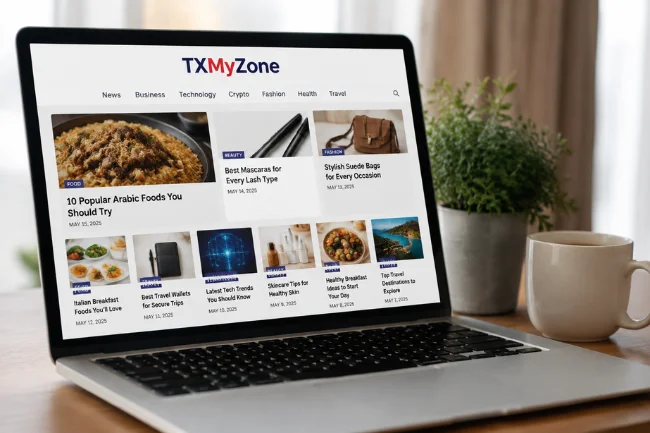
The website’s navigation includes News, Business, Technology, Crypto, Fashion, Health, and Travel.
Its recent posts extend beyond education into Arabic food, mascara, suede bags, Italian breakfast foods, travel wallets, technology, skincare, breakfast ideas, and travel destinations.
Education and Academic Planning
Education is part of the site’s stated identity. Readers may encounter content discussing student portals, schedules, grades, study resources, graduation plans, academic organization, and communication between students and teachers.
I would treat these pages as general informational content unless a school or education provider confirms that the instructions apply to its own system.
Academic platforms are usually configured differently by each institution, so a general article cannot replace instructions from a registrar, counselor, teacher, or school technology department.
Technology and Digital Tools
TXMyZone also publishes technology-focused material. Some pages discuss broad digital concepts, integrated systems, communication tools, online learning, and productivity.
This content may help a reader understand general ideas, but product-specific claims need stronger evidence.
Before relying on a claim about dashboards, artificial intelligence, security, real-time tracking, integrations, or personalized recommendations, I look for an official feature page, interface screenshot, dated release note, or support document.
General Consumer and Lifestyle Content
The site also covers food, travel, skincare, fashion, and health. That editorial mix suggests TXMyZone operates more like a multi-topic publication than a narrowly focused education platform.
Readers should therefore evaluate each article on its own sourcing and expertise.
Is TXMyZone a Student Portal?
The most accurate answer is that the public website contains an article describing TXMyZone as a student portal, but the site itself also identifies as a resource blog.
Those are not the same thing.
The student-portal article claims that users can view schedules and grades, receive assignment updates, communicate with teachers, use digital textbooks and quizzes, access personalized dashboards, and follow individual study plans. It presents these capabilities as established features.
During my review, I did not see those claims connected to a named school district, software company, product documentation center, or visible portal entry point on the main pages.
For that reason, I would describe the features as claims made by the article, not as independently verified functionality.
| Question | Public TXMyZone website | Typical verified school portal |
|---|---|---|
| Main public purpose | Publishing articles and guides | Managing institution-specific academic records |
| Visible institution | Not clearly identified on the reviewed pages | A school, district, college, or education provider |
| Login and account recovery | Not prominently presented in the reviewed navigation | Usually central to the service |
| Student records | Discussed in editorial content | Connected to authorized databases |
| Support | General contact email | Institution or software support team |
| Privacy context | General website privacy policy | Detailed student-data and institutional policies |
If your school gave you the term TXMyZone, use the exact link in the school’s official email, handbook, or website.
Do not choose a search result merely because its title says “student portal.”
Is TXMyZone a Social Networking Platform?
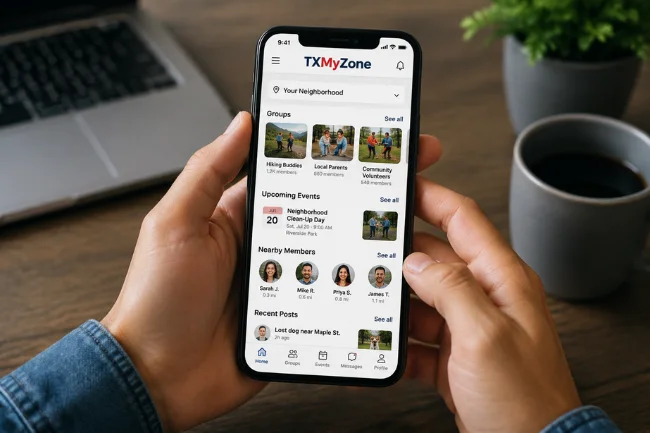
A July 2026 article on another website describes TXMyZone as a community-focused social network.
It says users can create profiles, share interests, join neighborhood discussions, use geolocation, find groups, organize events, message members, and make local connections. The article also presents stories about users finding friends, collaborators, hiking groups, volunteer opportunities, and romantic partners.
The article provides no linked product page, interface screenshots, direct user quotations, full case studies, or transparent testimonial method.
It also mentions AI personalization and expansion without attributing those plans to a company announcement. I would therefore avoid presenting TXMyZone as a confirmed social app unless stronger first-party evidence appears.
This distinction does not prove that a private, early-stage, or invitation-only service cannot exist. It means the available public evidence does not currently support a confident description of TXMyZone as an established community platform.
How to Verify the Right TXMyZone Before Using It
When a name produces conflicting search results, the safest approach is to verify the entity rather than guess from an article headline.
Check Who Sent You the Link
A school portal should come through an official school domain, student handbook, learning-management page, or staff communication.
A workplace tool should be introduced by an administrator. A consumer app should have a consistent publisher identity across its website, app listing, privacy policy, and support pages.
An unexpected message asking you to sign in deserves extra caution, especially when the sender does not explain why access is required.
Confirm the Destination Address
Look closely at the complete domain before signing in. Similar names, extra words, unusual subdomains, and minor spelling changes can lead to unrelated websites.
I also check whether the page uses HTTPS, but I do not treat the padlock as proof that the service itself is trustworthy.
Encryption can protect information while it travels between your browser and a website. It does not confirm that the operator’s descriptions, ownership claims, or services are genuine.
Look for Accountable Ownership
A credible platform should explain who runs it, what organization is responsible, how customer support works, and which terms govern the account.
The TXMyZone contact page provides a general email for content questions, collaborations, and advertising, while the site’s About description remains brief.
For a blog, that may be enough for ordinary editorial contact.
For software handling grades, payments, identity documents, private messages, or location data, I would expect considerably more operational detail, including company information, support procedures, user agreements, and data-handling disclosures.
Read the Privacy Policy in Context
The TXMyZone privacy policy discusses website data such as names, email addresses, IP addresses, browser details, pages visited, cookies, analytics, advertising, and possible affiliate links.
It also mentions account registration and transactions only where applicable.
That wording fits a general website policy more closely than a detailed policy for a student-record or location-based social system.
Those services would need more specific explanations of educational records, location permissions, profile visibility, authorized access, moderation, reporting, data retention, and account controls.
Verify Features Before Sharing Sensitive Information
Do not upload academic records, identification, payment details, private documents, or precise location information simply because an article describes useful features.
First confirm that the service is the one intended by your school, employer, financial provider, or another trusted organization.
You should also check whether there is a clear method for changing your password, recovering your account, downloading your information, contacting support, and deleting your profile.
What Makes TXMyZone Useful?
As a publication, TXMyZone can help readers discover introductory articles across several categories.
Its education-oriented branding may also attract students and parents researching course planning, schedules, digital learning, and academic organization.
I see it as a starting point rather than a final authority. General overviews may be useful for low-risk topics, while claims involving education records, privacy, finance, health, or account security should be checked against primary sources.
The value of any TXMyZone article ultimately depends on its evidence. A clearly sourced guide with identifiable authorship can be useful, regardless of whether the website covers one subject or many.
A page that makes specific software, medical, financial, or security claims without supporting documentation requires more cautious reading.
What TXMyZone Could Improve
The site could build greater trust by publishing a fuller About page with named editorial leadership, author biographies, subject credentials, sourcing standards, correction procedures, and a clear explanation of whether TXMyZone is solely a publication or connected to a software product.
Product-style articles would also benefit from:
- Original interface screenshots
- Tested workflows
- Current access instructions
- Dates showing when a feature was tested
- Named primary sources
- Links to official documentation
- Disclosure of commercial relationships
Claims about “real users” should include direct quotations, interview methods, anonymization notes, and enough context to understand what the user actually did.
A case study about a student, business owner, or community member becomes much more useful when it explains the person’s starting problem, the feature used, the time involved, and the measurable outcome.
Most importantly, TXMyZone should use consistent language.
Calling the brand a resource blog in one place and an operational student platform in another creates avoidable uncertainty. A clear entity definition would help readers understand the website and give search engines and AI systems a more reliable description to reference.
How to Evaluate a TXMyZone Article
When I evaluate a page on an unfamiliar website, I begin with the claims that could affect a reader’s money, privacy, safety, or decisions.
I ask whether the article identifies its sources, distinguishes confirmed information from predictions, and provides enough detail for the reader to verify important statements.
For a TXMyZone article, consider these questions:
- Does the page link to the official organization or service it discusses?
- Is the author identified beyond a first name?
- Are product features shown or only described?
- Are testimonials traceable to interviews or public reviews?
- Does the article disclose affiliate or advertising relationships?
- Is there a publication or update date?
- Are limitations and risks discussed alongside benefits?
- Can important statements be confirmed through primary sources?
An article does not need to answer every question to be useful. However, the more specific its claims become, the more evidence it should provide.
A Practical View of TXMyZone
After reviewing the available first-party and third-party pages, my view is that TXMyZone should currently be approached as a multi-topic information website with an education-oriented brand history.
Claims that it is a functioning student portal, local social network, transaction system, or personalized productivity platform remain insufficiently documented in the public pages I found.
That distinction protects readers from two common mistakes: expecting software features from an editorial website and trusting an unfamiliar signup page because its name resembles a popular search term.
Use TXMyZone for reading and discovery, but verify any account, portal, application, or service through the organization that asked you to use it.
A few minutes of verification is far easier than recovering a compromised account or correcting information sent to the wrong platform.
Frequently Asked Questions
What is TXMyZone?
TXMyZone is presented by its own website as a resource blog covering education and several general-interest topics.
Is TXMyZone a real student portal?
An article describes it as a student portal, but the reviewed public pages do not clearly establish a working institution-linked portal or verified software service.
Is TXMyZone a social media app?
A third-party article calls it a local social network, but that description lacks clear first-party product documentation and should be treated as unverified.
Is TXMyZone safe to use?
Reading the public website carries normal browsing considerations; verify ownership and policies before entering personal, academic, financial, or location data.
How do I find the correct TXMyZone login?
Use the exact link supplied by your school, employer, or service administrator rather than selecting an unverified search result.

Noah Sterling is a technology research writer with 8+ years of experience covering emerging technologies, software trends, digital tools, and innovation. He creates practical, research-based articles to help readers understand the evolving technology landscape.