Oncepik is an online name currently associated with several different ideas, including a visual productivity workspace, a content-planning platform, a design tool, a technology publication, and a photography website. The simplest factual answer is that Oncepik does not yet have one clearly verified public identity across the web. Many third-party articles describe it as software for organizing tasks, content, teams, and creative projects, but the exact-match Oncepik.com domain is listed for sale, and other active domains using similar names publish unrelated material.
When I researched Oncepik, I expected to find a normal software trail: an official homepage, pricing page, documentation, named company, app-store listing, and active support channels. I could not confirm that full trail.
That does not automatically mean the name is illegitimate, but it does mean readers should separate repeated online descriptions from independently verified product facts.
Why Is Oncepik Appearing in So Many Searches?
Oncepik has become a curious search term because many websites describe it with confidence, yet they do not all describe the same thing.
One article calls Oncepik an online design tool for creating visuals. Another presents it as a visual project-management system for creative teams. Other pages describe AI automation, blogging tools, content curation, team productivity, media management, or a technology-news platform.
That inconsistency matters. A real platform can serve several purposes, but its core identity should still be easy to confirm. Users should be able to answer basic questions such as who operates it, where they can register, what the product costs, and which features are available today.
In Oncepik’s case, much of the visible search content appears to repeat a broad concept rather than point readers to a single, verifiable service.
What Is Oncepik Supposed to Do?
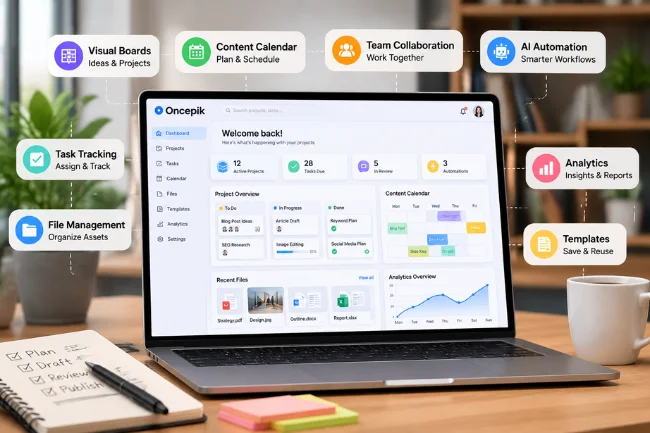
Across the pages I reviewed, the most common description is a visual-first digital workspace. In that version, Oncepik is said to combine project organization, content planning, file management, collaboration, and automation in one browser-based environment.
The proposed value is easy to understand. Instead of switching between a task board, notes app, shared drive, content calendar, and team chat, a user would manage related work inside one connected workspace.
Commonly mentioned capabilities include:
- Visual boards for ideas and projects
- Task assignment and progress tracking
- Content calendars and publishing workflows
- Shared files and media assets
- Team comments and real-time collaboration
- Templates for repeatable work
- AI-assisted content or workflow automation
- Analytics, reporting, or performance monitoring
The problem is not that these features are unrealistic. Plenty of modern software products offer them. The problem is that the claims are not consistently tied to official product documentation, live demonstrations, or a confirmed account portal.
Oncepik Claims Versus What Can Be Verified
The following table separates the recurring online narrative from the evidence I could locate.
| Area | What third-party articles commonly claim | What I could verify |
|---|---|---|
| Product type | Visual workspace, design tool, productivity app, or content platform | No single, consistently documented product identity |
| Official website | Often implied without a clear destination | Oncepik.com is currently presented as a domain for sale |
| Main users | Bloggers, creators, freelancers, agencies, students, and teams | These audiences are described by publishers, not confirmed through official product material |
| Features | Boards, automation, SEO, analytics, collaboration, templates, and media tools | Feature descriptions vary substantially between articles |
| Pricing | Free, team, pro, or business tiers are sometimes mentioned | I could not locate a verified official pricing page |
| Mobile access | Some pages imply browser or mobile availability | I could not locate a confirmed Apple App Store or Google Play listing |
| Company details | Usually omitted | I could not confirm a clearly identified operator, headquarters, or leadership team |
| Support | Tutorials, forums, documentation, and customer support are mentioned | I could not locate a verified official help center |
This distinction is essential for anyone writing about Oncepik. Repetition across several blogs does not turn a claim into a confirmed fact.
Is Oncepik a Productivity Platform, a News Site, or a Photography Brand?
At present, the name points to more than one web identity.
Oncepik.net describes itself as a technology-news platform covering areas such as artificial intelligence, software, cybersecurity, digital culture, and cryptocurrency. Oncepiks.com, with an added “s,” primarily publishes photography lessons and editing content, although it also hosts an article describing Oncepik as an AI workflow platform.
Meanwhile, numerous independent websites use the singular Oncepik name for a supposed creative-work or productivity product.
Some say it is similar to a project board. Others describe a Canva-like design tool. A few expand it into AI content generation, three-dimensional media, publishing, SEO, or automation.
I would not merge all these descriptions into one definitive product profile. The safer interpretation is that “Oncepik” is an ambiguous brand term whose meaning depends on the page a reader encounters.
Why Verification Matters Before You Sign Up
New software products often launch quietly. A limited public footprint is not unusual, especially during beta testing. Still, a trustworthy platform should provide enough information for users to make an informed decision.
Before uploading content, client files, brand assets, or payment details, I look for several basic signals.
A Clear Legal and Business Identity
The website should identify the company or individual operating the service. A privacy policy, terms of service, business address, and support email should use consistent names.
A domain hidden behind privacy protection is not automatically suspicious, but the service itself should still explain who is responsible for user data.
Product Documentation
Good documentation confirms what the software actually does. It should explain account setup, supported file types, integrations, plan limits, export options, permissions, and cancellation procedures.
Without documentation, it is difficult to distinguish a real feature from promotional wording copied across third-party articles.
Transparent Pricing
A pricing page should state what is free, what requires payment, and what happens when a trial ends. It should also explain storage limits, user limits, refund rules, taxes, and renewal terms.
Several Oncepik articles mention free or paid tiers, but the plan names and details are not consistently supported by an official source. One review, for example, describes free, team, and business plans while providing no direct verification from the product owner.
A Working Product Trail
A credible software trail usually includes some combination of:
- A secure registration page
- Product screenshots or a live demonstration
- Release notes
- Help documentation
- An app-store or verified browser-extension listing
- Active company social profiles
- Named founders or employees
- Customer support with a real domain
- Independent user discussions
I did not find enough of these elements to present Oncepik as a fully verified, publicly available SaaS product.
How Oncepik Compares With a Verifiable Software Purchase
Rather than comparing unconfirmed features with individual brands, I find it more useful to compare the quality of the buying information.
| Evaluation point | What a buyer should expect from established software | Current Oncepik search experience |
|---|---|---|
| Product definition | One clear explanation across the homepage, documentation, and listings | Multiple conflicting definitions |
| Feature evidence | Screenshots, demos, documentation, and release notes | Mostly descriptive third-party articles |
| Pricing | Public plans or a clearly explained sales process | Unverified or inconsistent plan references |
| Ownership | Named legal entity and contact information | Operator is difficult to identify |
| Security | Privacy, data retention, permissions, and compliance details | Little verifiable information |
| User proof | Reviews, case studies, community discussion, or customer references | Repeated editorial claims with limited first-hand evidence |
| Exit options | Export, cancellation, deletion, and refund information | Not clearly documented |
This does not prove that every Oncepik-related project is unsafe. It shows that a cautious reader currently lacks the normal information required to judge the product responsibly.
Could Oncepik Still Become a Useful Platform?
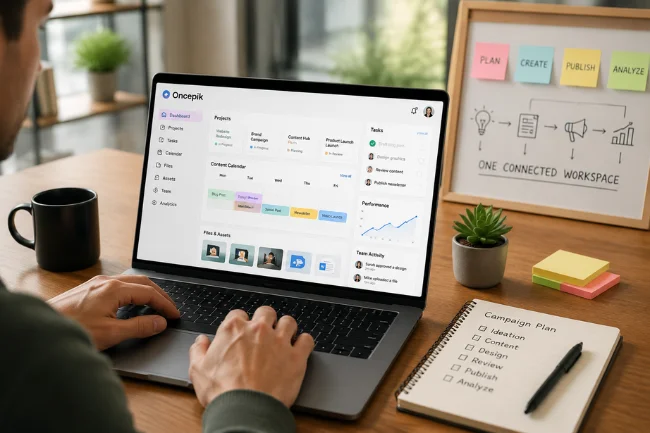
Yes. The core idea attributed to Oncepik is commercially sensible.
Creators and small teams often struggle with tool sprawl. A campaign may begin in a notes app, move to a project board, collect files in cloud storage, pass through a design tool, and end in a social scheduler. Every handoff adds friction.
A visual workspace that genuinely combines planning, assets, approvals, publishing tasks, and performance feedback could be useful.
It would be especially attractive to solo creators, bloggers, small agencies, and remote teams that do not need heavy enterprise software.
For that promise to become credible, Oncepik would need to make its identity and product evidence much clearer.
What I Would Want to See From an Official Launch
First, I would want a precise product statement. “A platform for creativity and productivity” is too broad. The homepage should explain the primary job the product performs and the audience it serves.
Second, I would want a public feature map. Users should know whether Oncepik is mainly a project manager, content system, design editor, AI assistant, digital asset manager, or publishing tool.
Third, I would want transparent limitations. New software does not need to do everything. In fact, a focused product with honest boundaries is more believable than a tool that claims to replace five unrelated platforms.
Finally, I would want proof: interface screenshots, a demo workspace, pricing, security information, integrations, customer examples, and an export policy.
How to Research Oncepik Without Getting Misled
When a search term produces many similar articles, I use a simple verification process.
Start with the exact domain and identify whether it contains an active product. Then check the website footer for the operating company, legal pages, contact details, and copyright name.
Next, look for documentation outside the marketing page. Search for a help center, status page, release notes, developer documentation, app listing, or public changelog.
Then compare feature claims across sources. If one page calls the service a design editor and another calls it a project-management platform, do not assume both are correct. Trace each statement back to its source.
Finally, avoid entering sensitive information until the service’s identity, data practices, and support process are clear.
A disposable email can reduce exposure during an early test, but it does not solve privacy or file-security concerns.
Who Should Pay Attention to Oncepik?
Oncepik is worth monitoring if you are interested in creative productivity software, visual collaboration, content operations, or emerging digital tools.
It may also be relevant to domain researchers and SEO professionals because the keyword demonstrates how an unclear entity can develop a large volume of search content before a stable, authoritative source becomes dominant.
For ordinary users, however, curiosity should come before commitment. Read the available material, but do not treat every feature list as confirmed product documentation.
Frequently Asked Questions
What is Oncepik?
Oncepik is an ambiguous online name associated with productivity software, content workflows, technology publishing, and photography content; no single identity is consistently verified.
Is Oncepik a real app?
Several websites describe a Oncepik app or platform, but I could not confirm an official app-store listing or a complete public software trail.
Is Oncepik free to use?
Some third-party articles mention free and paid plans, but I could not locate a verified official pricing page confirming current costs or limits.
Is Oncepik safe?
There is not enough consistent information about ownership, privacy, security, and data handling to make a confident safety judgment.
Where Is the Official Oncepik Website?
The exact-match Oncepik.com domain is currently listed for sale, while similarly named domains appear to represent separate websites or content brands.
Final Takeaway
Oncepik is best understood as an emerging but poorly defined online term, not as a fully verified product with a settled feature set.
The web repeatedly describes a visual productivity and collaboration platform, yet the available evidence does not establish one official service, company, pricing model, or product portal.
My next step would be simple: wait for an identifiable operator to publish an official website, working demo, legal documentation, pricing, and support information. Until then, treat Oncepik as a topic to research carefully rather than a platform to trust on the strength of repeated blog claims alone.

Noah Sterling is a technology research writer with 8+ years of experience covering emerging technologies, software trends, digital tools, and innovation. He creates practical, research-based articles to help readers understand the evolving technology landscape.