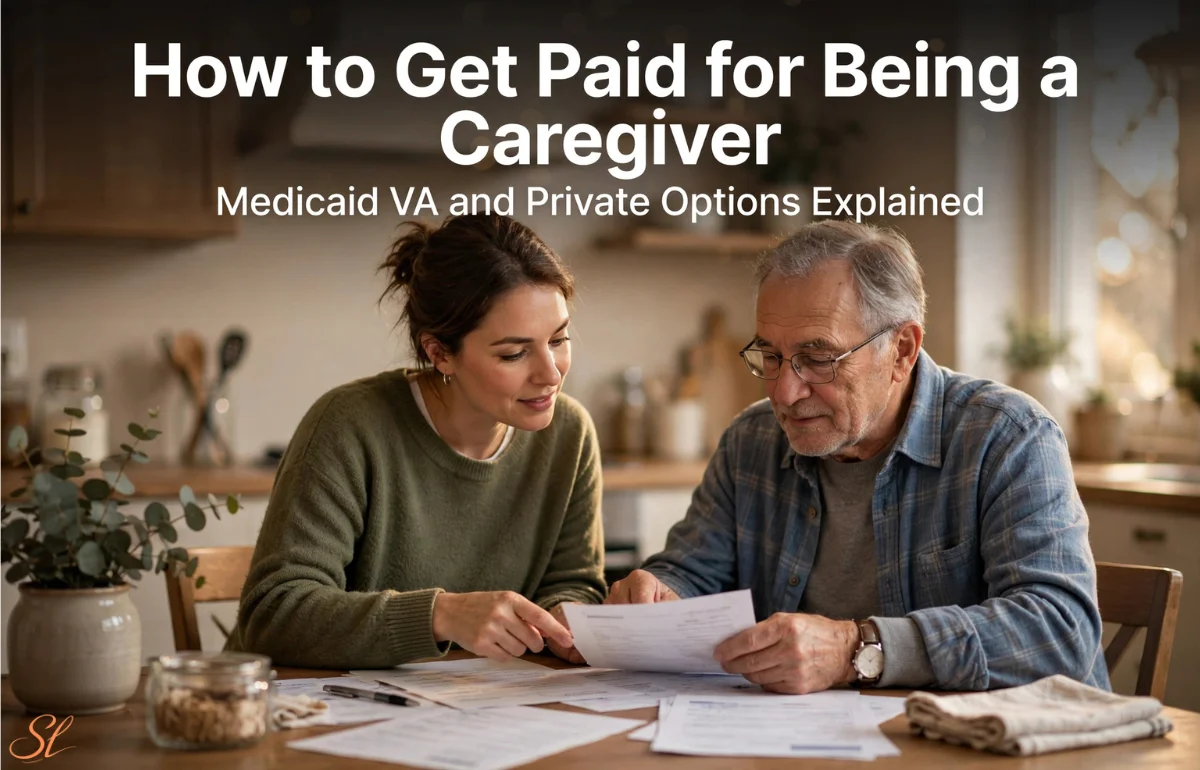
If you’re wondering how to get paid for being a caregiver, the short answer is that payment usually comes through a government program, a veteran benefit, a long-term care policy, or a formal private caregiving arrangement. In the U.S., one of the main routes is Medicaid self-directed care, which may allow an eligible person to choose and pay a family member or another trusted caregiver for approved services. Veterans may have additional options through VA caregiver programs. In other situations, a family can pay a caregiver from the care recipient’s own income or assets under a written agreement. I recommend starting with the care recipient’s Medicaid status, veteran status, insurance coverage, care needs, and state of residence—not with a generic caregiver job application.
What Does “Getting Paid as a Caregiver” Actually Mean?
Caregiver payment is not one single benefit. Depending on the program, you might receive hourly wages for approved care, a monthly caregiver stipend, reimbursement for certain costs, or temporary wage replacement while taking leave from another job.
A Medicaid program may treat you as a worker who records approved hours, while the VA caregiver program may pay an eligible Primary Family Caregiver a monthly stipend. Paid family leave is different: it can replace some wages while you provide care without necessarily making you an ongoing paid caregiver.
| Payment route | Who provides the money? | Can a family member be paid? | Typical payment |
|---|---|---|---|
| Medicaid self-directed services | State Medicaid program | Often, subject to state rules | Hourly wages |
| VA PCAFC | Department of Veterans Affairs | Yes, for an approved Primary Family Caregiver | Monthly stipend |
| Veteran-Directed Care | VA-funded program | Family members may be hired | Payments from an approved care budget |
| Private caregiver agreement | Care recipient or family | Yes | Hourly, weekly, or agreed compensation |
| Long-term care insurance | Insurance policy | Depends on policy terms | Benefits or reimbursement |
| Paid family leave | State program or employer | Provides income while you care for family | Temporary wage replacement |
1. Check Medicaid Self-Directed Care First

For many families, Medicaid is the first place I would check when researching how to get paid for being a caregiver.
CMS allows states to provide self-directed home and community-based services. Under self-direction, eligible participants may have authority to recruit, hire, train, and supervise the workers who provide their approved services. States can offer self-direction through several Medicaid authorities, including sections 1915(c), 1915(i), 1915(j), and 1915(k).
Because Medicaid is administered by states, the rules for adult children, spouses, guardians, parents, and live-in caregivers can differ.
If you want to get paid to care for an elderly parent or a family member with a disability, contact the care recipient’s state Medicaid office and ask specifically about “self-directed personal care,” “consumer-directed services,” “participant-directed services,” or an HCBS waiver. CMS directs consumers to their state Medicaid agencies for state-specific eligibility and program information.
I would ask four questions during the first call: Does the person qualify for Medicaid? Do they meet the required level of care? Is self-direction available? Can they hire someone with your exact relationship to them?
That last question matters. Never assume that because a program allows an adult daughter to be paid, for example, it automatically allows a spouse or legal guardian.
2. Apply for the VA Family Caregiver Stipend When Caring for a Veteran
If you care for an eligible Veteran, the Program of Comprehensive Assistance for Family Caregivers, or PCAFC, can provide direct financial support.
As of 2026, the Veteran generally needs a VA disability rating of 70% or higher, at least six continuous months of in-person personal care, enrollment in VA health care, and satisfaction of the program’s other eligibility requirements. An approved Primary Family Caregiver may receive a monthly stipend.
The stipend is not one flat nationwide amount.
VA bases its monthly stipend rate on the Office of Personnel Management GS-4, step 1 annual pay rate for the locality where the eligible Veteran lives. Level One uses 62.5% of that monthly rate, while Level Two uses 100% when VA determines that the applicable higher level of care criteria are met.
The Veteran and caregiver apply together, and VA evaluates both the Veteran’s care needs and the caregiving arrangement. Primary caregivers can also qualify for other benefits such as respite care and, in qualifying circumstances, CHAMPVA coverage.
3. Ask About Veteran-Directed Care
Veteran-Directed Care is another option that deserves attention.
The program gives eligible Veterans who need personal care and assistance with daily activities a budget for home- and community-based services. The Veteran or representative works with a counselor and can hire workers to help meet daily needs. VA specifically notes that hired workers might include a family member or neighbor.
Services are based on assessed needs, and availability can vary by location. I would ask the Veteran’s VA social worker whether Veteran-Directed Care is available through the local VA system.
This is especially worth checking if you provide substantial home care but the family does not fit the requirements for the PCAFC stipend.
4. Understand How VA Aid and Attendance Can Help
VA Aid and Attendance is frequently described online as caregiver pay, but I think that wording needs clarification.
Aid and Attendance provides an additional monthly amount to an eligible Veteran or survivor who receives a VA pension and meets care-related requirements, such as needing another person’s help with daily activities.
USAGov explains that these additional benefits can help pay caregiver costs and that the caregiver may be a family member. However, this is different from PCAFC because Aid and Attendance is a benefit paid to the qualified Veteran or survivor rather than a direct caregiver stipend.
If a family member will then be paid for providing care, I recommend documenting the arrangement properly rather than making irregular cash transfers.
5. Create a Formal Family Caregiver Agreement
A government program is not the only legitimate way to get paid.
If the care recipient has sufficient personal income, retirement income, savings, or other assets, they may be able to compensate a family member privately for caregiving services.
I recommend creating a written personal care or caregiver agreement stating the services being provided, expected schedule, rate of compensation, payment frequency, time-recording method, responsibilities of both parties, and how the arrangement can be changed or ended.
A formal agreement makes it easier to separate payment for real services from informal transfers between relatives.
That distinction may become particularly relevant if taxes, future Medicaid eligibility, estate administration, or disagreements among family members arise.
For a substantial long-term arrangement, I would have an elder-law attorney and tax professional review it under the applicable state rules.
6. Review Long-Term Care Insurance and Paid Family Leave
If the person receiving care has long-term care insurance, check the policy before assuming it will or will not help.
Medicare itself points consumers toward private long-term care insurance as one potential method of paying for long-term care that Medicare does not cover. Individual policies vary significantly, so the important question is whether the contract covers home care and whether it restricts who may provide that care.
Paid family leave is another source of financial support.
USAGov states that some state programs provide paid family leave to care for a family member, with eligibility, payment amounts, and duration varying by state. Federal FMLA, by contrast, generally provides eligible workers with job-protected leave but is unpaid.
I would treat paid leave as income support during caregiving rather than the same thing as an ongoing paid caregiver job.
The Fastest Way to Find the Right Caregiver Payment Program

If you’re searching for how to get paid for being a caregiver, identify the potential payer before completing applications.
Start with the care recipient.
If the person has Medicaid, investigate self-directed services. If they are a Veteran, check both PCAFC and Veteran-Directed Care. If they receive a qualifying VA pension, investigate Aid and Attendance. If they have long-term care insurance, read the policy or contact the insurer.
If none of those routes works, investigate a private caregiver agreement and state or local caregiver programs.
Local Area Agencies on Aging can also connect families with services. The Administration for Community Living’s National Family Caregiver Support Program funds services such as information, access assistance, counseling, caregiver training, respite care, and limited supplemental services. These supports can reduce caregiving costs even when they do not provide a paycheck.
| Your situation | Best place to start | Question to ask |
|---|---|---|
| Parent has Medicaid | State Medicaid office or case manager | “Is self-directed personal care available, and can an adult child be the paid worker?” |
| You care for a Veteran with significant disabilities | VA Caregiver Support Program | “Could we qualify for PCAFC?” |
| Veteran needs ongoing home care | VA social worker | “Is Veteran-Directed Care available here?” |
| Veteran receives a pension | VA benefits office | “Could Aid and Attendance help pay for home care?” |
| Parent has long-term care insurance | Insurance company | “Does this policy cover family or informal caregivers?” |
| Family plans to pay privately | Elder-law or tax professional | “How should we document caregiver compensation?” |
Build a Caregiver Pay File Before Applying
One area I think families often underestimate is documentation.
I would create a single file containing the care recipient’s diagnoses, medication information, relevant medical assessments, and specific limitations with bathing, dressing, eating, toileting, transferring, mobility, medication management, supervision, and other daily activities.
Keep care plans, program notices, timesheets, payment records, and any caregiver agreement together as well.
Specific descriptions are far more useful than vague ones.
For example, “I help my mother every day” tells an assessor very little. “I provide hands-on bathing assistance four mornings a week, meal preparation, transfer assistance, medication reminders twice daily, and supervision because she cannot safely remain alone” describes the actual caregiving workload.
This is particularly useful because programs such as Medicaid self-direction, PCAFC, and Veteran-Directed Care are tied to assessed services or functional care needs.
Understand Caregiver Taxes Before the First Payment
Getting paid to care for a family member can create tax responsibilities, and the correct treatment depends heavily on who pays you and your employment relationship.
For 2026, IRS Publication 926 states that Social Security and Medicare household-employment taxes generally apply when a household employee receives $3,000 or more in cash wages during the year, although important exceptions apply to certain family relationships.
There is another wrinkle for Medicaid caregivers. The IRS says certain Medicaid waiver payments may qualify for exclusion from federal gross income under specific circumstances, while Social Security and Medicare tax treatment can still depend on whether the caregiver is employed by an agency, the care recipient, or operates as an independent contractor.
Do not simply copy another caregiver’s tax setup. Medicaid wages, private family payments, agency employment, and VA benefits can have different tax treatment.
Common Reasons Families Miss Out on Caregiver Pay
A major mistake is beginning with the caregiver instead of the care recipient.
Public programs generally exist because the person receiving care satisfies particular medical, functional, financial, veteran, or disability requirements. The fact that a relative is already providing 30 or 40 hours of unpaid care does not automatically create eligibility.
Another mistake is describing the caregiving vaguely. Document what the person cannot safely or independently do and exactly what assistance you provide.
There is also a persistent Medicare misconception.
Medicare says it does not cover long-term care and generally does not pay for non-medical custodial care such as ongoing help with basic daily activities. Medicaid, VA benefits, private insurance, state programs, or private payment are usually more relevant routes for long-term family caregiving.
FAQs About Getting Paid as a Caregiver
Can I get paid to take care of my elderly parent?
Yes, potentially. Medicaid self-directed care, VA programs, long-term care insurance, paid leave, or a private caregiver agreement may provide compensation depending on eligibility.
Can Social Security pay me to be a caregiver?
Social Security benefits are not generally a direct family-caregiver hiring program. A care recipient may use personal benefit income toward expenses, but other programs such as Medicaid are usually the first place to investigate caregiver wages.
How much do family caregivers get paid?
There is no single national caregiver rate. Compensation depends on the program, approved hours, location, assessed care needs, wage rules, and whether the payment is wages or a stipend.
Can a spouse get paid to be a caregiver?
Sometimes. Certain Medicaid and VA arrangements may allow spouses or other relatives, but relationship restrictions and eligibility rules depend on the specific program.
Does Medicare pay family members for caregiving?
Generally, Medicare does not pay for ongoing non-medical custodial care when that is the only care needed. Medicaid, VA benefits, insurance, and private payment are more relevant options.
What I Would Do Next
If you want to know how to get paid for being a caregiver, start with one question: who currently pays for the care recipient’s health care and long-term support?
Then contact the relevant Medicaid office, VA care team, insurance company, or benefits agency and ask whether the person can choose a family member as a paid caregiver.
At the same time, document the actual care you provide. Keep a weekly record of hours and specific tasks, and understand the tax consequences before accepting private payments.
The most effective route is not searching for a universal “caregiver paycheck.” It is matching the care recipient’s eligibility, location, coverage, and level of care with the funding program that can legally compensate the person already doing the work.

Sophia Williams is a senior care writer with 8 years of experience covering elderly support, caregiving, healthy aging, and independent living. She creates well-researched guides to help seniors, families, and caregivers make informed decisions.