Decarlton is an uncommon personal name that appears both as a given name and as a surname. Historical records include people listed with DeCarlton as a family name, while modern professional and literary references show Decarlton or DeCarlton used as a first name. There is no widely established dictionary definition or reliably documented single origin for the exact name. That distinction matters: although Decarlton resembles the better-known surname Carlton, resemblance alone does not prove that the two names share a family history.
To understand Decarlton properly, I look at where the spelling appears, what the records actually confirm, and which questions remain unanswered.
What Is Decarlton?
In everyday terms, Decarlton is a name rather than a recognized English word with a standard meaning. Someone searching for it might be trying to identify a person, trace an ancestor, check a spelling, or learn whether the name has a particular cultural background.
The challenge is that these searches do not all have the same answer. A first name tells us how an individual was named; a surname may point toward a family’s history. Neither automatically reveals nationality, ethnicity, or a person’s relationship to anyone else with similar spelling.
I found a useful dividing line in the available evidence: records establish that the name has been used, but they do not establish one universal story explaining how it began.
What Does the Name Decarlton Mean?
The most accurate answer is that the exact meaning of Decarlton is not conclusively documented. The genealogy site AncientFaces includes a page for the Decarlton surname, but explicitly says it has no confirmed information about that name’s origin or pronunciation. Its family profiles show usage, not an etymology.
That may sound less satisfying than a polished name-meaning chart, but it is more useful. An attractive definition becomes misinformation when nobody can trace it to a linguistic source, an early document, or a family’s own account.
Is Decarlton Related to Carlton?
Possibly, but the connection remains a hypothesis for the exact spelling.
Carlton is an established English surname derived from place names. The Dictionary of American Family Names, as reproduced by Ancestry, traces those place names to Old Norse karl, referring to a common man or peasant, and Old English tūn, meaning a settlement.
It would be tempting to assign Decarlton the same translation. I would not do that without evidence showing when and why the additional “De” appeared. It might reflect a naming choice, a family-specific development, a written variation, or something entirely different.
A responsible explanation keeps the established meaning of Carlton separate from the unproven origin of Decarlton. Similar-looking names can share roots, but they can also develop independently.
Decarlton as a First Name
Documented uses of Decarlton and DeCarlton as first names provide an important clue: the term is not confined to family-name records.
For example, the California Department of Financial Protection and Innovation identified DeCarlton “Cory” Kincy in a January 2022 announcement about a managerial appointment.
An author named DeCarlton Wooten is also associated with the novel Sadie’s Row, listed by Goodreads as a 2003 publication.
These references place the name in two very different settings, public service and literature, without suggesting any connection between the individuals.
As a given name, Decarlton may appeal to families who prefer a distinctive, formal-sounding choice. That is an observation about how it reads today, not evidence of why any particular parent chose it.
I also avoid treating the name as automatically belonging to one gender, region, or community. A handful of named individuals is too small a sample to support broad demographic conclusions.
Decarlton as a Surname
The surname has a longer visible paper trail.
A Boston city directory for 1905, preserved by Tufts Digital Library, lists George DeCarlton and describes his occupation as an actor. It provides a concrete historical appearance of that written form.
Another historical reference comes from the Thanhouser filmography for The Spirit of ’61, released in May 1916. It credits an actress named Grace DeCarlton.
The record tells us how she was credited in a film; it does not by itself establish whether DeCarlton was her birth surname, married name, or professional name.
A separate family-history directory includes entries for people named Decarlton, including individuals associated with Pennsylvania. Those entries can offer starting points for genealogical research, but they are not a complete census of everyone who has carried the surname.
I would resist joining these historical figures into one family tree on the strength of their names. A credible family relationship requires connecting records, not merely matching letters.
A Brief Historical Timeline of Decarlton
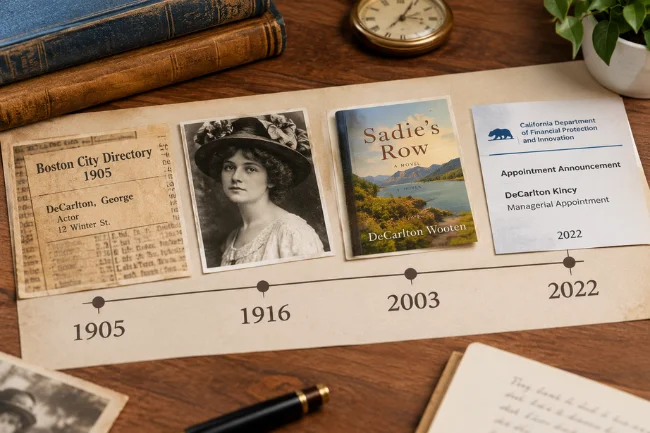
The scattered references become clearer when viewed in chronological order.
In 1905, George DeCarlton appeared in a Boston directory. In 1916, Grace DeCarlton was credited in a silent-era film. Later twentieth-century biographical entries show the Decarlton surname in family-history collections.
In the twenty-first century, the name remains visible as a given name. DeCarlton Wooten’s novel was published in 2003, and the California regulator’s 2022 bulletin named DeCarlton Kincy in a professional appointment.
This is a timeline of documented appearances, not a genealogy or a claim that the name spread from one person to another. The dates simply demonstrate that related written forms have appeared across different periods and occupations.
One thing I find especially interesting is the variety of sources. A city directory, a filmography, a book listing, and a government announcement each capture a different reason a name enters the public record.
Decarlton, DeCarlton, and Carlton: Are They the Same?
Capitalization and spacing can complicate a search. DeCarlton and Decarlton differ only in the capital C. De Carlton inserts a space.
Carlton and Carleton, meanwhile, are independently established surnames and should not be treated as automatic substitutes.
| Name form | What can be said reliably | How I would search it |
|---|---|---|
| Decarlton | Documented as a given name and surname | Search the exact spelling first |
| DeCarlton | Appears in historical and modern records | Repeat the search with the capital C |
| De Carlton | A possible spaced form to check in records | Test it as a separate phrase |
| Carlton | Established English surname with documented place-name roots | Explore only as a possible lead |
| Carleton | Recognized form related to Carlton | Check when dates, locations, or relatives match |
For general browsing, search engines often overlook differences in capital letters. Historical databases, however, may store names in separate fields, break them at spaces, or reproduce errors from older handwriting.
I recommend preserving the spelling on the original document while recording possible alternatives separately. Quietly changing someone’s documented name to a more familiar form can make the next record harder to find.
Where Does the Name Appear Geographically?
The available examples point to the United States, including Boston, Massachusetts, and references connected to Pennsylvania and California.
Those locations describe particular records, not the birthplace of the name itself.
A person living in one state may have been born elsewhere. A stage performer may have travelled constantly. An old directory can establish where a person was listed in a particular year without revealing where their ancestors originated.
That is why I would not label Decarlton “American in origin” merely because American sources are easier to find.
Digital archives are uneven: some communities, languages, and historical periods are represented far better than others.
Similarly, the known etymology of Carlton in England does not prove that every DeCarlton or Decarlton record leads back to an English settlement. The missing link is an actual sequence of family documents.
How Rare Is Decarlton?
Decarlton appears uncommon in the accessible sources I examined, but a precise worldwide count would be misleading without a defined dataset.
A surname site with seven biographies has seven entries in that particular collection, not necessarily seven people in history.
The same caution applies to baby-name statistics. The US Social Security Administration publishes popular-name rankings, but its ordinary search forms focus on the top 1,000 names. It offers broader research files, subject to privacy suppression for very small counts.
Consequently, not seeing Decarlton on a popular-name chart would not establish that nobody received the name.
It could mean the name fell outside the displayed rankings, appeared in a different spelling, or was excluded from a particular dataset.
For an unusual name, the first question should be “What exactly does this source count?” rather than “What number does this website display?”
That small habit prevents a surprising amount of false certainty.
How to Research the Decarlton Family Name
If Decarlton is part of your family history, I would begin with a known person rather than an origin theory.
Record the individual’s full name, approximate dates, and places lived. Add relatives only when a document actually supports the connection.
Next, search more than one spelling. The National Archives warns that census takers sometimes wrote names as they heard them, while transcription mistakes can create new variations.
FamilySearch likewise recommends trying alternate spellings, dates, and locations and inspecting original record images.
Start With Records That Connect Generations
Birth and marriage records can identify parents or spouses. Census returns may show household members together.
City directories can place someone at an address during a particular year, while death notices and probate records may reveal relatives not listed elsewhere.
I would work backward from the most recent confirmed person. Jumping directly from a present-day Decarlton to a nineteenth-century actor with the same surname risks creating a convincing-looking but unsupported family story.
Compare Evidence, Not Just Search Results
| Source | What it may establish | What it cannot prove alone |
|---|---|---|
| Census record | Household, location, approximate age | Exact family relationships in every case |
| Birth or marriage record | A recorded family event and named relatives | The ultimate origin of the surname |
| City directory | A name, address, or occupation in one year | Continuous residence or ancestry |
| Film or book credit | How a person was publicly named | Whether that was a legal or birth name |
| Online family tree | Potential relatives and research leads | Accuracy without supporting documents |
I suggest keeping a simple research log with the spelling found, document date, location, source, and the confidence level of each connection.
This is particularly valuable when the same unusual name turns up in unrelated households.
For a stronger check, compare at least two independent details, such as an occupation and address, or a spouse’s name and a birth year.
One matching surname is a lead. Several consistent details begin to make an identification persuasive.
Use Public Records Carefully
Older records are usually more suitable for open family-history research than information about living people.
I would not publish private contact details, speculate about relationships, or merge a living person’s identity with an old record simply to fill gaps in a family tree.
Where original documents are inaccessible, I would label an online transcription as a transcription. That modest distinction tells future readers exactly how much checking has taken place.
How Do You Pronounce and Spell Decarlton?
There is no single verified pronunciation for Decarlton in the sources I found.
Someone might naturally read the final portion like Carlton, but the beginning, stress, and preferred sound should be confirmed with the individual or family using the name.
The same applies to capitalization. DeCarlton and Decarlton may refer to the same person in some contexts, but a name’s official spelling is not something I would change just because a search engine treats the two similarly.
For writers, editors, and researchers, the practical rule is straightforward: use the form supplied by the person or the original source, then mention alternative spellings only when they genuinely help readers distinguish records.
Why Searches for Decarlton Can Be Confusing
A one-word search has ambiguous intent. Someone may be looking for a surname meaning, a particular professional, an author, or an older historical reference.
Search results can therefore seem unrelated even when they contain the identical word.
My approach is to add context before deciding what a result means. “Decarlton surname Pennsylvania” asks a different question from “DeCarlton author Sadie’s Row” or “DeCarlton Boston 1905.”
Each narrower query makes it easier to assess the relevant evidence.
There is also a subtle trap: a result headed “name meaning” can look authoritative even when its own page says the origin is unknown.
I always read past the headline and check which statements are documented.
What Decarlton Ultimately Reveals
Decarlton is a useful example of the difference between a recorded name and an explained name.
The historical and modern mentions establish real usage across different settings. They do not yet establish one pronunciation, one geographic origin, or one family line.
For me, that uncertainty is not a dead end.
It shows exactly what new evidence would add value: a verified early record, a documented link between generations, or an account from a family that explains how the spelling came into use.
Final Thoughts
The best starting point for understanding Decarlton is evidence, not a guessed translation.
If you’re researching the name, begin with one verified person, preserve the spelling on their documents, and build outward through records that genuinely connect. That approach can turn an intriguing name into a trustworthy family story.
Frequently Asked Questions About Decarlton
What is Decarlton?
Decarlton is an uncommon personal name recorded as both a first name and a surname; it is not a standard English word with a settled definition.
What is the meaning of Decarlton?
No authoritative meaning for the exact name has been established. Its resemblance to Carlton is not proof of a shared etymology.
Is Decarlton a first name or a last name?
Both. Historical records show surname use, while modern references include individuals whose first name is Decarlton or DeCarlton.
Where does Decarlton originate from?
Its precise origin remains unverified. US records document use, but those records do not establish where the name first arose.
Is Decarlton the same as Carlton?
Not necessarily. Carlton has a documented origin of its own; a connection to Decarlton would need supporting family or historical records.

Evelyn Hartwell is a biography writer and historical researcher with over 5 years of experience exploring the lives, achievements, and personal journeys of notable individuals. She focuses on creating well-researched, engaging biographies by analyzing reliable sources and presenting accurate life stories with meaningful context.