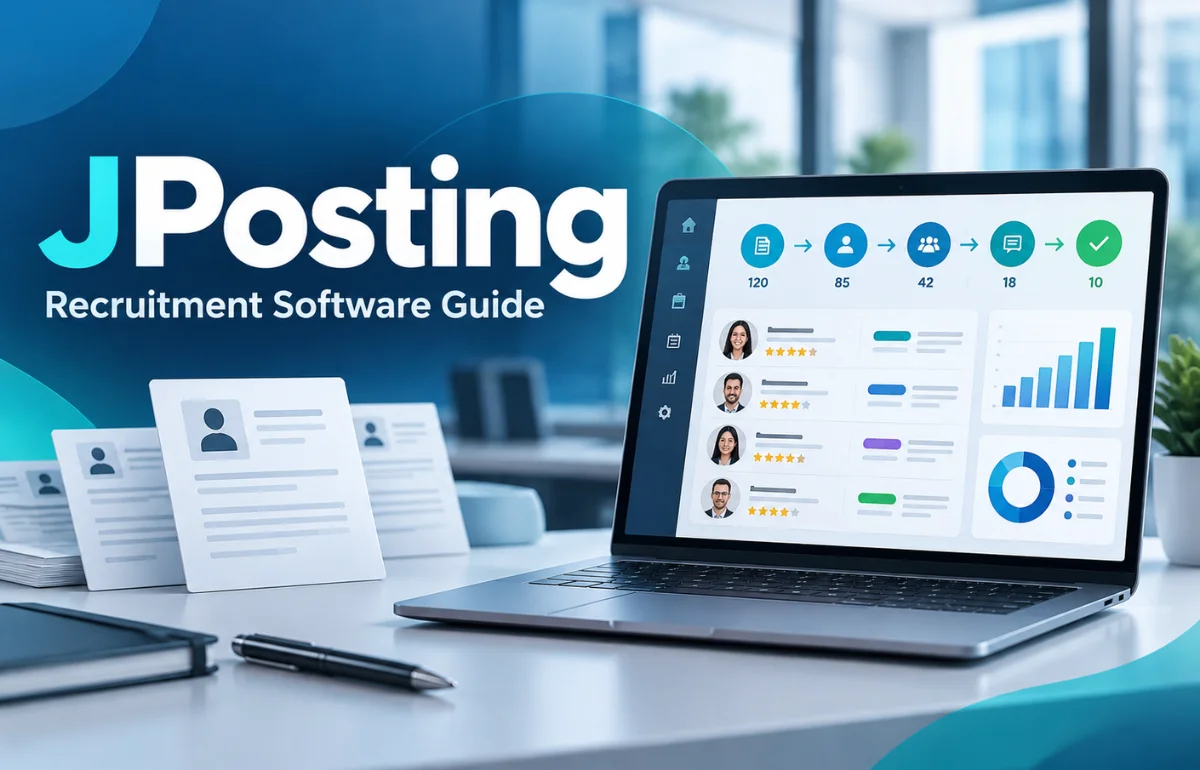
JPosting is a name associated with Japanese recruitment technology, especially the Japan Job Posting Service, the company historically known as JPOSTING. Its business focused on software that helps employers receive applications, organize candidate information, and manage hiring decisions. The name is closely connected with the JobSuite family of recruitment tools. In everyday conversation, people sometimes use “jposting” to mean publishing a job advertisement, but that informal meaning should not be confused with the specific Japanese business.
If you’ve found JPosting in an application URL or a hiring email, you may be looking at the system handling applications rather than a public job board. I’ll explain its history, how the software works, and what I’d check before sharing information or choosing a recruitment tool.
What Does JPosting Mean?
The documented meaning of JPosting comes from Japan Job Posting Service, a Japanese human resources technology company established in 1998. It used the JPOSTING name for recruitment management systems, career website services, and applicant software. Its products primarily served employers.
That distinction gets lost because the word looks almost identical to “job posting.” A job posting is an advertisement announcing an open position. JPOSTING was a company and business identity associated with the technology behind the recruitment process.
I ask one question whenever an unfamiliar recruitment name appears: Is this where I discover jobs, or where an employer processes my application? With JPosting-related pages, it may be the second.
The History of JPOSTING and the JobSuite Name
JPosting wasn’t created as a new hiring trend in 2026. Its roots reach back to early web-based recruitment management in Japan.
The parent company NSD’s official corporate history confirms the ownership and merger milestones. NSD Digital Solutions’ 2026 announcement explains the most recent change of name.
| Year | Development | Why it matters today |
|---|---|---|
| 1998 | Japan Job Posting Service began operating. | Older JPOSTING materials may use this original company identity. |
| 2017 | NSD acquired Japan Job Posting Service as a subsidiary. | Recruitment technology became part of the wider NSD group. |
| 2018 | Japan Job Posting Service merged with NM Systems; the combined business took the name StellaS. | JPOSTING and StellaS references can describe different stages of one business history. |
| 2026 | StellaS changed its corporate name to NSD Digital Solutions. | Current company information may appear under a newer name while historical product references remain online. |
This timeline describes corporate ownership and naming, not four separate job-search platforms. It does not make every site containing “posting” an official JPOSTING service.
Today, the relevant software portfolio is presented under JobSuite, including tools for experienced-hire recruitment, graduate recruitment, career-site content, and other human resources work. For the latest product scope, the official JobSuite website is a better reference than an old company profile.
How Does a JPosting-Related Recruitment System Work?

Recruitment software creates an organized path from an open position to a hiring decision. Employers configure the process; applicants see their portion.
1. An employer opens a position
A recruiter starts with the job details: responsibilities, location, qualifications, compensation information, and application requirements. A vacancy may then be displayed on the company’s careers page or distributed through permitted recruitment channels.
JobSuite CAREER documents functions for managing vacancies and sharing openings with company websites or recruitment agencies. Deployments can differ.
2. A candidate submits an application
An applicant fills in a form and may attach a résumé. The page can be hosted by a technology provider even though the employer makes hiring decisions.
This explains why a candidate might move from a familiar company website to a different domain. The change isn’t automatically suspicious, but it deserves verification before personal data is entered.
3. Recruiters organize and review applications
An applicant tracking system, commonly called an ATS, can help recruitment staff consolidate records, coordinate reviews, assign selection stages, and keep related communication together.
JobSuite CAREER lists applicant aggregation, selection management, interview coordination, reporting, integrations, and customization. Not every employer uses every function.
4. Candidates move through a decision process
An employer may screen applications, request additional information, schedule interviews, and record outcomes. Some applicants receive updates through a portal; others hear directly from recruiters. The visible experience depends on how the employer has configured its workflow.
A status such as “received” confirms submission, not a human review or a guaranteed interview.
JPosting vs. Job Boards vs. Applicant Tracking Systems
These terms overlap but solve different problems. Confusing them creates false expectations about application links.
| Term | Main purpose | Typical user activity | What it does not guarantee |
|---|---|---|---|
| JPOSTING | Historical name linked to Japanese recruitment technology | Encountering related recruitment services or legacy company references | Access to one universal public list of jobs |
| Job board | Helps people discover advertised vacancies | Searching roles and following application links | Managing the employer’s full selection process |
| Applicant tracking system (ATS) | Helps an organization manage applicants and hiring stages | Submitting, reviewing, routing, and tracking applications | Automatic acceptance or an interview |
| Recruitment CRM | Helps teams maintain relationships with prospective candidates | Building talent pools and managing outreach | A complete replacement for every ATS workflow |
Think of a job board as a storefront displaying opportunities. The ATS is closer to the organized work area behind the storefront. Both may be involved in one application, but they aren’t the same product or service.
Which JobSuite Features Are Relevant to JPosting?
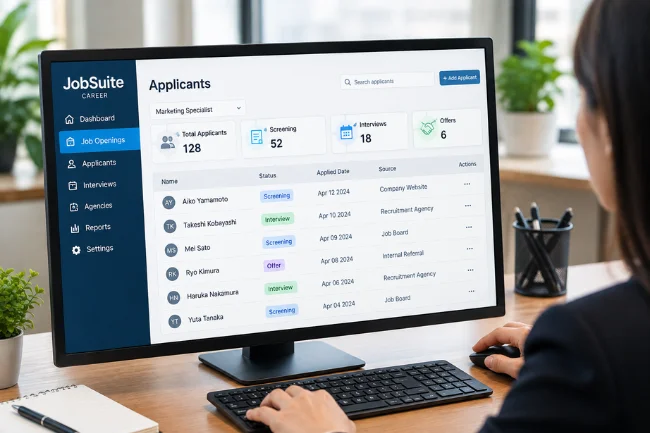
The JobSuite family spans several tasks often grouped together under online hiring.
Applicant tracking and workflow management
JobSuite CAREER focuses on mid-career recruitment. Its documented functions include gathering applicants, managing selection stages, coordinating interviews, working with agencies, and analyzing recruitment activity. For an employer receiving candidates from many channels, a shared record can prevent applications from being scattered across inboxes and spreadsheets.
Graduate hiring and candidate communication
JobSuite FRESHERS addresses new-graduate recruitment, which can involve larger cohorts, information sessions, several evaluation rounds, and timed communications.
Career websites and recruitment promotion
JobSuite STUDIO is associated with recruitment content and careers-site production, while JobSuite ADVERTISING supports recruitment advertising activity. These offerings address the challenge of attracting the right applicants before an ATS starts organizing them.
Wider employee and workforce tools
The portfolio includes talent management and temporary staffing services, but employers should check the individual product and contract rather than assume these come with an ATS subscription.
Why Employers Use Recruitment Management Software
The clearest benefit is visibility. When applications arrive by email, forms, agencies, and job boards, recruiters can easily lose track of which person applied for which role. A centralized system reduces that fragmentation.
Instead of forwarding résumés through long email chains, authorized reviewers can use shared records. Structured stages can reduce duplicated work and expose delays.
Reporting helps employers spot application abandonment, interview delays, and recruiting channels producing qualified applicants. The software exposes problems; it doesn’t fix them automatically.
For applicants, clear forms, timely acknowledgments, and straightforward scheduling can help. Yet employers can still communicate poorly with sophisticated software. I judge the candidate’s experience, not the feature list.
Is a JPosting Application Link Legitimate and Safe?

An unfamiliar domain can be perfectly normal in recruitment, but a familiar software name isn’t proof that a specific email or vacancy is genuine. Fraudsters can imitate employers and recruitment services.
Before entering a résumé, home address, or identification information, I would make these checks:
- Start on the employer’s official website and locate the vacancy independently. Follow its careers-page link instead of trusting a link in an unexpected message.
- Compare the job title, location, deadline, and recruiter contact details across the official vacancy and the application form. Look for material mismatches.
- Check the complete website address, not just the logo or the word “JPosting.” A lookalike domain may use a convincing design.
- Read the privacy notice to understand who receives the information, why it is collected, and how to contact the responsible organization.
- Be wary of requests for upfront “registration” payments, banking credentials, passwords, or unnecessary identity documents before the employer has established a legitimate reason.
In an October 2026 notice, NSD Digital Solutions reported possible exposure of information from a now-closed JobSuite CAREER document-request form on a third-party service. It said unauthorized access to its related systems had not been confirmed and cautioned readers about suspicious communications. The notice did not say all JobSuite applications were compromised.
If you have doubts about a specific link, contact the employer through independently verified details before uploading sensitive information.
How to Apply Through a JPosting-Related Page
The exact form will vary by organization, but a little preparation makes the process smoother.
First, confirm the role is open and understand its requirements. Prepare an up-to-date résumé with a clear filename.
Enter information consistently with your résumé. If asked for a motivation statement, tailor it to the actual role.
Before submitting, check attachments and consent text. Save the vacancy description and confirmation details; the advertisement may disappear later.
An automated acknowledgment means submission, not approval. If the stated timeline passes, follow up courteously through the employer’s channel.
What Employers Should Evaluate Before Choosing an ATS
Software demonstrations often emphasize attractive dashboards. I prefer to start with the actual recruitment journey: how a candidate enters the system, who reviews that record, what triggers an interview, and how the final decision is documented.
These questions uncover practical differences:
Can candidates finish the application without frustration?
Test the process on a mobile device, with a slow connection, and using realistic résumé files. Count unnecessary fields. Check whether errors preserve information already entered. A polished employer dashboard is little comfort if applicants abandon a difficult form.
Can the team control access and protect data?
Ask about permissions, audit trails, retention, account security, backups, vendor responsibility, and incident response. Don’t assume identical controls across products.
Does it fit the existing recruitment channels?
Map candidate sources—careers pages, agencies, referrals, and job sites—and confirm required integrations. Ask about failed connections and data export at contract end.
Can the business measure a better outcome?
Record a baseline for application completion, first human response, scheduling delay, stage-by-stage drop-off, and final updates. These beat raw application counts as experience measures.
I also suggest a metric called silent-stage time: days spent in a selection stage without a meaningful update. Track median and longest waits, then set escalation rules. This is my proposed operational measure, not a proprietary JobSuite feature.
Common JPosting Misunderstandings to Avoid

The first is assuming JPosting is a universal job board. The historical name refers to a recruitment technology business, and individual employer application pages may serve entirely different sets of vacancies.
The second is treating every ATS as an automatic résumé rejection machine. Software may help collect, organize, and route information, but screening criteria and decision-making practices differ among employers. Don’t infer a specific employer’s selection logic from the platform name alone.
The third is assuming every modern recruitment feature is available by default. Automated messages, reporting, integrations, customization, and access controls can depend on the product and configuration. Ask for a current demonstration and written specifications.
The fourth is overlooking candidate communication. A hiring process can be fast internally while leaving applicants in the dark. Clear timelines and honest updates are operational choices, not optional niceties that software can make on its own.
The Bigger Picture: JPosting and Digital Recruitment in 2026
JPosting’s story illustrates a broader change in hiring technology. Recruitment systems have moved beyond collecting online forms to connecting candidate sources, internal reviewers, interview scheduling, reporting, and employer communication. Different tools handle different parts of that journey.
The next challenge isn’t simply processing more résumés. It’s making the process understandable, proportionate, and accountable. Employers should be able to explain who sees applicant data, how long they retain it, and where a candidate can get help. Applicants should be able to recognize the employer behind the form and know what a submission does—and does not—mean.
For me, that’s a more useful standard than any promise of “effortless hiring.” Technology earns its place when it improves decisions and respects the people involved.
Final Thoughts
JPosting is best understood through its documented connection to Japan Job Posting Service and the JobSuite recruitment technology lineage. It isn’t interchangeable with an ordinary job advertisement or a single worldwide job-search portal.
If you’re applying for a role, begin with the employer’s official careers page and verify the application destination. If you’re evaluating software for a hiring team, test the real candidate journey, information safeguards, and communication practices before signing a contract. Those checks will tell you far more than the name on the login screen.
Frequently Asked Questions About JPosting
1. What is JPosting used for?
JPosting is historically associated with software used to organize job applications and recruitment processes, particularly Japan Job Posting Service and the JobSuite product lineage.
2. Is JPosting a job search website?
Not necessarily. The documented JPOSTING name refers to recruitment technology; an employer’s application portal is not the same as a general job board.
3. Is it free to apply for jobs through JPosting?
Employer-hosted job applications normally do not require a candidate payment. Verify the employer and be cautious if an unexpected application link demands fees.
4. Is JPosting the same as JobSuite CAREER?
No. JPOSTING is a historical business identity, while JobSuite CAREER is a specific applicant tracking product within the related recruitment software portfolio.
5. Does applying through JPosting guarantee an interview?
No. A successful submission only confirms that an application was sent or received; the employer decides who advances to interviews and offers.

Noah Sterling is a technology research writer with 8+ years of experience covering emerging technologies, software trends, digital tools, and innovation. He creates practical, research-based articles to help readers understand the evolving technology landscape.