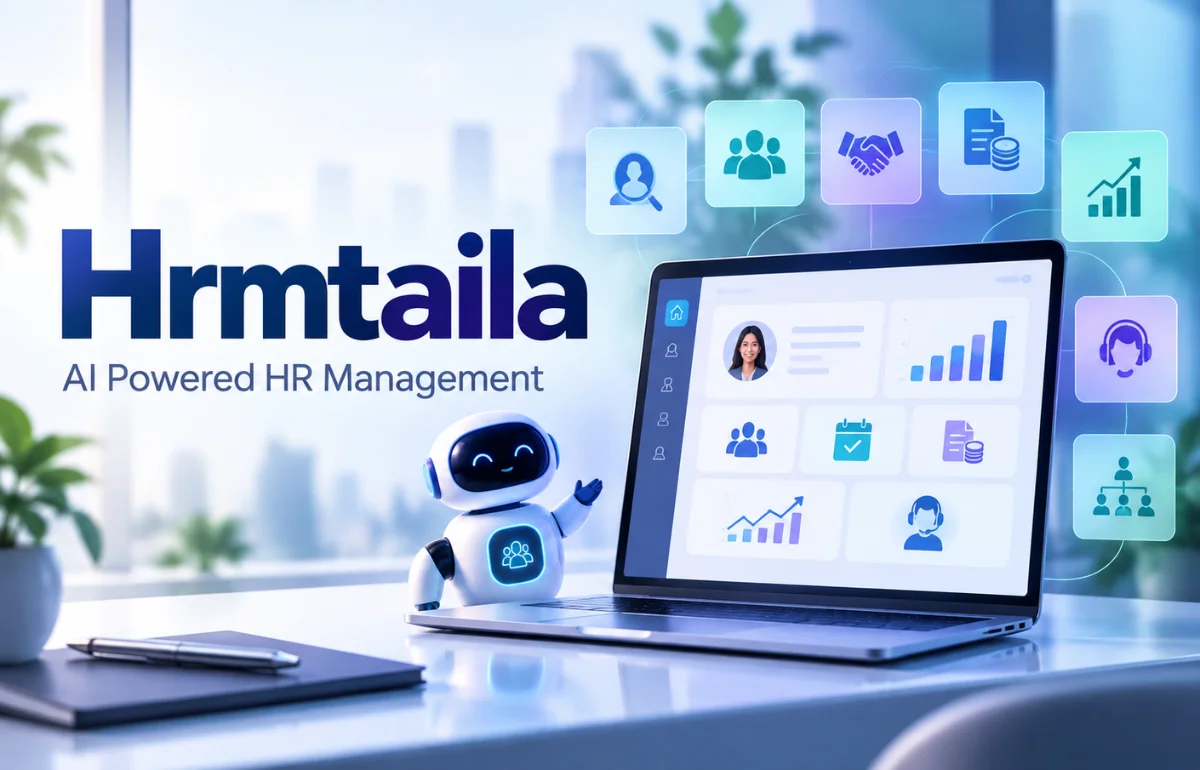
Hrmtaila is an emerging online term used to describe the combination of artificial intelligence and human resource management. In simple terms, it refers to using AI, automation, cloud software, and workforce data to help HR teams handle tasks such as recruitment, onboarding, employee support, payroll administration, performance reviews, and workforce planning.
The factual caution matters: Hrmtaila is not currently a widely documented software product, established company, or recognized industry standard. I treat it as a working label for AI-assisted HR management rather than a specific platform with confirmed features. That distinction gives readers a useful definition without turning repeated online claims into facts.
The idea behind the term is still relevant. Organizations are already using AI across the employee lifecycle, so Hrmtaila offers a convenient way to discuss what happens when intelligent tools become part of everyday HR work.
What Does Hrmtaila Mean?
There is no authoritative definition or confirmed origin for the full word. The opening letters, “HRM,” closely match the standard abbreviation for human resource management. That connection explains why recent articles associate the term with HR technology.
The remaining part, “taila,” has no verified meaning from an identifiable creator, developer, or organization. It would therefore be misleading to present a confident etymology. Until a primary source appears, the safest definition is an emerging term for AI-supported human resource management.
When I investigate an unfamiliar technology name, I separate its online usage from its verified identity. A term can describe a useful concept even when it does not belong to a real vendor. Hrmtaila currently fits that category: the surrounding ideas are real, but the product identity is unconfirmed.
Is Hrmtaila a Real Software Platform?
There is not enough public evidence to call Hrmtaila a confirmed commercial HR platform. A genuine software product normally leaves a trace: an official website, company ownership, product documentation, pricing or demo access, privacy terms, support information, and customers who can be independently verified.
Hrmtaila does not yet have that clear public footprint. This does not prove that no project exists under the name. It means readers should avoid assuming that features described across blog posts belong to one functioning product.
Here is the distinction I would publish prominently:
My rule is simple: if ownership, documentation, access, and independent evidence cannot be confirmed, describe the subject as a concept or emerging keyword—not as established software.
How Hrmtaila Fits Into Modern HR Technology
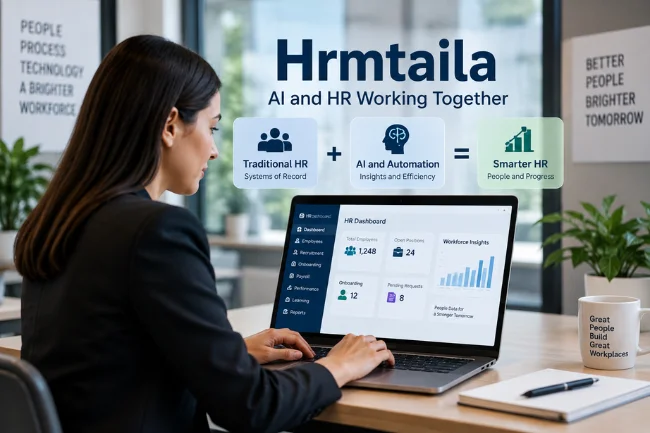
Traditional HR systems are mainly systems of record. They store employee profiles, contracts, leave balances, benefits information, payroll data, and performance documents. More advanced platforms also manage recruitment, learning, scheduling, and workforce reporting.
AI adds an analytical and conversational layer. It can summarize documents, classify requests, generate drafts, detect patterns, predict possible outcomes, and recommend next actions. Automation can then move information between systems or trigger routine workflows.
Hrmtaila is best understood as a label for this combined model rather than a replacement for every HR category.
This comparison prevents a common misunderstanding. A company does not need a product named Hrmtaila to use the underlying approach. It may already have similar capabilities inside an applicant tracking system, payroll platform, HCM suite, chatbot, or analytics tool.
How Hrmtaila Could Work Across the Employee Lifecycle
The most practical way to understand the concept is to follow an employee from application to ongoing development.
Recruitment and candidate screening
AI can help write job descriptions, identify required skills, organize applications, schedule interviews, and surface candidates whose experience matches stated criteria. According to SHRM’s 2026 research, recruiting is the leading HR use case for AI, with common applications including job-post optimization, résumé matching, and interview scheduling.
The system should support a recruiter rather than make the final hiring decision. Candidate data can be incomplete, and historical hiring patterns may contain bias. A qualified person needs to review recommendations, accommodations, borderline cases, and rejections.
Onboarding and employee support
An AI-assisted onboarding workflow might send forms, explain policies, assign training, confirm equipment requests, and remind managers about scheduled check-ins. A conversational assistant could answer routine questions about leave, pay dates, benefits, or internal processes.
The useful boundary is clear. A chatbot can explain an approved policy, but it should not improvise an answer about a sensitive grievance or personal employment matter. Those cases need a direct route to a human HR professional.
Payroll, leave, and employee records
Automation can move approved time, attendance, overtime, leave, and compensation data between connected systems. It can also flag missing fields or unusual values before payroll is finalized.
That does not make payroll autonomous. Tax rules, contracts, deductions, local requirements, and unusual employee circumstances create exceptions. I would use automation to reduce repetitive checking while keeping named people responsible for review and approval.
Performance, learning, and skills
AI can organize goals, feedback, project results, training records, and skills data. It may identify a possible skill gap or recommend learning content based on a role. Managers can use those signals to start a better conversation.
An algorithm cannot see every contribution, personal circumstance, or team dynamic. Performance ratings, promotions, disciplinary action, and termination should never depend on an unexplained score alone.
Workforce analytics and planning
Workforce analytics can connect information about headcount, turnover, absence, hiring time, labor costs, and skills. Predictive models may identify patterns linked with attrition or future staffing needs.
These outputs are estimates, not forecasts carved in stone. Their value comes from helping leaders ask better questions: Which team is losing experienced people? Where will a skill shortage appear? Which hiring stage is slowing growth?
A Practical Hrmtaila Workflow
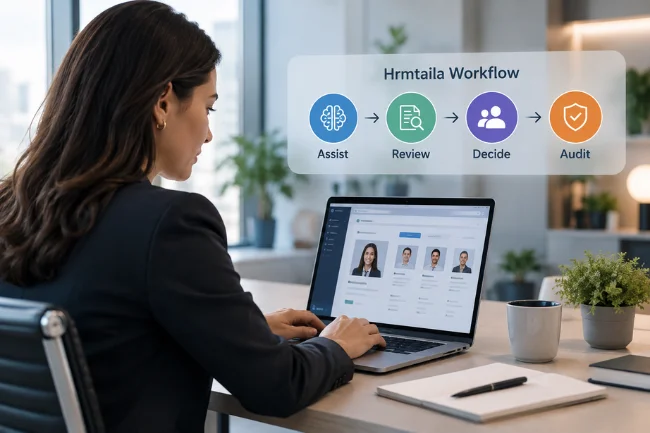
The clearest model I use for high-impact HR automation has four parts: assist, review, decide, and audit.
First, the system assists by organizing information or generating a recommendation. A recruiter might receive a skills-based candidate shortlist rather than reading hundreds of applications in random order.
Second, a trained person reviews the source data and checks whether the result makes sense. Missing experience, unusual career paths, disability-related accommodations, and transferable skills may require context the system does not have.
Third, an authorized person makes the decision and records the reason. Responsibility stays with the employer rather than being shifted to a vendor or algorithm.
Finally, the organization audits outcomes. It checks accuracy, error patterns, selection rates, complaints, overrides, and whether the tool is still solving the original problem. This final stage is often missing, yet it is where trust is either earned or lost.
Potential Benefits of Hrmtaila
The strongest benefit is not replacing HR staff. It is reducing the administrative load that prevents them from focusing on people, judgment, and organizational health.
Routine requests can be answered faster. Information can be entered once and reused across authorized systems. Recruiters can spend less time scheduling interviews, while HR teams can spot workforce trends without manually merging multiple spreadsheets.
Consistency is another advantage. An approved workflow can apply the same required checks to every onboarding case or leave request. Good automation also creates an activity trail, making it easier to identify when a task was completed, skipped, or changed.
The business case still needs measurement. Useful metrics might include time to fill a role, payroll correction rates, onboarding completion, employee support response time, recruiter hours saved, override rates, and user satisfaction. “We added AI” is not a result.
Risks, Privacy, and Responsible Governance
HR systems hold some of an organization’s most sensitive information: identity details, compensation, attendance, medical or accommodation records, performance notes, complaints, and career history. Combining that information with AI increases the need for strict access, retention, and security controls.
Bias is equally serious. A model trained on historical decisions may reproduce patterns that disadvantaged certain groups. Even a neutral-looking proxy, such as employment gaps, location, school, or word choice, can affect results in unintended ways.
The U.S. Equal Employment Opportunity Commission warns that employers’ use of algorithms and AI in job decisions can create discrimination risks, including for applicants and employees with disabilities. Buying a third-party tool does not remove the employer’s responsibility.
For a practical governance structure, I would borrow from the NIST AI Risk Management Framework. Its core functions—govern, map, measure, and manage—encourage organizations to define ownership, understand context, test risks, and respond when problems appear.
Regional rules also matter. The European Union’s AI Act uses a risk-based legal framework, and certain employment-related AI systems may face heightened requirements. Any organization operating across jurisdictions needs qualified legal advice rather than a single global assumption.
A responsible Hrmtaila-style system should provide clear notices, limited data collection, role-based access, documented human review, testing for harmful bias, an appeal route, incident reporting, and a way to stop the automation safely.
Who Could Benefit From This Approach?
Small businesses may benefit from focused automation around interview scheduling, onboarding reminders, document collection, leave questions, and simple reporting. They usually need tools that are easy to manage and do not require a dedicated data-science team.
Larger organizations may use AI across recruiting, internal mobility, workforce planning, employee service, compliance monitoring, and learning. Their scale creates more opportunity, but it also increases integration, governance, and change-management demands.
Employees can benefit when systems provide faster answers, clearer processes, and easier access to support. They can also be harmed when an opaque model makes decisions that affect pay, work opportunities, monitoring, or job security. The quality of governance determines which outcome is more likely.
How to Evaluate a Hrmtaila-Style Solution
I would begin with the problem, not the AI label. Define the delay, error, cost, or employee frustration the organization wants to reduce. If the problem cannot be measured, the proposed solution will be difficult to evaluate.
Next, examine the data. Identify what the tool needs, where that information comes from, who may access it, how long it is retained, and whether it can legally be used for the intended purpose.
Then test the vendor and workflow. Ask for documentation covering model limitations, integrations, security controls, audit logs, bias testing, accessibility, data deletion, human overrides, and incident response. A polished demonstration is not a substitute for evidence.
Before full deployment, use a limited pilot with real success and safety measures. Compare results with the existing process, review errors, gather employee feedback, and record situations where people overruled the system.
Finally, assign ownership. Someone must be accountable for performance, complaints, updates, audits, and the decision to pause or retire the tool. Technology that affects employment should never become everybody’s tool and nobody’s responsibility.
What Is the Future of Hrmtaila?
AI use in HR is growing, but adoption is not universal. SHRM reported in 2026 that 39% of organizations were using AI in HR, with recruiting ahead of other functions. That suggests the near-term future will be gradual: organizations will automate selected tasks before trusting connected systems across the entire employee lifecycle.
AI agents may eventually complete multi-part administrative workflows, such as gathering onboarding documents, updating authorized records, scheduling training, and notifying the right people. The useful systems will be the ones that explain what they did, preserve approvals, and make errors easy to correct.
The term Hrmtaila may develop into a recognizable framework, become associated with a specific product, or disappear while the underlying technology continues. For now, its value lies in opening a practical discussion about how AI and human judgment should work together in HR.
Final Takeaway
Hrmtaila is best understood as an emerging label for AI-assisted human resource management, not a verified product with an established feature list. Use the concept to explore better HR workflows, but verify any vendor or platform before trusting claims made under the name.
If you are considering this approach, choose one measurable HR problem, define the human decision points, and run a controlled pilot with privacy, fairness, and accountability built in from the start.
Frequently Asked Questions
What is Hrmtaila?
Hrmtaila is an emerging term associated with AI-assisted HR management, including automation, analytics, recruitment, onboarding, payroll support, and employee service.
Is Hrmtaila a real software product?
No widely documented commercial platform has been authoritatively verified under that exact name, so it is safer to treat Hrmtaila as a concept or developing keyword.
How can Hrmtaila be used in human resources?
It can describe the use of AI for candidate matching, onboarding workflows, HR chatbots, payroll checks, performance support, and workforce analytics.
Can Hrmtaila replace HR professionals?
No. AI can handle repetitive work and surface patterns, but people should remain responsible for sensitive employment decisions, exceptions, fairness, and employee care.
Is Hrmtaila safe for employee data?
Safety depends on the actual tools and controls used. Organizations should verify security, access, retention, bias testing, human oversight, and legal compliance before deployment.

Noah Sterling is a technology research writer with 8+ years of experience covering emerging technologies, software trends, digital tools, and innovation. He creates practical, research-based articles to help readers understand the evolving technology landscape.