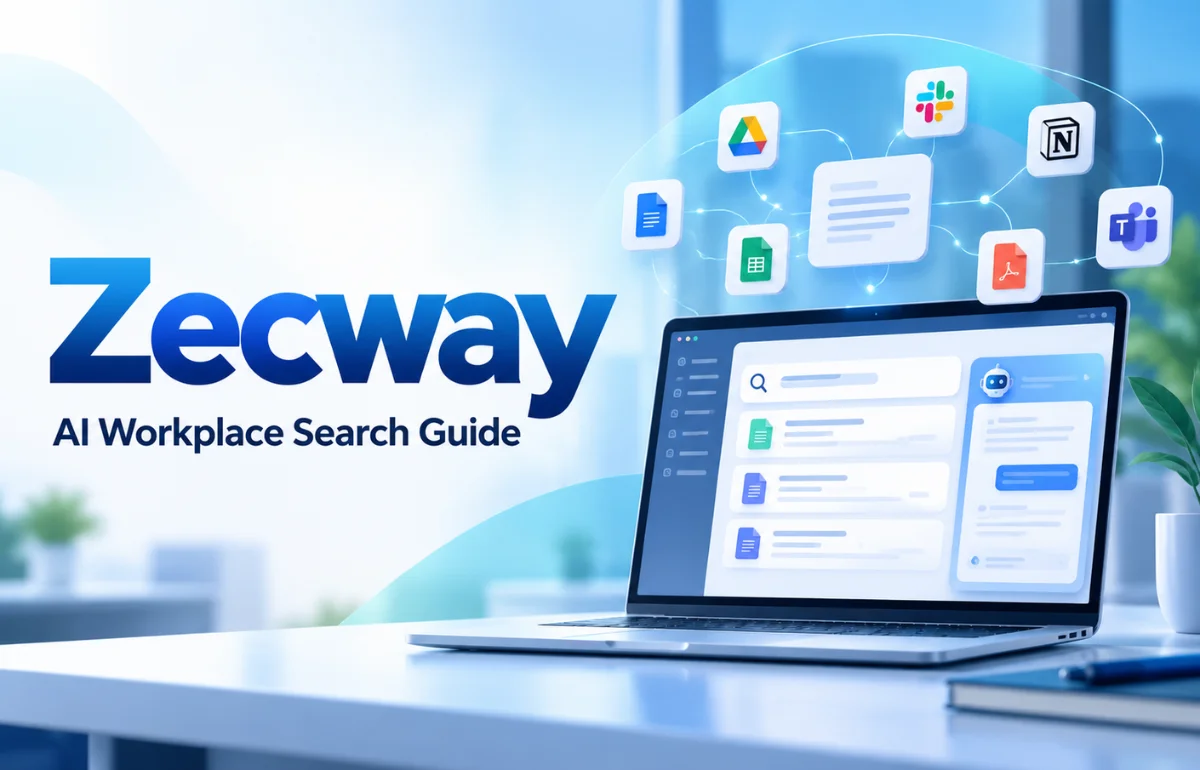
Zecway is an AI-powered workplace search platform designed to help employees find information spread across company apps, documents, and conversations. Instead of searching Google Drive, Slack, email, and other tools separately, a team can ask a question through one search experience and receive information linked to its original sources. Zecway also describes an AI assistant for drafting work and a longer-term vision for agents that handle recurring tasks. As of October 2026, the service is promoted through limited early access, so its advertised capabilities should not be confused with independently verified, generally available features.
A project decision may live in a chat thread, while the approved file sits in a shared folder. I reviewed Zecway’s public website and company description to separate what it says it offers from what a business still needs to verify. I have not conducted a hands-on product test, and I won’t present promotional demonstrations as measured results.
What Is Zecway and Who Is Behind It?
Think of Zecway as a potential search layer over the tools employees already use. It isn’t positioned as a replacement for every document library, chat service, or project management app. Its goal is to make knowledge within those systems easier to locate and use.
The company’s LinkedIn profile identifies it as a privately held software business founded in 2026 and based in Bangalore, India. It describes an intended audience of teams with roughly 30 to 500 employees. That number reflects product positioning, not a published rule that prevents smaller or larger organizations from enquiring.
What interests me most is the distinction between finding a file and finding an answer. If I ask where the current discount policy lives, a file link may be enough. If I ask what discount is permitted for a particular deal, I need the correct policy, its effective date, and a way to confirm the answer. That is the more demanding problem Zecway is trying to address.
How Does Zecway Work?
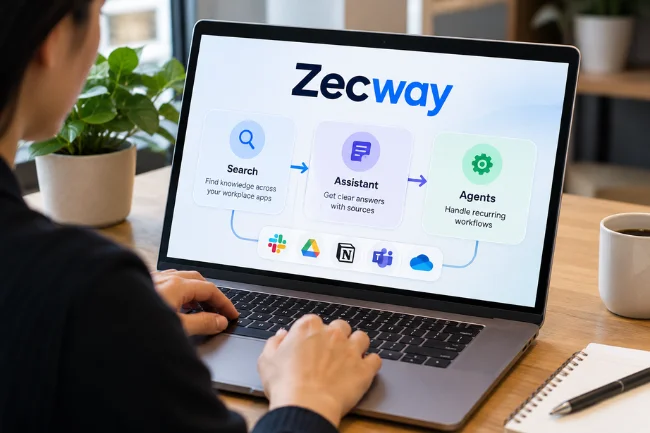
The public product description divides its direction into three layers: search, assistant, and agents. Those labels are helpful, but they do not establish that every capability is currently available to all early-access users.
1. One Search Experience Across Company Knowledge
Zecway promotes natural-language search across connected workplace information. Someone might type, “Where is the newest pricing presentation?” rather than remembering a file name or guessing which folder contains it.
For that experience to work well, a search system needs access to the right sources, an up-to-date index, and reliable permission information. Coverage depends on the connector and the permissions granted.
2. An Assistant That Uses Source Material
Its assistant is presented as a way to create summaries and drafts using company records. A sales colleague, for example, might request a first draft of a response to a customer’s security questionnaire, supported by approved internal policy documents.
The value comes from grounding an answer in relevant material and making that material inspectable. Even then, a citation proves where a statement came from, not that the statement is accurate or still valid.
3. Agents for Recurring Work
Zecway also describes AI agents that could research a topic, prepare an update, or carry out a scheduled workflow with human approval. Its website illustrates an agent preparing an item for posting to Slack after approval.
I would treat this as product direction rather than assume every automation is ready for production. Before allowing an agent to send messages or alter records, I would ask which actions are supported, how approvals work, and whether a mistaken action can be stopped or reversed.
Key Zecway Features and What Is Actually Confirmed
The clearest way to read an early-access product page is to separate advertised capabilities from independently tested results.
| Capability | What Zecway publicly describes | What to confirm before adoption |
|---|---|---|
| Cross-app search | One search experience for company knowledge | Supported apps, file types, indexing limits |
| Cited answers | Answers linked to original company sources | Citation accuracy and handling of conflicting files |
| Permission-aware results | Access checks before content reaches AI | Role changes, private content, and access revocation |
| AI assistant | Drafts and summaries informed by company material | Access status, accuracy, and editing controls |
| Workflow agents | Scheduled research and approved actions | Live actions, audit logs, approvals, and rollback |
These statements come from the official Zecway website and company profile. The table is not a performance scorecard, and I have not independently verified response speeds, accuracy, or deployment readiness.
One advertised example shows an answer in 0.4 seconds. That’s a marketing demonstration, not enough evidence to guarantee the same response time across a company’s actual data. Large files, complex questions, connection limits, and network conditions could change the experience.
Where Zecway Could Be Useful at Work
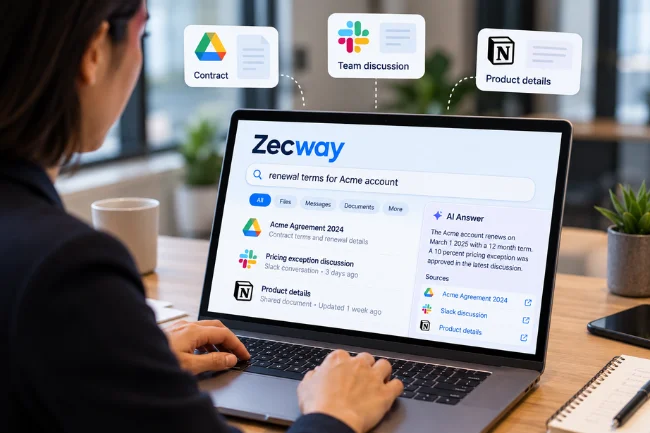
Sales and Customer Success
Imagine an account manager answering a renewal question. The current agreement is in a folder, the latest pricing exception was discussed in Slack, and the product details live in a shared document. A unified search tool could help gather the context faster.
However, I wouldn’t let an AI-generated commercial answer go straight to a customer. Pricing exceptions and contract terms need a named approver and the latest authoritative record.
Operations and Project Management
Project updates rarely arrive in a single neat document. Teams distribute decisions across meeting notes, chats, task trackers, and presentations. Search backed by source links could help a project manager trace why a deadline moved or which owner approved a change.
It is about avoiding decisions based on an older plan when a more recent agreement exists elsewhere.
HR and Employee Onboarding
New employees often ask the same questions about leave rules, equipment, training materials, and internal procedures. An AI knowledge assistant could direct them to the relevant policy instead of repeatedly interrupting HR colleagues.
That convenience introduces a boundary: a staff handbook is not the same as a private employee record. Any workplace AI system should prove it can keep those information types separate.
Zecway Integrations: Which Apps Might Connect?
Zecway’s company description names Google Drive, Slack, Notion, and email among the sources it aims to bring together. Its website also uses Drive and Slack in illustrative search results. I would not interpret either example as a complete, currently supported connector catalogue.
Before requesting access, ask whether each required integration is live for your account, how authentication works, which content types are indexed, and how often updates are reflected. These questions matter particularly for deleted messages, newly restricted files, shared drives, and historical attachments.
A tool that depends on broader access than your IT team can approve may be difficult to deploy, however attractive its interface looks.
Zecway Security, Privacy, and Accuracy
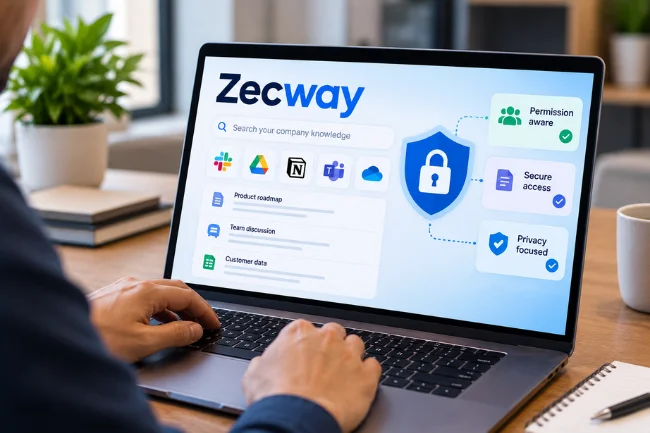
Zecway’s public positioning emphasizes permission-aware search. Its site says permissions are enforced before information reaches AI processing. That is a meaningful design claim, but buyers should request evidence rather than assume that wording covers every scenario.
Test Access, Not Just Answers
My first security test would involve two accounts: one authorized to read a confidential finance document and one without that permission. I’d ask both accounts the same question. The second should receive neither the document nor a summary revealing its contents.
I’d repeat the test after removing the first user’s access. Permission changes should be reflected promptly, not after an unexplained delay. Search results, generated summaries, previews, and automated actions all need checking.
Ask Where Company Data Goes
For confidential records, buyers should request clear answers about data storage locations, encryption, retention, deletion, subprocessors, incident reporting, and whether customer material can be used for model training. The site’s statement that data remains the customer’s does not replace detailed contractual terms.
A privacy promise is not the same as a verified security certification, independent audit, or suitable data-processing agreement.
Watch for Confident but Outdated Answers
Even perfectly permissioned retrieval can select the wrong source. A draft contract may contradict a signed contract; last year’s policy may conflict with a recently approved change. An answer with a citation can still be misleading.
I would make every important response answer three questions: Which record supports it? When was that record updated? Who owns the final decision? That simple habit is more useful than trusting the tone of a generated reply.
Zecway Pricing and Early Access in 2026
At the time of this review, Zecway’s official website advertises limited early access and says no credit card is required to request it. It does not display a standard public pricing table covering monthly subscriptions, per-user fees, enterprise plans, or agent usage.
That means I cannot responsibly call the platform free. A free early-access request is not a promise of permanent free service, nor does it reveal future contract terms.
If I were evaluating a paid rollout, I’d ask about seat minimums, charges for connectors, indexing or storage limits, AI usage allowances, support, setup assistance, contract duration, and cancellation terms. I’d also ask what happens to indexed company data if the service ends.
Anyone interested can visit the official Zecway website to request early access and confirm the latest commercial details directly.
Zecway vs. Other Workplace Search Options
Zecway operates in a category with established approaches. An organization may already use native search inside Drive or Slack, a general AI assistant, or a dedicated enterprise knowledge product such as Glean or Guru.
| Option | What it is best suited to | Main question to ask |
|---|---|---|
| Zecway | Exploring an emerging unified search and assistant concept | Which capabilities can my team actually access today? |
| Search inside existing apps | Finding known items within one service | Do staff regularly need evidence from several tools? |
| Glean | Evaluating documented enterprise search and connectors | Does its deployment and governance model fit our environment? |
| Guru | Combining connected knowledge with verification workflows | Who will own and maintain trusted content? |
| General-purpose chatbot | Drafting and reasoning over information users provide | Can it reliably access authorized, current company records? |
This is a buying framework, not a head-to-head benchmark. Glean documents connector-based enterprise search and source permissions, while Guru publishes documentation for connected sources and knowledge verification. Zecway’s accessible public documentation is less extensive, so a fair product comparison needs a controlled trial.
The more useful comparison is whether people get correct, current, permitted answers with less effort than their existing workflow requires.
How I Would Evaluate Zecway Before Rolling It Out
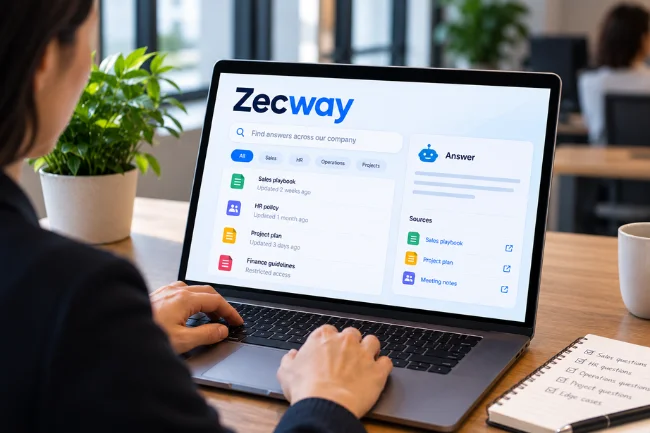
Rather than begin with a company-wide rollout, I would run a small pilot using non-sensitive or synthetic records. That would produce evidence without exposing confidential information before the security review is complete.
Build a Test Set That Reflects Real Questions
I’d prepare about 20 questions from sales, HR, operations, and project work. Some should have an obvious answer, some should involve two documents, and others should have no answer at all. A trustworthy system should admit uncertainty instead of inventing a response.
I would also include one old policy, a replacement policy, conflicting meeting notes, and a restricted file. These cases reveal weaknesses that polished demonstrations rarely show.
Measure More Than Search Speed
For every test, I’d record whether the answer was correct, whether its citation opened the right passage, whether the newest source was used, and whether unauthorized content stayed hidden. Then I’d compare the experience with searching the original apps manually.
A useful pilot worksheet could score five dimensions from zero to two: correctness, source quality, freshness, access control, and practical time saved. This ten-point checklist is my suggested evaluation method, not a published Zecway benchmark.
The most informative metric may be the percentage of answers requiring human correction. A five-second response that sends someone to an outdated policy can cost more time than it saves.
Choose One Workflow and Assign an Owner
I’d start with something measurable, such as locating approved sales materials or answering routine onboarding questions. Give the pilot a defined period, a responsible administrator, and a way for employees to flag mistakes.
If the system cannot pass those checks, adding more apps will not solve the underlying problem.
Advantages and Limitations to Consider
The attractive side of Zecway is its straightforward proposition: one place to search, traceable answers, and the possibility of moving routine knowledge work into assisted workflows. For growing teams, reducing the number of places people need to check could be valuable.
The uncertainty is equally real. Early access limits what outside observers can verify. Public pricing is incomplete, available integrations need confirmation, and performance claims are not a substitute for independent testing. Automation also creates responsibility for mistakes, approvals, and data access.
I would view Zecway as worth investigating if fragmented company knowledge causes repeated delays, but I would not recommend buying or deploying any workplace AI service on attractive demonstrations alone.
Is Zecway Right for Your Business?
The strongest fit is likely an organization with multiple knowledge sources, frequent cross-team questions, and someone who can own security and content quality. The company publicly targets teams of about 30–500, but the right size depends on the complexity of your workflows rather than employee count alone.
If most information already sits in one well-organized platform, improving that platform’s native search might be cheaper and simpler. If your organization handles sensitive records and cannot obtain adequate legal or security assurances, postpone live-data integration until those questions are resolved.
My decision rule is simple: adopt a tool because it consistently solves a measured problem, not because its demo makes a difficult task look effortless.
Final Thoughts
Zecway presents a promising answer to a familiar workplace problem: information is scattered, and finding the right version takes work. Its combination of connected search, cited answers, and proposed AI agents deserves attention, particularly from growing teams.
For now, the sensible next move is to check the current early-access offer, request a connector and security briefing, and evaluate the product against your own questions before sharing sensitive data. A successful pilot should make work more reliable, not merely make answers appear faster.
Frequently Asked Questions
What is Zecway used for?
Zecway is designed to search workplace knowledge across connected business tools and provide source-linked answers, with AI assistance and agents part of its broader direction.
Is Zecway free to use?
Its website offers a limited early-access request without a credit card, but it does not publicly confirm a permanent free plan or standard subscription prices.
Does Zecway integrate with Slack and Google Drive?
Both appear in its public product materials, but businesses should confirm current connector access, content coverage, and requirements with the provider.
Is Zecway safe for confidential company data?
Zecway advertises permission-aware retrieval; security, privacy terms, and real-world access controls should be independently reviewed before connecting confidential files.
What are the alternatives to Zecway?
Options include Glean, Guru, and search features already built into workplace apps. The best fit depends on integrations, governance, content quality, and budget.

Noah Sterling is a technology research writer with 8+ years of experience covering emerging technologies, software trends, digital tools, and innovation. He creates practical, research-based articles to help readers understand the evolving technology landscape.