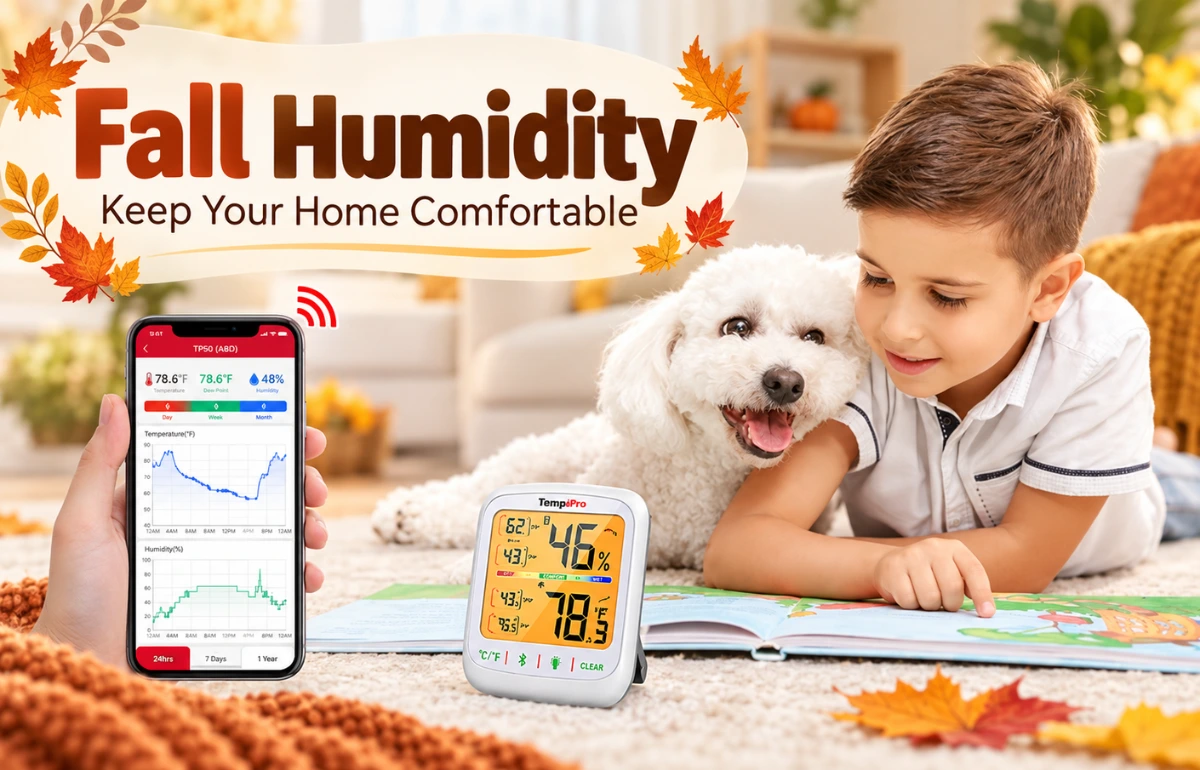
Fall is a season of change. Temperatures begin to drop, air conditioners run less often, heaters start coming on in some parts of the country, and people spend more time indoors. All of these changes can affect the humidity inside your home.
One week, your house may feel warm and sticky. A few weeks later, the same rooms may feel noticeably dry. In some homes, the basement may remain humid while the upstairs bedroom becomes dry. Even homes in the same neighborhood can have very different indoor humidity levels.
That is why it is better to measure indoor humidity instead of guessing. Here is how fall humidity can change, how to monitor it, and what you can do to create a more comfortable home.
Why Does Indoor Humidity Change in the Fall?
Indoor humidity is closely connected to outdoor weather, HVAC use, ventilation, cooking, showers, and other everyday activities.
Fall is especially interesting because it is a transition season. In northern states and higher elevations, colder weather can cause indoor air to become increasingly dry once the heating season begins. EPA guidance notes that indoor air can become too dry during the heating season, particularly in northern and mountain states.
In warmer and more humid regions, however, early fall can still bring plenty of moisture. In parts of the South and Southeast, air conditioning may continue running while outdoor humidity remains high. This means there is no single “fall humidity” level that applies to every American home.
Your Region Matters
Consider two homes in different parts of the United States.
A homeowner in Minnesota may start using the furnace as September turns into October. Heating the indoor air can cause relative humidity to fall, making the home feel dry.
Meanwhile, a homeowner in Florida or Texas may still be running the air conditioner regularly because outdoor temperatures remain high. If moisture is not adequately controlled, indoor humidity can remain elevated. The important point is that fall can push indoor humidity in either direction. Your indoor reading is more useful than a general seasonal assumption.
What Is a Comfortable Indoor Humidity Level?
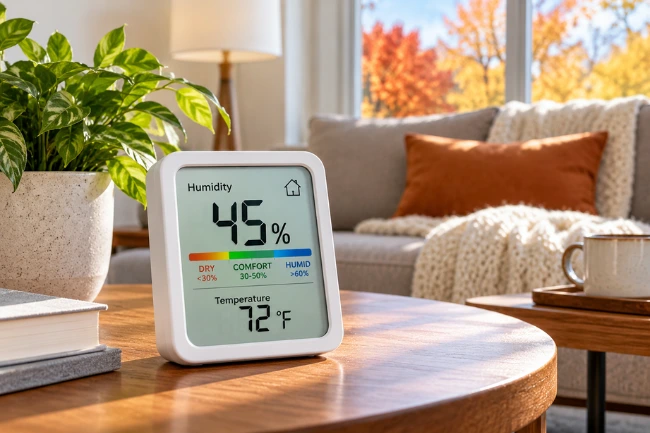
For most homes, 30% to 50% relative humidity (RH) is a useful target range. EPA guidance recommends keeping indoor humidity in this range and below 60% when possible.
Relative humidity tells you how much moisture is in the air compared with the maximum amount the air can hold at a particular temperature.
For example:
- Below 30% RH: The air may feel noticeably dry.
- 30-50% RH: A commonly recommended range for indoor environments.
- 50-60% RH: May still feel comfortable in some homes, but moisture should be watched.
- Above 60% RH: Excess moisture becomes a greater concern, especially if the level stays high.
These numbers are guidelines rather than a guarantee of comfort. People have different preferences, and the ideal setting can also depend on the building, outdoor climate, and room.
Still, having a measurable target is much better than guessing.
Signs Your Home May Be Too Humid
You may not need a hygrometer to notice that your home has a moisture problem, but visible and sensory clues can tell you when it is time to investigate.
1. Condensation on Windows
If you regularly see water droplets or fogging on the inside of windows, especially when the weather becomes cooler, it can be a sign that indoor moisture is too high.
EPA recommends acting quickly when condensation or moisture collects on windows, walls, or pipes.
2. A Musty Smell
A persistent musty smell in a basement, bathroom, closet, or other enclosed area can be a reason to investigate moisture.
Humidity itself does not tell you whether mold is present, but excess moisture can contribute to conditions that support mold growth.
3. Damp or Sticky Rooms
Does your bedroom feel unusually damp when you wake up? Does the basement feel noticeably different from the rest of the house?
These sensations can be clues that humidity is not well controlled.
4. Moisture Around Bathrooms or Kitchens
Showers, cooking, and other everyday activities add moisture to indoor air. EPA recommends using exhaust fans vented outdoors when showering or cooking to help control indoor moisture.
5. A High Hygrometer Reading
This is the clearest sign because it gives you an actual measurement.
Instead of saying, “My basement feels humid,” you might discover that it is consistently at 65% or 70% RH.
That information makes it much easier to decide what to do next.
Signs Your Home May Be Too Dry
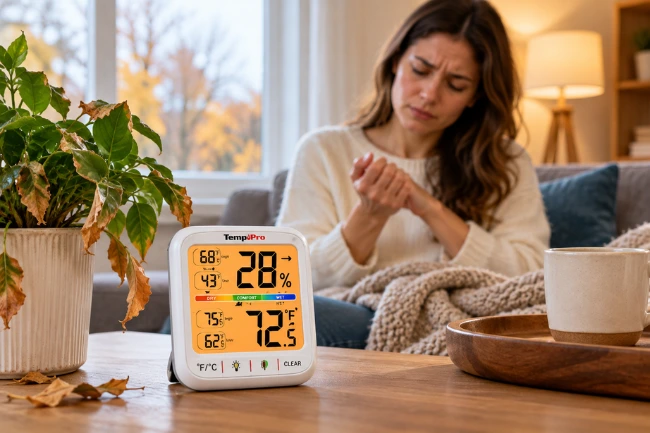
Low humidity can be just as frustrating, particularly as colder weather arrives.
You may notice:
- Dry or irritated skin
- Static electricity
- Dry-feeling air
- Houseplants struggling with dry conditions
- Wood surfaces or musical instruments becoming more sensitive to environmental changes
- A bedroom that feels noticeably different after the heating system starts running
These signs do not prove that humidity is too low, but they are good reasons to check the actual RH level. An indoor humidity and temperature monitor can help you determine whether the problem is really humidity or something else.
Where Should You Measure Humidity?
The best location depends on what you want to learn.
Bedroom
A hygrometer for the bedroom can help you understand the environment where you spend several hours every night. Place the sensor away from direct sunlight, heating vents, humidifiers, and exterior doors.
Living Room
The living room is a good general location for monitoring the overall comfort of your home, particularly if it is where your family spends most of the day.
Basement
Basements often behave differently from upper floors. They may remain cooler and more humid, especially when moisture enters through foundations, floors, or other sources. If you have a basement that feels damp, monitoring it separately can be more useful than relying on a sensor upstairs.
Nursery or Plant Room
Some homeowners also need more precise monitoring for plants or other humidity-sensitive spaces. In these situations, a device that records historical temperature and humidity data can help you understand whether conditions remain stable.
How to Monitor Humidity in Your House
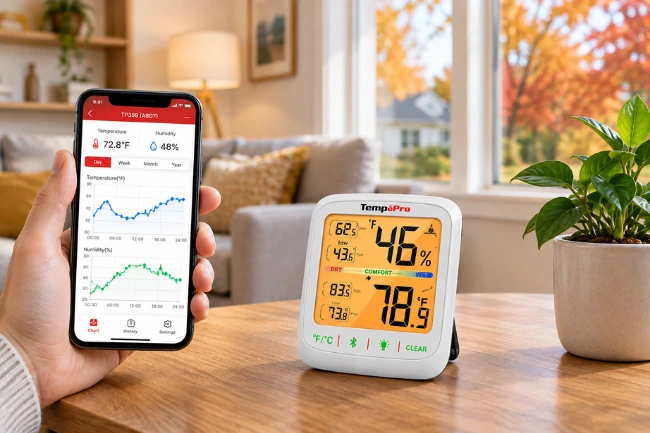
For homeowners who want a more complete picture of indoor conditions, the TempPro TempAir ELITE TP359 Bluetooth Indoor Hygrometer Thermometer combines temperature and humidity monitoring with smartphone connectivity and long-term data tracking. It uses a Swiss-made Sensirion sensor and is designed for precise indoor environmental monitoring. The device provides temperature and humidity readings on its large display while also connecting to the TempPro Sensor app through Bluetooth.
Here are some of the features that make the TP359 particularly useful for monitoring fall humidity:
- Swiss-Made Sensirion Sensor: Delivers accurate temperature and humidity readings of up to ±0.9°F and ±2% RH for reliable indoor monitoring.
- 260-Foot Bluetooth Range: Monitor temperature and humidity from your phone from up to 260 feet away in open conditions.
- Real-Time App Monitoring: Connect to the TempPro Sensor App to check current temperature and humidity readings without being next to the device.
- Long-Term Data Tracking: View temperature and humidity trends over time to understand seasonal changes and identify recurring humidity problems.
- Custom Temperature & Humidity Alerts: Set your preferred limits and receive phone notifications when conditions move outside your selected range.
- 3.5-Inch Backlit LCD: The large backlit display makes temperature and humidity readings easy to see at a glance, even in low light.
- High/Low Records: Check the highest and lowest temperature and humidity readings directly on the device without opening the app.
- 10-Second Refresh Rate: Updates readings every 10 seconds, helping you quickly notice changes in your indoor environment.
What to Do If Humidity Is Too High
If your TempPro TempAir ELITE TP359 shows that humidity is consistently above your preferred range, start by looking for the source.
- Improve Bathroom Ventilation: Run the exhaust fan while showering and for a while afterward.
- Control Kitchen Moisture: Use an exhaust fan when cooking, especially when boiling water or using the stove for extended periods.
- Check for Leaks: Look around sinks, pipes, windows, ceilings, and the basement for signs of water intrusion.
- Use a Dehumidifier: A dehumidifier can be useful when ventilation alone is not enough, especially in basements or other persistently damp areas.
- Watch for Condensation: Condensation on windows, pipes, or walls can be a sign that moisture needs more attention. EPA recommends drying wet surfaces and addressing the source of excess moisture.
What to Do If Humidity Is Too Low
If your home becomes very dry during the fall and winter, a humidifier can add moisture to the air. However, avoid running a humidifier continuously without monitoring the result. Adding too much moisture can create a different problem.
Instead, use your hygrometer to see how the RH changes after the humidifier runs. Once your indoor environment reaches a comfortable range, you can adjust the humidifier accordingly. This is also useful for identifying seasonal patterns in your home.
FAQs About Fall Humidity
What is the ideal humidity level for a home in fall?
EPA generally recommends keeping indoor relative humidity between 30% and 50%, while keeping it below 60% can help control excess moisture.
Does indoor humidity increase or decrease in the fall?
It can do either. In colder regions, indoor humidity often falls as heating systems begin running. In warmer and humid regions, homes may continue to experience high humidity during early fall.
How do I know if my house is too humid?
A hygrometer is the simplest way to check. Condensation on windows, persistent dampness, or a musty smell can also be signs that moisture needs attention.
Should I use a humidifier in the fall?
Only if your indoor humidity is actually too low. Measure the RH first, then use a humidifier if needed and continue monitoring the result.
Where is the best place to put a hygrometer?
Place it in the room you want to monitor, away from direct sunlight, heating or cooling vents, humidifiers, windows, and other immediate sources of temperature or moisture.
Can one hygrometer monitor my whole house?
One device can give you useful information, but different rooms can have different conditions. If you have a damp basement or another problem area, it can be helpful to monitor that space separately.
How often should I check indoor humidity?
For everyday use, you do not need to check constantly. A smart hygrometer that records data automatically can make it easier to watch trends and identify changes without manually recording every reading.
Final Thoughts
Fall does not bring the same humidity conditions to every home. For some households, the transition into colder weather means increasingly dry indoor air. For others, especially in warmer and humid regions, excess moisture can remain a concern well into the fall.
That is why the best approach is not to guess what your home needs. Measure indoor humidity. Understand the pattern. Make a small adjustment. Then measure again. The TempPro TempAir ELITE TP359 Bluetooth Indoor Hygrometer Thermometer makes this process easier by combining accurate temperature and humidity readings, a large backlit display, Bluetooth connectivity, customizable alerts, on-device high/low records, and up to two years of historical data through the app.
Whether you are trying to keep a bedroom comfortable, monitor a basement, protect indoor plants, or simply understand how your home changes as the seasons shift, having real temperature and humidity data gives you a much clearer picture.

Olivia Parker is a home improvement research writer with 8+ years of experience covering home design, renovation ideas, maintenance tips, and practical living solutions. She creates easy-to-follow content to help readers make informed decisions about improving their homes.