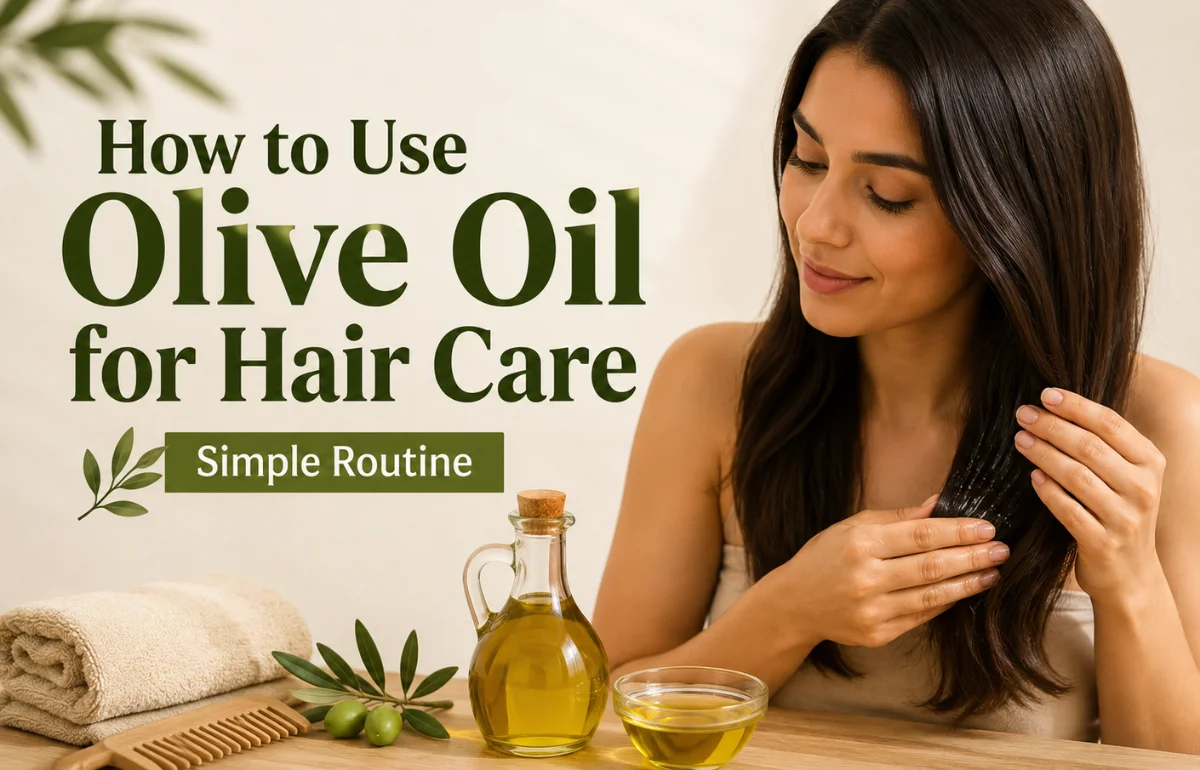
If you want to know how to use olive oil for hair care, the simplest method is to apply a small amount to the dry or damaged parts of your hair, leave it on for about 15 to 30 minutes, and then shampoo it out thoroughly. I recommend starting with less than you think you need: around 1 teaspoon for fine or short hair and up to 1 tablespoon or more for thick, long, or very dry hair. Concentrate mainly on the mid-lengths and ends rather than automatically coating your scalp.
Olive oil works primarily as an emollient and lubricant. It can coat hair fibers, reduce friction, improve softness, and make dry or weathered hair look smoother and shinier. Research on plant oils also suggests that some oils can penetrate hair fibers to different degrees, although olive oil should not be treated as a proven cure for hair loss or scalp disease.
The key is matching the amount and application method to your hair rather than copying a one-size-fits-all oiling routine.
What Does Olive Oil Actually Do for Hair?
Olive oil is rich in fatty compounds, with oleic acid being one of its major components. On hair, its most useful role is cosmetic conditioning: it can lubricate the hair surface and help dry, rough strands feel smoother.
That distinction matters. When I assess claims about natural hair oils, I separate improving the condition of the hair shaft from changing what happens inside the follicle.
Hair that feels softer, looks shinier, or breaks less easily because it is better lubricated is not necessarily “growing faster.”
Hair oils and conditioning products can help reduce friction and mechanical stress, while dermatologists also recommend regular conditioning as part of preventing avoidable hair damage and breakage.
Olive oil may be especially useful when hair feels coarse, dry, frizzy, chemically processed, or rough at the ends. Fine or naturally oily hair usually needs much less.
How to Use Olive Oil for Hair Care as a Pre-Shampoo Treatment
For most people trying olive oil for the first time, I prefer a pre-shampoo treatment over leaving straight olive oil in the hair all day.
It gives the oil time to coat the strands while making buildup easier to remove.
1. Start With Dry or Slightly Damp Hair
You can apply olive oil to dry hair, which makes it easy to see which areas need the most attention.
Slightly damp hair can also work, but the hair should not be dripping wet. Too much water makes it harder to distribute a small amount of oil evenly.
2. Measure the Oil Instead of Pouring It Directly
One of the most common reasons people dislike hair oiling is simply using too much.
I suggest these amounts as practical starting points, not strict medical measurements:
Add more only if your hair can absorb and wash out the first amount comfortably.
Fine hair can become limp very quickly, while dense, tightly curled, or highly weathered hair may need more lubrication.
3. Warm It Between Your Hands
There is no need to make olive oil hot.
Rub the measured oil between your palms for a few seconds, then smooth it through your hair in sections. Excessively heating oil creates an unnecessary burn risk and offers no reason to turn a simple conditioning treatment into a kitchen experiment.
4. Focus on Mid-Lengths and Ends
The ends of your hair are older than the hair close to your scalp and usually experience more brushing, washing, heat, sunlight, and chemical exposure.
That makes the lower lengths the logical place to concentrate an oil treatment.
Dermatology guidance similarly emphasizes conditioning vulnerable hair and applying leave-in products primarily where hair is dry, brittle, frizzy, or tangled rather than automatically coating the scalp.
5. Leave It On, Then Shampoo Thoroughly
For an ordinary pre-shampoo treatment, 15 to 30 minutes is a sensible starting window.
Then shampoo your scalp normally and allow the lather to move through the lengths. If your hair still feels unusually greasy after rinsing, a second gentle shampoo may be necessary.
Follow with your normal conditioner if your hair benefits from it. Olive oil does not need to replace a well-formulated conditioner.
Should You Put Olive Oil on Your Scalp?
Not everyone needs scalp oil.
If your scalp is comfortable and healthy and you enjoy occasional oil massage, using a very small quantity may be reasonable. I would still avoid saturating the roots unless you already know your scalp tolerates it.
If you regularly experience dandruff, greasy scaling, itching, scalp acne, unexplained redness, or seborrheic dermatitis, I would focus on the hair lengths rather than treating olive oil as a scalp remedy.
The American Academy of Dermatology recommends appropriate dandruff shampoos for dandruff and seborrheic dermatitis, including products with ingredients such as ketoconazole, selenium sulfide, salicylic acid, zinc pyrithione, sulfur, or coal tar depending on the situation.
Persistent flaking also deserves a proper diagnosis because dandruff-like symptoms can sometimes be associated with psoriasis, eczema, fungal infection, or other scalp conditions.
Which Hair Types Benefit Most From Olive Oil?
Olive oil is not automatically “good for every hair type.”
The better question is whether your hair needs the weight and lubrication that olive oil provides.
Curly and tightly coiled hair commonly needs more conditioning because natural scalp oils do not travel down curved hair shafts as easily. Dermatologists recommend keeping curly hair moisturized and note that oils or leave-in conditioners can be used after washing when appropriate.
That does not mean more oil is always better. If curls become coated, dull, sticky, or difficult to cleanse, reduce the amount.
Can You Use Olive Oil as a Leave-In?
You can use a tiny amount on dry ends, but straight olive oil is not my first choice as an everyday leave-in conditioner.
A drop or two rubbed thoroughly between the palms can tame rough ends on thick or coarse hair. Using teaspoons of oil as a leave-in is much more likely to make hair greasy, attract buildup, and force you to wash more aggressively later.
For regular leave-in conditioning, a product designed specifically to remain on the hair usually gives more predictable results.
Dermatologists distinguish rinse-out conditioners from products formulated as leave-ins and recommend using small amounts targeted to areas that need conditioning.
What Type of Olive Oil Is Best for Hair?
You will often see extra virgin olive oil recommended because it is minimally processed, but there is no strong evidence showing that an expensive culinary EVOO produces dramatically better hair-conditioning results than every other appropriate olive oil.
If I were choosing one, I would prioritize a fresh, plain olive oil with no added fragrances or flavorings.
Also, avoid the common claim that extra virgin, virgin, and refined oils simply represent “first,” “second,” and “third” pressings.
The International Olive Council classifies virgin olive oils according to production methods and chemical and sensory criteria. Refined olive oil is produced by refining virgin olive oils; it is not simply the product of a later pressing.
For hair care, purity and tolerability matter more than buying the fanciest bottle available.
Olive Oil vs. Coconut Oil for Hair
Olive oil and coconut oil are often treated as interchangeable, but the research behind them is not identical.
Coconut oil has stronger direct evidence for reducing protein loss from hair fibers in research comparing it with sunflower and mineral oils.
Olive oil has been studied for its interactions with hair fibers and can function as a conditioning oil, but I would not claim that it has the same level of evidence for protein-loss protection simply because both are plant oils.
If your goal is mainly softness, shine, reduced roughness, and easier handling, olive oil can still be useful.
Does Olive Oil Help Hair Grow?
This is where marketing often gets ahead of evidence.
There is laboratory and animal research involving olive-derived compounds such as oleuropein. For example, a study found hair-growth effects from topical oleuropein in mice. That is interesting research, but a mouse study involving an isolated olive compound does not prove that applying ordinary kitchen olive oil makes human hair grow faster.
I would therefore describe olive oil as a hair-conditioning ingredient, not a proven treatment for androgenetic alopecia, alopecia areata, telogen effluvium, or other forms of hair loss.
If you notice widening parts, bald patches, persistent shedding, scalp pain, or progressive thinning, treating the underlying cause matters far more than applying additional oil. Dermatologists recommend evaluation when hair loss or ongoing breakage persists despite better hair-care practices.
Can Olive Oil Repair Split Ends?
Olive oil can make split or rough ends look smoother temporarily because lubrication reduces friction and improves the way damaged strands lie against each other.
It cannot permanently fuse badly split hair back into an undamaged fiber.
Think of it as maintenance rather than structural reconstruction. If an end is severely split, trimming remains the dependable way to remove the damaged section.
After that, reducing excessive heat, aggressive brushing, chemical processing, and friction can help slow additional damage.
How Often Should You Use Olive Oil on Hair?
I prefer to base frequency on how the hair responds rather than following a fixed calendar.
Very dry or coarse hair may tolerate a pre-shampoo treatment once a week. Medium or moderately dry hair may need it every one or two weeks. Fine or oily hair might benefit only occasionally—or not at all.
Your hair is giving you useful feedback.
If it feels softer and easier to detangle after washing, your amount is probably reasonable. If it looks flat, sticky, stringy, or greasy after shampooing, use less oil or apply it less often.
Mistakes That Make Olive Oil Hair Treatments Worse
The biggest mistake is assuming that more oil produces more moisture.
Oil itself does not add water to the hair. Its useful cosmetic role is mainly lubrication and helping reduce moisture loss or friction.
I would also avoid repeatedly applying heavy layers without properly cleansing the scalp and hair. Regular shampooing removes accumulated oils, dead skin, microorganisms, and hair products; excessive buildup can create its own scalp and styling problems.
Another mistake is using olive oil as a substitute for medical treatment. It is not a proven head-lice remedy, for example. The American Academy of Dermatology specifically states that home remedies such as olive oil have not been shown to effectively eliminate lice.
A Simple Olive Oil Routine I Recommend
For most people with dry lengths, I would keep the routine uncomplicated.
Use a small measured amount of olive oil before shampooing. Work it mainly through the mid-lengths and ends, leave it for around 15 to 30 minutes, shampoo thoroughly, and condition as usual.
Try that routine once before increasing either the amount or the treatment time.
This approach gives you something many olive-oil hair guides miss: a way to judge whether the treatment is actually helping your hair rather than assuming that an oily feeling automatically means better conditioning.
Frequently Asked Questions
Can I leave olive oil in my hair overnight?
You can, but it is rarely necessary. A shorter pre-shampoo treatment is easier to wash out and reduces the chance of excessive buildup.
Should I apply olive oil to wet or dry hair?
Dry or slightly damp hair both work. I prefer dry hair for pre-shampoo oiling because it makes controlling the amount and targeting damaged areas easier.
Can I use olive oil on my hair every day?
Most people do not need straight olive oil every day. Fine or oily hair can become weighed down quickly, while very dry hair may tolerate tiny amounts on the ends.
Does olive oil get rid of dandruff?
Olive oil is not an established dandruff treatment. Persistent flakes are better addressed with appropriate dandruff care or a dermatologist when symptoms continue.
Is extra virgin olive oil better for hair than regular olive oil?
EVOO is less refined, but there is no strong evidence proving that it delivers dramatically better hair-conditioning results. A plain, fresh oil used in the right amount is more important.
Making Olive Oil Work for Your Hair
Learning how to use olive oil for hair care is less about soaking your hair and more about controlling where, how much, and how often you apply it.
I recommend starting with a small pre-shampoo treatment on the driest lengths, monitoring how easily it washes out, and adjusting from there. If your hair becomes softer without feeling coated, you have probably found the right balance.
If your real concern is persistent dandruff, scalp irritation, unexplained breakage, or hair loss, move beyond DIY oiling and address the underlying problem with appropriate hair or dermatologic care.

Natalie Brooks is a hair care writer with 6 years of experience creating practical content about hair health, scalp care, hair routines, ingredients, and everyday maintenance. She focuses on helping readers understand their hair needs through simple, research-informed guidance while promoting realistic care practices and informed choices.