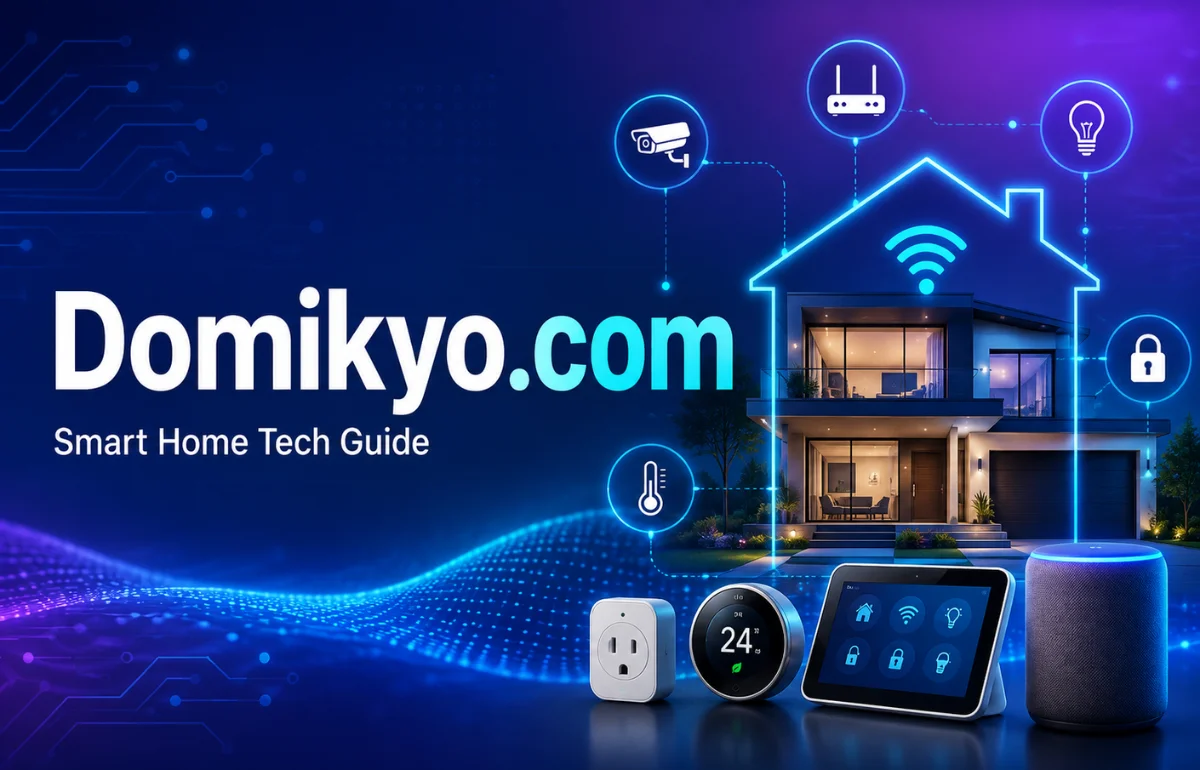
Domikyo.com is a web domain currently associated in 2026 search results with digital connectivity, smart-home networking, Internet of Things (IoT) devices, and modern connected-home technology. Recent third-party coverage consistently presents Domikyo.com as an informational resource for people trying to understand how smart devices, home networks, automation platforms, and security fit together. I would describe it as a technology information destination rather than a smart-home product, app, or hardware manufacturer.
There is one useful caveat. When I checked the live domain while researching this article, its homepage blocked automated retrieval with a 403 response. Because of that, I cross-checked indexed references and domain records instead of treating every third-party description as fact. Some pages describe a broader editorial scope, but smart-home connectivity is the clearest recurring theme in current search results.
What Is Domikyo.com Used For?
The main reason people encounter Domikyo.com appears to be research. A reader may be trying to understand why a smart bulb keeps dropping offline, whether a mesh network is worth buying, how IoT devices should be separated from personal computers, or how newer standards such as Matter and Thread change a connected-home setup.
That matters because smart-home problems are often misdiagnosed as device problems. A perfectly good camera can feel unreliable if Wi-Fi coverage is weak. A smart lock can appear slow when cloud communication adds latency. Multiple IoT devices can also increase security exposure if they share the same network as laptops holding sensitive files.
When I assess smart-home advice, I look beyond product recommendations. I want to see whether the guidance explains networking, interoperability, security, local control, firmware support, and what happens when the internet connection fails.
What Current Search Results Say About Domikyo.com
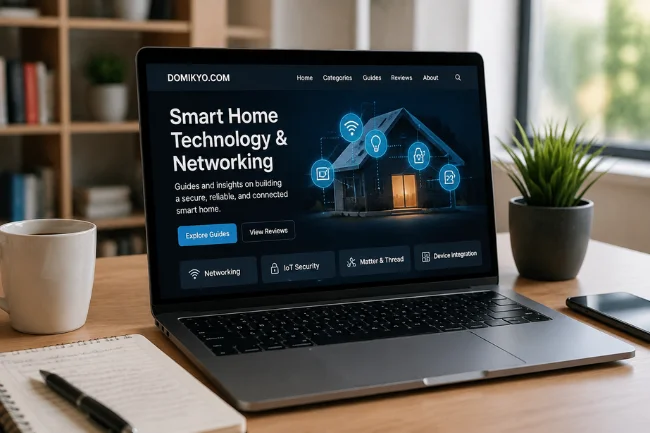
Recent indexed articles describe Domikyo.com primarily as a platform connected with smart-home technology and networking. One 2026 technology article characterizes it around networking foundations, IoT security, performance optimization, Matter, Thread, and device integration. Another recent result places Domikyo.com in a technology category and describes it through the lens of digital connectivity and modern home living.
Not every third-party description agrees. One indexed page portrays the domain as a broader information website covering technology, business, finance, health, and lifestyle. Since I could not independently verify the full current category structure from the live homepage, I would treat those broader claims cautiously.
This is a useful rule for any unfamiliar website: separate what can be observed from what other sites merely repeat.
The Smart-Home Topics Most Closely Associated With Domikyo.com
The strongest topical association around Domikyo.com is connected-home infrastructure. That includes the less glamorous parts of home automation that determine whether everything actually works.
Home Networking and Wi-Fi Reliability
A smart home depends on stable connectivity. Router quality, access-point placement, wall materials, radio interference, backhaul, and the number of active devices can all affect performance.
A useful networking resource should help readers distinguish between internet speed and local network quality. Paying for faster broadband will not fix a dead Wi-Fi zone caused by poor router placement. Likewise, strong Wi-Fi cannot compensate for a limited upload connection if several cloud cameras are transmitting video at once.
IoT Devices and Network Segmentation
Connected lights, plugs, sensors, thermostats, cameras, locks, appliances, and hubs all fall under the IoT umbrella. They do not necessarily need the same level of access as a personal laptop or work computer.
For security, I prefer to think in zones: trusted devices, IoT devices, guests, and infrastructure equipment. Even a basic guest network can provide some separation on consumer routers, while more capable hardware may support VLANs and firewall rules.
CISA guidance recommends segmentation for IoT environments because separation can reduce unnecessary communication and limit exposure between device groups.
Smart-Home Interoperability
The connected-home market has historically been fragmented. A household may contain products built around Wi-Fi, Zigbee, Z-Wave, Thread, Bluetooth, or vendor-specific hubs.
Matter is designed to reduce some of that friction. The Connectivity Standards Alliance says Matter uses Wi-Fi, Ethernet, and Thread for connectivity, with Bluetooth Low Energy used during setup. Existing Zigbee or Z-Wave devices can also participate through compatible bridges.
That distinction matters because Matter does not replace every smart-home radio. It provides a common application layer that can work across supported transports and bridges.
Domikyo.com in the 2026 Smart-Home Landscape
A useful way to judge any site discussing smart homes is to compare its coverage with the technology readers actually encounter today.
| Area | What Readers Need to Understand | Why It Matters in 2026 |
|---|---|---|
| Wi-Fi and Ethernet | Coverage, bandwidth, backhaul, router placement | Backbone for cameras, TVs, hubs, computers, and controllers |
| Thread | Low-power IP mesh networking | Used by newer sensors and smart-home devices |
| Matter | Cross-ecosystem interoperability | Helps supported products work across major platforms |
| Zigbee/Z-Wave | Established low-power device networks | Large installed base, often connected through hubs or bridges |
| Network security | Segmentation, credentials, updates, firewall settings | More IoT devices mean more network endpoints |
| Local control | Operation without constant cloud access | Can improve responsiveness, resilience, and privacy |
The timing is relevant. Matter 1.6 was announced on June 17, 2026, with improvements focused on setup, multi-ecosystem experiences, device management, and context-aware control. Current smart-home coverage should therefore explain more than generic Wi-Fi advice.
What I Look for Before Trusting Advice From Domikyo.com or Any Similar Site
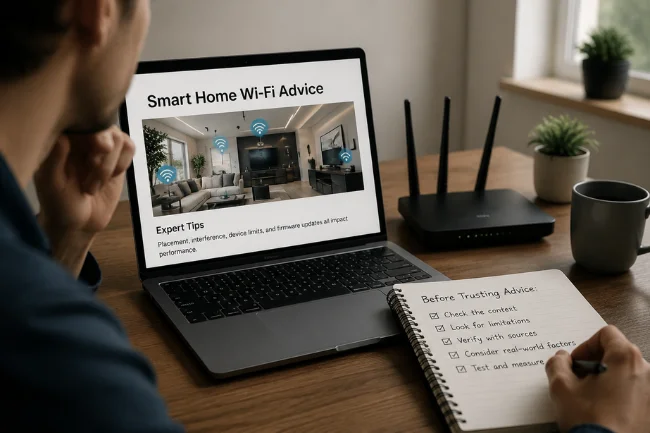
I do not judge a technology article only by how polished it sounds. I use a few practical checks.
Does the Advice Explain Its Limits?
Statements such as “a router can handle 20 devices” or “you need mesh above a certain square footage” are too broad without context.
Device capacity depends on the router, radio bands, traffic patterns, interference, firmware, and how many clients are active. Home size also tells only part of the Wi-Fi story. Concrete, brick, metal, mirrors, floor layout, and access-point placement can matter as much as square footage.
Does It Separate Wi-Fi Problems From Internet Problems?
These are not the same.
If a local smart switch responds slowly while you are standing beside the router, the cause may involve the device, controller, cloud service, DNS, or automation platform. If only a distant bedroom has trouble, coverage is a more likely suspect.
Good troubleshooting starts by identifying which layer is failing.
Does It Cite Standards or Primary Sources?
For current smart-home topics, I value references from organizations such as the Connectivity Standards Alliance, CISA, device manufacturers, and established networking vendors.
A general article can provide useful context, but factual claims about protocols, compatibility, and security should be checked against primary documentation.
Does It Explain Security Beyond Strong Passwords?
Passwords matter, but connected-home security is broader. Firmware updates, account protection, network isolation, cloud dependencies, end-of-support policies, remote access, and device permissions all deserve attention.
CISA’s IoT material identifies weak credentials and limited segmentation as risk areas, which is why credible smart-home security advice should go beyond a single password tip.
Domikyo.com vs. a General Smart-Home Blog
Domikyo.com is most useful to think about as part of a wider research process rather than as the only source a reader should consult.
| Research Need | Domikyo.com-Style Informational Content | Primary or Specialist Source |
|---|---|---|
| Understand a concept quickly | Useful for plain-language explanations | Often more technical |
| Check Matter compatibility | Helpful for context | Manufacturer and CSA documentation should be decisive |
| Configure a router | Useful for general principles | Router support pages provide exact settings |
| Evaluate IoT security | Good for awareness | CISA and vendor documentation add authority |
| Troubleshoot a specific device | May suggest common causes | Manufacturer support is usually more specific |
I often start with an accessible explanation to understand the shape of a problem, then move to primary documentation before changing a network setting or buying hardware.
Is Domikyo.com Safe and Trustworthy?
I would avoid giving any unfamiliar domain a blanket “safe” or “unsafe” label without a full security assessment.
What I could verify during this review is that Domikyo.com resolves through Cloudflare infrastructure and has active DNS records, including a Google site-verification TXT record. Those details show an actively configured domain, but they do not prove editorial quality, ownership transparency, or the safety of every page, download, advertisement, or outbound link.
The better approach is practical: keep your browser updated, avoid unexpected downloads, check where links lead, and do not enter passwords or payment details unless you understand why they are required and trust the destination.
For content quality, apply a similar test. Look for named authors, publication dates, sources, corrections, transparent methodology, and links to primary documentation.
What Would Make Domikyo.com More Useful to Readers?
There is room for a smart-home information site to stand out in 2026 by going beyond broad recommendations.
I would want to see real network diagrams, measured Wi-Fi results, device compatibility notes, router screenshots, Matter and Thread explanations, and troubleshooting trees that start with symptoms rather than products.
Original testing would be even more valuable. Showing how a camera behaves before and after an access point is repositioned tells the reader more than simply saying “place your router centrally.”
Comparing wireless mesh backhaul with wired Ethernet backhaul in the same home would add evidence readers can act on.
That is the difference between content that sounds knowledgeable and content that demonstrates experience.
A Practical Way to Use Domikyo.com
If you arrive at Domikyo.com from search, use the article you found to identify the relevant concept first. Is your real problem Wi-Fi coverage, internet bandwidth, device compatibility, automation reliability, or security?
Next, note the specific protocol and model names involved. A Matter-over-Thread sensor has different networking requirements from a Wi-Fi camera, even though both may appear in the same smart-home app.
Then verify any setting that could affect security or compatibility against the hardware manufacturer’s documentation or the relevant standards body.
This two-source habit prevents a general article from becoming a single point of failure in your research.
Final Take
Domikyo.com is best understood as a web resource currently associated with digital connectivity, smart-home networking, IoT, and connected-home technology. Its value depends less on the domain name itself and more on whether individual articles provide accurate, current, transparent, and verifiable guidance.
My recommendation is to use accessible technology content to learn the concepts, then confirm protocol, security, and product-specific claims with primary sources before making changes to your home network.
If you are researching Domikyo.com because you want a more reliable smart home, your next move should be to inventory your devices, identify which protocols they use, and map the network they depend on.
FAQs About Domikyo.com
What is Domikyo.com?
Domikyo.com is a web domain currently associated in search results with digital connectivity, smart-home networking, IoT, automation, and connected-home technology.
What topics does Domikyo.com cover?
Current third-party descriptions most consistently connect it with home networking, smart devices, IoT security, automation, and interoperability, although some sources describe a broader scope.
Is Domikyo.com a smart-home company?
Current evidence points more toward an informational web resource than a manufacturer of smart-home hardware or a dedicated automation platform.
Is Domikyo.com safe to use?
An actively configured domain is not a security guarantee. Use normal web-safety practices and verify sensitive, technical, or purchasing claims with primary sources.
Why are people searching for Domikyo.com?
Search interest appears to combine navigational intent with curiosity about what the site offers, particularly around smart-home connectivity, networking, IoT, and technology information.

Noah Sterling is a technology research writer with 8+ years of experience covering emerging technologies, software trends, digital tools, and innovation. He creates practical, research-based articles to help readers understand the evolving technology landscape.