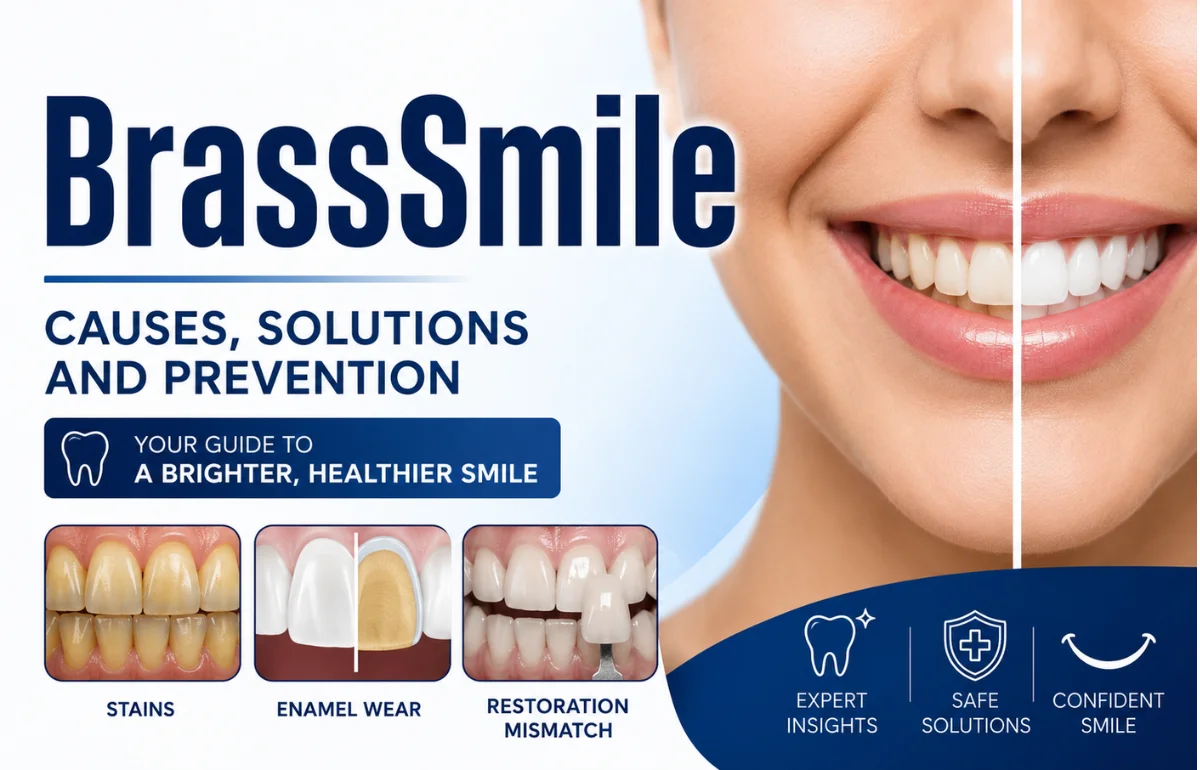
BrassSmile is not a formally recognized dental diagnosis. Online, the term is used loosely for a smile that looks yellow, warm-toned, metallic, uneven, or less bright than expected. In some searches, BrassSmile may also refer to a dental brand, website, or general smile-improvement concept.
From a dental perspective, a “brassy” appearance can come from surface stains, naturally yellow dentin showing through enamel, plaque around braces, mismatched restorations, developmental enamel changes, or a single damaged tooth.
That distinction matters because BrassSmile is a description, not a diagnosis. Whitening may help coffee stains, but it will not recolor a crown, repair enamel loss, straighten crowded teeth, or treat decay. When I assess an unfamiliar smile-related term as a writer, I start with one practical question: what visible problem is the person actually trying to solve?
Is BrassSmile a Real Dental Term?
BrassSmile is best understood as an informal internet label rather than a standard term used in dental records. A dentist is more likely to describe the underlying issue as extrinsic staining, intrinsic discoloration, enamel thinning, hypomineralisation, plaque accumulation, restoration mismatch, or tooth misalignment.
The safest way to understand BrassSmile is to separate appearance from cause. Two people may describe their teeth as “brassy,” yet one may have harmless coffee stains while the other has an enamel defect or a damaged tooth that needs treatment.
This is why choosing a whitening product before identifying the cause can lead to disappointing or uneven results.
What Can Cause a BrassSmile Appearance?
Surface Stains From Food, Drinks, and Tobacco
Coffee, tea, red wine, dark soft drinks, and tobacco can leave pigments on the outer surface of teeth. Dentists generally describe these marks as extrinsic stains.
Some surface discoloration may improve after professional cleaning and polishing. Deeper or more widespread staining may respond to dentist-supervised whitening, depending on the condition of the teeth and gums.
Surface stains usually develop gradually. They may be more noticeable near the gumline, between crowded teeth, or around areas that are difficult to brush properly.
Naturally Yellow Dentin Showing Through Enamel
Healthy teeth are not naturally paper-white. Dentin, the layer beneath enamel, has a yellow tone. Because enamel is partly translucent, the color underneath influences the final shade of each tooth.
MedlinePlus describes dentin as the hard yellow portion beneath the enamel.
As enamel becomes thinner through age, wear, or repeated acid exposure, teeth may appear warmer even when they are clean. The American Dental Association describes dental erosion as the progressive loss of dental tissue caused by acids from dietary, lifestyle, environmental, or internal sources.
In this situation, frequent whitening may produce only a limited improvement. It can also create more sensitivity when products are overused or applied without professional guidance.
Plaque, Tartar, and Staining Around Braces
Fixed braces create additional spaces where plaque, food particles, and pigments can collect. Coffee, tea, and red wine may stain teeth during orthodontic treatment, while acidic and sugary drinks can contribute to enamel damage and cavities.
The American Association of Orthodontists recommends careful cleaning around brackets and wires and advises patients to limit stain-producing, sugary, or acidic drinks.
Clear aligners are removable, but they do not eliminate staining or decay risks. Drinking anything other than water while wearing trays can trap liquid against the teeth, discolor the aligners, stain enamel, and increase the chance of cavities.
After braces or aligners, differences in color may also become more obvious. Areas that were covered by plaque or surrounded by brackets may look different from the rest of the tooth.
Existing Fillings, Crowns, or Veneers
Dental restorations do not always age at the same rate as natural enamel. A crown may look more opaque than nearby teeth, an old filling may darken around its edges, or natural teeth may become lighter after whitening while restorations remain unchanged.
This is one of the biggest BrassSmile issues missing from many online explanations. Whitening can affect natural teeth, but it does not change the color of existing fillings, crowns, or veneers.
Leeds Teaching Hospitals advises that tooth whitening will not alter the color of previously placed fillings or veneers. Restorations may need to be replaced if they no longer match the whitened teeth.
A dentist may recommend polishing, repairing, or replacing a restoration after the surrounding teeth have reached a stable shade.
Developmental Enamel Changes
Cream, yellow, brown, or chalky patches are not always ordinary stains.
Molar-incisor hypomineralisation, commonly shortened to MIH, occurs when enamel does not form normally. Affected teeth can look cream, yellow, brown, or chalky. They may also be sensitive, weaker, and more vulnerable to tooth decay.
Because the affected areas can differ in thickness and structure, standard whitening may produce an uneven result. Depending on the severity, treatment may involve fluoride care, resin infiltration, microabrasion, bonding, whitening, or another restorative approach.
A Dark or Discolored Single Tooth
One tooth that becomes darker than the others deserves a dental assessment.
Possible causes include previous trauma, decay, a large restoration, internal changes in the tooth, or previous root canal treatment. A single dark tooth is different from generalized staining and may require a completely different treatment.
Composite veneers, crowns, internal bleaching, or restorative procedures may be considered after diagnosis. The American Dental Association has reported that composite veneers can help mask discoloration, while crowns may be more suitable in certain moderate-to-severe cases. Crowns, however, can involve greater cost, more removal of tooth structure, and a higher risk of future repair.
A Practical BrassSmile Self-Check
I use a simple “location, texture, history, and symptoms” framework when organizing this topic. It does not replace a dental examination, but it helps identify the right first question.
Ask yourself four questions:
- Is the color change spread across most teeth or limited to one area?
- Does the surface feel smooth, rough, chalky, or covered with buildup?
- Did the change appear after braces, trauma, whitening, medication, or dental treatment?
- Is there pain, sensitivity, swelling, bleeding, or an unpleasant taste?
The more localized, sudden, painful, or structurally unusual the change is, the less sensible it is to treat it as a simple cosmetic stain.
Which BrassSmile Treatment Makes Sense?
Professional Cleaning and Polishing
Cleaning is a logical starting point when plaque, tartar, or superficial stains are visible. Removing deposits reveals the natural tooth shade and allows a dentist to see whether another problem remains underneath.
Professional cleaning can improve the appearance of surface staining, but it does not bleach dentin or change discoloration that originates inside the tooth.
For many people, cleaning is also a useful first diagnostic step before spending money on cosmetic treatment.
Dentist-Supervised Whitening
Whitening is generally most useful for natural teeth with widespread discoloration. Treatment may involve custom trays used at home under professional supervision or a procedure completed in a dental office.
Temporary tooth sensitivity, gum irritation, a sore throat, or temporary white patches on the gums can occur. The NHS also warns that whitening obtained outside professional dental care may work less effectively and could damage teeth or gums.
Whitening is not a universal solution. It will not:
- Straighten crowded teeth
- Fill chips or cracks
- Remove tartar
- Treat cavities
- Repair weak enamel
- Change the shade of crowns, veneers, or fillings
A proper examination should come before whitening when teeth are painful, highly sensitive, heavily restored, or unevenly discolored.
Composite Bonding
Composite bonding uses tooth-colored resin to cover localized discoloration, reshape an edge, close a small gap, or repair a minor chip.
It is usually more conservative than a crown or porcelain veneer because little or no healthy tooth structure may need to be removed. Bonding can be particularly helpful when whitening cannot correct one small patch or when the concern involves both color and shape.
Composite resin is not permanent. It can stain, chip, wear, or lose its polish over time. Careful shade planning is also necessary.
When whitening and bonding are both planned, whitening is commonly completed first. The bonding material can then be matched to the new, settled tooth shade.
Porcelain Veneers and Crowns
Porcelain veneers cover the front surface of selected teeth. They can change color, visible shape, length, spacing, and symmetry.
Crowns cover more of the tooth. They may be recommended when a tooth is weakened, heavily filled, fractured, root-treated, or deeply discolored.
These treatments should not be viewed as stronger versions of whitening. They are restorative procedures that may involve permanent alteration of the tooth and future maintenance.
Leeds Teaching Hospitals notes that crowns may be used for weakened teeth, large or discolored fillings, tooth wear, root-filled teeth, and certain inherited conditions that affect tooth structure or shape.
A conservative dentist should explain why a veneer or crown is preferable to whitening, bonding, or no treatment before irreversible work begins.
Braces or Clear Aligners
Orthodontic treatment changes tooth position rather than enamel color.
It may improve a BrassSmile appearance when crowding creates shadows, overlapping edges, uneven spacing, or areas that are difficult to clean. Straighter teeth may also make plaque control easier for some patients.
Clear aligners can be discreet and removable, but suitability depends on the orthodontic problem and the patient’s ability to wear and maintain the trays correctly.
Traditional braces can treat a wide range of alignment and bite problems but require detailed cleaning around brackets and wires. The American Association of Orthodontists notes that clear aligners may make routine cleaning easier, while fixed braces require particularly careful brushing and flossing.
How to Maintain a Cleaner, More Even Smile
Brush twice daily with fluoride toothpaste and a soft-bristled toothbrush. Clean between the teeth with floss, interdental brushes, or another aid recommended by your dental professional.
People with fixed braces may need small interdental brushes, floss threaders, or water flossers to reach around wires and brackets.
Rinse your mouth with water after coffee, tea, or other strongly colored drinks. Frequent sipping keeps pigments and acids in contact with enamel for longer periods, so drinking them with meals may be preferable to consuming them slowly throughout the day.
Avoid brushing immediately after acidic food or drinks. Acid can temporarily soften the enamel surface, and the ADA advises allowing saliva time to neutralize acids before brushing.
For clear aligners, remove the trays before eating or drinking anything other than water. Brush before placing them back in your mouth and clean the trays according to your orthodontist’s instructions.
I also recommend taking progress photographs in the same room, at the same time of day, and under the same lighting. Phone filters, bathroom lights, camera exposure, and nearby colors can make identical teeth look dramatically different.
Consistent photographs help you judge real changes instead of chasing a tooth shade created by lighting.
What Not to Do
Do not use lemon juice, vinegar, acidic fruit mixtures, abrasive powders, or repeated harsh scrubbing to brighten teeth.
Acids can contribute to enamel erosion, while excessive abrasion may gradually expose more yellow dentin. The result can be teeth that look darker and feel more sensitive, even though the original goal was whitening.
Do not keep increasing whitening frequency because the color looks uneven. Uneven results may be caused by fillings, crowns, enamel defects, white-spot lesions, demineralisation, or a non-vital tooth. Bleaching cannot reliably solve all of these problems.
Do not whiten over untreated cavities, painful gums, unexplained sensitivity, or a suddenly dark tooth. Tooth decay begins when bacteria produce acids that attack enamel. Without treatment, it can progress to pain, infection, and eventual tooth loss.
When Should You See a Dentist?
Arrange a dental assessment when discoloration:
- Appears suddenly
- Affects only one tooth
- Develops after an injury
- Comes with pain or swelling
- Includes bleeding gums or a bad taste
- Looks rough, pitted, chalky, or crumbly
- Appears around a damaged filling or crown
- Continues to worsen despite normal cleaning
A consultation is also sensible before whitening if you have veneers, crowns, large fillings, gum recession, sensitive teeth, enamel erosion, or a history of extensive dental treatment.
The goal is not automatically to select the whitest or most expensive treatment. It is to identify the least invasive option that addresses the actual cause.
Frequently Asked Questions
What does BrassSmile mean?
BrassSmile is an informal online term for a yellow, warm-toned, uneven, or cosmetically dull smile. It is not a recognized dental diagnosis.
Can I whiten a BrassSmile at home?
Home whitening may improve some stains, but a dental assessment is safer when you have sensitivity, patches, restorations, decay, or one unusually dark tooth.
Why are my teeth yellow even though I brush them?
Brushing removes plaque but cannot change natural dentin color, internal discoloration, enamel thickness, or the shade of fillings and crowns.
Can clear aligners fix BrassSmile?
Aligners can correct crowding and spacing, which may improve overall appearance and cleaning access, but they do not whiten tooth enamel.
Is a brassy-looking tooth a sign of decay?
Not always, but a localized dark, brown, rough, painful, or rapidly changing area should be examined to rule out decay, trauma, or internal tooth changes.
Choose the Cause Before the Cosmetic Treatment
BrassSmile is most useful as a starting description: “My smile looks warmer, darker, or less even than I want.”
The next step is to determine whether the cause is surface staining, enamel structure, tooth alignment, restoration color, or a problem inside one tooth. Each cause requires a different approach.
Start with a professional examination and cleaning before committing to whitening, bonding, veneers, crowns, or orthodontic treatment. A cause-first plan is more likely to produce a natural-looking result, protect healthy tooth structure, and prevent you from paying for a procedure that cannot solve the real problem.
Other Resources
- Delta Dental of Missouri: 5 Smart Plan Comparisons
- Dental Implants Cost Calculator: Essential 2026 Guide
- Full Mouth Dental Implants: Complete Patient Guide

Daniel Reed is a dental health writer with 6 years of experience creating clear, research-informed content about oral hygiene, gum care, preventive habits, and everyday dental wellness. He focuses on making reliable information easy to understand while encouraging readers to seek professional dental care for diagnosis and treatment.