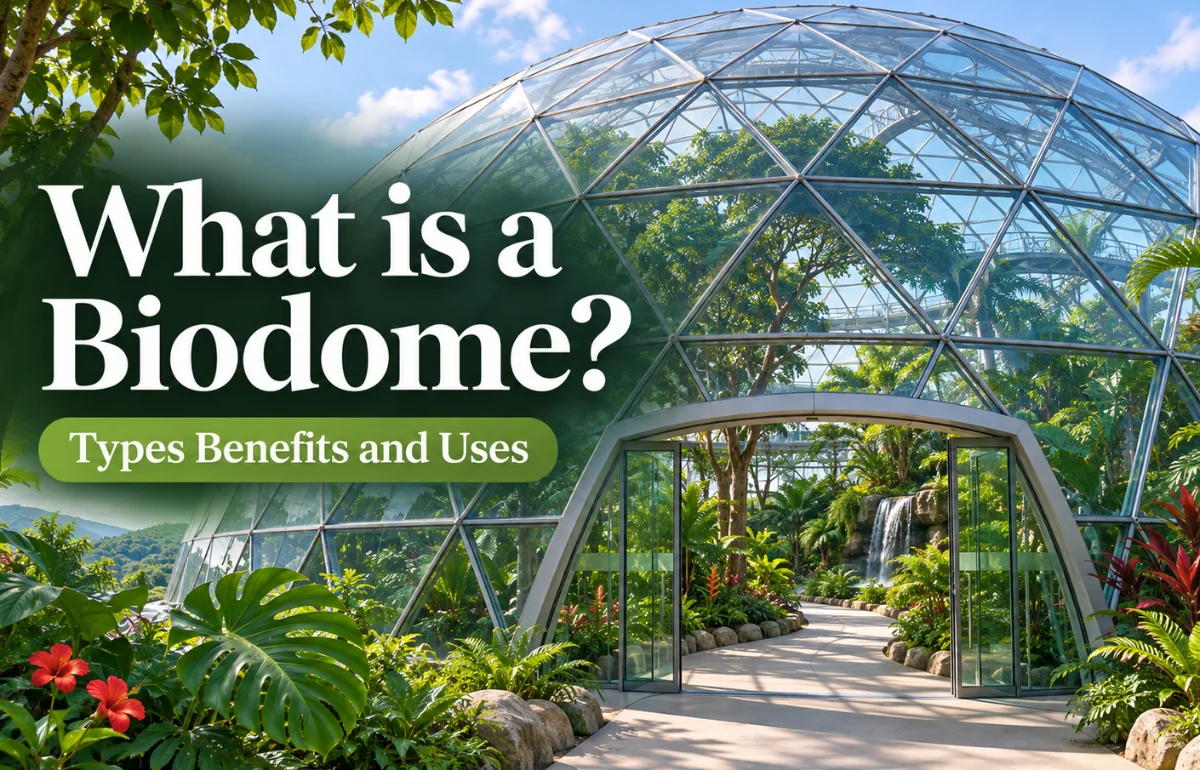
What is a Biodome? A biodome is a controlled environment designed to recreate the living conditions of one or more natural ecosystems. Inside, plants, animals, microorganisms, water, soil, and air interact while people manage factors such as temperature, humidity, and light. Some biodomes are public attractions where visitors explore different habitats; others support scientific research, conservation, or food production. Although the name suggests a dome-shaped building, a biodome does not have to be round or completely sealed. The defining feature is the ecosystem being maintained inside it, not the shape of its roof.
I find it helpful to picture a rainforest operating inside a building during a freezing winter. The trees still need warmth, moisture, and sunlight, while the creatures living among them need suitable food and shelter. A biodome brings those requirements together in one managed space.
What Does Biodome Mean?
The word combines “bio,” meaning life, with “dome,” a term associated with a covered enclosure. In everyday use, it describes an indoor or enclosed habitat that imitates the conditions of a real ecosystem, such as a tropical forest, desert, or coastal environment.
A biodome is more than a collection of potted plants. The goal is to support relationships among living organisms and their surroundings. Fallen leaves may decompose, insects may pollinate flowers, and water may circulate through different parts of the habitat.
Not every installation contains animals, and not every biodome tries to become self-sufficient. Some depend heavily on outside electricity, water, food, and maintenance. That distinction matters when people describe biodomes as miniature versions of Earth.
How Does a Biodome Work?
A biodome works by controlling the conditions that allow its selected ecosystem to function. Engineers and habitat specialists monitor the physical environment, while horticulturists, biologists, and animal-care teams manage the living components.
1. Temperature and Humidity Control
Heating, cooling, ventilation, misting, and dehumidification equipment help reproduce the chosen climate. Tropical plants generally need different conditions from desert species, so a facility with multiple habitats may need separate climate zones.
Humidity is particularly tricky. Plants release water vapor through transpiration. That moisture can support a rainforest environment, but it can also cause condensation on glazing and increase the risk of fungal problems if airflow is poor.
2. Sunlight and Artificial Lighting
Transparent roofs or walls bring in daylight. Where natural light is insufficient, horticultural LEDs can supplement it and help maintain suitable growing cycles.
More light is not automatically better. Species differ in their light requirements, and additional lamps generate electricity costs and sometimes extra heat that must be removed.
3. Water and Nutrient Cycling
Irrigation systems deliver water to plants, while drains, filters, storage tanks, and treatment equipment manage runoff. Some biodomes capture rainwater or reuse treated water, but the safety and suitability of that water depend on its intended use.
Nutrients move through soil, plants, animals, and decomposers. However, a managed habitat may still need fertilizer or other external inputs to replace nutrients lost through harvesting, waste removal, or routine cleaning.
4. Air Quality and Gas Exchange
Plants absorb carbon dioxide during photosynthesis and release oxygen, while plants, animals, and microbes also respire. Air movement helps distribute gases, prevent stagnant pockets, and support temperature control.
A large greenhouse-style biodome normally exchanges some air with the outside. A tightly sealed research enclosure needs a more sophisticated approach to atmospheric monitoring and life-support management.
5. Sensors, Controls, and Human Care
Sensors can track temperature, moisture, light, carbon dioxide, and water conditions. Automated controls respond to readings, but they do not replace human judgment.
Staff still inspect equipment, prune plants, test water, monitor pests, care for animals, and adjust the environment when conditions change. In my view, that ongoing work is the clearest difference between a biodome and the fantasy of a perfectly self-running ecosystem.
What Is Inside a Biodome?
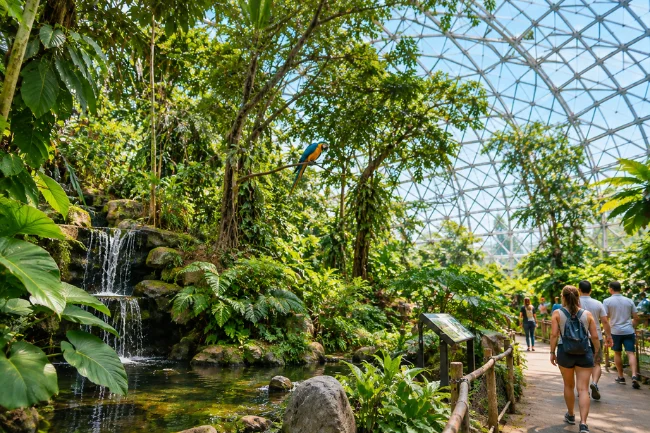
The contents depend on the habitat being recreated. A tropical biodome might contain tall trees, vines, birds, insects, streams, and damp soil. A desert enclosure might feature cacti, succulents, sandy substrates, rocks, and species adapted to dry conditions.
Four groups make most ecosystem displays easier to understand:
- Producers: plants and algae that use light to make organic matter.
- Consumers: animals and other organisms that feed on plants or one another.
- Decomposers: fungi, bacteria, and small invertebrates that break down organic material.
- Nonliving components: air, water, minerals, light, temperature, and habitat structures.
Not all those components are visible. Healthy soil microbes and water chemistry can matter just as much as the dramatic trees visitors photograph.
Main Types of Biodomes
Biodomes can be classified by the environment they imitate or the job they are designed to perform.
Tropical Rainforest Biodomes
These recreate warm, humid habitats with dense vegetation and layered plant growth. Their main challenges include moisture control, airflow, pest management, and providing enough light beneath a crowded canopy.
Desert Biodomes
Desert habitats emphasize strong light, carefully managed water, and species adapted to dry conditions. Designers must avoid assuming that every desert is constantly hot; some desert ecosystems experience substantial changes between daytime and nighttime temperatures.
Aquatic and Wetland Biodomes
These may recreate coastal waters, freshwater habitats, marshes, or mangroves. Water filtration, oxygen levels, salinity where relevant, and the needs of aquatic animals become central operating concerns.
Agricultural Biodomes
Agricultural enclosures focus on growing crops under managed conditions. They may use soil beds, hydroponics, vertical growing systems, or aquaponics. Their success is usually judged by crop quality, resource use, reliability, and operating cost rather than by the number of species displayed.
Research and Educational Biodomes
Research facilities investigate ecosystem processes, while educational biodomes help visitors understand biodiversity and the relationship between climate and living things. A single facility can serve both purposes.
Biodome vs. Greenhouse, Terrarium, and Biosphere
People often use these terms interchangeably, although they describe different ideas.
| Feature | Biodome | Greenhouse | Terrarium | Biosphere |
|---|---|---|---|---|
| Main meaning | Managed ecosystem habitat | Structure mainly for growing plants | Small enclosed plant or animal habitat | Global zone of life on Earth, or a modeled life-support system |
| Typical scale | Room to large complex | Small to commercial scale | Usually tabletop | Planetary concept; experimental systems vary |
| Animals included? | Sometimes | Not usually the focus | Sometimes | Yes, in the Earth’s biosphere |
| Main purpose | Ecology, education, research, or display | Horticulture and crop production | Observation or decoration | Understanding interconnected life systems |
A greenhouse can form part of a biodome, and a terrarium can demonstrate similar ecological processes at a much smaller scale. A geodesic dome, meanwhile, is a structural shape; it is not automatically a biodome.
Three Real Biodomes Worth Knowing
Montréal Biodôme, Canada
The Montréal Biodôme presents five ecosystems of the Americas, including a tropical rainforest, the Gulf of St. Lawrence, a maple forest, and two colder coastal and island habitats. It occupies a former velodrome built for the 1976 Olympic Games.
What makes this example useful is its focus on distinct living communities rather than a single impressive indoor garden. The official institution also describes research, conservation, and education as parts of its mission.
Eden Project, England
The Eden Project in Cornwall contains large covered Rainforest and Mediterranean Biomes. Its architecture uses lightweight steel framing and inflated ETFE cushions to enclose extensive planted spaces.
The two climates show why environmental design must follow biological needs. Eden lists temperatures of approximately 18–35°C for its Rainforest Biome and 9–25°C for its Mediterranean Biome. Those are descriptions of the exhibits, not universal biodome settings.
Biosphere 2, United States
University of Arizona’s Biosphere 2 is a 3.14-acre research facility in Arizona containing environments such as rainforest, ocean, mangrove, savanna, and desert. Earlier closed-system missions studied how people and ecological systems could function together in an enclosed setting.
Today, the facility supports Earth-system and climate-related research. Its history provides an important lesson: ecological balance is difficult to engineer, even when a building contains many of the ingredients found in nature.
What Is a Biodome Used For?
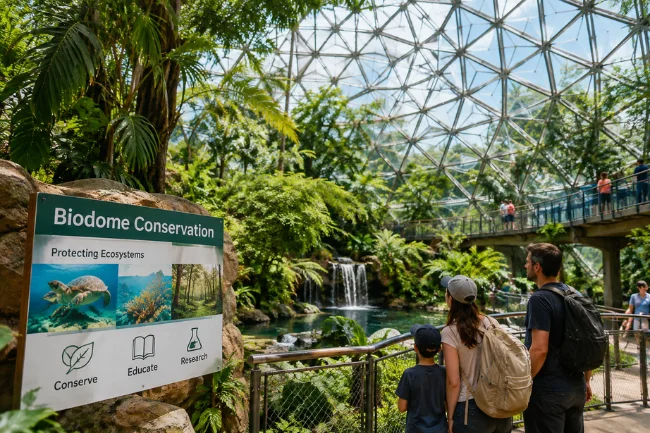
Conservation and Environmental Education
A well-run biodome lets visitors see how living things depend on one another. It can support conservation education and, in some facilities, carefully managed research or breeding programs. It should never be presented as a substitute for protecting wild habitats.
Scientific Research
Researchers can examine plant responses, water movement, soil processes, and environmental changes under monitored conditions. Controlled environments make certain variables easier to study, although findings still need to be tested against the complexity of outdoor ecosystems.
Food Production
A crop-growing biodome may reduce exposure to harsh weather and give growers more control over irrigation and nutrients. Hydroponic systems can recirculate water, while carefully chosen crops can make efficient use of space.
Whether it is genuinely efficient depends on local climate, crop type, electricity source, yields, labor, and the amount of equipment needed. An enclosed farm is not automatically cheaper or greener than an outdoor one.
Are Biodomes Sustainable?
They can be, but the building’s appearance does not determine its environmental performance. A glass enclosure full of plants may still require intensive heating, cooling, pumping, lighting, and repairs.
I would evaluate sustainability using a practical five-part check: energy consumed, water brought in, materials used, waste generated, and ecological results achieved. These measures reveal more than a claim that a structure is “eco-friendly.”
Consider the trade-offs. Extra glazing admits daylight but may increase unwanted heat gain. Heavy misting raises humidity but can create a greater need for dehumidification. Water recycling reduces demand for fresh water, yet treatment equipment consumes power and needs maintenance.
The best design balances these connected systems rather than optimizing just one. Rainwater capture, shading, efficient pumps, well-chosen materials, and monitoring can help, provided their benefits are measured against real operating data.
How Is a Biodome Designed and Built?
Construction begins with the intended ecosystem, not the shape of the structure. The requirements of a tropical display differ from those of a small educational wetland or a commercial growing enclosure.
The usual process involves defining species and climate requirements, selecting a suitable site, designing the supporting structure, choosing transparent or insulated enclosure materials, and installing water, ventilation, heating, cooling, and monitoring systems. Specialists then establish the habitat and test it before introducing sensitive species.
Material choices involve compromises. Glass offers durability and visibility but can be heavy. ETFE is lightweight and transmits light, though the system design and maintenance requirements matter. Steel structures can span large areas, while their protection against corrosion depends on the surrounding environment.
Long-term operation deserves a place in the first design meeting. If a fan stops, a pump fails, or a heatwave arrives, staff need alarms, maintenance access, and suitable backup plans. Animals add welfare requirements that go far beyond keeping plants alive.
What Does a Biodome Cost to Build and Maintain?
There is no reliable one-price answer. “Biodome” can describe anything from a modest enclosed educational habitat to a complex public facility with large mechanical systems and specialist staff.
Instead of relying on an attractive but misleading price-per-square-foot estimate, I would divide a preliminary budget into these categories:
| Cost category | What it may include |
|---|---|
| Initial construction | Land preparation, foundations, framing, glazing or membrane, access routes |
| Environmental systems | Heating, cooling, ventilation, lighting, sensors, irrigation, filtration |
| Living collections | Plants, soil, water features, habitat development, specialist installation |
| Ongoing operations | Electricity, water, staffing, animal care, cleaning, repairs, replacement parts |
A humid rainforest exhibit in a cold climate will have a different operating profile from a naturally ventilated plant enclosure in mild weather. Public access, accessibility, safety regulations, and animal care can add substantially to the total.
For a serious project, compare several location-specific designs using both upfront costs and annual operating expenses. A lower construction price can become expensive if the facility loses heat, leaks, or needs constant repairs.
Can You Build a Small Biodome at Home?
You can create a small ecosystem-inspired enclosure using a planted terrarium or a controlled greenhouse cabinet. It is better to describe these accurately than to promise a fully self-sustaining miniature world.
Start with compatible plants, an appropriate container, drainage or water-management provisions, suitable light, and a way to check moisture and temperature. Avoid adding animals without understanding their space, welfare, and ventilation needs.
I would choose a simple planted setup before attempting a sealed mixed-species habitat. It makes problems easier to identify and teaches the underlying principles without the complexity of a large installation.
Could Biodomes Support Life on Mars?
The idea is scientifically interesting, but a future Mars habitat would need much more than plants under a transparent roof. Radiation protection, pressure control, reliable power, water recovery, food safety, and emergency systems would all be essential.
NASA’s Advanced Plant Habitat demonstrates how plants can be grown in a tightly controlled research chamber aboard the International Space Station. That is an important step toward understanding space agriculture, not proof that a biodome can already sustain a settlement independently.
Frequently Asked Questions
Is a biodome a real ecosystem?
Yes. It contains living organisms and environmental interactions, but people usually regulate conditions and provide outside resources to keep it functioning.
Does a biodome have to be dome-shaped?
No. The term describes a managed ecological habitat; its enclosure may be curved, rectangular, or part of an existing building.
Can people live inside a biodome?
People can occupy specially designed controlled environments, but long-term habitation requires life-support, sanitation, food, and safety systems beyond a typical public biodome.
Is a biodome the same as a greenhouse?
No. Greenhouses primarily support plant growth, while biodomes typically emphasize a broader habitat and the interactions among its components.
Can a biodome survive without human help?
Most cannot do so indefinitely. They generally need monitoring, repairs, climate management, and additional supplies to remain stable.
Final Thoughts
A biodome is best understood as a living ecosystem supported by careful design and continual management. Its value lies not merely in enclosing nature, but in revealing how climate, water, soil, organisms, and technology depend on one another.
If you’re considering a visit, explore the official resources for Montréal, Eden Project, or Biosphere 2. If you’re planning a small project, begin by defining the habitat you want to maintain—and the resources it will need every day.

Olivia Parker is a home improvement research writer with 8+ years of experience covering home design, renovation ideas, maintenance tips, and practical living solutions. She creates easy-to-follow content to help readers make informed decisions about improving their homes.