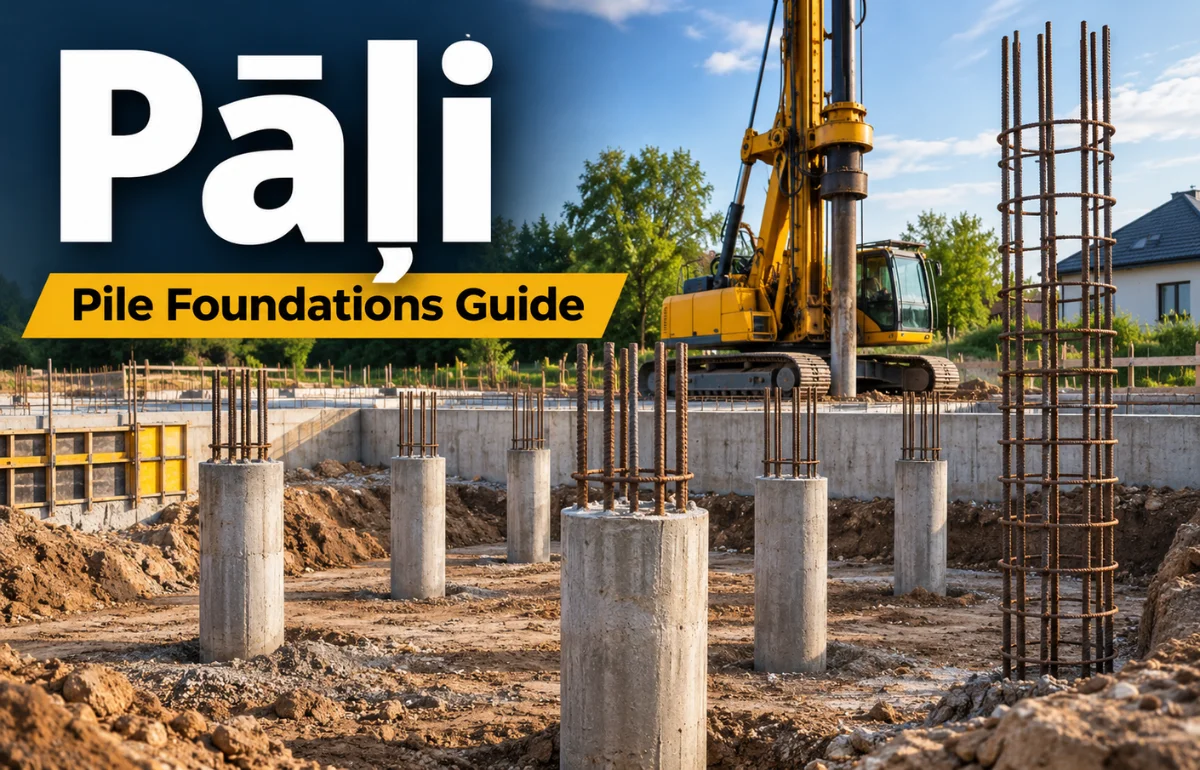
Pāļi is the Latvian plural of pālis, meaning a pile: a long structural element driven, drilled, or otherwise installed into the ground to support a building, bridge, deck, or similar structure. In construction, pāļi help transfer loads to soil or rock that can safely carry them, particularly when ground near the surface is weak. They may be made from concrete, steel, timber, or combinations of materials.
Some carry weight mainly through resistance at their tips, others through friction along their sides, and many use both. The term can also describe posts used for mooring boats. If you are researching foundations, however, the relevant meaning is foundation piles, or pāļu pamati in Latvian.
I explain below how they work, where they make sense, and what I would check before choosing them.
What Does Pāļi Mean?
The singular word is pālis; pāļi means more than one pile. The Modern Latvian Dictionary confirms its use for building supports and mooring posts.
The spelling matters: Pāļi is not the same word as Pāli, the Middle Indo-Aryan language associated with Theravāda Buddhist texts. Similar-looking letters can lead to completely different search results.
Related Latvian terms include pāļu pamati (pile foundations), dzenamie pāļi (driven piles), urbpāļi (bored piles), skrūvpāļi (screw piles), and mikropāļi (micropiles).
The underlying question stays the same: how will the loads reach reliable ground?
How Do Pile Foundations Actually Work?
A building puts downward pressure on the ground. Wind, sloping terrain, water, and certain structural arrangements can also create sideways forces or uplift.
If shallow soil cannot safely resist those actions without excessive movement, deeper foundations may offer a better route.
End-bearing resistance
An end-bearing pile transfers a substantial part of its load through its base into a stronger soil or rock layer.
Picture a long column resting on a firm bearing surface. Actual performance depends on all the soil layers involved.
Shaft resistance
A friction pile develops resistance along its contact with surrounding soil. Engineers call this shaft or skin resistance.
It can support significant loads without having to end on solid rock. Its contribution depends on soil, geometry, installation, and movement.
Piles usually work as a group
Most buildings use several piles connected by a pile cap or reinforced-concrete beams, often called a ground beam or grillage.
Importantly, a group does not always behave like an isolated pile multiplied by the number installed.
The ground beneath the whole group may settle differently, which is why engineers analyze group effects and overall movement, not just the strength of one pile.
When Are Pāļi the Right Foundation Choice?
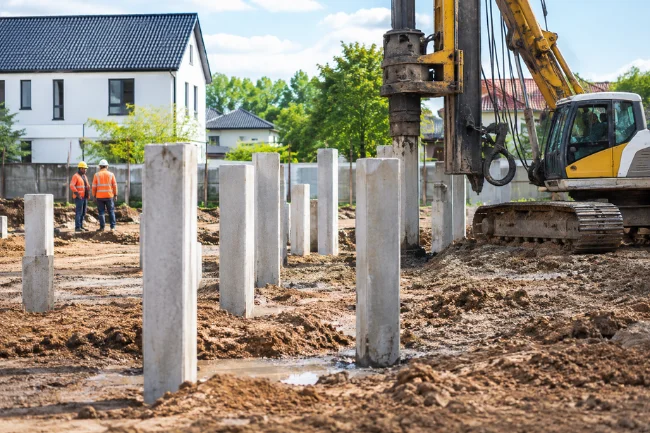
Pile foundations become attractive when ordinary strip footings or a ground-bearing slab cannot meet the project’s needs economically or reliably.
A soil investigation might reveal soft clay, peat, loose fill, variable layers, or firm material buried below weaker ground.
I would particularly investigate piles for a heavy building on compressible soil, a bridge where erosion could remove soil around supports, an extension near vulnerable neighboring structures, or a site where uneven settlement would damage the finished building.
Piles may also help on constrained sites, where a wide excavation is impractical.
That does not mean every wet garden or sloped plot needs piling. A suitably designed shallow foundation, ground improvement, or a different structural layout can sometimes perform just as well for less money.
Start with measured ground conditions and loads. A quotation based only on photographs or building height is preliminary.
Main Types of Piles and How They Compare
| Pile type | How it is installed | Typical strengths | Main considerations |
|---|---|---|---|
| Driven precast pile | A manufactured pile is hammered or pressed into the ground | Quality-controlled unit; little excavated soil | Noise, vibration, access, possible ground displacement |
| Bored cast-in-place pile | A hole is excavated, reinforced, and filled with concrete | Flexible sizes; generally less driving vibration | Bore stability, groundwater, concrete placement and spoil |
| Screw or helical pile | A steel shaft with helices is rotated into the soil | Fast installation for suitable lighter or specialist works | Corrosion, torque verification, soil suitability |
| Micropile | A small-diameter hole is drilled and grouted with reinforcement | Restricted access, underpinning and retrofit projects | Specialist installation and testing; higher unit complexity |
Driven piles
Precast concrete and steel piles are commonly installed using impact hammers, vibration equipment, or pressing systems, depending on the design.
Their progress can produce useful construction records, but resistance during driving is not a substitute for proper engineering assessment.
In a dense urban area, I would ask how vibration and noise will be controlled before accepting this option.
Bored piles
Bored piles are created by excavating a shaft and placing concrete, often around a reinforcing cage.
Temporary casing or drilling fluid may be required where the hole will not remain stable on its own.
They can handle substantial loads, but successful construction depends on keeping the excavation stable and the concrete continuous.
Screw piles and micropiles
Helical piles can be practical for decks, light buildings, temporary works, and selected engineered structures.
Micropiles, by contrast, are especially useful when equipment must fit into an existing building or a cramped site.
I would choose between these on the basis of design capacity, access, durability, and verified installation—not speed alone.
Which Materials Are Used for Pāļi?
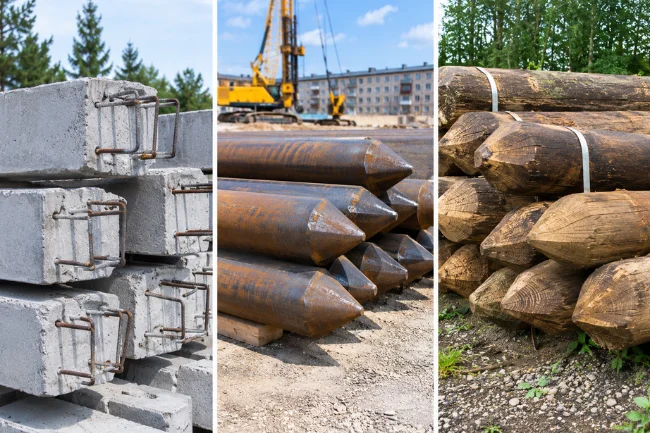
Concrete, steel, and timber each have a legitimate place in pile construction, but none is universally superior.
Reinforced-concrete piles are widely used because they combine compressive strength with reinforcement that handles bending and tension.
Precast units arrive as manufactured elements; cast-in-place piles are formed on site. Concrete quality, cover to reinforcement, exposure conditions, and installation defects all influence durability.
Steel piles may use tubular sections or structural shapes. They can be useful where high loads, driving requirements, or connections favor steel.
Corrosion protection requires attention to soil chemistry, water exposure, and the intended service life.
Timber piles have a long history in waterfront and foundation work.
Their performance depends on species, treatment, moisture, and exposure. In some permanently submerged or waterlogged environments, timber can last a long time; alternating wet and dry exposure may create different deterioration risks.
From Soil Investigation to Finished Foundation
Pile installation is not simply a matter of driving posts until they seem firm.
The process begins with a geotechnical investigation. Boreholes, in-situ tests, sampling, groundwater observations, and laboratory results help engineers build a picture of the layers beneath the site.
The scope should match the project’s complexity and risk.
Next comes foundation design. The engineer evaluates structural loads, bearing resistance, settlement, uplift, lateral actions, pile spacing, group behavior, and durability.
A drawing then specifies pile positions, dimensions or performance criteria, top levels, reinforcement, and connections.
Before construction, the contractor should confirm underground services, equipment access, working-platform stability, environmental restrictions, and proximity to adjacent foundations.
A heavy piling rig needs a properly assessed platform, even when the final building itself is small.
During installation, records should identify each pile and document the information relevant to its method: driving depth and resistance, bore depth and diameter, concrete volumes, drilling conditions, or installation torque as applicable.
Unexpected ground conditions must be reported rather than hidden in a revised invoice.
Finally, the piles are trimmed or finished at their specified levels and connected to caps, beams, or the structural slab.
Specified tests and inspections should be completed and reviewed before the supports are covered.
I would ask for the final installation records because they tell a more useful story than a photograph of completed concrete.
How Much Do Pile Foundations Cost?
There is no defensible universal price per pile.
Costs change with diameter, length, number, local labor rates, materials, equipment, mobilization, testing, site access, and the ground itself.
A cheap unit rate can become expensive when the project needs a large rig, extensive spoil removal, multiple visits, or unexpected extra depth.
I compare proposals by their total foundation scope, rather than by the quoted cost of one pile.
The foundation cap, connecting beams, excavation, concrete, testing, design, and reinstatement all belong in the calculation.
| Cost driver | Why it changes the budget | What I would ask for |
|---|---|---|
| Soil profile and depth | Weak layers may require deeper or additional piles | Assumptions based on investigation results |
| Pile installation method | Rig size, noise controls, spoil handling and speed differ | Method statement and access requirements |
| Pile caps and beams | Concrete and reinforcement can be a major part of the system | Separate structural quantities |
| Testing and quality control | Verification is necessary but scope varies | Identified tests and acceptance criteria |
| Unforeseen conditions | Obstructions or groundwater can disrupt production | Clear variation and contingency rules |
An initially higher bid may be better value if it includes realistic ground assumptions and a clear testing plan.
Conversely, piling can be over-engineering when competent shallow bearing soil is readily available.
I would request a shallow-foundation comparison wherever the ground investigation makes one plausible.
Five Risks That Deserve More Attention
Settlement is not just about a pile’s strength
A foundation can have sufficient ultimate bearing resistance and still move more than the building can tolerate.
Uneven or differential settlement is especially troublesome because it can distort floors, crack finishes, and strain services.
The performance of an entire pile group therefore matters as much as the capacity of a single test pile.
Soil can pull downward on a pile
A less familiar problem is negative skin friction, also called downdrag.
If surrounding soft soil settles relative to the pile, it can add downward force rather than support it.
The FHWA describes downdrag in its foundation research.
This risk must be considered in suitable ground conditions; it is not solved simply by claiming that more shaft friction is always better.
Water can remove support
For bridges, waterfront works, and flood-prone sites, flowing water may scour soil from around piles.
A pile designed without accounting for potential erosion can lose vital embedment or lateral support.
The fact that a foundation extends below ground does not, on its own, make it flood-resistant.
Installation can affect neighbors
Driven piles may generate vibration or displace soil.
Bored piles can produce spoil, groundwater management issues, or risks to an open excavation.
Near existing properties, monitoring requirements and construction sequencing deserve early discussion.
Poor records hide costly defects
A pile buried under a completed cap is difficult to inspect directly.
Missing records, unreported changes in depth, and questionable concrete placement make later verification harder.
The practical safeguard is a documented inspection and testing plan agreed before the first pile is installed.
How Can I Tell Whether the Work Was Properly Tested?
Different tests answer different questions.
Static load testing measures the relationship between applied load and displacement under controlled conditions.
Dynamic methods may help evaluate driven piles and installation performance.
Integrity testing can identify possible defects in certain cast-in-place piles, but it does not by itself prove load-bearing capacity.
I would ask which tests the designer specified, why they were chosen, which piles were tested, what acceptance limits applied, and who reviewed the findings.
Independent inspection, calibration records, concrete delivery documentation, and an as-built pile schedule provide useful assurance.
Testing does not replace good construction practice; it complements it.
The Federal Highway Administration documents pile-load testing; ISO 22477-1 specifies static compression testing procedures.
Pāļi in Latvia: Terminology and Standards in 2026
If the project is in Latvia, I would begin with the current local regulatory framework and applicable national standards rather than copying specifications from a foreign construction blog.
Latvia’s standards body lists LVS EN 1997-1:2025 for general geotechnical design rules.
Execution standards include LVS EN 12699:2015 for displacement piles, LVS EN 1536+A1:2015 for bored piles, and LVS EN 14199:2015 for micropiles.
A standard’s listing does not tell a homeowner which pile to select, and applicability can depend on the project and governing requirements.
A qualified structural or geotechnical engineer must interpret the site information, verify design assumptions, and identify the appropriate documents.
A Practical Way to Compare Foundation Proposals
I use three questions to cut through product claims.
First, what evidence shows that the soil can carry the proposed loads with acceptable movement?
Second, what disturbance will installation cause to the site and its neighbors?
Third, what documentation will prove the foundation that was built matches the design?
These form a simple ground–construction–verification check.
A proposal that answers only the first question is incomplete; one that answers only the second is selling convenience rather than performance.
A credible quote should make the trade-offs visible, including what will happen if actual ground conditions differ from the investigation.
This framework also helps avoid a common mistake: choosing a pile by a headline load rating without checking the real soil, spacing, group settlement, lateral resistance, corrosion conditions, or pile-to-building connection.
A stated capacity is only meaningful alongside the assumptions and tests supporting it.
Frequently Asked Questions About Pāļi
What does Pāļi mean in English?
Pāļi is Latvian for “piles,” usually meaning structural posts embedded in the ground for foundations or related support works.
Are pile foundations better than concrete footings?
Not always. Piles are useful when deeper support is needed; conventional footings can be simpler and more economical on suitable shallow soil.
How deep do foundation piles need to go?
There is no standard depth for every site. An engineer determines it from the soil profile, design loads, settlement limits, and installation method.
Can screw piles support a house?
Yes, in appropriately engineered circumstances. Their suitability depends on verified soil conditions, loads, corrosion protection, and connection details.
Do pile foundations prevent all settlement?
No. Properly designed piles can control settlement, but piles and groups still move under load and must be checked against acceptable limits.
Final Thoughts
Pāļi are more than hidden posts under a building. They are engineered load paths that connect a structure to the ground capable of supporting it.
The strongest foundation decision is not the one with the most piles or the deepest piles; it is the one supported by a credible investigation, sound design, careful installation, and reliable records.
If you are planning a project, start by obtaining a site-specific geotechnical assessment and ask a qualified engineer to compare realistic foundation options before accepting a contractor’s proposal.

Olivia Parker is a home improvement research writer with 8+ years of experience covering home design, renovation ideas, maintenance tips, and practical living solutions. She creates easy-to-follow content to help readers make informed decisions about improving their homes.