
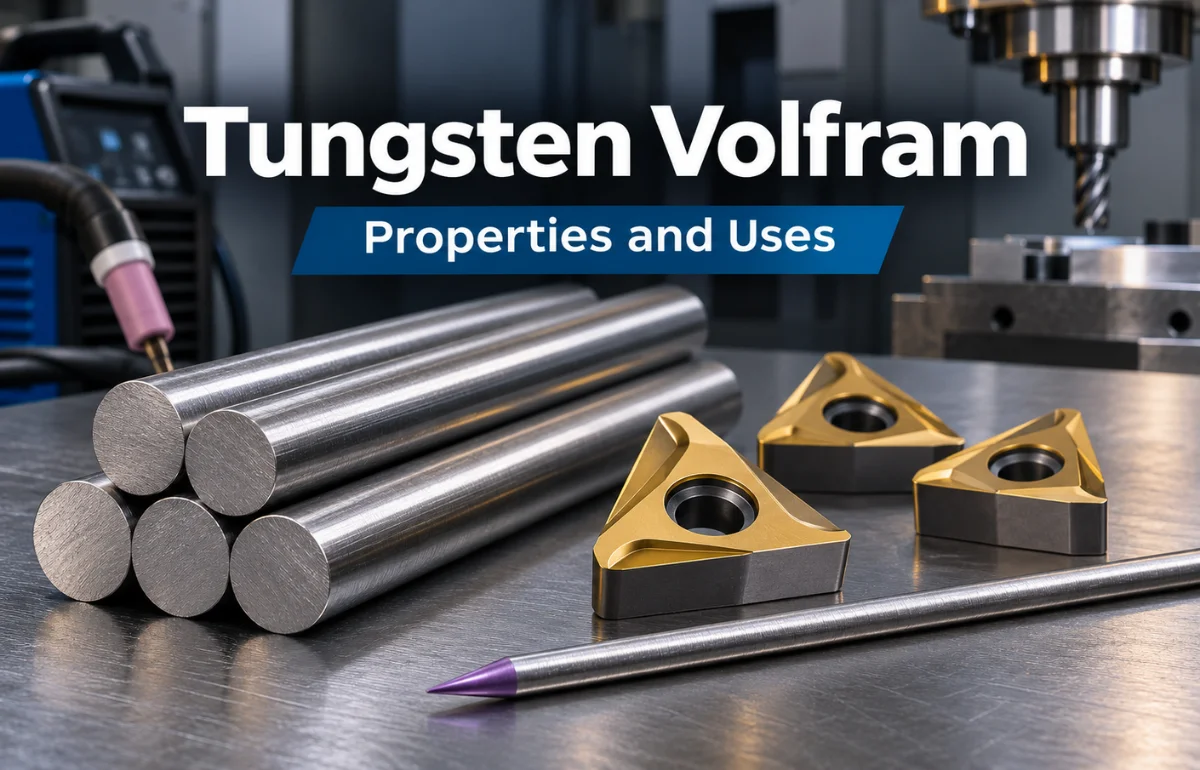
Tungsten Volfram is a chemical element known for its exceptional heat resistance, high density, strength, and industrial importance. Its chemical symbol is W, its atomic number is 74, and it has the highest melting point of any pure metal. The words tungsten, wolfram, and volfram refer to the same element, although their usage varies across languages and scientific traditions. Tungsten is widely used in cutting tools, welding equipment, electronics, aerospace components, and radiation shielding because it performs well under conditions that would damage many ordinary metals.
What Is Tungsten Volfram and Why Does It Have Different Names?
Tungsten Volfram is not a separate alloy or a newly discovered material. It is simply another way of referring to tungsten, a naturally occurring metallic element belonging to Group 6 of the periodic table.
The name tungsten comes from the Swedish words tung sten, meaning “heavy stone.” This description makes sense because tungsten is remarkably dense.
The alternative name wolfram has historical roots in the mineral wolframite. The spelling volfram also appears in several languages, including Swedish, Croatian, and Slovenian.
According to the Royal Society of Chemistry, tungsten is the element’s internationally accepted English scientific name. Its symbol, W, preserves the older name wolfram.
The History Behind Tungsten’s Discovery
The history of tungsten stretches back to the eighteenth century.
In 1781, Swedish chemist Carl Wilhelm Scheele identified a tungsten-containing oxide while studying a mineral later called scheelite.
Two years later, Spanish chemists Juan José and Fausto Elhuyar successfully isolated tungsten metal from wolframite in 1783.
Their discovery established tungsten as a distinct chemical element.
Interestingly, the discoverers favored the name volfram. However, the International Union of Pure and Applied Chemistry (IUPAC) retained tungsten as the official name in its 2005 nomenclature recommendations.
I find this naming history particularly useful because it explains why the periodic table displays W rather than T or another abbreviation.
Physical and Chemical Properties of Tungsten Volfram
Tungsten possesses an unusual combination of characteristics that makes it valuable in demanding engineering applications.
Before exploring those benefits, I want to establish the basic scientific facts.
| Property | Tungsten Volfram Specification |
|---|---|
| Chemical symbol | W |
| Atomic number | 74 |
| Atomic mass | 183.84 u |
| Element classification | Transition metal |
| Appearance | Silvery-white to steel-gray |
| Density | Approximately 19.3 g/cm³ |
| Melting point | Approximately 3,414°C |
| Boiling point | Approximately 5,555°C |
| Periodic table group | Group 6 |
| Principal minerals | Wolframite and scheelite |
Values are based on reference data from the Royal Society of Chemistry. Some technical references list a melting point closer to 3,422°C.
These figures help explain tungsten’s popularity, but the numbers alone don’t tell the entire story.
The real advantage comes from how the material behaves under heat, mechanical stress, and repeated industrial use.
1. Exceptional Melting Point and Heat Resistance
One of tungsten’s most impressive characteristics is its extremely high melting point.
While aluminum melts at approximately 660°C and iron at around 1,538°C, tungsten remains solid until temperatures exceed 3,400°C.
This makes it suitable for high-temperature furnace components, heating elements, and specialized electrical equipment.
However, a high melting point does not mean unlimited heat resistance. Tungsten can oxidize at elevated temperatures when exposed to air.
For this reason, many high-temperature tungsten applications require vacuum systems or protective atmospheres.
2. Remarkably High Density
Tungsten is nearly as dense as gold and considerably denser than lead.
Its density allows manufacturers to produce compact components with substantial weight.
I consider this particularly valuable when equipment needs mass without excessive size.
Counterweights, precision balancing components, and specialized aerospace systems benefit from this characteristic.
3. Strength, Hardness, and Wear Resistance
Tungsten offers impressive mechanical properties, especially when used in carefully designed alloys.
However, pure tungsten and tungsten carbide behave differently.
Tungsten carbide is significantly harder and offers excellent resistance to abrasion, making it suitable for cutting and drilling equipment.
Its performance also depends on the binder material, grain size, and manufacturing process.
4. Electrical Conductivity and Dimensional Stability
Tungsten conducts electricity and has a relatively low coefficient of thermal expansion.
This means its dimensions change comparatively little when temperatures fluctuate.
These properties are useful for electrodes, electrical contacts, and components requiring dimensional stability.
Still, tungsten is not automatically the best electrical conductor. Copper, for example, conducts electricity much more efficiently.
The choice depends on whether electrical performance, temperature resistance, or durability matters most.
Tungsten vs. Tungsten Carbide: What’s the Difference?
Many people use tungsten and tungsten carbide interchangeably. Technically, that is incorrect.
Pure tungsten is a metallic element, while tungsten carbide is a compound formed from tungsten and carbon.
Industrial cemented carbide usually contains tungsten carbide particles held together by a metallic binder, commonly cobalt.
| Feature | Pure Tungsten | Tungsten Carbide | Tungsten Heavy Alloy |
|---|---|---|---|
| Composition | Primarily elemental W | WC, often with a binder | Tungsten with metals such as nickel and iron |
| Main advantage | High-temperature performance | Hardness and wear resistance | High density with improved workability |
| Common applications | Electrodes, heating elements | Cutting tools, drill bits | Counterweights, shielding |
| Main limitation | Difficult processing and possible brittleness | Can chip or fracture | Properties depend on alloy composition |
The distinction matters when selecting a material.
For instance, I would consider tungsten carbide for a cutting insert but pure tungsten for a component operating at extremely high temperatures.
Likewise, a tungsten heavy alloy may be more suitable than pure tungsten when a dense component must withstand mechanical loading.
Choosing the correct material form is often more important than choosing the element itself.
Major Industrial Applications of Tungsten Volfram
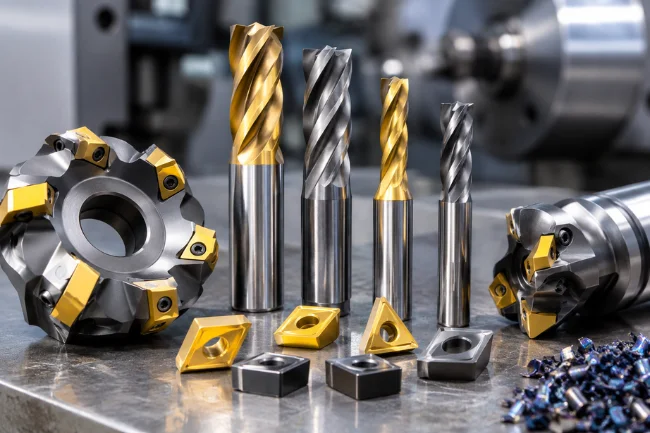
Tungsten’s combination of thermal, mechanical, and physical properties supports a surprisingly diverse range of applications.
Cutting Tools and Manufacturing Equipment
One of the largest markets for tungsten is cemented carbide tooling.
Manufacturers use tungsten carbide in drill bits, milling cutters, cutting inserts, dies, and wear-resistant machinery components.
These tools can maintain cutting performance under demanding conditions and often last longer than conventional alternatives.
The U.S. Geological Survey estimates that approximately 60% of tungsten consumed in the United States is used in cemented carbide applications.
Welding and High-Temperature Equipment
Tungsten electrodes are essential components of tungsten inert gas (TIG) welding.
Their high melting point allows them to support a stable electric arc without being consumed as rapidly as many other electrode materials.
Different tungsten electrode compositions are available for specific welding requirements.
Tungsten also appears in industrial furnaces, heating assemblies, and equipment designed for extreme temperatures.
Electronics and Medical Technology
Although traditional incandescent bulbs made tungsten famous, its technological significance extends much further.
Tungsten is used in electrical contacts, semiconductor manufacturing, and certain electronic components.
It is also important in medical X-ray equipment, where tungsten-containing targets generate X-rays when struck by high-energy electrons.
Its high density also makes it useful in radiation shielding products.
These applications illustrate why tungsten remains relevant even as LED lighting replaces older incandescent technologies.
Aerospace and Precision Engineering
Aerospace manufacturers use tungsten-based materials for specialized high-density components, balancing systems, and parts that must tolerate demanding thermal environments.
The metal’s density allows engineers to concentrate considerable mass within limited space.
However, weight is not always an advantage in aircraft.
I would therefore evaluate tungsten primarily for applications where compact mass or specific thermal properties justify its additional weight.
Jewelry and Everyday Products
Tungsten-related materials also appear in wedding bands, watches, sporting equipment, and precision weights.
Many products marketed as tungsten rings are actually made from tungsten carbide.
These rings are popular because they resist everyday scratching.
However, scratch resistance should not be confused with impact toughness. A hard carbide ring can still crack or fracture after a sufficiently strong impact.
How Is Tungsten Volfram Extracted and Manufactured?
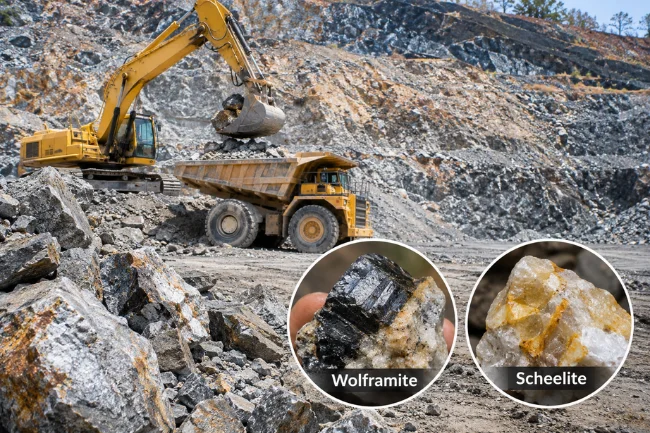
Tungsten does not normally occur in nature as pure metallic deposits.
Instead, it exists within mineral compounds that must undergo several processing stages.
Mining Tungsten Ores
The two principal tungsten-bearing minerals are wolframite and scheelite.
Wolframite contains tungsten combined with iron and manganese, while scheelite is calcium tungstate.
Mining operations extract tungsten-bearing rock through methods appropriate to the deposit.
The ore is then crushed, separated, and concentrated to increase its tungsten content.
Refining Tungsten into Metal
Concentrated material undergoes chemical processing to produce purified tungsten compounds.
An important intermediate product is ammonium paratungstate, commonly abbreviated as APT.
Further processing can produce tungsten oxide, which is reduced to metallic tungsten powder, often using hydrogen.
The powder can then be consolidated into usable products through powder metallurgy.
This manufacturing approach is especially useful because tungsten’s extremely high melting point makes conventional melting and casting challenging.
Producing Tungsten Carbide
Manufacturers produce tungsten carbide by reacting tungsten-containing material with carbon under controlled conditions.
The resulting carbide powder can be combined with a binder and consolidated through sintering.
The finished material’s performance depends heavily on its composition and microstructure.
This explains why two tungsten carbide tools can have noticeably different durability despite sharing the same basic chemical compound.
Why Tungsten Is a Critical Industrial Material in 2026
Tungsten is more than a useful engineering material. It is also an important strategic commodity.
According to the U.S. Geological Survey’s 2026 Mineral Commodity Summaries, worldwide tungsten mine production was estimated at approximately 85,000 metric tons in 2025.
China accounted for approximately 67,000 metric tons, representing roughly 79% of global production.
This concentration creates supply-chain concerns for manufacturers that depend on reliable access to tungsten.
The same report describes export controls introduced by China in February 2025 and significant tungsten price increases during that year.
For businesses, this means material sourcing can be just as important as material performance.
I believe purchasers should consider supplier diversification, available inventory, product specifications, and recycling opportunities rather than focusing exclusively on the lowest initial price.
Tungsten Recycling and Environmental Sustainability
Tungsten is recoverable from many industrial products, including worn cutting tools, manufacturing scrap, and used metal components.
Recycling can reduce demand for newly mined material and recover valuable tungsten already circulating within industry.
A published analysis of global tungsten flows estimated a recycling input rate of approximately 35% for 2016. This is a historical benchmark, not a verified worldwide recycling rate for 2026.
Recycling methods vary depending on the scrap’s composition, contamination, and intended reuse.
An important distinction is that a product being technically recyclable does not guarantee that it will actually be collected or recycled.
For businesses, effective scrap segregation and access to established recovery facilities can make a significant difference.
How to Choose the Right Tungsten Material
When assessing a tungsten-based product, I recommend considering its working conditions before comparing prices.
Identify the Main Performance Requirement
Start by determining what the component must accomplish.
Does it need high-temperature resistance, abrasion protection, electrical performance, or concentrated weight?
Different objectives point toward different tungsten materials.
For example, tungsten carbide may be ideal for abrasive cutting, whereas a tungsten heavy alloy could be better for a precision counterweight.
Consider the Operating Environment
Temperature is only one part of the equation.
Exposure to oxygen, moisture, chemicals, vibration, and mechanical impact can also influence material performance.
A component that works extremely well in a vacuum may not perform equally well in hot, oxygen-rich surroundings.
Check Material Grades and Specifications
The label “tungsten” does not provide enough information to determine product quality.
For industrial purchases, I would request details about chemical composition, purity, density, manufacturing tolerances, and applicable material standards.
For cemented carbide, binder content and carbide grain size deserve particular attention.
A material certificate or technical data sheet provides much stronger evidence than a general marketing description.
Compare Long-Term Value
The cheapest component may not be the most economical.
A more expensive cutting tool that lasts significantly longer could reduce replacement costs and production downtime.
I prefer evaluating the cost per useful operating hour rather than purchase price alone.
This approach makes material comparisons more practical and meaningful.
Is Tungsten Volfram Safe?
Solid tungsten products and tungsten-containing powders should not be treated as having identical exposure risks.
For most ordinary applications, finished solid products present different concerns from airborne particles generated during grinding, cutting, or manufacturing.
One important occupational hazard involves cemented tungsten carbide containing cobalt.
The U.S. National Institute for Occupational Safety and Health identifies specific exposure limits for these hard-metal mixtures because their dust can present significant health risks.
Industrial workplaces should use suitable dust extraction, exposure controls, protective equipment, and established safety procedures.
I would also recommend reviewing the safety data sheet for the exact material rather than assuming all tungsten compounds have the same toxicological properties.
Common Misconceptions About Tungsten
Several misunderstandings can make tungsten appear either more impressive or less practical than it really is.
Tungsten Is Completely Indestructible
Tungsten has exceptional characteristics, but it can still suffer mechanical damage, oxidation, or fracture under unsuitable conditions.
Tungsten Carbide and Pure Tungsten Are Identical
They are chemically different materials with different performance characteristics.
Tungsten Is Always Better Than Steel
Steel can be lighter, more economical, easier to manufacture, and more appropriate for many structural applications.
The best material depends on the job rather than a single impressive property.
The Future of Tungsten in Modern Technology
Tungsten will likely remain important in advanced manufacturing, semiconductor technology, precision engineering, and specialized high-temperature systems.
Researchers are also studying improved tungsten-based composites, alternative carbide binders, and additive manufacturing techniques.
Recent research has explored 3D-printing approaches for tungsten carbide-cobalt hardmetals, although conventional powder metallurgy remains widely used.
I expect future developments to focus not only on better material performance but also on efficient processing, reduced waste, and more dependable supply chains.
These improvements could expand tungsten’s usefulness while helping manufacturers manage its cost and availability.
Conclusion
Tungsten Volfram is an exceptionally useful metallic element whose high melting point, density, and versatility support industries ranging from manufacturing to medical technology.
Its true value, however, depends on selecting the appropriate form, grade, and operating conditions.
If you’re researching tungsten for an industrial project, product purchase, or technical application, start by identifying your performance requirements and comparing verified material specifications. That simple decision can prevent costly mistakes and help you choose a more reliable solution.
Frequently Asked Questions About Tungsten Volfram
1. Is tungsten the same as volfram?
Yes. Tungsten, wolfram, and volfram refer to the same chemical element, W, with atomic number 74. The names differ primarily by language and historical usage.
2. Is tungsten stronger than steel?
Tungsten offers superior heat resistance and density, but it is not universally stronger than steel. The comparison depends on the particular alloy and mechanical property.
3. What is tungsten mainly used for?
Tungsten is primarily used in cemented carbide cutting tools, drilling equipment, welding electrodes, electronics, high-temperature components, and specialized alloys.
4. Is tungsten more expensive than gold?
Generally, no. Gold is usually much more expensive per unit of weight, although specialized tungsten products can carry substantial manufacturing costs.
5. Can tungsten rust or corrode?
Tungsten does not rust in the same way as iron, but it can oxidize at elevated temperatures and react under certain chemical conditions.

Noah Sterling is a technology research writer with 8+ years of experience covering emerging technologies, software trends, digital tools, and innovation. He creates practical, research-based articles to help readers understand the evolving technology landscape.