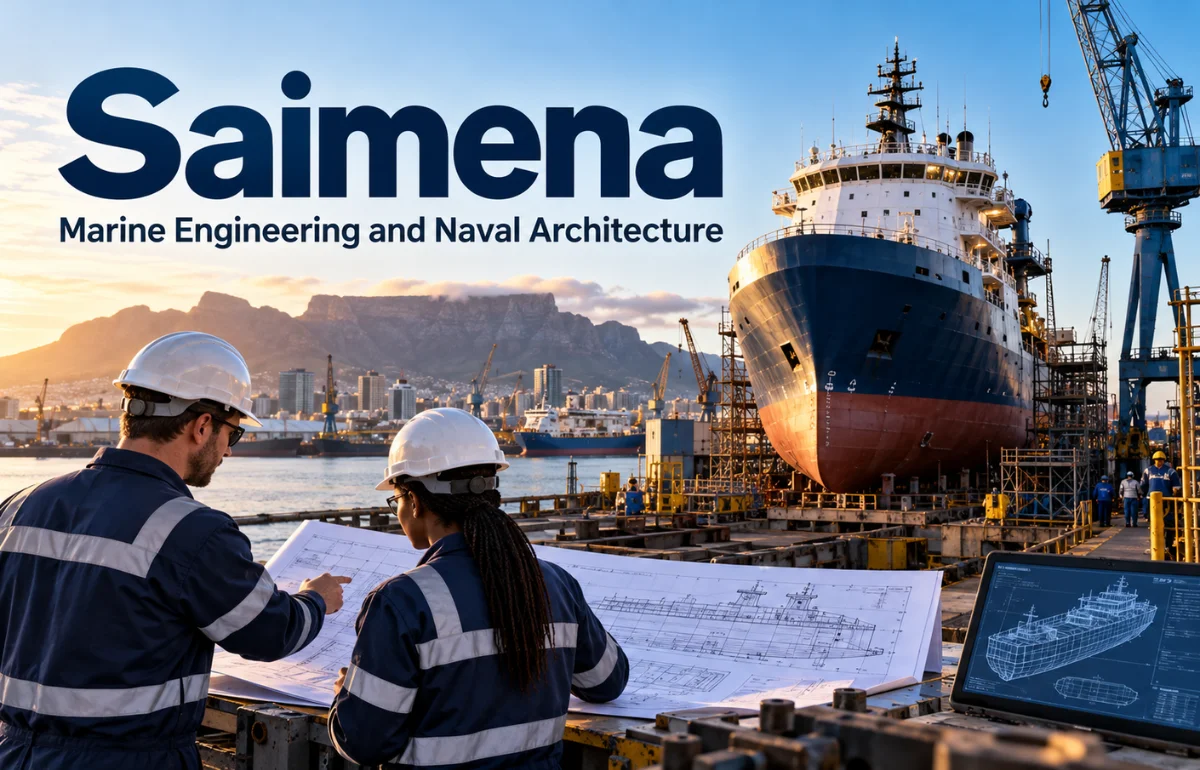
Saimena, officially written as SAIMENA, stands for the South African Institute of Marine Engineers and Naval Architects. It is a professional association that supports marine engineers, naval architects, and other specialists working in South Africa’s maritime industry. The institute promotes technical knowledge, professional development, engineering standards, and collaboration across shipbuilding, vessel maintenance, and ocean engineering.
Established in the mid-1970s, SAIMENA connects professionals involved in designing, operating, repairing, and maintaining marine vessels and related infrastructure.
Its work includes technical presentations, educational initiatives, industry discussions, and continuing professional development activities.
I find that understanding SAIMENA requires looking beyond its name. Its real significance lies in how it brings maritime expertise together and helps strengthen an industry that depends on technical competence, safety, and experienced professionals.
What Is Saimena and What Does It Stand For?
SAIMENA is a South African professional institution dedicated to marine engineering, naval architecture, shipbuilding, ship repair, and related technical disciplines.
Unlike a commercial engineering company, it operates as a professional association. Its purpose is to encourage knowledge sharing, maintain professional standards, and represent the interests of people working in maritime engineering.
The institute has historically maintained active branches in Cape Town and Durban, two important centers of South Africa’s maritime economy.
Its membership brings together professionals from various backgrounds, including marine engineering officers, naval architects, ship repair specialists, technical consultants, and educators.
Saimena at a Glance
| Feature | Details |
|---|---|
| Official name | South African Institute of Marine Engineers and Naval Architects |
| Abbreviation | SAIMENA |
| Country | South Africa |
| Formation | November 29, 1974 |
| Operational history | Commonly dated from 1975 |
| Main disciplines | Marine engineering and naval architecture |
| Main branches | Cape Town and Durban |
| Professional recognition | ECSA-recognized Category A voluntary association |
| Official website | saimena.co.za |
The distinction between a professional association and a regulatory authority is particularly relevant here. SAIMENA supports professional development, but it does not replace the organizations responsible for statutory engineering registration or maritime certification.
The History and Origin of SAIMENA
Why the Institute Was Established
SAIMENA’s history began when South African marine engineers and naval architects needed a locally based professional organization.
Before its formation, many maritime professionals belonged to British institutions, particularly the Institute of Marine Engineers and the Royal Institution of Naval Architects.
Changes in South Africa’s professional engineering framework during the late 1960s created a need for locally recognized professional bodies.
As a result, marine engineering and naval architecture professionals worked toward establishing an independent South African institution.
According to the institute’s constitution, SAIMENA was formally constituted on November 29, 1974, following a nationwide referendum among relevant professionals.
Its first council operated in 1975, explaining why many historical references identify 1975 as its founding year.
Five Decades of Maritime Engineering
The institute celebrated 50 years of operation in 2025, including anniversary events in Cape Town and Durban.
During its development, it expanded its activities beyond professional representation to include technical presentations, publications, educational involvement, and engagement with the wider maritime sector.
One detail I find particularly useful is the distinction between its formal constitution in 1974 and its recognized operational history beginning in 1975.
Both dates appear in the institute’s own records, and understanding that difference prevents unnecessary confusion.
The Main Purpose of SAIMENA
SAIMENA exists to advance marine engineering and naval architecture while supporting the professionals who practice these disciplines.
Its constitutional objectives cover marine engineering, ocean engineering, shipbuilding, and ship repair.
The institute works toward these goals through several interconnected activities.
Promoting Technical Knowledge
Marine engineering evolves as new propulsion systems, materials, environmental requirements, and automation technologies enter the industry.
SAIMENA provides opportunities for professionals to discuss these developments through technical meetings, presentations, and publications.
Supporting Professional Standards
Engineering decisions can affect vessel safety, operational reliability, environmental protection, and substantial commercial investments.
A professional association helps reinforce the value of competence, ethical conduct, technical accountability, and continuous learning.
Connecting Industry Professionals
The maritime sector includes professionals who work at sea, in shipyards, at universities, and within technical consulting businesses.
SAIMENA creates opportunities for these groups to exchange practical knowledge that might otherwise remain confined to individual organizations.
Marine Engineering vs. Naval Architecture: Understanding the Difference
Although the two professions overlap, they address different aspects of maritime technology.
Marine Engineering
Marine engineering primarily concerns the machinery and technical systems required to operate a vessel.
These include propulsion machinery, electrical generation, cooling systems, fuel systems, pumps, automation, and onboard mechanical equipment.
A marine engineer may work on maintaining engines, improving machinery performance, investigating failures, or managing technical operations.
Naval Architecture
Naval architecture focuses on vessel design, structural integrity, stability, hydrodynamics, and overall performance.
Naval architects consider how a vessel floats, moves through water, withstands environmental forces, and carries its intended loads safely.
Both disciplines must work together to produce practical, efficient, and reliable ships.
For example, changing a vessel’s propulsion arrangement can influence machinery weight, internal layout, stability, and structural design.
This interconnected relationship explains why an organization such as SAIMENA represents both professions rather than treating them as completely separate industries.
How Saimena Supports the Maritime Industry
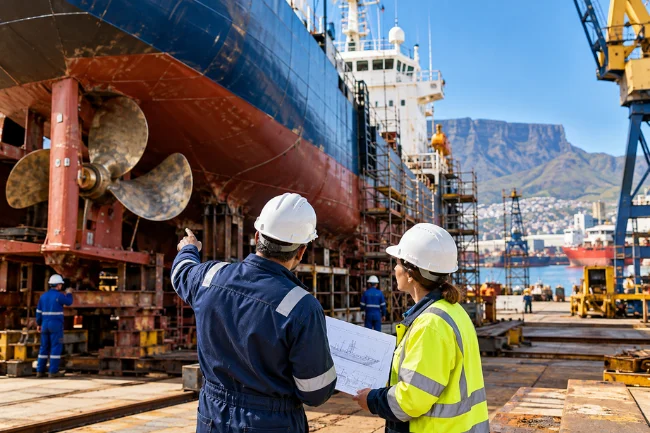
SAIMENA’s activities connect engineering theory with the technical challenges faced by maritime businesses.
Its professional interests extend into several important areas.
Shipbuilding and Vessel Maintenance
Shipbuilding requires coordination between designers, engineers, manufacturers, surveyors, and equipment suppliers.
Similarly, vessel repair demands knowledge of mechanical systems, structures, corrosion, materials, and operational standards.
Industry discussions organized through professional institutions can help specialists exchange lessons from these activities.
Marine Safety and Technical Reliability
Marine incidents can involve machinery failures, structural damage, operational mistakes, or difficult environmental conditions.
Technical presentations examining these challenges encourage engineers to learn from real-world experience.
For example, a SAIMENA Cape Town meeting in April 2026 focused on South Africa’s marine emergency response and salvage services.
The discussion covered emergency towing, maritime incidents, and the technical planning required for salvage operations.
Education and Research
SAIMENA also maintains connections with educational institutions and maritime training initiatives.
Its involvement helps bring industry knowledge into academic discussions while giving developing professionals greater exposure to practical engineering work.
Who Can Become a Member of SAIMENA?
SAIMENA provides different membership categories to accommodate professional experience, qualifications, and involvement in maritime engineering.
Its constitution identifies several membership grades.
| Membership grade | General purpose |
|---|---|
| Student | For eligible students and cadets studying relevant disciplines |
| Associate | For people involved in or intending to enter marine technology |
| Member | For suitably qualified and experienced professionals |
| Fellow | For professionals meeting advanced qualification and experience requirements |
| Honorary Fellow | Recognition of exceptional professional service |
| Honorary Recognition | Recognition of distinguished contributions |
| Marine Partner | For eligible businesses and organizations in the maritime sector |
Admission is governed by the institute’s constitution and council.
Holding an engineering qualification does not automatically guarantee acceptance into a particular membership grade.
Applicants must satisfy the relevant eligibility requirements.
Student and Early-Career Membership
Student membership is especially relevant to people studying marine engineering or naval architecture at recognized institutions.
It allows emerging professionals to become familiar with professional activities before entering the workforce.
I would encourage prospective student members to consider the practical learning opportunities rather than viewing membership solely as an additional qualification on a résumé.
Benefits of Joining Saimena
The value of professional membership depends partly on how actively someone participates.
A membership certificate can demonstrate professional affiliation, but meaningful benefits often come from taking part in institute activities.
Professional Networking
Members can connect with experienced engineers, naval architects, industry consultants, and other maritime specialists.
These relationships may help individuals understand technical career paths and identify opportunities for professional collaboration.
Knowledge and Industry Awareness
Technical meetings and professional publications offer insights into engineering developments, safety challenges, and maritime operations.
SAIMENA’s Two Oceans Journal has historically provided articles, technical discussions, organizational news, and perspectives from industry members.
Career Development
Participation can support professional growth by exposing members to unfamiliar technologies and engineering disciplines.
However, membership should not be confused with guaranteed employment, automatic promotion, or a professional engineering license.
The strongest value usually comes from combining membership with relevant qualifications, experience, and continued learning.
SAIMENA and the Engineering Council of South Africa
One of SAIMENA’s most significant professional relationships is with the Engineering Council of South Africa (ECSA).
ECSA is the statutory regulator responsible for professional engineering registration in South Africa.
SAIMENA, by comparison, is a recognized voluntary professional association.
What Does ECSA Recognition Mean?
ECSA officially lists SAIMENA as a Category A recognized voluntary association.
As of October 2026, its voluntary-association reference is VA A0017, with recognition listed through October 2028.
This reference deserves attention because SAIMENA’s own website displays VA A0010, while ECSA assigns that number to a different engineering association.
For verification, I would rely on ECSA’s official voluntary-association register.
ECSA also identifies SAIMENA as a continuing professional development licensed body and verified CPD service provider.
Recognition strengthens the institute’s connection to South Africa’s broader professional engineering framework.
Nevertheless, joining SAIMENA does not automatically confer registration as a professional engineer, engineering technologist, or other ECSA-recognized professional category.
The Role of Continuing Professional Development
Continuing professional development, commonly called CPD, helps engineers maintain and expand their knowledge throughout their careers.
Learning does not end when someone graduates or obtains professional registration.
New technologies, regulations, materials, and operational challenges require ongoing technical education.
SAIMENA’s recognized involvement in CPD provides a connection between maritime technical activities and the engineering profession’s development requirements.
However, attending an event does not necessarily mean it qualifies for CPD credits.
I recommend checking an activity’s current validation status, reference number, and applicable credit allocation before relying on it for professional registration purposes.
Engineers should also retain attendance records and follow ECSA’s current CPD requirements.
SAIMENA vs. Other South African Maritime Organizations
Several South African institutions have similar-sounding names or overlapping maritime interests.
Understanding their different responsibilities helps professionals contact the appropriate organization.
| Organization | Primary responsibility |
|---|---|
| SAIMENA | Professional association for marine engineers and naval architects |
| ECSA | Statutory engineering profession regulation and registration |
| SAMSA | Maritime safety, shipping regulation, and marine pollution prevention |
| SAIMI | Maritime skills development, education, training, and research coordination |
The South African Maritime Safety Authority (SAMSA) is responsible for important maritime regulatory functions.
The South African International Maritime Institute (SAIMI) focuses extensively on maritime education, research, and skills development.
SAIMENA occupies a different position by concentrating on professional maritime engineering interests.
These organizations can contribute to shared industry objectives, but their mandates are not interchangeable.
Why SAIMENA Matters to Students and Young Engineers
An engineering qualification provides essential technical foundations, but maritime careers often require additional practical experience.
Students may need exposure to operating vessels, ship repair facilities, design offices, and engineering projects.
Professional associations can help bridge the distance between academic education and industry practice.
I believe the most useful opportunity for a young engineer is learning how experienced professionals approach genuine technical problems.
A discussion about propulsion efficiency, for example, becomes much more valuable when it includes operational experience, maintenance limitations, and actual equipment performance.
The Practical Training Challenge
SAIMENA’s December 2025 journal discussed difficulties experienced by maritime engineering students seeking seagoing training berths and relevant workplace experience.
This highlights a problem that classroom education alone cannot solve.
Students need employers, training institutions, and maritime organizations to cooperate in creating meaningful practical opportunities.
Professional connections are helpful, but they cannot replace mandatory training, sea service, or statutory certification requirements.
Recent Activities and Developments in Saimena
SAIMENA continues to organize technical discussions and support maritime education.
Its activities during 2025 and 2026 illustrate the range of topics relevant to modern marine engineering.
Examples include presentations involving electric ships, marine emergency response, vessel engineering, and research associated with the South African polar research vessel SA Agulhas II.
The institute also reported supporting marine engineering student merit awards at Nelson Mandela University during 2026.
In April 2026, SAIMENA announced that its membership application to the National Science and Technology Forum had been approved.
Such activities demonstrate that the organization remains involved in professional discussions, education, and wider scientific engagement.
A Challenge Worth Recognizing
SAIMENA’s 2025 publications also acknowledged declining participation among some existing members.
One membership profile indicated that more than half of the recorded members were above 65 years of age, although the underlying records also contained missing age data.
That finding makes younger-member engagement a particularly relevant issue.
The institute’s long-term strength will depend not only on preserving established expertise but also on attracting professionals who can carry it forward.
How to Join SAIMENA
Anyone interested in joining should begin with the institute’s official website and current membership requirements.
The general process involves identifying the appropriate membership grade, preparing relevant details, and submitting an application for consideration.
Depending on the category, documentation may include evidence of education, professional qualifications, industry experience, or supporting recommendations.
The institute’s published by-laws describe nomination and approval procedures for certain membership grades.
Applicants should confirm current procedures directly, especially if they do not already know existing members who can support an application.
Membership fees may vary by category and can change over time, so I would avoid relying on outdated fee schedules.
For current information, visit SAIMENA’s official website or contact the institute at saimena@saimena.co.za.
Is SAIMENA Membership Worth It?
Whether membership is worthwhile depends on professional interests, career stage, and willingness to participate.
For a practicing marine engineer, the main attraction may be technical discussions and professional connections.
For a naval architect, engagement with vessel design specialists and the wider engineering community may be particularly valuable.
Students may benefit from meeting experienced professionals and understanding industry expectations.
Before applying, I would consider three practical questions:
- Does the institute offer activities relevant to my area of engineering?
- Can I attend technical meetings, participate in discussions, or contribute professional knowledge?
- Will membership complement my qualifications, experience, and long-term career goals?
If the answers are positive, membership could provide useful professional value.
It is best understood as an opportunity for engagement rather than a guaranteed career advantage.
The Future of Saimena in Maritime Technology
The maritime industry faces changing technical expectations involving energy efficiency, alternative fuels, digital monitoring, automation, and environmental performance.
These developments create opportunities for professional associations to encourage informed discussion.
Marine engineers increasingly need to understand how traditional machinery interacts with electronic control systems, data analysis, and modern propulsion technologies.
Naval architects must also evaluate changing design requirements, energy consumption, vessel safety, and operational efficiency.
I see an especially valuable role for SAIMENA in connecting experienced engineers with students and younger specialists.
Established professionals possess practical knowledge that is difficult to capture in textbooks.
New entrants bring familiarity with emerging software, digital systems, and developing technologies.
Encouraging both groups to exchange knowledge can strengthen technical competence across generations.
SAIMENA’s future relevance will therefore depend on maintaining its professional heritage while responding to modern maritime engineering needs.
Conclusion
SAIMENA is more than an abbreviation for a professional institution. It represents a longstanding effort to connect marine engineers, naval architects, educators, and maritime specialists across South Africa.
Through technical activities, professional development, and industry engagement, SAIMENA contributes to the exchange of maritime engineering knowledge.
If you are studying or working in this field, explore the institute’s official publications, review its membership requirements, and consider attending a relevant technical event.
Frequently Asked Questions About Saimena
1. What is Saimena?
Saimena, officially SAIMENA, is the South African Institute of Marine Engineers and Naval Architects, a professional association supporting maritime engineering.
2. When was SAIMENA established?
SAIMENA was formally constituted on November 29, 1974, and commonly dates its operational history from 1975.
3. Who can join SAIMENA?
Eligible marine engineers, naval architects, students, cadets, related professionals, and maritime organizations may apply under the appropriate membership categories.
4. Is SAIMENA recognized by ECSA?
Yes. SAIMENA is recognized by the Engineering Council of South Africa as a Category A voluntary association.
5. What is the official website of SAIMENA?
The official website is https://saimena.co.za/, where visitors can find organizational information, publications, and contact details.

Noah Sterling is a technology research writer with 8+ years of experience covering emerging technologies, software trends, digital tools, and innovation. He creates practical, research-based articles to help readers understand the evolving technology landscape.