
Milomagazine.co.uk is the website of Milo Magazine, an online publication that shares articles on a wide range of subjects, including fashion, education, health, business, technology, law, and celebrity-related stories. It is a reading website rather than a traditional print-magazine subscription service. Visitors can browse public articles, follow topic links, and read individual posts without creating an account on the pages I checked.
What makes this website slightly unusual is the difference between its description and its recent output. Its homepage talks about information on celebrities, yet the latest articles cover everything from student accommodation to streetwear. I examined the homepage, older archive entries, and several full articles on November 6, 2026, to understand what readers actually get, what remains unclear, and how to judge the information before relying on it.
Milomagazine.co.uk at a Glance
Here are the basic details I could establish from publicly accessible pages. Where the information is not independently confirmed, I have said so instead of filling in the blanks.
| Detail | What I found |
|---|---|
| Website name | Milo Magazine |
| Official address examined | https://milomagazine.co.uk/ |
| Publication format | Online articles and features |
| Main subjects observed | Fashion, education, health, law, business, family stories, technology, and entertainment |
| Visible article byline | Sandra Conway appears on the sampled recent posts |
| Historical content | Archive entries are dated as early as October 2025 |
| Reading access | Sampled articles opened without a login or subscription payment |
| Ownership | A named owner or operating company was not verified |
| Contact | A Contact Us page is available on the domain |
What Is the Purpose of Milo Magazine?
The site’s own homepage presents Milo Magazine as a place for celebrity information. That gives a useful clue about its original or stated editorial identity, but it does not describe the whole experience today.
When I reviewed the front page, I encountered articles about hoodies, personalized health, family-history projects, legal disputes, and UK universities. That is closer to a general-interest digital magazine than a tightly focused celebrity publication.
For that reason, I think the most accurate description is simple: Milo Magazine publishes a changing mixture of general-interest information and practical articles. Its current articles tell us more about its scope than the short promise at the top of the homepage.
What Topics Does Milomagazine.co.uk Cover?

Fashion, streetwear, and lifestyle
Clothing is prominent in the recent feed. Articles discuss relaxed outfits, hoodie sizing, and modern streetwear, often using individual products or brands as examples.
One piece, How Does Raspberry Hills Clothing Fit Into Modern Streetwear, discusses personal style, comfortable silhouettes, shorts, and sweatpants. I noticed that this fashion-related article is filed under the Business category. That is a small but telling reminder that category labels are not always a perfect description of an article’s subject.
Education and student accommodation
A particularly visible group of posts focuses on student life in the UK. Subjects include saving money on accommodation in Manchester, finding housing in Newcastle, and comparing the universities of Edinburgh and Newcastle.
For example, How to Save Money on Manchester Student Accommodation discusses neighbourhoods, shared rooms, tenancy lengths, and the total cost of renting. That is more actionable than a vague lifestyle feature because it addresses a decision readers genuinely face.
However, student rents and property availability change. I would treat any quoted prices or accommodation recommendations as a starting point, then check current listings, tenancy conditions, and the relevant university’s housing guidance.
Health, technology, and digital tools
The website also publishes articles about health trends and technology-related ideas. A recent health feature, The Future of Personalized Health Is Already Here, discusses genetic testing, biomarkers, wearable devices, and supplements.
These are interesting subjects, but the quality of the evidence matters more than how confident the writing sounds. Health claims need credible research, appropriate qualifications, and clear distinctions between established findings and emerging ideas.
Law, family history, and general features
Other articles are harder to fit into one simple category. Challenging a Will: What Evidence Matters Most? discusses testamentary capacity, undue influence, and documentary evidence. A family-history feature explores how to map relationships and preserve stories across three generations.
The range is interesting, but it creates an important distinction. Family-history advice can be exploratory and personal; legal advice depends heavily on jurisdiction. A discussion of a Los Angeles probate attorney, for example, should not be treated as a statement of English inheritance law.
Celebrities and entertainment
Celebrity coverage does exist in the site’s archives. Older entries include profiles involving people connected to well-known actors and performers. The archive therefore helps explain why the homepage describes Milo Magazine in celebrity-focused terms.
Still, the most recent articles I saw are not primarily entertainment news. Someone arriving specifically for celebrity interviews or breaking entertainment reporting should browse the archive rather than assume every new post covers that beat.
What the Latest Articles Reveal About Its Editorial Focus
Instead of relying on category names, I classified the ten recent headlines visible on the homepage during my November 6 review. Four concerned universities or student housing, three concerned clothing, and one each concerned health, legal matters, and family history.
Here are representative examples from that same homepage snapshot:
| Article shown on the homepage | Displayed date | Main subject |
|---|---|---|
| How Does Raspberry Hills Clothing Fit Into Modern Streetwear | Nov. 5, 2026 | Fashion and clothing |
| The Future of Personalized Health Is Already Here | Nov. 5, 2026 | Health trends |
| Three Generations on One Page: Mapping a Family History Project That Feels Like a Story | Nov. 4, 2026 | Family history |
| Challenging a Will: What Evidence Matters Most? | Nov. 4, 2026 | Legal information |
| How to Save Money on Manchester Student Accommodation? | Nov. 4, 2026 | Student housing |
| University of Edinburgh vs Newcastle University: Which Is Better? | Nov. 4, 2026 | Higher education |
| What Is the Best Private Student Accommodation in Newcastle? | Nov. 4, 2026 | Student housing |
This small exercise is more revealing than simply saying that the website covers “many topics.” In that particular snapshot, seven of the ten headlines dealt with either clothing or university-related decisions. None was an obvious new celebrity profile.
It does not prove those topics always dominate. It shows what a visitor would have encountered at the time of the check. A useful website review should make that distinction because a content feed is a moving target.
Who Writes and Owns Milomagazine.co.uk?
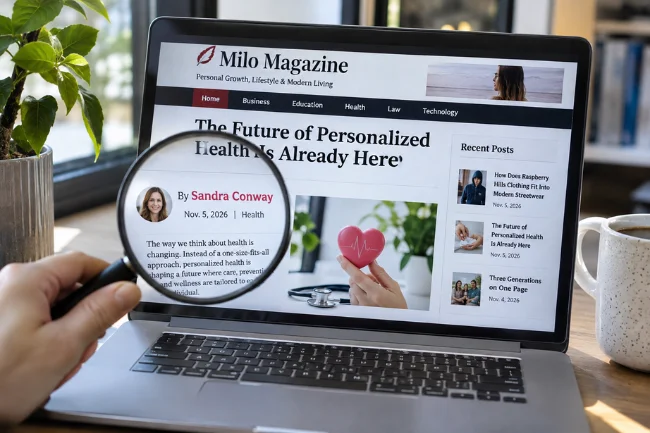
The recent articles I opened display Sandra Conway as their author. They also show publication dates, category labels, article images, and a comment area. These are helpful navigational and attribution features.
However, a visible byline does not answer every credibility question. I could not verify a detailed author biography establishing professional qualifications across the different subjects covered. Nor could I verify a named legal company, founder, or publisher responsible for the exact domain from the pages available during this review.
That means I would avoid saying that Sandra Conway founded or owns the magazine. The same caution applies to claims that the business is headquartered in a specific UK city. A name on a post and a British-style web address are not proof of either point.
When did the website begin publishing?
This is another detail worth checking rather than guessing. The older end of the site’s accessible archive contains entries dated October 17–20, 2025, including celebrity-oriented profiles.
Those dates establish that the archive currently displays content attributed to 2025. They do not, by themselves, prove the date the company was established, when the domain first went live, or whether older material was imported later. I did not find a verified founding announcement.
For historical questions, I prefer this distinction: the earliest dated posts I could see are evidence of the site’s published archive, not a certified company history.
Is Milomagazine.co.uk Legitimate and Trustworthy?
The website is real in the straightforward sense that it is accessible and serves readable articles. I opened multiple pages directly. But “the site exists” and “every article is reliable” are two very different judgments.
I look for several things when assessing a digital publication: identifiable authors, relevant expertise, source links, transparent corrections, sensible advertising disclosures, and content that matches its title. Milo Magazine provides dates and bylines, which are useful. I could not verify a complete public account of ownership and editorial review procedures on the exact domain.
I also noticed that some articles contain links to specific brands or services. That alone does not prove an article is sponsored. It does mean readers should ask whether a recommendation is independently assessed, commercially motivated, or both. A clearly marked sponsorship policy would make such judgments easier.
Extra caution for high-stakes subjects
When an article concerns health, money, or law, I raise the standard. Medical claims should be cross-checked against reputable clinical or public-health sources. Legal information must be matched to the correct country or state. Financial and housing guidance should use current figures and explain relevant conditions.
A magazine can introduce a subject without being the final authority on it. That is how I would use this site: for discovery, background reading, and questions to investigate further—not as the sole evidence for a major decision.
What Is the Reading Experience Like?
The sampled pages use a familiar article layout: a headline, category, byline, date, main text, subheadings, and a comments section. I could follow stories from the homepage and read them without encountering a subscription wall.
I found the most useful approach was to search for the specific topic I wanted, open the relevant story, and read its date before paying attention to any product or service recommendation. The homepage is better treated as a changing feed than as a complete directory of expertise.
Is the content free to read?
The individual articles I tested were accessible without signing in, providing payment details, or purchasing a subscription. That supports saying the sampled public content was free at the time of review.
It would be too broad to promise that every present or future feature is free. Access policies can change, and I did not test every URL on the website.
Does the .co.uk Address Mean the Magazine Is Based in Britain?
Not necessarily. The .co.uk ending identifies a domain within the United Kingdom’s country-code naming space. It does not independently establish an office address, the nationality of the editors, or the country in which a particular article’s guidance applies.
The site’s UK student-housing stories clearly concern British locations. Other content, including an article referencing Los Angeles probate litigation, has a different geographical context. Readers outside the UK can access public pages, but they should not assume that every legal, medical, or practical recommendation applies locally.
For American readers searching for “Milo Magazine UK” or “milomagazine.co.uk USA,” I found no verified separate US edition of this exact website. The safest route is to use the precise domain and check each article’s location-specific details.
Is It the Same as TheMiloMagazine.co.uk?
No one should assume that similar-looking web addresses belong to the same publisher. Milomagazine.co.uk and themilomagazine.co.uk are different domain names, and the second address has displayed its own descriptions of Milo Magazine.
A similar name, shared branding language, or a link between sites does not by itself establish shared ownership. I could not independently confirm their corporate relationship. The practical advice is to compare the full address before relying on an About page, sending an editorial pitch, or contacting a supposed representative.
How Can Readers Contact Milo Magazine?
The exact domain has a Contact Us page inviting genuine inquiries and indicating an email contact link. I could confirm the page’s presence, but the address was protected in the text available to my review, so I will not reproduce an unverified email from another website.
For a correction request, I would include the article title, its URL, the sentence in question, and a reliable source supporting the correction. That gives the recipient something specific to investigate.
If you want to contribute a guest article or propose a commercial collaboration, first ask for current submission rules, editorial terms, and any sponsorship disclosure requirements. I could not verify a comprehensive contributor policy for the exact domain.
How I Would Check an Article Before Trusting It
My approach is practical rather than complicated. First, I ask whether the headline accurately describes the piece. Next, I look for an identifiable author, relevant experience, recent dates, and links to original evidence. Then I compare the central claim with at least one independent source.
What Milo Magazine Does Well—and Where It Could Improve
Its strengths are easy to understand: publicly accessible reading material, a steady flow of dated posts, recognizable headlines, and coverage that reaches beyond a single niche. Some practical articles identify choices a reader can investigate further, such as accommodation types or ways to compare costs.
The biggest unresolved issues are editorial identity and transparency. The site’s celebrity-oriented description does not reflect its entire recent feed. Author credentials across specialist subjects are not fully established in the pages I checked, and ownership information remains unclear. More visible source citations, clear commercial disclosures, and an accessible editorial-policy page would help readers weigh its advice.
Frequently Asked Questions
What is Milomagazine.co.uk?
It is the website of Milo Magazine, an online publication featuring general-interest articles on fashion, education, health, business, law, technology, and entertainment.
Is Milomagazine.co.uk free to use?
The public articles I checked opened without registration or payment. I cannot confirm that every future feature will have the same access rules.
Who owns Milo Magazine?
I could not verify a named owner or operating company for the exact domain. Sandra Conway appears as an article byline, but that does not establish ownership.
Is Milomagazine.co.uk a trustworthy website?
It is an active publishing site, but reliability varies by article. Check author qualifications, sources, dates, commercial links, and location-specific claims.
Can readers outside the UK access Milo Magazine?
Its public web pages are accessible online, including to international readers. Check local applicability before following legal, health, housing, or financial advice.
Final Thoughts
Milomagazine.co.uk is best understood as a broad online magazine whose actual publishing range is wider than its celebrity-focused homepage description. I found useful topic variety and readable articles, alongside unanswered questions about ownership and editorial oversight.
If you are curious about the site, visit the official Milo Magazine homepage, choose a recent article that interests you, and check its sources before acting on important advice. That small habit will tell you more than a confident-sounding website description ever could.

Noah Sterling is a technology research writer with 8+ years of experience covering emerging technologies, software trends, digital tools, and innovation. He creates practical, research-based articles to help readers understand the evolving technology landscape.