
The Iowa Secretary of State Business Search is a public tool for looking up businesses registered with the state. You can search by business name or business number, then open a record to check details such as its status, registered agent, addresses, and filing history. It is useful when you want to confirm that a company exists, find your own business number, or research a name before forming an LLC.
The search is free to use. Start with the official Business Entities Search, which is separate from Iowa’s Fast Track Filing system for submitting documents. I use the search as a starting point for verification, not as a guarantee that a company is licensed, financially sound, or owned by the person who contacted me. Iowa describes its office as a filing repository and does not warrant that every detail in a submitted filing is complete or correct.
What Can You Find in Iowa’s Business Search?
Iowa’s database covers more than 600,000 active and inactive business entities and over one million filings, according to the Secretary of State. It can display names, addresses, previous names, registered agents, officers, directors, stock information, and other details when those records are available. The amount of information varies by entity and filing history.
You might use an Iowa business entity search to answer questions such as:
- Is this LLC or corporation registered in Iowa?
- What is its exact legal name and business number?
- Does its record show an active or inactive status?
- Who is listed as its registered agent?
- Has it changed its name or address?
- What documents has it filed with the state?
The distinction between “registered” and “operating” matters. A company might appear in the database long after it stopped doing business. Conversely, a sole proprietorship may be operating legitimately without appearing there: Iowa says sole proprietorships and some partnerships are not required to register with the Secretary of State.
How to Search by Business Name
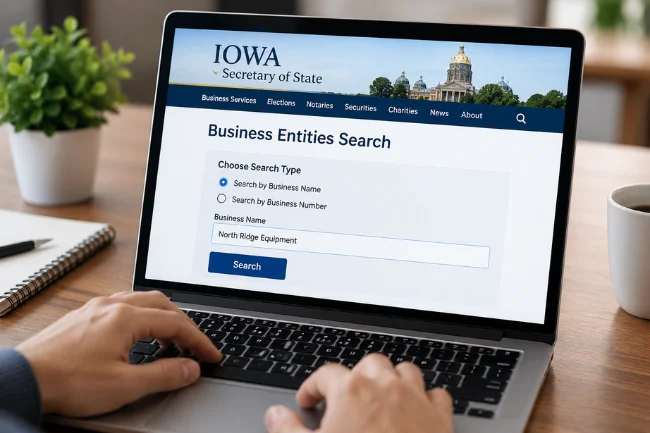
Open Iowa’s Business Entities Search. Under “Choose Search Type,” select “Search by Business Name.” The page asks for the first few letters or words of a business name, so you do not need to know every word of the legal name to begin.
I would start with the most distinctive part of the name. If an invoice says “North Ridge Equipment Solutions LLC,” for example, I might first try “North Ridge Equipment.” This is a hypothetical example, not a claim that a company by that name exists. If the results are too broad, add another word; if nothing appears, shorten the phrase and check the spelling.
Iowa’s system removes some common words while processing a name search. Its help page gives “THE” and “AN” at the beginning and “CORPORATION” and “INC” at the end as examples. Searches return no more than 1,000 results, so a very short or common phrase may need refining.
When the results appear, compare more than the displayed name. Look at the business number, status, and name type. Then click the business number to open the entity’s summary. A similar name can belong to another company, and a result can represent a former or fictitious name rather than the current legal name.
Search by Business Number When You Have It
Select “Search by Business Number” if a contract, state notice, or earlier record gives you the company’s number. Enter the complete number using digits only. Iowa’s search page provides a separate field for this method, and the Secretary of State recommends it when you want to eliminate excess name matches.
If you need to recover your own number, search your company’s name first and find the matching result. Keep the number with your business records once you have confirmed the entity. It is a useful reference when you return to the state’s filing system.
How to Read the Search Results
A result is a lead, not the end of the check. Iowa’s results show a business number, name, status, and a “Type” field. That last field can be surprising: it describes the type of name record, rather than simply telling you whether the business is an LLC or corporation.
For example, Iowa’s name-type list includes “L” for legal, “F” for former name, “FN” for fictitious name, and “R” for reserved. A company appearing under a former name does not necessarily use that name today. The state also displays a “Modified?” flag for certain legal names containing characters that are difficult to type into the search.
Once you open the summary, compare its available addresses, agent, previous names, and filings with the information you already have. I find it helpful to write down three things before deciding I have the right business: the exact legal name, the business number, and one independent matching detail, such as an address on a signed contract. That small check can prevent a convincing name match from becoming a mistaken identification.
Can You Find an Iowa LLC’s Owner?
Do not treat the registered agent as proof of ownership. The agent is the person or service designated to receive legal and official notices. An owner can serve in that role, but so can someone else.
Likewise, a person who signed or organized a filing may have a different role from an LLC member. Iowa business records can help you identify names associated with a company, but they should not be presented as a complete ownership register. If ownership matters for a purchase, loan, or significant contract, ask the company for appropriate ownership documentation and confirm the signer’s authority through your transaction process.
Corporation filings may show officers or directors. Those roles can help you investigate the company, but an officer’s name alone does not establish who holds its shares. I would describe exactly what the state record says rather than turning a listed role into an unsupported ownership claim.
Checking Whether an Iowa Business Name Is Available
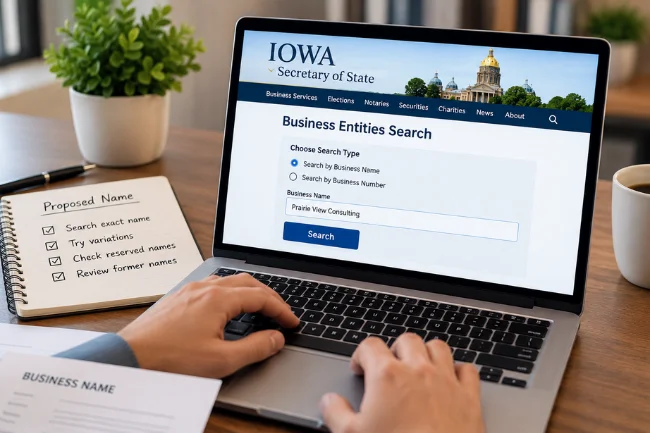
The business search is also a sensible first check before choosing an LLC or corporation name. Search your proposed name, then try its distinctive words and close variations. Review legal names as well as reserved and former names before assuming a clean exact match settles the question.
Iowa requires LLC and corporation names to be distinguishable from protected names on record. Changing punctuation, capitalization, “&” to “and,” or the way you write an LLC suffix generally will not create a distinguishable name. A different letter or sequence of letters may make a difference. The state also says the name of an administratively dissolved entity can remain unavailable for public use for five years.
For that reason, “no results” is encouraging, but it is not a promise of approval. Iowa’s Fast Track Filing application has a separate name-availability check during formation. You can also reserve an approved name for 120 days, though reservation is optional. Iowa currently lists a $10 reservation fee.
I would make one more check before paying for a logo, signage, or a domain: search relevant trademarks and existing marketplace use. State entity-name availability and the right to use a brand in commerce are different questions.
What Does a Business Status Tell You?
Status is often the first detail a customer or potential partner notices. It needs context from the entity’s filing history.
An active record is evidence of the entity’s status in Iowa’s registration system. It does not certify that the business has every license it needs, pays its bills, has no liens, or is safe to hire. If a record is inactive or shows a standing problem, look for reports, dissolution documents, reinstatement filings, or other changes that explain it.
I separate two questions when reviewing a company:
- What is the entity’s current state record status?
- Are there recent filings that explain how it got there?
That approach is especially useful when an old invoice, website, or contract uses a former company name. It also avoids treating a recently submitted filing as an approved change before the state’s public record reflects it.
If the status matters to a lender, landlord, or another party requiring official proof, ask what document they need. A search-result page and a purchased Certificate of Existence serve different purposes.
Iowa Biennial Reports and Common Filing Fees
Iowa generally uses a two-year reporting cycle. Profit corporations report in even-numbered years. LLCs, LLPs, and nonprofit corporations report in odd-numbered years. The normal filing window begins January 1 and runs through April 1 of the applicable year. The Secretary of State publishes these schedules and fees on its Business Entity Forms and Fees page.
For a newly formed business, the first report follows the applicable reporting year after its formation year. Under the Iowa Code, an LLC formed in 2026 would generally make its first regular report in 2027; a for-profit corporation formed in 2026 would generally do so in 2028. That distinction prevents a new corporation from assuming it owes a report merely because 2026 is an even year.
Missing a required report can affect an entity’s standing and may lead to administrative dissolution. If that has happened, check Iowa’s reinstatement guidance rather than assuming one payment will fix everything. The state says a qualifying reinstatement requires the two most recent biennial reports. It also draws a significant distinction for foreign entities registered in Iowa: an inactive foreign registration cannot use that reinstatement process and must be registered anew, receiving a new business number.
Fees and procedures can change. Check the state’s live fee page before submitting a document or budgeting for a filing.
When You Need a Certificate of Existence
A bank, buyer, or another state may ask for an official certificate rather than a screenshot of a search result. Iowa issues a Certificate of Existence for a qualifying domestic entity that is currently in good standing. The listed fee is $5.
To obtain one online, search for the entity and open its Business Entity Summary. Iowa says the “Print Certificate of Existence” link appears above the business name. After payment, the receipt page provides the link to print it; the state advises keeping that page open until the certificate has been printed. It also offers a Certificate Validation Tool for checking an issued certificate number.
A foreign entity registered to do business in Iowa has a different document available through this process: a Certificate of Authorization/Registration. For a Certificate of Existence from its formation jurisdiction, contact that jurisdiction instead. That distinction is easy to miss when someone simply asks for “a good-standing certificate.”
Use the Record for Due Diligence, Not as a Verdict
Suppose a vendor sends an invoice under a trade name, asks for payment to an account bearing another name, and points you to an active Iowa LLC record. The active record answers only one part of your question. I would ask how the invoice name relates to the legal entity, compare the business number and address, and use a known contact channel to confirm the payment instructions.
For a higher-value decision, build on the state search with the checks that fit the transaction: professional licensing, UCC financing statements, court records, references, financial documents, or the company’s record in its formation state. An Iowa registration does not replace those sources.
Pay attention to unexplained changes in a record, too. Iowa’s 2026 STOP Fraud Act gave the Secretary of State additional ways to investigate suspected fraudulent filings. The state says an individual whose name, address, or email was used without consent in a business filing can submit a notarized Affidavit of Unauthorized Use at no cost for review. An unexpected entry deserves investigation; it is not, by itself, proof of wrongdoing by the company you are researching.
What If You Cannot Find the Business?
Try the simplest fixes first: remove a suffix such as “LLC” or “Inc.,” enter fewer words, and check spelling. Search a previous name if you know one. If you have the Iowa business number, use it instead of the name.
If the company was formed elsewhere, check both its original jurisdiction and whether it registered to transact business in Iowa. If it is a sole proprietorship, absence from the Secretary of State’s entity search may be entirely expected. Iowa does not require sole proprietorships and certain other structures to register with that office.
When a search still does not resolve a filing or record question, Iowa’s Business Services Division lists 515-281-5204 as its contact number. Tell them the exact name or business number you searched and what you expected to find.
Frequently Asked Questions
Is the Iowa Secretary of State Business Search free?
Yes. You can search public business-entity records online without paying; obtaining certain official documents, such as a Certificate of Existence, has a fee.
Can I search an Iowa LLC by its business number?
Yes. Select the business-number option on the official search page and enter the complete number using digits only.
Does an active Iowa business status mean a company is trustworthy?
No. It tells you about its state entity record, not its finances, licenses, payment practices, or the accuracy of every submitted filing.
Why is my sole proprietorship missing from the search?
Iowa does not require sole proprietorships to register with the Secretary of State, so a missing entity result does not necessarily mean the business is operating improperly.
Is finding no matching name enough to form an Iowa LLC?
No. Search close variations and use the name check in Fast Track Filing; the state decides whether a proposed name meets its distinguishability rules.
Your Next Move
Open the official Iowa Secretary of State Business Search and look up the name or number you have. Confirm the legal name and business number, read the full record, and choose your next step based on your purpose. If you are forming a business, continue to check name availability and filing requirements. If you are verifying someone else’s company, compare the state record with independent evidence before making a decision.

Ethan Caldwell is a business research writer with 9+ years of experience covering entrepreneurship, market trends, business strategies, and industry insights. He focuses on creating clear, data-informed articles that help readers understand modern business concepts.