Sajar Plastics Inc. is a long-established custom plastics manufacturer in Middlefield, Ohio, best known for producing large, complex, appearance-sensitive injection-molded parts. The company was founded in 1949 and built a particular reputation around gas-assist injection molding, along with structural foam and conventional injection molding. Today, the operation is part of Universal Plastics Group, which acquired Sajar in 2017. Current Ohio public records identify the Middlefield facility as “Universal Plastics – Sajar Molding Services Inc.,” while the parent group continues to use the Sajar Plastics name in its marketing.
In simple terms, Sajar is not a consumer plastics brand. It is a business-to-business manufacturer that helps OEMs turn engineered designs into finished plastic components, especially when size, surface quality, strength, or part geometry makes ordinary molding more difficult.
Sajar Plastics Inc. at a Glance
When I researched Sajar Plastics, one thing became clear quickly: the company’s online footprint is fragmented across older corporate pages, acquisition announcements, trade publications, supplier directories, and government records.
That can make a straightforward company lookup harder than it should be.
Universal Plastics Group currently describes Sajar as a Middlefield-based large-part molder specializing in gas assist, structural foam, and straight injection molding. Its corporate materials also state that Sajar operates from a facility of roughly 150,000 square feet and is ISO 9001 registered.
That naming issue matters for anyone researching suppliers, employment history, environmental records, or business registrations. Searching only “Sajar Plastics Inc” can surface older material, while newer records may appear under Universal Plastics or Sajar Molding Services.
The History of Sajar Plastics
Sajar Plastics traces its origins to 1949, giving the Middlefield operation more than seven decades of manufacturing history.
A 2017 Geauga County business feature reported that the Sajar name came from an acronym based on the surnames of its founders, although the article did not identify those founders individually.
There are also useful historical breadcrumbs outside normal company-profile pages.
A 1973 NASA industry invitation list identified Tom W. Johnson as president of Sajar Plastics Inc. in Middlefield. A 1977 Federal Register notice referenced transportation of plastic articles from Middlefield under contract with Sajar Plastics.
Those records do not tell the entire company story, but they independently confirm that Sajar had an established industrial presence decades before today’s online supplier directories existed.
For me, that is more meaningful than simply repeating “founded in 1949.” It shows continuity across different eras of American plastics manufacturing.
Sajar’s Role in Gas-Assist Injection Molding
The most distinctive part of Sajar’s history is its connection to gas-assist molding.
Universal Plastics Group says the Middlefield operation was one of three original companies involved in developing gas-assisted injection molding in the early 1980s. The Plastics Hall of Fame’s biography of gas-assist pioneer James R. W. Hendry also records his work with Sajar Plastics as the technology developed.
That history is not just a marketing anecdote.
A BASF plastic-part design guide preserved in U.S. Patent and Trademark Office materials cites a 1990 “Design Tips for Gas-Assisted Injection Molding” diagram by Indra Baxi of Sajar Plastics. This shows Sajar personnel were contributing technical knowledge to the field while the process was still maturing.
Universal Plastics has since reported that Sajar commercialized more than 500 gas-assist parts for OEM customers.
What Does Sajar Plastics Manufacture?
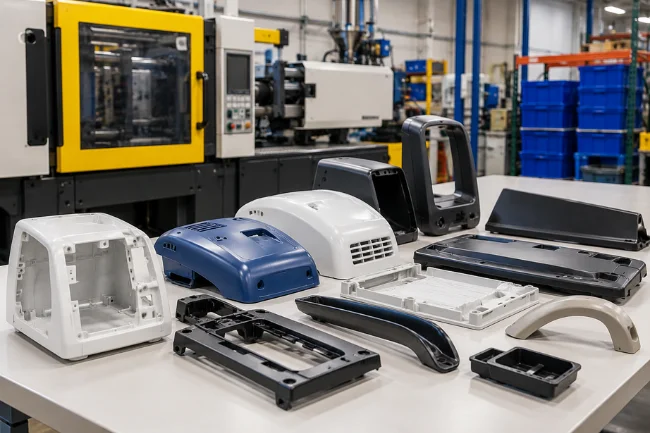
Sajar Plastics is primarily a custom manufacturer. That means its business does not revolve around one branded consumer product line.
Instead, it manufactures plastic components according to customer designs and production requirements.
Examples of parts suited to its capabilities include equipment covers, housings, bezels, panels, doors, handles, cabinets, skins, and other large molded components where appearance and dimensional performance both matter. A regional business profile specifically identified large handles, equipment covers, doors, bezels, cabinets, and skins as examples of gas-assist applications associated with the operation.
Older federal court records describe Sajar as manufacturing injection-molded components for medical and banking applications. More recent Universal Plastics material broadens the market picture to medical, laboratory and diagnostic equipment, manufacturing, business equipment, and retail or dispensing systems.
Gas-Assist Injection Molding
Gas-assist injection molding introduces pressurized gas, commonly nitrogen, into or alongside molten plastic during the molding cycle.
Depending on the process and component design, the gas can create hollow sections, help pack thicker regions, minimize sink marks, and make large parts more practical without turning every thick section into a heavy solid mass.
For buyers, the potential benefits include lower material consumption, reduced component weight, improved dimensional behavior, increased stiffness in selected areas, and better control of cosmetic defects.
Sajar’s experience becomes particularly relevant when a design contains broad surfaces, thick ribs, handles, channels, bosses, or other geometry that can create sink and warpage challenges in conventional injection molding.
Structural Foam Molding
Structural foam molding is another process Sajar offers for larger plastic components.
A foaming mechanism produces a cellular interior beneath a denser outer skin. The approach can provide a favorable stiffness-to-weight relationship while reducing molded-in stresses compared with some thick solid-wall designs.
It is commonly considered for industrial housings, bases, equipment structures, carts, cabinets, and other sizeable parts where strength and rigidity are major design requirements.
Sajar’s published capabilities have historically included high-pressure structural foam molding as well as conventional and gas-assisted injection processes.
Standard Injection Molding
Straight or conventional injection molding remains part of the Middlefield operation as well.
That matters because not every plastic component benefits from gas assist or structural foam.
Having multiple processes available gives a manufacturer more opportunity to match the production method to annual volume, tooling economics, wall thickness, appearance requirements, mechanical performance, and part geometry.
How Sajar’s Main Plastic-Molding Processes Compare
The thermoforming comparison is worth including because Sajar’s 2017 acquisition was partly about giving customers a broader manufacturing path.
Universal Plastics explained that customers can start with thermoformed products at lower production volumes and potentially transition toward injection molding as their volumes and product requirements change.
That production-life-cycle flexibility can matter commercially as much as any individual molding process.
The 2017 Acquisition by Universal Plastics
Universal Plastics acquired Sajar Plastics in June 2017, with the transaction publicly announced in July. Financial terms were not disclosed.
The strategic logic was straightforward.
Universal already specialized in heavy-gauge thermoforming, while Sajar brought expertise in large-part gas-assist injection molding. Together, the businesses could support OEM programs at different production stages and volumes.
Independent coverage from Modern Distribution Management reported the same rationale: Sajar’s gas-assist capabilities gave Universal an opportunity to support customers farther along a product’s manufacturing life cycle.
The acquisition did not mean the Sajar identity disappeared overnight.
Universal stated at the time that Sajar would retain its facilities, employees, and established procedures. The parent group still presents Sajar Plastics as one of its specialized plastics-manufacturing operations.
What Makes the Middlefield Facility Different?
Universal Plastics says the Middlefield facility has small-, medium-, and large-tonnage molding presses together with in-house painting, secondary operations, and assembly capabilities.
Universal Plastics says the location has small-, medium-, and large-tonnage molding presses together with in-house painting, secondary operations, and assembly capabilities.
That combination can be useful when an OEM needs more than a raw molded component.
A part may require painting, labeling, printing, installed hardware, assembly, packaging, or another finishing operation before it is ready to enter the customer’s production system.
Historical company material specifically lists secondary services that include finishing, painting, labeling, printing, assembly, and packaging.
This “mold plus finish” model can reduce the number of supplier handoffs.
Fewer handoffs do not automatically guarantee lower manufacturing costs, but they can simplify scheduling, transportation, cosmetic consistency, quality responsibility, and supplier management.
Quality and Appearance Are Central to the Business Model
Sajar’s public descriptions repeatedly emphasize large, complex, quality-critical and aesthetically demanding components.
Those words matter in plastics manufacturing.
A hidden internal bracket and a customer-facing medical equipment enclosure can have very different acceptance standards. The enclosure may require controlled gloss, color, texture, paint adhesion, dimensional stability, assembly-gap consistency, and minimal visible sink or distortion.
Universal Plastics Group currently says Sajar is ISO 9001 registered.
For prospective customers, I would still request the current certificate, certified scope, revision, accreditation information, and expiration details during supplier qualification rather than relying on a website statement alone.
That is sensible procurement practice for any manufacturing supplier.
Industries Served by Sajar Plastics
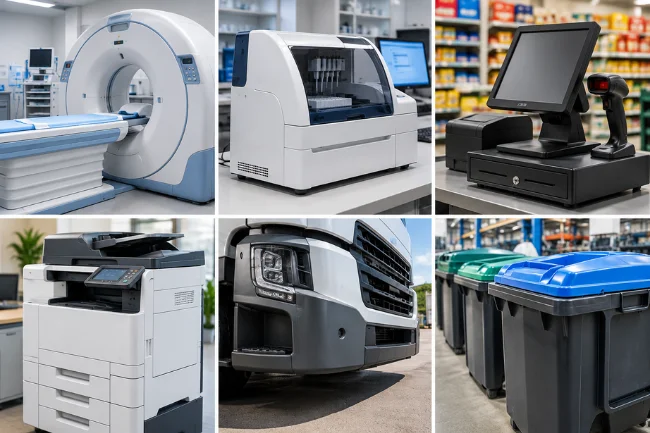
Sajar’s market mix has changed over the decades, but available sources consistently point to OEM manufacturing rather than retail consumer products.
Medical and laboratory equipment are prominent markets. These types of products can require large exterior enclosures and molded components where appearance, repeatability, dimensional control, and reliable assembly interfaces matter.
Business equipment and retail systems also appear repeatedly in Sajar’s history. Older records refer to banking applications, while newer company descriptions mention retail registers and dispensing machines.
Manufacturing and general industrial applications fit the same capability set: large housings, structural covers, bezels, access panels, equipment skins, and molded assemblies.
The wider Universal Plastics Group also works across transportation, aerospace, medical devices, consumer products, waste management, lawn and garden, and other industrial sectors through its various manufacturing operations.
Those group-level capabilities should not automatically be attributed to the Sajar plant itself, but they can matter when an OEM needs several plastic-processing methods across one sourcing program.
A 2026 Public Record Shows the Operation Is Still Active
One of the most useful pieces of current information I found does not come from a marketing page.
An Ohio Bureau of Workers’ Compensation transparency report lists “Universal Plastics – Sajar Molding Services Inc” as receiving a $40,000 Safety Intervention Grant approved on June 3, 2026. The program provides funding intended to help employers obtain equipment that substantially reduces or eliminates workplace injury and illness risks.
The public summary does not identify the specific equipment associated with Sajar’s grant, so I would not speculate about what was purchased.
Still, this provides recent independent evidence that the Middlefield operation remains active and is participating in a state workplace-safety investment program.
A current Ohio EPA industrial permit listing also identifies Universal Plastics – Sajar Molding Services Inc. at 15285 South State Road/Street in Middlefield.
For anyone trying to determine whether “Sajar Plastics Inc” is simply an old company name or connected to a functioning manufacturing operation, the distinction is useful: the Sajar manufacturing operation continues, although current government records can use the newer Universal Plastics–Sajar Molding Services name.
What Potential Customers Should Ask Before Requesting a Quote
If I were evaluating Sajar Plastics for an OEM program, I would focus less on general company claims and more on whether the facility matches the proposed part.
I would confirm the target resin, annual volume, expected program life, maximum part dimensions, required press tonnage, cosmetic specification, tooling ownership, tolerance stack, secondary operations, validation requirements, packaging method, and capacity expectations.
For a gas-assist project, I would also ask how early Sajar can participate in design review.
Gas channels, ribs, wall transitions, bosses, gate location, material flow, thick sections, and customer-facing cosmetic zones are not details that should first be considered after production tooling has already been built.
For medical or diagnostic equipment, supplier qualification may require documentation beyond ISO 9001 depending on the component’s regulatory role.
Buyers should verify the standards applicable to the actual program rather than assuming that experience supplying medical-equipment manufacturers means every medical-industry certification is automatically held.
What I Could Verify — and What I Would Not Guess
A credible profile of Sajar Plastics Inc. needs to distinguish current information from old directory data.
I could verify Sajar’s 1949 founding, Middlefield location, 2017 acquisition, core molding technologies, history in gas-assist molding, broad end markets, ISO 9001 registration as stated by its parent group, and current public-record use of the Sajar Molding Services name.
I also found older sources giving employee counts, estimated sales, and slightly different facility-size figures. A historical Geauga County industrial directory, for example, recorded 115 employees and provided building figures that differ from the roughly 150,000-square-foot figure used in current Universal Plastics marketing.
Because those numbers are date-sensitive, I would not present them as current 2026 statistics.
I also could not verify authoritative current public figures for exact molding-machine tonnage ranges, annual revenue, live employee headcount, current major customers, or production capacity by individual machine.
Those are better confirmed directly with the company during the sourcing process.
That restraint is part of useful research. Filling an information gap with an unsupported number may make an article look more complete, but it makes the information less trustworthy.
Why Sajar Plastics Still Matters in Custom Plastics Manufacturing
Sajar Plastics occupies a specific manufacturing niche: producing large molded components that need to be structurally capable and visually acceptable at the same time.
Its history in gas-assist molding gives it a technical identity beyond simply being another injection-molding company.
Its structural foam, conventional injection molding, painting, assembly, and secondary finishing capabilities widen the range of work that can remain within one manufacturing operation.
The Universal Plastics acquisition added another dimension by connecting those injection-molding capabilities with thermoforming and other plastics processes available elsewhere in the group.
For OEMs, that can provide a more flexible route from early-stage manufacturing to mature production volumes.
The strongest takeaway I found is not one machine specification or historical sales figure. It is the continuity between Sajar’s early technical involvement in gas-assisted molding and the current Middlefield operation’s emphasis on large, complex, appearance-sensitive plastic components.
Final Takeaway
Sajar Plastics Inc. is best understood today as a historic and still-active Middlefield plastics manufacturing operation within Universal Plastics Group. Its main strengths center on gas-assist injection molding, structural foam, conventional injection molding, and value-added finishing for large, complex OEM components.
If you are considering Sajar for a manufacturing project, the next useful move is to compare your part geometry, annual production volume, surface-finish requirements, material, tooling budget, and validation needs with the Middlefield facility’s current capabilities, then request a technical review or quotation directly from Universal Plastics.
Frequently Asked Questions
What is Sajar Plastics Inc.?
Sajar Plastics is a Middlefield, Ohio custom plastics manufacturer known for large-part injection molding, particularly gas-assist and structural foam processes.
Who owns Sajar Plastics?
Universal Plastics acquired Sajar Plastics in 2017, and the manufacturing operation is now part of Universal Plastics Group.
Where is Sajar Plastics located?
The Sajar manufacturing operation is located at 15285 South State Street/Avenue in Middlefield, Ohio 44062.
What does Sajar Plastics manufacture?
It manufactures custom OEM plastic components, including large housings, covers, panels, bezels, handles, cabinets, and other complex molded parts.
Is Sajar Plastics still in business?
Yes. Universal Plastics still lists Sajar as its Middlefield molding operation, while 2026 Ohio records identify the facility as Universal Plastics – Sajar Molding Services Inc.

Ethan Caldwell is a business research writer with 9+ years of experience covering entrepreneurship, market trends, business strategies, and industry insights. He focuses on creating clear, data-informed articles that help readers understand modern business concepts.