

Andhra Law Times is an Indian legal reporting journal that publishes selected court decisions and related legal material, particularly useful to lawyers researching Andhra Pradesh and Telangana law. Commonly abbreviated as ALT, it helps readers find reported judgments, understand legal principles through editorial headnotes, and cite authorities in court submissions or academic work.
The publication traces its origins to 1954 and is registered as an English-language fortnightly journal based in Hyderabad. It is not a court, government law database, or substitute for the full text of a judgment.
I see its real value in the link it creates between an individual decision and the wider body of precedent. But knowing how the reports are organized—and how the region’s courts have changed—is essential before relying on any ALT citation.
What Is Andhra Law Times Used For?
At its simplest, Andhra Law Times is a law reporter: an edited publication of judicial decisions. Instead of expecting a reader to examine every order issued by every court, a reporter makes selected rulings easier to discover, read, and reference.
Its audience includes advocates preparing arguments, judges and court staff checking authorities, law students researching precedents, and academics investigating the development of regional law. A reported decision may discuss property disputes, civil procedure, constitutional issues, employment, education, or other legal questions.
The distinction between a law report and a statute book matters. A statute states rules enacted through the legislative process. A reported judgment records how a court interpreted or applied the law in a particular dispute.
Both may be relevant, but they answer different research questions.
I would use ALT to identify potentially helpful decisions, then inspect the actual reasoning, relevant legislation, and subsequent judicial treatment before forming a legal conclusion.
The History Behind the Publication
From the Andhra High Court to an Established Law Reporter
The journal’s historical account places its beginnings alongside the High Court of Andhra at Guntur. The court was established in 1954 and moved to Hyderabad in 1956.
This makes ALT especially interesting when researching judgments from the former undivided Andhra Pradesh.
The publisher says L. D. Gogia acquired the copyright to the journal from M. L. Tilak in 1977. It also describes later expansion into criminal, revenue, and legislative publications.
That history explains why ALT can refer both to a core journal and to a broader publishing family.
A historical detail worth checking: the Government of India’s Press Registrar lists a registration date of 2 May 1999.
This does not mean the journal was first founded in 1999. The publication’s history and a particular registration record describe different milestones.
The same official record identifies the journal as English-language and fortnightly, with Hyderabad listed as its publication location.
Since historical registration data can retain older editorial or ownership information, I would not treat every name in the record as a statement about the journal’s present management.
Why the Journal’s Own Court Case Is Worth Knowing
There is even a reported case involving the publication itself. In Andhra Law Times v. Senior Superintendent of Post Offices, decided on 27 August 2008, the High Court considered concessional postal treatment for the journals.
The judgment described the publication as carrying court decisions, legal provisions, and articles of public interest.
The case, reported at (2009) 1 ALT 418, offers an unusual window into how legal periodicals circulated before searchable digital resources became routine.
What Does Andhra Law Times Publish?
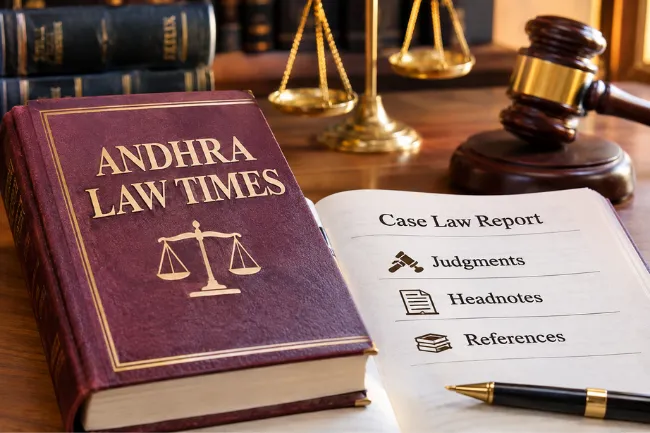
The central attraction is case law reporting. A reader can encounter judicial decisions accompanied by case details, citations, and editorial summaries that bring the legal question into focus.
Judgments, Headnotes, and References
A headnote is an editor’s condensed account of the issues or legal principles addressed in a decision. It can save time when screening results, particularly where many rulings discuss similar statutory provisions.
I regard a headnote as a starting point, never the final authority. The judge’s actual words, the facts, the operative order, and any limitations on the ruling are what matter when someone needs to rely on a case.
Legal reporters may also provide cross-references to related cases and subject classifications.
These features help locate judgments that use different terminology for the same problem. The exact details and coverage depend on the journal, edition, and database being consulted.
The Wider ALT Publication Family
Andhra Law Times is associated with several specialist publications. They are useful because a criminal-law inquiry, a land-record question, and a legislative update do not necessarily call for the same source.
| Publication | Main research focus |
|---|---|
| Andhra Law Times (ALT) | General reported decisions and legal developments |
| Andhra Law Times (Criminal) | Criminal-law judgments and related issues |
| ALT (Revenue) | Revenue, land, and related statutory disputes |
| ALT (Legislative Supplement) | Legislation and connected legal material |
| Andhra Weekly Reporter | A related series historically associated with motor accident reporting |
I would verify the precise series before ordering an old volume or searching a citation. Similar names do not mean the journals share one continuous page sequence.
How to Read an ALT Case Citation
A case citation is a locator, not a summary of a legal rule. Consider this real reference: Gayathri Degree College v. Government of Andhra Pradesh, (2013) 3 ALT 759.
Here, 2013 is the reporting year, 3 identifies the volume, ALT names the reporter, and 759 is the opening page.
The decision itself was delivered on 3 September 2012. That difference shows why the year of a report should not automatically be treated as the date of judgment.
In practical legal research, I would record both dates. I would also preserve the case title, court, case number if available, and any parallel citation.
This makes the reference more useful if a database formats the same case differently.
ALT, ALD, and APLJ Are Not Interchangeable
ALT means Andhra Law Times. ALD stands for Andhra Legal Decisions, while APLJ is Andhra Pradesh Law Journal.
These are separate reporters, despite their shared regional focus. Similarly, an AIR citation refers to All India Reporter, not a volume of ALT.
A single judgment can appear in more than one reporter. For instance, the Gayathri Degree College ruling is also cited as (2013) 3 ALD 129.
These are parallel references to the same decision, not two different judgments.
A final caution: an ALT reference tells me where a decision was reported, not whether it remains authoritative.
An appeal, later larger-bench ruling, statutory amendment, or contrary Supreme Court decision may change how I should use it.
Why Andhra Pradesh and Telangana Must Be Researched Carefully
This is where a regional law reporter becomes more than a citation index. The historical label “Andhra Pradesh High Court” can refer to judgments issued before today’s separate Andhra Pradesh and Telangana High Courts existed.
The Andhra Pradesh Reorganisation Act, 2014 created a transitional arrangement in which the High Court at Hyderabad served both states.
As the Supreme Court e-Committee confirms, separate High Courts began functioning on 1 January 2019: Andhra Pradesh’s principal seat was established at Amaravati, while Telangana’s remained at Hyderabad.
I therefore ask three questions when reading an older ALT decision: Which court made the ruling? Which territory and law did it concern at the time? And does the reasoning still apply to the present dispute?
A Useful Example of Changing Legal Context
Suppose a judgment from 2012 interprets a land-related law in an area now forming part of Telangana. It may still be relevant to a modern case, but I would check whether the applicable enactment was adapted, amended, repealed, or replaced after reorganisation.
The same caution applies to administrative instructions, local rules, and government orders.
Shared legal history does not guarantee identical current legislation across the two states.
This jurisdiction-and-date check is one of the most valuable habits a reader can develop. It prevents the common mistake of finding an apparently perfect precedent while missing the legal changes that followed.
How to Search Andhra Law Times Online
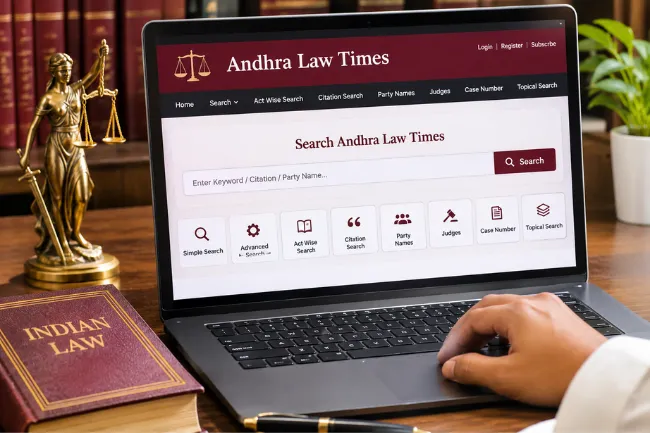
The publication operates the ALT website, which displays several research options.
Its navigation includes simple and advanced search, act-wise lookup, citation search, party names, judges, case numbers, and topical routes.
I would start with the strongest piece of information already available. If I have a citation, searching by citation is more precise than typing a broad phrase.
If I know only the dispute, a party-name or subject search may reveal related decisions.
Search by Citation or Case Details
Take the reference (2013) 3 ALT 759. I would first try the full citation, then variants such as “2013 3 ALT 759” if the search engine handles punctuation differently.
Once the result appears, I would compare the title, court, and decision date.
Where an exact citation is unavailable, I would use the statute’s name, section number, and a distinctive legal issue.
Searching only “land case” or “criminal judgment” tends to produce more noise than a focused query.
The site also presents registration, login, subscription, and demo options.
I would check the current terms directly before assuming a particular judgment, back volume, or PDF is free to download. Search functions and access rights are not the same thing.
Check the Judgment Against an Official Source
For consequential research, I would cross-check the reported decision with an available court-issued copy.
The Andhra Pradesh High Court, Telangana High Court, and eCourts judgments portal provide routes to official judicial material.
For Supreme Court cases, the e-SCR portal offers digital access to the official Supreme Court Reports.
These sources help confirm wording, paragraph numbering, parties, dates, and the final order.
Not every older decision will be equally easy to locate online. Where a digitized copy is missing, a properly identified print volume or law-library collection may be the practical next option.
ALT Reports Compared With Other Research Sources
I see printed reporters, databases, and official court portals as complementary. Each solves a different research problem.
| Source | Best use | Main limitation |
|---|---|---|
| ALT journal or digital collection | Finding reported decisions and editorial research aids | Selected coverage; access may depend on subscription |
| Official High Court judgment | Confirming the court’s actual text and order | Historical search and indexing may be uneven |
| e-SCR | Checking Supreme Court judgments in official reports | Does not replace a regional High Court reporter |
| General legal search database | Discovering cases across courts and parallel citations | Metadata and editorial summaries still need verification |
My preferred approach combines discovery and verification.
I may begin with a reporter’s concise case summary, but I end with the judgment and the legal position as it stands today.
Who Benefits Most From Andhra Law Times?

For practising advocates, ALT can shorten the search for regional precedents and provide familiar citations for pleadings.
It is especially useful where a dispute turns on local legislation, procedural interpretation, or a sequence of decisions from the same judicial system.
For law students, the collection can teach something a textbook often cannot: how judges apply broad rules to specific facts.
I would recommend comparing a reported headnote with the judgment’s reasoning to understand how much nuance a short summary can leave out.
Researchers and journalists can use older volumes to trace how debates over land rights, administration, education, and public law developed over time.
The most revealing material is often not a famous ruling but a series of ordinary cases showing how an issue gradually changed.
For businesses, too, reported decisions can supply useful background when examining contractual disputes, regulatory requirements, employment issues, or property questions.
They should inform professional advice, not replace it.
Four Checks I Make Before Relying on an ALT Judgment
First, I verify identity: case name, court, judgment date, and the exact reporter reference. Similar party names and multiple proceedings can otherwise create confusion.
Second, I inspect the holding. A judgment may mention a principle without actually deciding the issue for which someone wants to cite it.
I look for the point necessary to the court’s decision, not just a convenient sentence.
Third, I check later treatment. Has a superior court reversed the decision? Has a larger bench disagreed with it? Has legislation changed?
A useful old case can become a poor present-day authority if these questions go unanswered.
Fourth, I separate geography from governing law. Particularly after the 2014 state reorganisation and 2019 High Court split, I verify which state’s version of a statute applies.
Together, these checks make a citation more defensible.
Does Andhra Law Times Still Matter in Digital Legal Research?
Yes, because finding a judgment quickly and understanding its place in the law are different tasks.
Full-text search is excellent at locating words. A curated law reporter can help readers identify decisions worth examining and recognize connections across an area of law.
Digital access also changes expectations. I want searchable citations, reliable publication details, links between related decisions, and a clear distinction between editorial analysis and judicial text.
Whether those features are available for a particular ALT volume must be checked rather than assumed.
The practical goal is not to choose between tradition and technology. It is to preserve the reliability of established reporting while using digital tools to make verification quicker and more transparent.
Frequently Asked Questions
What is the full form of ALT in law?
ALT commonly stands for Andhra Law Times, a legal reporting journal that publishes selected Indian court decisions and related material.
Is Andhra Law Times an official government website?
No. It is a legal publication, not a government court portal; use official judicial websites when you need to verify an order or judgment.
How can I find an Andhra Law Times judgment online?
Try the ALT website’s citation, party-name, act-wise, or case-number search, then check the relevant court’s record where available.
What is the citation format for Andhra Law Times?
A typical format is (2013) 3 ALT 759: reporting year, volume number, reporter abbreviation, and starting page.
Does Andhra Law Times cover Telangana cases?
Its historical reports include decisions from the former combined judicial system; confirm the issuing court and current legal relevance for each case.
Final Thoughts
Andhra Law Times remains a useful gateway to the case law and legal history of Andhra Pradesh and Telangana.
Its contribution goes beyond supplying citations: it helps readers locate decisions worth examining.
If you are researching a specific dispute, begin with the exact ALT reference or legal issue, read the full judgment, and verify its present status through authoritative court records.
That extra check turns an interesting citation into dependable research.

Ethan Caldwell is a business research writer with 9+ years of experience covering entrepreneurship, market trends, business strategies, and industry insights. He focuses on creating clear, data-informed articles that help readers understand modern business concepts.