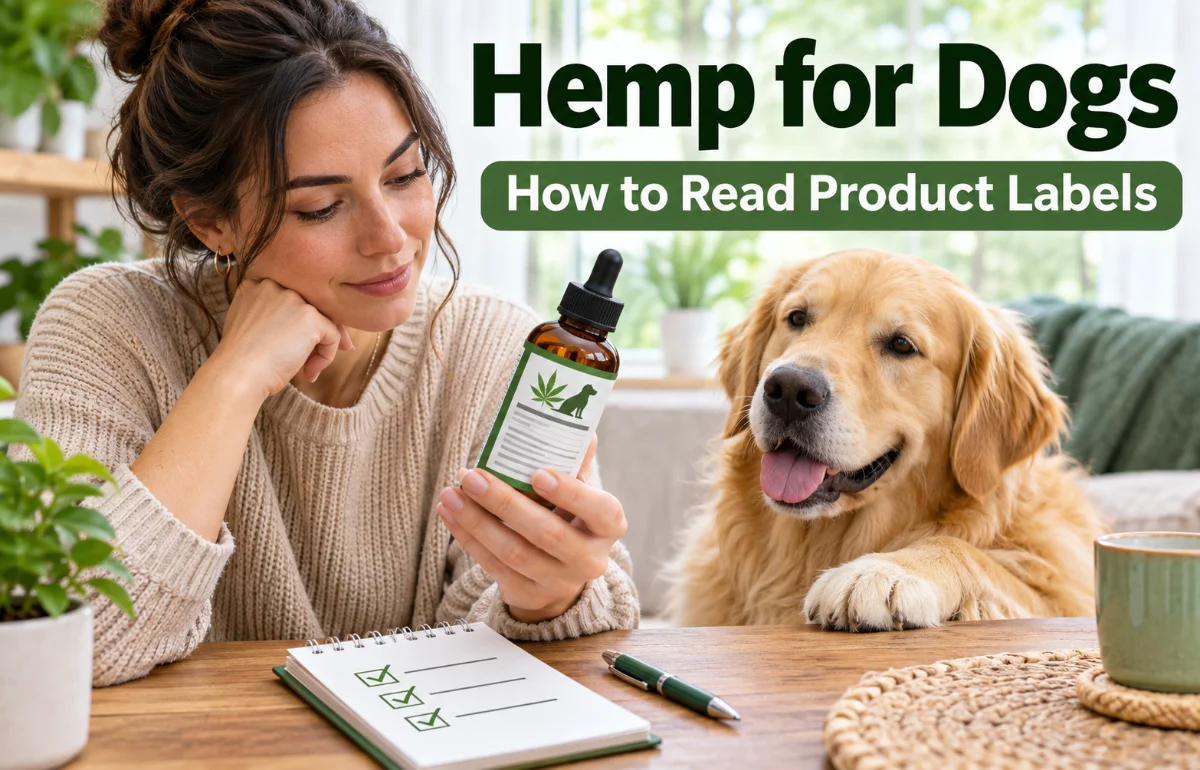
Your dog doesn’t read labels. You do. And the moment you’re standing in the aisle or scrolling a product page with a bottle in your other hand, the last thing you need is a wall of marketing copy telling you this one is “premium.” What you actually need is a way to connect the bottle to the dog currently drooling on your shoe.
That connection is energy. Not the woo-woo kind, the practical kind: how your dog moves through a Tuesday. Is your dog pacing the hallway at the first firework? Knocking into furniture on the stairs? Sleeping through a thunderstorm and waking up stiff? Those are three different dogs, and they need three different conversations, even if the product label looks identical.
Here’s the honest version: most people start with the label, and they should start with the dog. When you’re comparing Hemp for dogs, the energy read you do at home matters more than the font size on the bottle. Get that part right and the label becomes a filter instead of a guessing game.
Start with the dog, not the shelf
I keep a scratch note in my phone for each of my dogs. Nothing fancy, just a line per day: how they woke up, how they ate, whether the evening was calm or a mess. After two weeks, you have a pattern, and that pattern tells you which product category you’re actually shopping for.
Here’s the split I use:
- Calm and steady: your dog is fine most of the day but falls apart at noise, travel, or a house full of people.
- Stiff and slow: the morning walk takes longer to warm up, and stairs get a second look.
- Skin and coat: licking, chewing, dull patches, seasonal itch that shows up every spring.
- Day to day: nothing dramatic, you just want a baseline for a dog who’s getting older.
Notice there’s no “all of the above.” A dog can absolutely land in two buckets, but you pick one to start. Chasing four goals at once with a single bottle is how people end up confused and out forty bucks.
What the label should tell you in ten seconds
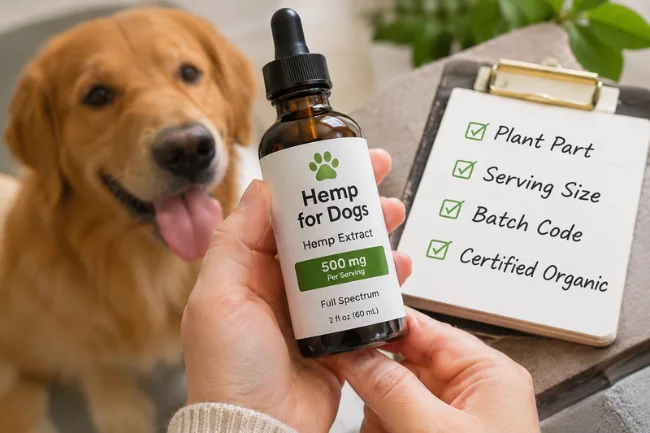
Good labels answer three questions fast: what plant part went in, how much is in each serving, and who checked the batch. If you can’t find those three, put it down. I’d rather you walk out empty-handed than buy something you can’t explain to your own vet.
Look for a milligram figure that ties to a specific serving size, not just a total on the front. A bottle that says “1000mg” in big letters and then hides the per-drop math in the fine print is technically honest and practically useless. You want the number you’ll actually give your dog.
Then look for a batch or lot code. That’s the difference between a producer who tests and one who says they test. A lot code means you can trace your specific bottle back to a specific batch, which is the whole point of third-party testing.
Organic claims are worth checking, too. The USDA runs the national organic program, and “certified organic” is a defined standard rather than a mood. If a brand leans hard on organic but can’t show the seal, that’s your answer.
The calm-moment test before you commit
Here’s the piece I wish someone had told me years ago: the first trial isn’t about the product. It’s about the moment. Pick a calm, ordinary, boring evening, not the night before a vet visit or the afternoon of a thunderstorm. Give the serving, then watch your dog for a couple of hours without hovering.
Write down three things: when you gave it, what your dog was doing before, and what your dog was doing after. That’s it. Two evenings of that tells you more than a dozen reviews from strangers whose dogs live nothing like yours.
One thing I’d skip: treating the first serving as a verdict. Dogs are creatures of routine and a single evening is a coin flip. Give it a few consistent days before you decide anything, and if your dog seems more anxious or off, stop and call your vet. That guidance isn’t from a label; it’s from your dog, and it outranks anything on a bottle.
Why “calm,” “ease,” and “heal” aren’t the same thing
Brands split their lineup by purpose because the formulas differ, and the naming usually tells you which bucket you’re in. A “calm” product is built for situational stress, travel, and noise. An “ease” product is usually aimed at older dogs and joint comfort. A “heal” style product tends to sit in the daily wellness and immune-support corner.
When you’re scanning a shelf, match the name to the bucket you picked at home. If your dog is a firework wreck who’s otherwise spry, calm is your lane. If your dog is a senior who takes a while to get up, ease is your lane. Buying both at once is tempting and usually a waste of money, at least at the start.
Reviews are useful, and here’s how to use them
Reviews from other dog owners are genuinely valuable, just not the way most people use them. Don’t read for star averages. Read for the dog. Find a reviewer whose dog looks like yours in age, size, and temperament, and pay attention to what they say about timing and consistency.
The Federal Trade Commission has been clear that testimonials and endorsements need to reflect real experience, and that’s a good mental filter. If every review is a five-star paragraph that sounds like ad copy, treat it like ad copy. If a reviewer mentions their dog got a little sleepy at first, that’s the kind of detail that helps you plan.
Red flags that don’t get mentioned enough
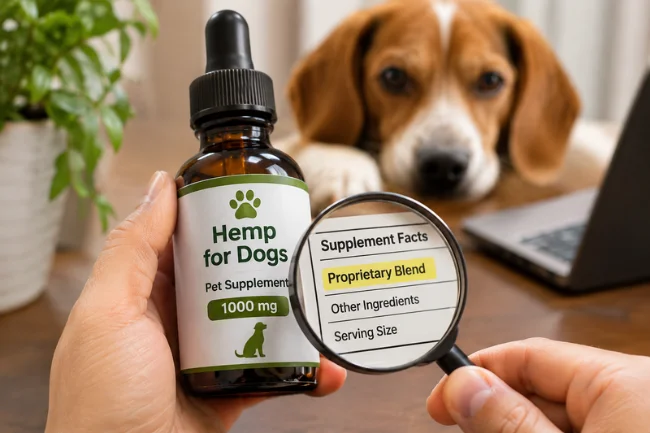
Several things make me put a bottle back:
- A per-serving number that can’t be found anywhere on the page.
- No lot code, no batch number, no traceable path to a test.
- A “proprietary blend” that hides every ingredient behind one label.
- A front-of-bottle claim that reads like a medical promise. The FDA doesn’t allow a supplement to claim it treats or cures a disease, and a brand that flirts with that line is telling you something about how it treats the rest of the label too.
None of these are automatic disqualifiers if the company is willing to answer a phone call. But you shouldn’t have to make that call. The good brands front-load the boring info because they know their buyer is careful.
My pick, if you only do one thing
If you’re going to keep it simple, skip the multi-product starter bundle and buy one product that matches your dog’s single clearest issue. Give it on a calm evening. Write down what happened. Repeat for a few days. Then decide.
That’s it. That’s the whole method. It’s slower than clicking add to cart, and it will save you more money than any discount code.
What to do tomorrow
Open a note in your phone tonight and write one line about your dog’s day. Tomorrow, do it again. By the end of the week, you’ll know which of the four buckets you’re in, and you’ll be able to walk into any product page or store and read the label the way you read your dog: quickly, and with a clear purpose.
What’s the one thing your dog does every day that you’ve never written down? Start there. That note is the shopping list you didn’t know you needed.
This article is for informational purposes only and does not replace veterinary advice. Always consult your veterinarian before giving your dog hemp products, especially if your dog has health concerns or takes medication.

Claire Morgan is a health and wellness writer with 7 years of experience creating clear, research-informed content on nutrition, sleep, movement, preventive habits, and everyday wellbeing. She focuses on making reliable health information practical and easy to understand. Her articles are educational and do not replace professional medical advice.