

You wake up in the middle of the night because your fingers feel strange. Maybe they’re tingling, completely numb, or prickling as though tiny needles are pressing against your skin. You shake your hand, change position, and wait for the feeling to return.
A few minutes later, it settles. By breakfast, you’re holding your coffee mug and scrolling through your phone without much trouble. Whatever happened during the night seems to have disappeared.
It’s easy to dismiss something that goes away so quickly. Perhaps you slept awkwardly or tucked your wrist underneath your pillow. But when the same thing happens several nights in a row, it’s worth paying attention.
For people living with chronic illness, new numbness can be easy to fold into existing symptoms. Yet recurring nighttime hand numbness can point to a separate problem, including carpal tunnel syndrome.
Why Your Hand Keeps Waking You Up
A hand that falls asleep occasionally isn’t necessarily a sign of disease. Temporary pressure on a nerve can cause pins and needles that resolve after changing position. However, repeated numbness affecting particular fingers, especially when it interrupts sleep, may suggest that a nerve is being compressed.
What Happens to Your Wrist While You Sleep
Carpal tunnel syndrome occurs when pressure builds around the median nerve as it passes through a small channel inside the wrist, known as the carpal tunnel.
The median nerve carries sensory signals from the thumb, index and middle fingers, as well as the thumb-side portion of the ring finger. It also supplies certain muscles involved in thumb movement.
During sleep, you have less awareness of how your wrists are positioned. Some people curl their hands inward, bend their wrists beneath a pillow, or sleep with their hands tucked close to their bodies. These positions can increase pressure within the carpal tunnel and aggravate an already sensitive median nerve.
The National Institute of Arthritis and Musculoskeletal and Skin Diseases (NIAMS) notes in its carpal tunnel syndrome overview that symptoms usually start gradually and often first appear at night before becoming more noticeable during daytime activities.
This helps explain an otherwise confusing experience: your fingers may wake you repeatedly even though your hands seem relatively normal during the day.
Why Shaking Your Hand May Temporarily Help
When numbness wakes you, shaking or repositioning your hand can sometimes ease the sensation. Changing your wrist position may reduce temporary pressure on the irritated nerve. But relief doesn’t necessarily mean the underlying problem has resolved.
If the nerve remains vulnerable to compression, symptoms may return the following night. The timing matters, too. Some people initially experience symptoms only while sleeping. Later, they may notice tingling while holding a book, driving, or talking on the phone.
The important change isn’t simply how uncomfortable the sensation feels. It’s whether episodes are becoming more frequent, lasting longer, or affecting activities that previously felt effortless.
Which Fingers Go Numb Can Be an Important Clue
When describing hand numbness, people often say their entire hand feels asleep. That description is understandable, especially when the sensation wakes them suddenly. But the distribution of numbness can be more useful than its intensity. Where the sensation starts, which fingers it reaches, what position brings it on, and what makes it ease can point a clinician toward different nerves and different causes.
How Carpal Tunnel Syndrome Affects the Median Nerve
Carpal tunnel syndrome commonly affects the thumb, index finger, middle finger, and thumb-side portion of the ring finger. The little finger is generally spared because its sensation comes primarily from a different nerve. NIAMS describes this same median-nerve pattern and notes that the little finger is not typically involved.
Tingling in the thumb, index, and middle fingers with a relatively normal little finger fits the median-nerve territory better than numbness concentrated in the ring and little fingers. These distinctions are not enough to diagnose a condition, but they provide useful clues.
The NIH’s MedlinePlus resource on carpal tunnel syndrome identifies numbness, burning, tingling, and hand weakness among the common symptoms. People may also notice trouble gripping small objects as nerve function becomes more affected.
Carpal tunnel syndrome doesn’t always begin with obvious wrist pain. In some cases, numbness is the most noticeable symptom a person experiences. Others experience burning or tingling in the fingers, while discomfort may extend toward the forearm.
When Numbness May Be Coming From Somewhere Else
Numbness in the hand can have several possible causes, and carpal tunnel syndrome is only one of them. Compression of the ulnar nerve near the elbow, for instance, can produce tingling in the ring and little fingers. Problems affecting nerves in the neck may also cause altered sensation or weakness farther down the arm.
Thumb, index, and middle-finger symptoms that are worse at night fit a median-nerve pattern more closely. Ring- and little-finger symptoms, especially when elbow position changes them, can point toward the ulnar nerve. Symptoms traveling from the neck or shoulder into the arm may lead a clinician to consider a cervical nerve source. None of these patterns is diagnostic on its own.
Peripheral neuropathy, including neuropathy associated with diabetes, can also cause numbness in the hands, although the distribution and accompanying symptoms may differ.
A clinician may therefore ask whether your little finger is affected, whether changing your elbow or neck position makes a difference, whether symptoms occur in one hand or both, and whether weakness is developing.
The aim isn’t simply to attach a label to the numbness. It’s to identify which nerve or underlying condition is responsible so treatment addresses the appropriate problem.
Sudden numbness with facial drooping, trouble speaking, or new weakness on one side of the body requires emergency attention rather than routine wrist assessment. The Centers for Disease Control and Prevention lists sudden one-sided numbness or weakness and speech difficulty among stroke warning signs and advises calling 911 right away.
When You Already Live With Pain, New Symptoms Can Be Easy to Dismiss

Chronic illness can change how you respond to physical discomfort. When symptoms have been part of your life for years, you may become skilled at adjusting your routines, planning around difficult days, and deciding which problems need immediate attention.
Those skills can be valuable. But they can also make it tempting to categorize every new sensation as another part of an existing condition.
Why Familiar Pain and New Numbness Should Be Considered Separately
Imagine someone living with rheumatoid arthritis who begins waking with tingling fingers. They might assume the sensation is another consequence of painful, inflamed joints. Yet rheumatoid arthritis is one of the medical conditions
NIAMS identifies as associated with carpal tunnel syndrome, so a new nerve-like symptom should not automatically be attributed to joint pain. Similarly, diabetes is associated with both generalized peripheral neuropathy and an increased risk of carpal tunnel syndrome.
These conditions can coexist, making the cause of hand numbness less obvious. NIAMS also identifies diabetes and certain thyroid disorders among medical conditions associated with carpal tunnel syndrome.
Having one of these conditions doesn’t mean recurring numbness must be caused by carpal tunnel syndrome. It means that new symptoms deserve assessment rather than being automatically attributed to an established diagnosis.
Changes Worth Mentioning to Your Healthcare Provider
You don’t need to maintain an elaborate symptom diary to make a medical appointment useful. A short record is more useful when it captures four things: location, timing, relief or triggers, and function.
A few observations may help:
- Which fingers are numb or tingling?
- Does it happen in one hand or both?
- How many nights each week does it interrupt sleep, and how long does it last?
- Does shaking your hand or changing your wrist, elbow, or neck position relieve the sensation?
- Have you started dropping objects or struggling with buttons, keys, or other small items?
- Do symptoms also appear while driving, reading, holding a phone, or doing another repeatable activity?
Those details turn “my hand goes numb” into a pattern a clinician can compare with median-nerve, ulnar-nerve, neck-related, and more generalized causes.
If you have chronic pain or another diagnosed condition, mention that as well, along with relevant medications and previous nerve-related symptoms.
When Nighttime Numbness Needs Professional Attention
One of the more misleading features of early carpal tunnel syndrome is that symptoms can disappear between episodes.
Feeling better by morning may encourage you to wait. But recurring numbness deserves attention when episodes are becoming more frequent, lasting longer, or beginning to affect hand function.
What a Carpal Tunnel Assessment May Involve
A healthcare professional will usually begin by asking about the pattern of numbness, your medical history, and any changes in hand function. The examination may include checking sensation, thumb muscle strength, and whether certain wrist positions reproduce symptoms.
Depending on the findings, additional testing may be appropriate. Nerve conduction tests assess the speed and strength of electrical impulses moving through nerves, helping doctors detect pressure on the median nerve. Electromyography can provide information about muscle involvement, and ultrasound can show changes in the median nerve.
NIAMS describes all three as tests that may be used when a physical examination alone does not establish the diagnosis. The American Academy of Orthopaedic Surgeons’ 2024 Clinical Practice Guideline for Management of Carpal Tunnel Syndrome gives a strong recommendation for the CTS-6, a clinical diagnostic tool that combines characteristic symptoms and examination findings.
According to AAOS, the CTS-6 assessment tool may help diagnose carpal tunnel syndrome without the need for routine ultrasound scans, nerve conduction testing, or electromyography. That does not mean testing is never useful; it means testing should answer a clinical question rather than be treated as an automatic step for every patient.
Understanding Treatment Options and When Specialist Care Is Needed
Treatment depends on how long symptoms have been present, how severe they are, and whether there is evidence of impaired nerve function. For mild cases, clinicians may recommend nighttime wrist splinting and adjustments to activities that provoke symptoms.
A corticosteroid injection can sometimes provide temporary relief. NIAMS notes that steroid injections can temporarily alleviate symptoms, while the AAOS 2024 guideline concludes that corticosteroid injections do not provide long-term improvement.
Evidence for other nonsurgical approaches varies. The AAOS guideline reports that exercise, massage therapy, and manual therapy have not shown improvement in long-term patient-reported outcomes. These approaches should not delay further assessment when numbness or weakness is progressing.
For readers comparing carpal tunnel treatment in Fort Lauderdale, checking for local information can be a starting point, but it is still important to find a clinician who will confirm the source of the numbness, assess weakness and hand function, and explain whether testing or referral would change the treatment plan.
People with persistent numbness, increasing weakness, or visible wasting of the muscles at the base of the thumb should seek medical assessment. NIAMS notes that chronic or untreated carpal tunnel syndrome can lead to constant numbness and weakness of the muscles at the base of the thumb, while MedlinePlus advises evaluation when sensation worsens, objects are being dropped, or muscle bulk is being lost.
Carpal tunnel release surgery reduces pressure on the median nerve by cutting the ligament that forms the roof of the tunnel. NIAMS describes how the procedure relieves pressure on the nerve, and MedlinePlus notes that surgery may be an option when symptoms are severe and other treatments have not worked.
Surgery isn’t necessary for everyone. The goal is to relieve nerve pressure, preserve hand function, and reduce the risk of lasting nerve damage.
What You Can Do Before Bed to Reduce Wrist Strain
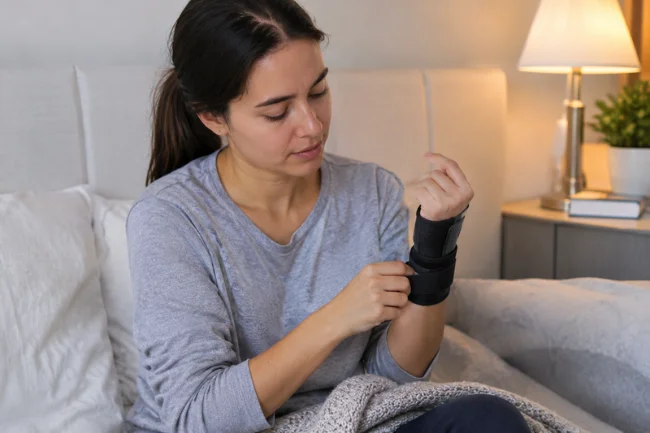
Once nighttime numbness becomes noticeable, it’s understandable to look for something that might help you sleep more comfortably. Some adjustments may reduce symptoms, particularly when carpal tunnel syndrome is mild. However, self-care should not replace assessment when numbness is persistent, worsening, or accompanied by weakness.
How Wrist Positioning and Night Splints May Help
Keeping the wrist relatively straight during sleep can help avoid positions that increase pressure on the median nerve. Wearing a wrist splint that keeps the joint in a straight, natural position is often one of the first approaches recommended for relieving mild carpal tunnel symptoms. It limits excessive wrist bending while allowing the hand to rest.
NIAMS describes nighttime splinting or bracing as a common initial treatment, and AAOS patient guidance explains that a night splint keeps the wrist in a neutral position. A suitable splint should hold the wrist comfortably without excessive tightness. If it worsens numbness, causes swelling, or creates pressure marks, its fit should be reviewed.
Splinting may provide symptom relief, but NIAMS notes that nonsurgical treatments can improve symptoms without necessarily correcting the underlying median-nerve problem. People with significant weakness, constant numbness, or worsening symptoms should not rely on a brace alone while delaying further evaluation.
Everyday Habits That May Aggravate Symptoms
Nighttime symptoms can also be influenced by activities during the day. Holding the wrist in a bent position for extended periods, repeatedly gripping objects forcefully, or using vibrating tools may aggravate symptoms in some people.
Practical adjustments include changing hand positions during prolonged tasks, avoiding unnecessarily tight grips, and taking short breaks when an activity increases tingling.
If holding a phone causes numbness, for example, using a stand or switching hands may make the task more comfortable. If a hobby involves sustained gripping, dividing it into shorter sessions may help you recognize what aggravates your symptoms.
These changes are intended to reduce discomfort, not eliminate every normal hand movement.
It’s also important not to assume that typing or computer use alone caused the condition. MedlinePlus states that researchers are not sure whether long-term typing or computer use causes carpal tunnel syndrome, and the AAOS 2024 guideline notes that its workgroup found no evidence strongly supporting an association with high keyboard use.
Don’t Wait Until Your Hands Struggle During the Day
There’s something particularly frustrating about a symptom that disappears just when you’re ready to take it seriously. At three in the morning, numb fingers can feel impossible to ignore. By nine, when you can hold your breakfast plate and answer messages normally, the previous night’s interruption may seem less important. But symptoms don’t have to be constant to deserve attention.
If your fingers repeatedly go numb during sleep, notice which ones are affected, what positions change the sensation, whether episodes are becoming more frequent, and whether ordinary activities are starting to feel different.
An existing diagnosis shouldn’t become a reason to overlook a potentially separate, treatable problem. You don’t need to assume the worst or investigate every occasional tingle. A repeated pattern, especially one that is worsening or affecting hand function, deserves a proper explanation.
Your hands do a remarkable amount of work throughout the day, often without much thought. If they’re repeatedly waking you at night, paying attention to what has changed may help you protect the things you still want and need them to do.
Medical Disclaimer
This article is intended for general educational purposes and should not replace professional medical advice, diagnosis, or treatment. If you experience recurring finger numbness, worsening symptoms, or hand weakness, consult a qualified healthcare professional for an appropriate evaluation.

Claire Morgan is a health and wellness writer with 7 years of experience creating clear, research-informed content on nutrition, sleep, movement, preventive habits, and everyday wellbeing. She focuses on making reliable health information practical and easy to understand. Her articles are educational and do not replace professional medical advice.