
Çbiri is an ambiguous term appearing on explanatory websites, but I could not verify a standard dictionary meaning, an established translation, or a documented origin in the sources I reviewed. The safest description is an unidentified term whose meaning needs context. It should also be distinguished from CBIRI, a documented acronym for the Center for Biomedical Informatics Research and Innovation at the University of Nebraska.
If you arrived here expecting a quick translation, that uncertainty may feel frustrating. Still, a useful answer should help you identify what you encountered rather than attach an appealing story to an unfamiliar spelling.
I investigated the keyword, compared its written forms, and checked an official institutional source alongside Unicode documentation. Here is what those checks establish, what remains unresolved, and how you can find a more specific answer.
What Does Çbiri Mean?
For the exact spelling Çbiri, I have not found enough reliable evidence to give one universal definition. That is a finding about this investigation, not proof that nobody uses the term meaningfully.
A name can have a clear meaning within a small community while remaining absent from general references. A creator might also invent a label and explain it on a profile or project page. Those possibilities need an identifiable source before they become useful explanations.
I would therefore avoid translating Çbiri into words such as creativity, unity, or belonging without evidence connecting that interpretation to an actual speaker, organization, or text.
The practical question is narrower: what does this spelling mean in the place where you saw it? A caption, account biography, document title, or neighboring sentence may answer that more accurately than a broad definition article.
If you only have the keyword, keep the answer provisional. If you have the original page, you already have a much better starting point.
What I Found When Researching the Keyword
My searches returned pages offering substantially different explanations. Some framed the term around culture or identity; others described a digital marketing method or a tradition involving games and food. Those search results demonstrate conflicting claims, not that any particular explanation is correct.
I also found something more concrete: an official university website documenting CBIRI as an institutional acronym. That gave me a verifiable referent for one similar spelling, although it did not resolve the accented version.
This changed the direction of my research. Instead of trying to combine incompatible stories, I separated the strings and asked what evidence supported each one.
The distinction matters because a search result can be relevant to the letters you entered while being irrelevant to the thing you meant. A biomedical research center, an invented username, and an unfamiliar expression should not be merged into one definition.
My conclusion is limited to the available evidence as of September 30, 2026. I have not identified an original creator or earliest use for Çbiri, and I have not performed an exhaustive search of every dictionary, archive, or language community.
Çbiri and CBIRI Are Different Starting Points
Before researching an origin, I recommend checking the spelling carefully. The cedilla beneath the first letter is meaningful character information, not merely decoration.
| Written form | What can be established | What to check next |
|---|---|---|
| Çbiri | Begins with capital C with cedilla; meaning remains unverified here | Original sentence, page, or named creator |
| çbiri | Begins with the lowercase version of the same accented letter | Whether capitalization changes the intended name |
| cbiri | Uses plain c and may retrieve other names or acronyms | Source context and any expanded name |
| CBIRI | Has a documented university acronym use | Whether the surrounding material concerns that institution |
The character distinctions and institutional expansion are documented independently; they do not establish a shared meaning between these forms.
This comparison does not rule out other uses of these strings. It simply prevents an established meaning for one form from being automatically assigned to another.
If you copied the term from an image or scanned document, compare it with the image itself. Optical character recognition can misread text, so a searchable transcription should not always outrank the original.
The Verified University Acronym
The University of Nebraska Medical Center’s official CBIRI website identifies the Center for Biomedical Informatics Research and Innovation as a joint initiative involving UNMC and the University of Nebraska at Omaha. Its work concerns biomedical informatics and molecular data science.
If your source mentions research infrastructure, bioinformatics, clinical informatics, or university resources, that documented expansion is worth checking.
If you encountered Çbiri in an unrelated profile or cultural article, the institutional acronym does not explain it. I would need a source explicitly linking the two before treating them as equivalent.
Does the Letter Ç Make Çbiri Turkish?
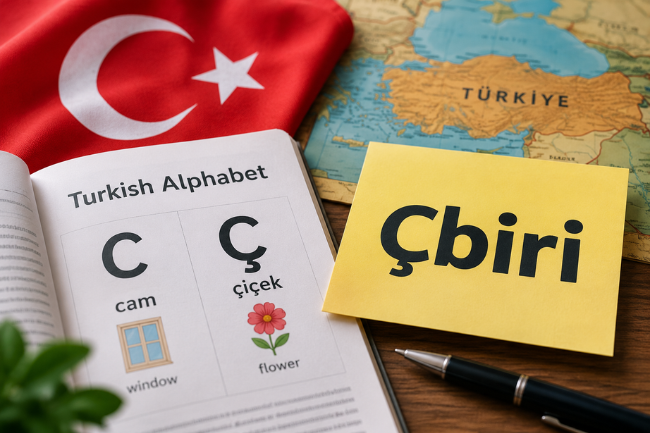
Ç belongs to the Turkish alphabet. The Yunus Emre Institute’s introductory Turkish textbook presents C and Ç as separate letters, with examples for each. That supports a connection between the character and Turkish writing, but it does not identify this entire string as a Turkish word.
I find it helpful to separate three questions: where a letter is used, what language a particular word belongs to, and where that word originated. An answer to the first does not automatically answer the other two.
The cedilla also appears beyond Turkish. Unicode’s combining-mark chart associates the combining cedilla with languages including French, Turkish, and Azerbaijani. A character shared across languages cannot establish an exclusive origin.
A reliable translation needs the complete expression and its context. Recognizing a smaller sequence of letters inside it is not enough; unfamiliar names and misspellings can resemble ordinary words.
Can I Give It a Reliable Pronunciation?
I cannot verify an established pronunciation for the complete term. Knowing how an initial letter is pronounced in one language does not settle the language, syllables, or stress of an unidentified name.
For a personal name, username, or brand, I would look for audio from the person using it. For a word in a sentence, I would first identify the language and ask a qualified speaker to interpret that sentence.
What Can Be Said About Its Origin?
An origin story requires traceable evidence. Ideally, it identifies an early occurrence, explains its context, and connects that occurrence to later usage.
For Çbiri, I have not established that chain. I would not present a country, historical era, inventor, or cultural practice as its confirmed source.
Even finding an older webpage would only establish an earlier documented appearance. It would not necessarily show who coined the term or whether the writer borrowed it from somewhere else.
To investigate further, I would record the URL, visible publication date, exact spelling, and surrounding sentence for each meaningful occurrence. Archived copies could then help establish whether the text existed at a particular time.
This approach produces a useful timeline without overstating what it proves. It also leaves room for a community member or original creator to supply evidence that ordinary web searches miss.
The Technical Detail Behind the Spelling
There is a small digital detail worth understanding if you are comparing names, copying text, or troubleshooting a search.
Unicode’s character list identifies Ç as U+00C7 and ç as U+00E7. The capital character can also be represented using a plain capital C followed by a combining cedilla.
I tested the single-character and combining-character versions of Çbiri. They differed in a raw text comparison but matched after NFC normalization. Neither normalized version became plain Cbiri.
That result illustrates a distinction: two strings can represent the same accented text through different underlying sequences, while removing the accent creates a different string. Unicode’s normalization standard explains how equivalent sequences can be normalized.
You do not need to inspect character codes to understand a name. The practical lesson is to preserve the original spelling, and use plain-letter searches only as an additional research route.
Normalization can help software compare equivalent representations. It does not translate a term, establish its origin, or prove that an accented name and an acronym identify the same thing.
How I Would Identify Çbiri in Different Contexts
The best next action depends on where the term appeared. I would investigate a research document differently from a social profile because each source offers different clues.
In a Social Media Profile
I would read the biography, linked website, and relevant posts before assigning a linguistic meaning. The account owner may explain the name or use it only as a personal identifier.
A handle alone does not demonstrate a broader slang meaning. If the owner provides an explanation, attribute it to that person rather than presenting it as a universal definition.
In a Research Document
I would search within the document for the acronym’s first occurrence and expanded name. A heading, affiliation, or footnote may resolve it immediately.
If CBIRI appears beside Nebraska University references, I would compare the document with the official center website. Matching subject matter is a clue; an explicit expansion is stronger evidence.
In a Cultural or Travel Article
I would look for a named community, local-language source, interview, or archival reference. A cultural claim should connect to people who actually use the expression.
An evocative photograph or descriptive passage cannot establish a tradition by itself. Without an attributable source, I would keep the cultural interpretation unconfirmed.
In a Product or Business Name
I would check the organization’s own website and name explanation. A business can define its chosen name without that definition becoming a dictionary meaning.
For purchasing or contacting purposes, confirming the correct organization matters more than guessing the name’s etymology.
How to Compare Conflicting Explanations
When several pages disagree, I assess the evidence behind each claim. The following comparisons are useful questions to ask, rather than a rating of every page about this keyword.
| Claim | Evidence that would help | Evidence that does not settle it |
|---|---|---|
| An established word | Dictionary entry or documented linguistic usage | A definition repeated across blogs |
| An old cultural tradition | Identifiable community testimony and historical records | A historical-sounding description |
| A particular acronym | Official expanded name in the relevant context | Matching letters without contextual agreement |
| A username or brand | The owner’s explanation or official page | A stranger’s interpretation of the spelling |
| Growing popularity | Dated usage or search-interest data with methodology | Articles calling it a trend |
I also ask whether apparently separate sources are genuinely independent. Several pages citing one unsupported statement provide less confirmation than several sources documenting separate real-world occurrences.
Specificity helps. A source saying where, when, and by whom a term was used gives you something to check. A statement that it represents a timeless cultural idea may offer little you can verify.
The goal is not to dismiss unfamiliar vocabulary. It is to give each explanation the level of confidence its evidence deserves.
Why Search Visibility Does Not Prove Popularity
Finding multiple articles about Çbiri tells me that publishers have written about the spelling. It does not establish widespread conversation, a growing community, or measurable search demand.
I would need dated examples or relevant data before calling it a popular expression. Claims about popularity should explain what was measured, over which period, and in which location.
For example, a collection of independent public posts would help investigate usage. Search-interest data might help investigate demand. These answer different questions, and neither automatically supplies a definition.
This is useful for readers because a familiar-looking search results page can make an uncertain subject seem settled. I prefer to follow the evidence back to its source before accepting the surrounding story.
Using Çbiri as a Creative Name
If you are considering the spelling for a project, treat it as a naming decision. I would first establish what you want it to represent and explain that meaning plainly to your audience.
Then test the practical experience. Can someone remember the name after hearing it? Can they enter it on their usual device? Will searching the plain-letter version lead them somewhere confusing?
I would test both written and spoken introductions with a few intended readers. Their attempts to repeat and type the name can reveal problems that a logo mockup will not show.
Platform support and availability also require individual checks. A display name, account handle, and domain do not necessarily follow the same rules. Do not assume that one available form guarantees every other form is available.
A clear description can help explain an invented name. It should describe your project honestly rather than borrow an unverified cultural history to make the name seem older or more established.
Keep the Original Context
My best answer to the Çbiri question is to start with the exact spelling and the place it appeared. The institutional acronym is verifiable; a universal meaning for the accented term remains unresolved in this research.
Save the original sentence or link, then compare its context with an attributable source. If you have an example that includes a creator’s explanation or an earlier documented occurrence, share that evidence so the answer can become more precise.
Frequently Asked Questions
What does Çbiri mean in English?
I could not verify a standard English translation. Its intended meaning needs the original source or an explanation from the person using it.
Is Çbiri a Turkish word?
The letter Ç is used in Turkish, but that alone does not establish Çbiri as a Turkish word. I have not verified a Turkish definition for the complete spelling.
Are Çbiri and CBIRI the same thing?
They should not automatically be treated as equivalent. CBIRI has a documented university acronym use; that does not establish the meaning of Çbiri.
How do you pronounce Çbiri?
I could not verify a standard pronunciation. For a name or brand, the most useful reference would be audio from its owner or creator.
Is Çbiri a word or a username?
It may be used as a name, but I cannot identify a particular use from the spelling alone. Check the original profile, sentence, or project description.

Noah Sterling is a technology research writer with 8+ years of experience covering emerging technologies, software trends, digital tools, and innovation. He creates practical, research-based articles to help readers understand the evolving technology landscape.