
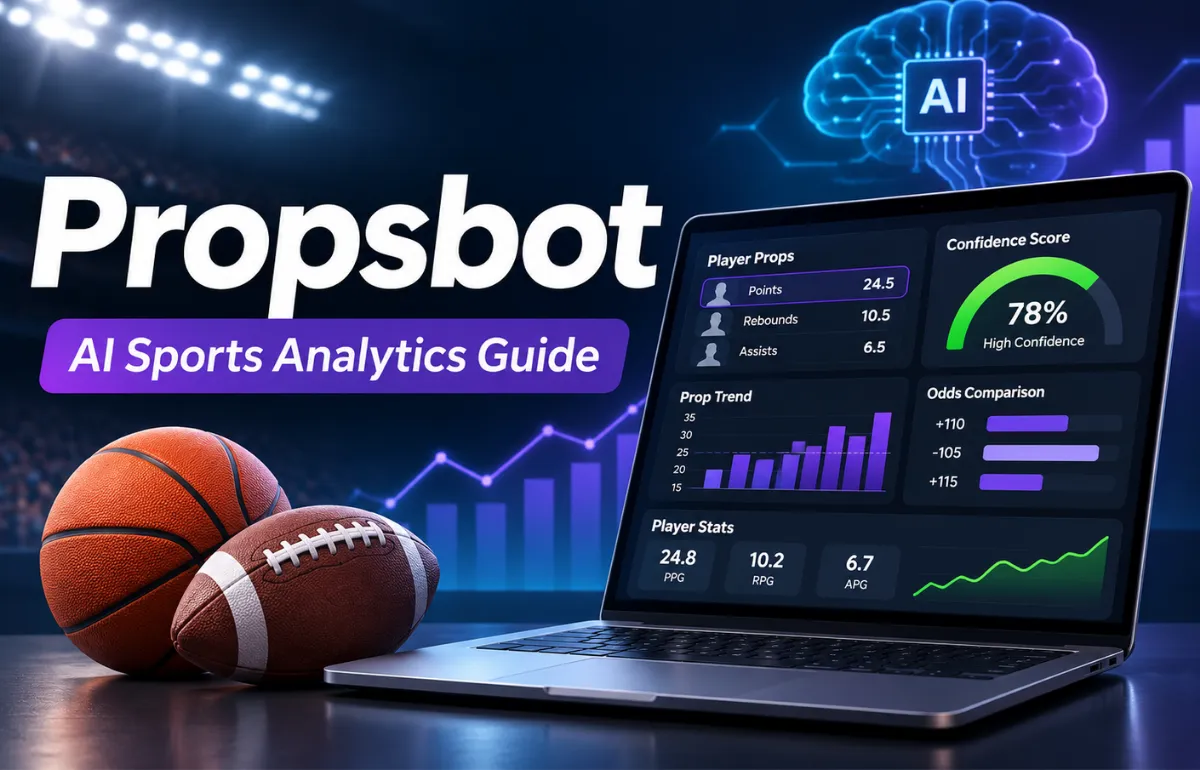
Propsbot is an AI-powered sports betting research platform that helps users analyze player prop bets, compare sportsbook odds, and identify potentially valuable betting opportunities. Rather than relying only on recent statistics or personal predictions, it uses machine learning, historical performance data, matchup analysis, and probability estimates to evaluate sporting events.
Available through its website and mobile applications, Propsbot provides tools such as Confidence Scores, Edge Scores, player projections, betting trends, and AI-generated research signals.
Its main purpose is to make complex sports data easier to understand and compare. However, Propsbot is an analytics service, not a sportsbook, and it cannot guarantee winning bets.
In this article, I’ll explain how the platform works, what its features actually mean, how much it costs, and what users should consider before trusting its predictions.
What Is Propsbot, and Why Is It Getting Attention?
Propsbot, also branded as PropsBot.AI, is a sports analytics application developed to help people research player proposition bets, commonly called player props.
A player prop is a prediction about an individual athlete’s performance rather than the final result of a game.
For example, an NBA player might have an over/under line of 24.5 points. The question is whether that player will score at least 25 points or finish with 24 or fewer.
Researching such a prediction involves more than checking the player’s last game. Playing time, opponent strength, injuries, team strategy, and the sportsbook’s offered price can all affect the assessment.
Propsbot brings many of these factors together in a single interface.
What interests me most about this concept is the shift from simple statistical comparisons toward probability-based analysis. Instead of showing only what happened previously, the software attempts to estimate what might happen next.
That distinction explains both the platform’s appeal and its limitations.
How Does Propsbot Work?
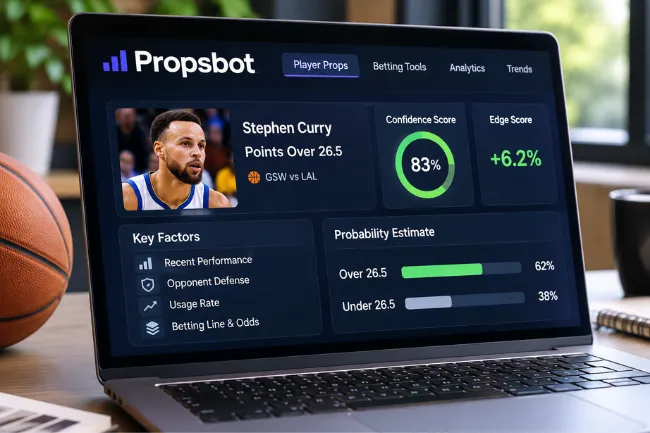
Propsbot uses predictive models to analyze historical and current sports information.
According to its published methodology, the platform combines multiple machine-learning models rather than depending on a single statistical formula.
These models examine information such as:
- Recent player performance and season averages
- Opponent defensive efficiency and matchup history
- Playing time, usage rates, and other advanced statistics
- Sportsbook betting lines and implied probabilities
- Changes in available odds and market prices
The information is processed to produce probability estimates and other research indicators.
The platform then presents its findings through scores, filters, and automated signals.
Understanding the Confidence Score
One of Propsbot’s central features is its Confidence Score, displayed on a scale from 0 to 100.
The score reflects how strongly the platform’s models agree about a particular prediction.
For example, when multiple models support the same outcome, the system may assign a stronger confidence rating.
However, a Confidence Score of 85 should not automatically be interpreted as an 85% probability of winning.
Model agreement and actual outcome probability are different measurements.
I would always examine the underlying projection, available odds, and matchup information rather than making a decision based solely on a high score.
What Is the Edge Score?
The Edge Score attempts to identify differences between Propsbot’s estimated probability and the probability implied by a sportsbook’s odds.
This connects to a concept called positive expected value, or +EV.
Consider a hypothetical example.
A sportsbook offers +120 odds on a particular outcome. Those odds imply a break-even probability of approximately 45.45%.
Suppose a model estimates the outcome’s actual probability at 50%.
The estimated probability advantage would be about 4.55 percentage points.
If the 50% estimate were accurate, a $100 wager at those odds would have a theoretical expected profit of $10 before other costs.
That does not mean the individual wager is likely to produce a profit. It means the mathematical expectation is favorable under the model’s assumptions.
This distinction matters because even a genuinely positive-EV prediction can lose.
How AI Signals Work
Propsbot also uses automated filters called AI Signals.
Its published materials describe signals including High ROI, High Hit Rate, and Line Is Nuts.
These signals highlight different characteristics, such as potential pricing opportunities, historically successful prediction patterns, or unusual betting lines.
They are designed to help users narrow large collections of player props.
However, each signal should be evaluated separately. A selection with a high historical success rate does not necessarily offer attractive odds or positive expected value.
Key Features of Propsbot
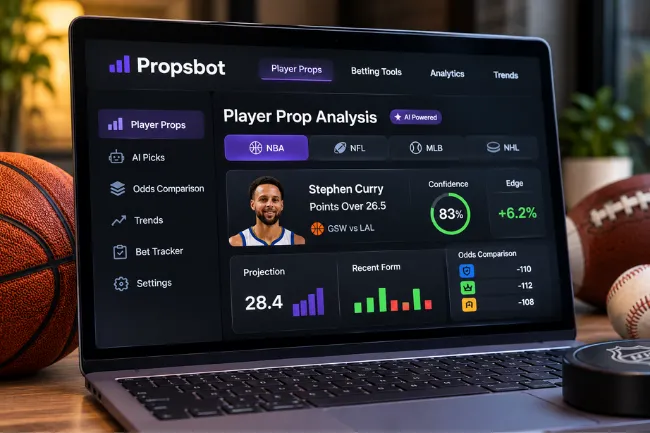
The platform offers several connected tools intended to reduce the time required for sports research.
1. AI-Powered Player Prop Analysis
Propsbot evaluates individual player markets using predictive statistics and matchup data.
Depending on the sport, users can research basketball points, rebounds, assists, football passing yards, baseball strikeouts, hockey shots, and other available markets.
Its primary advantage is consolidating different research inputs rather than requiring users to examine numerous statistical websites separately.
2. Sportsbook Odds Comparison
Different sportsbooks sometimes offer different prices for the same player prop.
Propsbot includes odds comparison tools that allow users to examine available prices across supported operators.
This matters because two identical predictions can have different mathematical values depending on the offered odds.
A prediction can remain unchanged while its expected return becomes less attractive after the sportsbook adjusts its price.
3. Historical Hit Rates and Trends
Historical statistics provide context for the model’s predictions.
Propsbot displays recent performance information, including rolling averages and results over previous games.
These numbers can help identify whether an athlete’s recent performance differs from the season average.
Nevertheless, historical hit rates are descriptive, not guarantees about future outcomes.
4. Player and Matchup Research
A player’s statistics become more meaningful when considered alongside the opposition.
Propsbot examines matchup-related information such as defensive performance, pace, player usage, and relevant historical splits.
For instance, an NBA player’s scoring average may look impressive, but a change in minutes or offensive responsibilities could make that average less representative of the next game.
5. Betting Line Movement
Sportsbook lines can change as new information emerges or market activity increases.
Propsbot provides line movement information to help users examine these changes.
I consider this particularly useful as a research feature because it highlights how quickly the available price can become outdated.
However, a moving line does not automatically reveal why the market changed.
6. Bet Tracking and Research Organization
The mobile application also advertises a bet tracker for saving and reviewing selections.
This feature can help users examine past decisions, compare predictions against outcomes, and identify patterns in their research.
Tracking losses alongside wins is especially useful because selective memory can create an exaggerated impression of forecasting accuracy.
7. Mobile Access and Additional Research Tools
Propsbot is available through web access and mobile applications for iOS and Android.
Its app listings also describe tools such as alternative-line comparisons, community research features, parlay-building functionality, and supported sportsbook deep links.
The availability of individual features may vary by sport, platform, subscription, and region.
Which Sports Does Propsbot Support?
Propsbot’s main subscription documentation emphasizes four major American professional sports leagues:
- NBA: Basketball player points, rebounds, assists, and related statistics.
- NFL: Football passing, rushing, receiving, and touchdown markets.
- MLB: Baseball strikeouts, hits, total bases, and other player statistics.
- NHL: Hockey shots, goals, saves, and related performance markets.
Its mobile app listings describe broader research coverage, including WNBA, college sports, soccer, tennis, golf, combat sports, and esports.
However, advertised league coverage does not necessarily mean every sport receives identical predictive models, data depth, or AI Signals.
Before subscribing for a particular league, I would check whether the specific markets and analytical features I need are actually supported.
Propsbot vs. Traditional Sports Research
The main difference between Propsbot and conventional research is how information is collected and presented.
| Feature | Propsbot | Traditional Manual Research |
|---|---|---|
| Player statistics | Consolidated within the platform | Collected from multiple sources |
| Predictive analysis | Machine-learning estimates | Primarily user-created assessments |
| Odds comparison | Available across supported sportsbooks | Requires separate price checks |
| Historical trends | Organized into research tools | Often examined individually |
| Confidence indicators | Proprietary model scores | Usually personal judgment |
| Cost | Subscription for full access | Free or paid, depending on sources |
| Main limitation | Dependence on model and data quality | Time-consuming and potentially inconsistent |
Neither approach eliminates uncertainty.
Propsbot may simplify the research process, but a faster assessment is not automatically a more accurate one.
How I Would Evaluate a Propsbot Prediction
When reviewing a predictive analytics service, I prefer to examine the evidence behind its recommendations rather than accepting a ranking at face value.
For Propsbot, I would use a five-part evaluation.
Check the Player’s Current Situation
First, I would examine whether the player is expected to participate and whether recent changes could affect performance.
An injury, rotation adjustment, or unexpected change in playing time can quickly make historical averages less useful.
Examine the Matchup
Next, I would look beyond the player’s individual statistics.
Opponent strength, playing conditions, expected game pace, and other contextual factors can change the outlook considerably.
A model may already consider these variables, but understanding them helps me interpret its output.
Compare Probability With Price
This is where the Edge Score becomes relevant.
A prediction can be reasonably likely to occur without offering good value at the listed odds.
For example, an outcome estimated at 70% probability would not be attractive at any price. Its mathematical value depends on what the sportsbook requires the user to risk.
Check When the Information Was Updated
I think freshness deserves more attention than it usually receives in discussions about sports prediction tools.
Three different timestamps matter: when the player information was updated, when the model generated its prediction, and when the sportsbook price was recorded.
If those timestamps do not align, an apparently attractive opportunity may no longer exist.
Record the Actual Outcome
Finally, I would compare the original prediction with the eventual result.
I would retain unsuccessful predictions rather than remove them from the analysis.
Over time, a complete record is more informative than a collection of memorable successful picks.
Propsbot Pricing: Is It Free or Paid?
Propsbot offers trial access and paid subscriptions.
As listed on its official pricing page in November 2026, the available web subscription options are:
| Subscription Plan | Listed Price | Approximate Monthly Cost |
|---|---|---|
| Monthly | $49.99 | $49.99 |
| Six months | $254.99 | $42.50 |
| Annual | $419.99 | $35.00 |
The website states that these plans include access to its core scores, signals, player prop research, and supported sportsbook comparisons.
A seven-day trial is advertised in its mobile app listings.
One detail deserves attention: the Apple App Store description also contains a $34.99 monthly figure, while its in-app purchase section lists $49.99.
Because published descriptions can differ from current checkout pricing, users should verify the final amount, renewal terms, and trial eligibility before purchasing.
The cost also deserves practical consideration.
For example, a $49.99 subscription represents approximately 5% of a hypothetical $1,000 monthly amount wagered. Any claimed betting return would need to cover that expense before producing a net gain.
That calculation does not make wagering advisable; it simply shows why subscription costs must be included when evaluating financial claims.
Is Propsbot Accurate? Examining Its Published Performance
Accuracy is arguably the most important question about any predictive analytics platform.
Propsbot publishes a track record with historical results for different models and signals.
According to its company-reported figures dated September 29, 2026, its High ROI Signal produced a 16.8% return across 8,571 graded NFL picks and a 25.9% return across 81,410 graded NBA picks.
The same published report shows something especially revealing.
Its NFL High Hit Rate Signal recorded a 74.4% win rate across 22,210 picks, yet reportedly produced a negative 5.0% ROI.
This demonstrates why winning frequently and making a profit are not the same thing.
A prediction can win regularly but still lose money when the payouts are too small relative to the losses.
What the Brier Score Reveals
Propsbot also publishes probability-calibration measurements using the Brier score.
A Brier score evaluates how closely predicted probabilities match actual outcomes. Lower values indicate better probabilistic forecasting.
In a company-reported MLB comparison dated July 12, 2026, Propsbot reported a Brier score of 0.1903 versus 0.1947 for the sportsbook closing-line benchmark.
The result suggests stronger forecasting accuracy within that particular evaluated sample.
However, I would not treat this as proof that every Propsbot market or model consistently outperforms sportsbooks.
The figures come from the company’s published reporting, and I have not independently audited its underlying prediction dataset.
Users should consider sample selection, model updates, available prices, and whether reported returns reflect achievable real-world conditions.
Limitations and Risks Users Should Understand
Propsbot has useful analytical features, but its technology cannot remove the fundamental uncertainty of sports outcomes.
One limitation is dependence on data quality.
If player information is delayed, incomplete, or inaccurate, the model’s estimates may become less reliable.
Another is the possibility of changing market conditions.
A favorable price may disappear before someone can act on the information. Historical model performance does not guarantee that identical opportunities will remain available.
There is also the problem of correlated predictions.
Multiple props involving the same player or game may depend on similar underlying events. Treating them as independent can create an inaccurate impression of diversification.
Perhaps most importantly, a high-confidence prediction should never be mistaken for certainty.
I would also be cautious about interpreting performance claims without examining both profitable and unprofitable periods.
A model’s long-term usefulness depends on its complete record, not simply its strongest historical results.
Is Propsbot Legit and Safe to Use?
Propsbot is an identifiable software product with an official website, published subscription information, and applications listed on major mobile app stores.
Its Google Play and Apple listings identify DLM Innovations LLC as the app developer.
These details support the existence of a genuine commercial product, but they do not independently establish the accuracy of its predictions or guarantee a satisfactory subscription experience.
Privacy deserves attention as well.
The app store disclosures describe the potential collection or use of device identifiers. I recommend reviewing the current privacy policy before creating an account.
Users should also understand that Propsbot does not itself place wagers. Betting transactions occur separately through supported third-party services where legally available.
Age restrictions and gambling regulations vary by location. Accessing a research app does not automatically mean sports betting is legal in the user’s jurisdiction.
Who Should Consider Propsbot?
Propsbot is most relevant to adults who already understand player prop markets and want a centralized source of statistical research.
It may also appeal to sports analysts interested in predictive modeling, probability comparisons, and the relationship between betting prices and historical outcomes.
For beginners, the platform’s numbers may be useful educational material, although concepts such as implied probability, expected value, and model calibration require some understanding.
I would not recommend purchasing a subscription solely because promotional material highlights impressive historical returns.
People who do not bet, cannot legally wager, or are uncomfortable with financial risk have little reason to pay for the service.
The strongest reason to consider Propsbot is its potential usefulness as a research tool, not an expectation of reliable profits.
Frequently Asked Questions About Propsbot
1. What is Propsbot used for?
Propsbot is used to research player props, analyze sports statistics, compare sportsbook odds, and examine AI-generated probability estimates.
2. Is Propsbot free to use?
Propsbot advertises free research tools and trial access, but full analytical features generally require a paid subscription.
3. Does Propsbot guarantee winning bets?
No. Its predictions are probability-based estimates, and neither high confidence nor positive expected value guarantees a successful outcome.
4. Is Propsbot available on Android and iPhone?
Yes. Propsbot offers applications for Android and iPhone, alongside access through its website.
5. Is Propsbot worth the subscription price?
Its value depends on how useful its research features are to you, their reliability, your usage frequency, and the subscription cost.
Final Thoughts
Propsbot represents an increasingly data-driven approach to sports research. By combining machine learning, historical statistics, sportsbook prices, and predictive signals, it makes information that once required substantial manual work easier to explore.
What stands out to me is its emphasis on distinguishing predicted probability, model confidence, and betting value. These concepts are related, but they should never be treated as interchangeable.
The platform also has meaningful limitations, including subscription costs, changing market conditions, and uncertainty surrounding future model performance.
If you’re interested in exploring Propsbot, my suggested next step is to review its free research features and published performance methodology before considering a subscription.
The most valuable outcome is understanding the data more clearly, not assuming that software can predict an uncertain sporting event with certainty.

Noah Sterling is a technology research writer with 8+ years of experience covering emerging technologies, software trends, digital tools, and innovation. He creates practical, research-based articles to help readers understand the evolving technology landscape.