
Kraakt is a Dutch verb form that usually means “creaks,” “cracks,” or “cracks open” in English. These meanings are also reflected in the Cambridge Dutch–English Dictionary. It comes from kraken, a verb used for the noise of a wooden floor, the action of cracking a nut or code, and, in a different context, occupying a building without the owner’s permission.
Grammatically, kraakt is the present-tense form used with hij, zij, het, jij, and the polite pronoun u in standard Dutch. The correct translation depends on what is making the sound or what someone is doing.
De trap kraakt means “The staircase creaks,” while zij kraakt de code means “She cracks the code.” I find the most reliable way to understand this word is to read the entire sentence rather than translate kraakt in isolation.
Kraakt at a Glance
| Question | Quick answer |
|---|---|
| What language is kraakt? | Dutch. |
| What is its base verb? | Kraken. |
| What does it usually mean? | Creaks, cracks, or cracks open. |
| What tense is it? | Present tense, usually second- or third-person singular. |
| What is the past tense? | Kraakte (singular), kraakten (plural). |
| What is the past participle? | Gekraakt. |
| How is it pronounced? | Approximately /kraːkt/, with a long Dutch a. |
Kraken can describe something happening by itself or a deliberate action. A floor creaks; a person can crack a walnut, decipher a code, or occupy a property. This distinction guides accurate translation.
What Does Kraakt Mean in Different Contexts?
When Something Creaks or Makes a Cracking Sound
The most familiar use concerns a noise. In a sentence such as De oude stoel kraakt als ik ga zitten (“The old chair creaks when I sit down”), nothing necessarily breaks. The chair simply produces a sharp, uneven sound when pressure is applied.
The word also describes stairs, floorboards, doors, or someone’s voice. English offers several choices—creaks, crackles, groans—depending on the object.
A creaking floor, however, is not necessarily damaged. The verb describes its sound, not its condition.
When Someone Cracks Something Open
Kraakt can describe an action that breaks an outer shell or defeats a barrier. Hij kraakt een walnoot means “He cracks a walnut.” The action is intentional, and the object is directly affected.
Someone can also crack a safe: een kluis kraken. Here, “crack” may mean defeating the lock rather than smashing the safe.
When a Code, Puzzle, or Password Is Cracked
Dutch also uses kraken for overcoming an intellectual or technical challenge. De onderzoeker kraakt de code means “The researcher cracks the code.” In this setting, nothing has to make a sound.
A code may be deciphered, a puzzle solved, or a password cracked. The terms aren’t interchangeable: technical reports and classroom exercises demand different translations.
When Someone Occupies an Empty Building
In Dutch housing and social-history discussions, een pand kraken means to occupy a building without the owner’s permission. A kraker is someone who does this; English commonly uses “squatter.”
For example, De groep kraakt een leegstaand kantoorpand means “The group squats in a vacant office building.” This is not a metaphor about cracking walls. It is a distinct social and legal use of the verb.
It appears in reporting about housing, protests, and vacant property. Legal implications differ by jurisdiction.
When Something Is Struggling Under Pressure
Sometimes the sound meaning becomes figurative. If a writer says een organisatie kraakt onder de druk, the image is of an organization creaking under pressure—not making an audible noise.
Natural English choices include “is under strain” or “is buckling under pressure,” rather than a literal translation.
How to Pronounce Kraakt in Dutch

Kraakt is a one-syllable word. Its approximate pronunciation in the International Phonetic Alphabet is /kraːkt/. The symbol /aː/ signals a long vowel; it should not be reduced to the short English vowel in “cat.”
Start with the consonant cluster kr, hold the open vowel slightly longer, and finish with a clear kt. There is no extra vowel after the final t.
The double a in the related form kraak marks vowel length, while the single a in kraken remains long because it sits in an open syllable.
Compare a native-speaker recording of kraakt with kraak and kraken. English-style respellings can encourage the wrong vowel length.
Kraakt Conjugation: The Grammar Behind the Word
Kraken is a regular Dutch verb. Its stem is kraak, with -t added for many singular subjects. The Algemeen Nederlands Woordenboek confirms these forms.
| Subject or form | Dutch | English example |
|---|---|---|
| Ik (I) | ik kraak | I crack |
| Jij/je (you, informal) | jij kraakt | You crack |
| U (you, formal) | u kraakt | You crack |
| Hij/zij/het (he/she/it) | hij kraakt | He cracks |
| Wij/we (we) | wij kraken | We crack |
| Jullie (you, plural) | jullie kraken | You crack |
| Zij/ze (they) | zij kraken | They crack |
| Past, singular | kraakte | Cracked or creaked |
| Past, plural | kraakten | Cracked or creaked |
| Past participle | gekraakt | Cracked or creaked |
| Present participle | krakend | Creaking or cracking |
Therefore, het hout kraakt is correct but ik kraakt is not. With ik, use kraak; with plural subjects, use kraken.
Why “Jij Kraakt” Becomes “Kraak Jij”
A small grammar rule catches many learners: when jij or je follows the present-tense verb in a question, the final -t disappears. Compare these sentences:
- Jij kraakt die moeilijke code. — You crack that difficult code.
- Kraak jij die moeilijke code? — Are you cracking that difficult code?
- Kraakt hij die moeilijke code? — Is he cracking that difficult code?
- Kraakt u die moeilijke code? — Are you cracking that difficult code? (formal)
Only informal jij/je triggers this change. I remember it as a word-order rule, not a change in meaning. Onze Taal explains the same rule.
Kraakt, Kraakte, and Heeft Gekraakt
Present, simple past, and perfect tense carry different timing. De deur kraakt means the door creaks now or habitually. De deur kraakte means it creaked in the past.
De deur heeft gekraakt indicates that it has creaked or did creak, depending on context.
Dutch forms perfect tenses with hebben here: hij heeft de noot gekraakt, “He has cracked the nut.” In main clauses, gekraakt often appears near the end.
Kraakt vs. Kraken, Kraak, Krakend, and Gekraakt
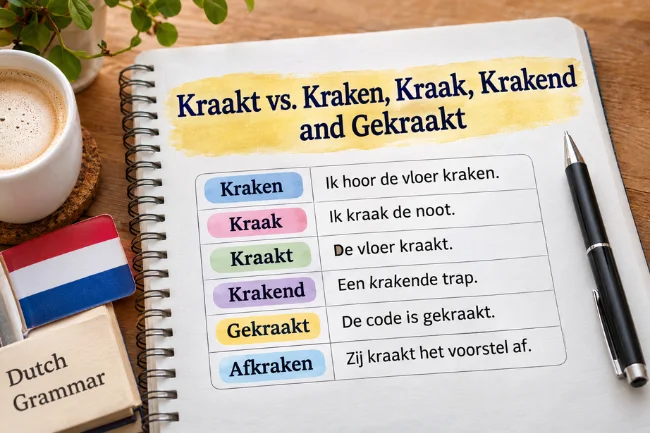
These similar words play different roles. I learn them as a family.
- Kraken is the infinitive: Ik hoor de vloer kraken, “I hear the floor creak.”
- Kraak is the first-person singular form: Ik kraak de noot, “I crack the nut.” It can also be a noun in other contexts.
- Kraakt is the present-tense singular form: De vloer kraakt, “The floor creaks.”
- Krakend is a present participle used descriptively: een krakende trap, “a creaking staircase.”
- Gekraakt is the past participle: De code is gekraakt, “The code has been cracked.”
There is also afkraken, a separate compound verb meaning to criticize or tear something down verbally.
Zij kraakt het voorstel af means “She harshly criticizes the proposal.” The prefix af changes the meaning significantly; dropping it can change the sentence you think you have understood.
20 Dutch Sentences Using Kraakt and Related Forms
Rather than memorizing one translation, I use short examples to show how the context shifts. These are illustrative sentences written to demonstrate the grammar, not quotations from conversations.
Sounds Around the Home
- De trap kraakt bij elke stap. — The staircase creaks with every step.
- Mijn bed kraakt als ik me omdraai. — My bed creaks when I turn over.
- Waarom kraakt die deur zo hard? — Why does that door creak so loudly?
- Het droge hout kraakt in het vuur. — The dry wood crackles in the fire.
- Zijn stem kraakt wanneer hij moe is. — His voice cracks when he is tired.
Notice how “crackles” works better than “creaks” for wood burning in a fire. Translation is a choice about natural English, not simply a dictionary substitution.
Breaking or Opening Something
- Zij kraakt de schaal van de noot. — She cracks the nut’s shell.
- Hij kraakt de walnoten voor het gebak. — He cracks the walnuts for the cake.
- De expert kraakt de kluis. — The expert cracks the safe.
- Kraak jij de noot, of zal ik het doen? — Will you crack the nut, or shall I?
- De notenkraker kraakt de harde schil. — The nutcracker cracks the hard shell.
Codes and Difficult Problems
- De puzzelaar kraakt eindelijk de code. — The puzzle solver finally cracks the code.
- Niemand kraakt dit raadsel meteen. — Nobody solves this riddle immediately.
- De specialist kraakt een zwak wachtwoord. — The specialist cracks a weak password.
- Kraak jij de code zonder aanwijzingen? — Can you crack the code without clues?
- Het team heeft de versleuteling nog niet gekraakt. — The team has not yet cracked the encryption.
Buildings, Pressure, and Figurative Language
- De groep kraakt een leegstaand pand. — The group squats in a vacant building.
- In het nieuws staat dat iemand het gebouw kraakt. — The news says someone is squatting in the building.
- De oude brug kraakt onder het gewicht. — The old bridge creaks under the weight.
- Het plan kraakt onder de kritiek. — The plan is buckling under criticism.
- De samenwerking kraakt al maanden. — The partnership has been under strain for months.
The final two examples describe pressure, not physical damage.
Dutch Idioms and Expressions with Kraken
Idioms show how meaning extends beyond physical sounds. The Woorden.org expressions index records several with kraken.
Het Vriest Dat Het Kraakt
This expression describes very severe frost. A natural translation is “It’s bitterly cold” or “It’s freezing hard.”
You would not normally say that the weather is literally cracking in English. The phrase evokes the sharp sounds associated with intense cold.
Een Harde Noot Kraken
Literally, this means “to crack a hard nut.” Figuratively, it refers to dealing with something difficult or tackling a tough problem.
English has its own expression, “a hard nut to crack,” which makes this one particularly easy to remember.
Een Appeltje Met Iemand Te Schillen Versus Een Noot Te Kraken
Dutch also uses een appeltje met iemand te schillen for having a score to settle.
Idiom collections list een lelijke noot met iemand te kraken, but fixed expressions aren’t automatically interchangeable. Check the context and register.
Het Kraakt Aan Alle Kanten
For a plan or organization under strain, I might translate this as “It’s falling apart at the seams.”
How I Choose the Right English Translation
When I encounter kraakt in an unfamiliar sentence, I check three things.
First, what is the subject? A floor, voice, code, and group of people point toward very different meanings. Second, is there a direct object? Someone cracking a nut affects an object; a staircase creaking usually does not.
Third, is the context literal, technical, social, or figurative?
Consider Hij kraakt de code tegenover Het hout kraakt. Both contain the same verb form, but only the first describes someone overcoming a challenge. The second describes a sound.
Translating both mechanically as “cracks” is grammatically possible in some settings but rarely the clearest English.
Tense and sentence structure matter too. De code wordt gekraakt means “The code is being cracked,” while de code is gekraakt means “The code has been cracked.”
Here the auxiliary verb changes whether the event is ongoing or completed. The English translation should capture that difference.
If the subject is a building, double-check who is performing the action. Het pand kraakt might describe a building making noise; iemand kraakt het pand describes someone squatting in it.
This contrast is easy to miss and makes an excellent reading exercise.
Common Mistakes to Avoid
The first mistake is treating kraakt as a noun. It is a conjugated verb. Kraak can serve as a noun, but kraakt describes an action or state in a sentence.
The second is assuming that every use involves damage. A creaky bed may function perfectly well, while a “cracked code” involves no broken object.
Avoid ik kraakt and kraakt jij. Use ik kraak and kraak jij, but retain -t in formal kraakt u.
Another trap is translating afkraken as though it were identical to kraken. In an opinion piece, een film afkraken means to criticize a film harshly, not to crack the film.
Similarly, the English sea monster called the Kraken is a separate name; it should not guide your interpretation of the everyday Dutch verb.
Finally, be cautious with English “crack.” Sometimes “creak,” “crackle,” “solve,” “decipher,” “squat,” or “strain” communicates the Dutch meaning more precisely.
Good translation is about what sounds right in the full sentence.
A Short Practice Check
Try translating these before reading the answers. Use the subject and the rest of the sentence as clues.
- De vloer kraakt ‘s nachts.
- Kraak jij de code?
- De noten zijn gekraakt.
- De oude samenwerking kraakt onder druk.
My answers are: “The floor creaks at night”; “Can you crack the code?”; “The nuts have been cracked”; and “The old partnership is under strain.”
Other English renderings can be equally valid if they preserve the meaning and sound natural.
I like this exercise because it checks four skills at once: sound vocabulary, inverted questions, perfect or passive constructions, and figurative translation. Those skills transfer to many other Dutch verbs.
Final Thoughts
Kraakt becomes much easier to understand once you connect each meaning to a subject, an object, and a real situation.
Start with the basic translations “creaks” and “cracks,” then expand into grammar, idioms, technical uses, and figurative language.
My suggestion is to write three original Dutch sentences today—one about a sound, one about an object, and one about a problem. You’ll remember the word far better when you can use it yourself.
Frequently Asked Questions
What Does Kraakt Mean in English?
It most commonly means “creaks” or “cracks,” but it can also refer to cracking a code or squatting in a building, depending on context.
Is Kraakt Present or Past Tense?
Kraakt is present tense. The singular past tense is kraakte, and the past participle is gekraakt.
How Do You Pronounce Kraakt?
It is one syllable, approximately /kraːkt/, with a long Dutch a and a final kt consonant cluster.
What Is the Difference Between Kraakt and Kraken?
Kraken is the infinitive and plural present-tense form; kraakt is used with singular subjects such as hij, zij, het, jij, and u.
Why Do Dutch Speakers Say Kraak Jij Instead of Kraakt Jij?
In standard Dutch, the -t drops when informal jij or je follows the present-tense verb in a question.

Emily Carter is a personal growth writer with 9 years of experience creating practical content about confidence, mindset, productivity, habits, goal setting, and self-improvement. She focuses on helping readers build positive routines, develop self-awareness, and make meaningful changes through simple, actionable strategies.