
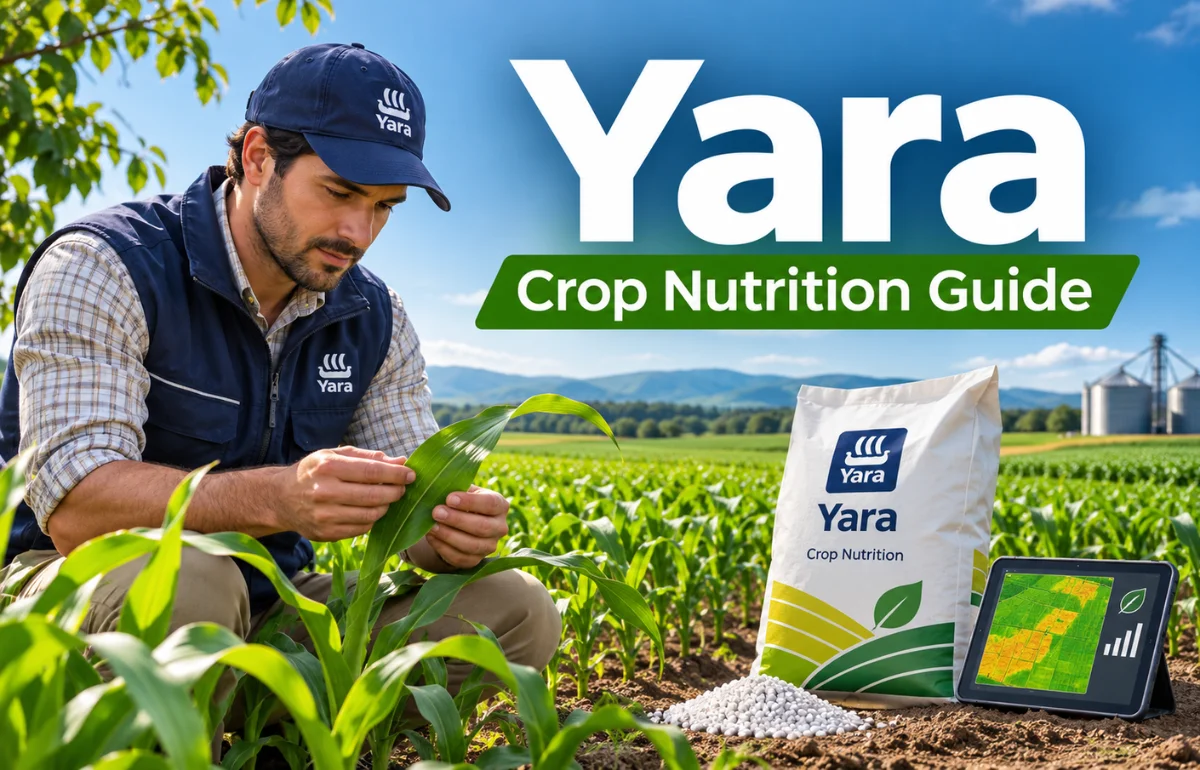
Yara is a Norwegian agricultural and industrial company best known for producing fertilizers, supplying crop nutrients, and developing tools that help farmers use those nutrients more efficiently. Officially called Yara International ASA, it serves agricultural markets worldwide and also supplies ammonia and other nitrogen-based products for industrial applications.
Its business reaches beyond selling bags of fertilizer: Yara combines manufacturing, plant nutrition research, agronomic advice, and digital farming technology.
The company traces its industrial roots to 1905 and became an independent, publicly listed business in 2004. Today, its central challenge is easy to understand but difficult to solve: help growers produce reliable harvests while reducing wasted nutrients, costs, and environmental harm.
Yara at a Glance
Yara is headquartered in Oslo, Norway. According to Yara’s published 2025 figures, the company operated in more than 60 countries, served over 140 markets, employed approximately 15,700 people, and generated $15.7 billion in annual revenue. Fertilizer deliveries totaled about 23.76 million metric tons that year.
Those numbers tell me two useful things. First, this is a large international supplier, not a local fertilizer label. Second, its products must work across dramatically different farming systems, from extensive grain operations to fruit and vegetable production.
Revenue and deliveries describe the size of the business, however, not the results a farmer will automatically achieve. Actual crop performance depends on soil, weather, seed quality, irrigation, fertilizer choice, and management.
How Did Yara Begin?
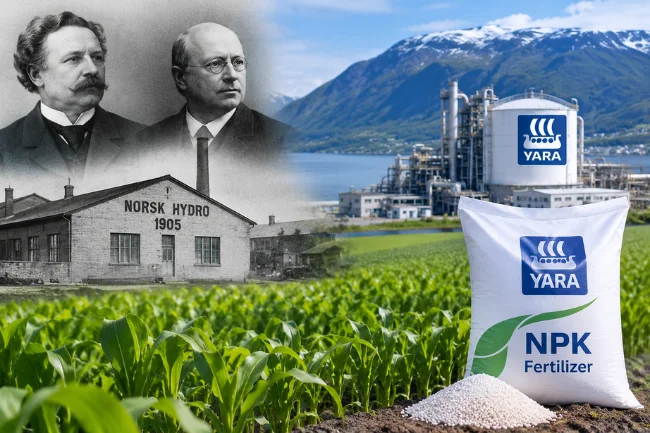
From a Norwegian invention to a global business
Yara’s history begins with Norsk Hydro, established in Norway in 1905. Industrial pioneers Sam Eyde and Kristian Birkeland helped develop a method for capturing nitrogen from the air using electric power. Their work supported the early production of mineral nitrogen fertilizers at a time when European agriculture urgently needed higher yields.
Over the following decades, the fertilizer operation developed new manufacturing processes, expanded its product range, and entered international markets. In 1938, its predecessor began producing compound NPK fertilizers, combining three major plant nutrients in one product.
Why 2004 matters
On March 25, 2004, the fertilizer division separated from Norsk Hydro and became Yara International ASA, listed on the Oslo Stock Exchange.
This is why you may see two different dates associated with the company: 1905 marks the roots of the business, while 2004 marks its existence as an independent listed company.
I find that distinction useful because company profiles often compress a century of history into a single founding date. Both dates are meaningful, but they describe different milestones.
What Does Yara Actually Do?
Its activities fit into three closely connected areas.
1. Crop nutrition
This is the part most farmers recognize. Yara produces and markets mineral fertilizers supplying nitrogen, phosphorus, potassium, calcium, and other essential plant nutrients.
Its products range from broad-acre fertilizers to specialized formulations for horticulture and fertigation.
2. Industrial nitrogen solutions
Nitrogen chemistry has uses beyond agriculture. Yara supplies ammonia, technical products, and solutions used in industrial processes.
Its diesel exhaust fluid products, for example, support selective catalytic reduction systems that lower nitrogen oxide emissions from suitable diesel engines.
3. Ammonia production and trade
Ammonia is a key ingredient in many nitrogen fertilizers. Yara also operates in the ammonia market itself, including work on lower-emission production and potential uses in shipping and energy-intensive industries.
These activities are connected through chemistry, infrastructure, logistics, and customer relationships. They also expose the company to changing energy prices and environmental regulations.
Why Plant Nutrition Matters
A healthy crop needs more than sunlight and water. It also needs mineral nutrients in the right amounts and at the right stages of growth.
Nitrogen supports leafy growth and proteins. Phosphorus contributes to energy transfer and root development, while potassium helps regulate water use and many plant processes.
Calcium, magnesium, sulfur, and micronutrients also matter, even though plants require different quantities of each.
The familiar letters NPK refer to nitrogen, phosphorus, and potassium. A fertilizer labeled 15-15-15 indicates a declared analysis of 15% nitrogen, 15% available phosphate expressed as P2O5, and 15% soluble potash expressed as K2O.
It does not mean that 45% of the bag is instantly absorbed by plants.
One detail I always look for is the difference between supplying nutrients and making nutrients available. A field can receive fertilizer yet still perform poorly because of drought, unsuitable soil pH, weak roots, or poor application timing.
Main Yara Fertilizer Brands and Their Uses
According to its global product portfolio, Yara sells different product families for different crops, delivery methods, and nutrient requirements.
Availability and formulations vary by country, so a brand name alone is not enough to choose a product.
| Product family | Main focus | Typical reason to consider it |
|---|---|---|
| YaraMila | Compound NPK nutrition | Supplying several major nutrients together |
| YaraBela | Nitrogen-based fertilizers | Supporting nitrogen demand in field crops |
| YaraLiva | Calcium nitrate products | Supplying nitrate nitrogen and calcium |
| YaraVita | Foliar and specialist nutrients | Addressing identified micronutrient needs |
| YaraTera | Water-soluble fertilizers | Feeding crops through suitable irrigation systems |
| YaraVera | Urea-based nitrogen | Providing a concentrated nitrogen source |
| YaraAmplix | Biostimulants | Complementing a nutrition program, not replacing fertilizer |
Are Yara fertilizers better than ordinary fertilizers?
That question deserves more than a marketing answer. A premium formulation may offer advantages in nutrient form, handling, solubility, consistency, or suitability for a specific crop.
But a more expensive product is not automatically a better investment.
I would compare the nutrient analysis, cost per unit of usable nutrient, crop requirements, application method, and evidence from local field trials.
Where the soil already contains enough of a nutrient, paying to add more may produce little benefit.
How Yara Uses Digital Farming Technology
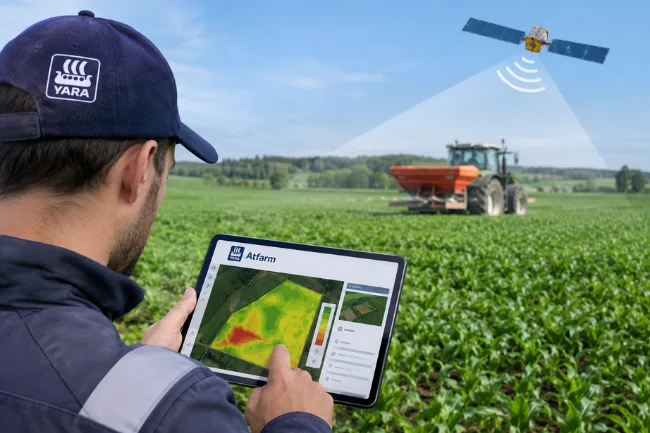
A modern fertilizer company increasingly sells decisions alongside products. Yara’s digital tools reflect that shift.
Its Atfarm platform uses satellite imagery and crop information to help users observe differences within a field.
Depending on location and functionality, farmers can monitor biomass, create variable-rate nitrogen application maps, and use supporting measurements or agronomic recommendations.
The idea is simple: a field rarely grows uniformly. One area may have stronger plants, another may be recovering from waterlogging, and a third may have a genuine nutrient shortage.
Treating every square meter identically can waste inputs.
However, a satellite image cannot diagnose every problem. Yellowing leaves might reflect nitrogen deficiency, disease, drainage problems, or other stresses.
I would treat a digital map as a reason to inspect a particular area, not as a substitute for soil tests and field observations.
The technology is most useful when it changes a decision: where to inspect, whether to apply, how much to apply, or whether another problem needs attention first.
What Benefits Can Farmers Realistically Expect?
Yara’s approach can support three practical goals: providing missing nutrients, managing application more precisely, and matching formulations to crop needs.
When those choices are correct, growers may improve yield, produce quality, or nutrient-use efficiency.
Consider a vegetable grower with irrigation equipment that supports fertigation. A suitable water-soluble product could allow nutrients to be delivered in smaller quantities across the growing season, rather than through one large application.
The potential advantage is better timing and control, not a guaranteed harvest increase.
For a grain grower, a nitrogen monitoring tool may reveal uneven crop growth and support a more targeted spreading plan.
Yet the results still depend on weather, equipment calibration, soil conditions, and the quality of the recommendation.
The most useful measure of success is not simply greener leaves. It is whether the additional crop value or avoided input expense exceeds the total cost of the program.
How to Choose the Right Fertilizer
Before considering any branded product, I would start with the crop and its field conditions.
A sensible selection process asks five questions:
- What crop is growing, and what yield or quality target is realistic?
- What do recent soil or tissue tests indicate about nutrient availability?
- Which nutrients are actually limiting growth at this stage?
- How will the fertilizer be applied: broadcasting, placement, spraying, or fertigation?
- What will the complete treatment cost, including labor, transport, and equipment?
These questions prevent a common mistake: choosing fertilizer because a neighbor obtained good results without checking whether the two fields have the same needs.
Comparing basic and precision-focused programs
| Decision area | Conventional blanket approach | Evidence-led, precision approach |
|---|---|---|
| Nutrient planning | Often uses a standard field rate | Starts with test results and crop demand |
| Application | Similar rate across the whole field | Adjusts rate or timing where justified |
| Monitoring | Relies mainly on periodic visual checks | Combines field checks with tests or digital data |
| Cost | May require less planning or equipment | May require testing, time, and compatible tools |
| Main risk | Overfeeding some zones and underfeeding others | Misinterpreting weak data or overcomplicating the program |
Neither column guarantees success. On a small, uniform field, a well-managed conventional program may be perfectly sensible.
Precision methods add the most value when field variability is meaningful and growers can act on the information.
Is Yara Environmentally Friendly?
There is no responsible one-word answer. Fertilizers help produce food, but their manufacture and use can create significant environmental pressures.
Conventional ammonia production is energy-intensive. In fields, nitrogen can be lost through several pathways, including emissions of nitrous oxide, a powerful greenhouse gas.
Excess nitrogen and phosphorus can also move into waterways and contribute to harmful algal blooms. The US Environmental Protection Agency identifies nutrient runoff as an important pollution issue.
Yara works on more efficient nutrient application, emissions-reduction technology, and fertilizers made using lower-emission ammonia.
These efforts matter, but lower-emission does not mean impact-free. Actual outcomes depend on the production process, energy source, transportation, and what happens after application.
The distinction I consider essential is between reducing emissions at the factory and reducing nutrient losses on the farm.
A product may improve one without solving the other. An informed buyer should examine both claims rather than treating a green label as a complete environmental assessment.
What Is Yara Doing With Clean Ammonia?
Ammonia is traditionally produced using hydrogen often derived from natural gas, which results in carbon emissions.
Lower-emission approaches can use renewable electricity to produce hydrogen or capture carbon dioxide from conventional production, although their costs and impacts differ.
Yara is involved in developing and supplying ammonia with reduced production emissions.
The possible uses go beyond fertilizer, including proposals for shipping fuel and industrial energy applications.
That future has technical challenges. Ammonia requires careful handling because it is toxic, and its use as fuel demands suitable engines, infrastructure, and emissions controls.
Calling it a promising option is more accurate than calling it a universal clean-energy solution.
Yara in Pakistan: Why Its 2026 Partnership Matters
Yara’s global story now has a particularly relevant local chapter.
In July 2026, Pakistan’s Fauji Fertilizer Company announced a partnership with Yara International to introduce biological and specialty crop nutrition products to Pakistani farmers.
The announced portfolio included products from the YaraAmplix and YaraVita ranges as well as YaraLiva TropiCote.
The companies said they would combine Yara’s product development and agronomic capabilities with FFC’s local distribution and advisory network.
For growers in Pakistan, the practical question is whether a new product addresses a measurable limitation in local conditions.
Wheat, rice, cotton, and horticultural crops have different nutrient demands; irrigation quality, soil characteristics, and affordability also vary widely.
I would look for independent or locally documented performance data before assuming that a successful formulation elsewhere will deliver the same results on a Pakistani farm.
Product access is useful, but locally appropriate guidance is what turns availability into value.
Common Misunderstandings About Yara
Yara is not just one fertilizer
It is a company with multiple product families and industrial operations. Two bags carrying its name may contain quite different nutrients and have different application instructions.
More fertilizer does not always mean more yield
Once crop requirements are met, additional nutrients may deliver diminishing returns or cause damage. Excess application can also waste money and increase environmental losses.
A biostimulant is not the same as an NPK fertilizer
Biostimulants aim to support plant processes or nutrient-use efficiency. They should not be treated as substitutes for the essential nutrients a crop requires.
A technology recommendation is not a diagnosis
Remote sensing and plant measurements can guide decisions, but pests, diseases, moisture stress, and soil conditions still require proper investigation.
What Lies Ahead for Yara?
Yara faces competing pressures. Farmers want affordable and reliable nutrients; governments and food companies are asking for lower environmental impacts; and fertilizer manufacturers must navigate energy costs, trade disruptions, and increasingly complex supply chains.
I expect the most useful innovation to sit at the intersection of chemistry and practical decision-making: nutrients with appropriate characteristics, delivered at the right time, supported by trustworthy field evidence.
A sophisticated digital platform means little if a grower cannot afford the input or use the recommendation.
For businesses assessing Yara, its 2025 financial scale shows considerable reach, but future performance also depends on margins, operational efficiency, regulation, and demand.
For farmers, the better question remains narrower: does a specific product or service improve results under my conditions?
Frequently Asked Questions About Yara
What is Yara famous for?
Yara is best known for mineral fertilizers, crop nutrition expertise, and its international ammonia and nitrogen-based products business.
Is Yara a Norwegian company?
Yes. Yara International ASA is headquartered in Oslo, with industrial roots dating to 1905 and an independent stock-market listing since 2004.
What is Yara fertilizer used for?
Different formulations supply nutrients such as nitrogen, phosphorus, potassium, calcium, and micronutrients to crops according to their needs.
Is Yara fertilizer suitable for every crop?
Not automatically. Suitability depends on the formulation, crop, growth stage, soil test, application method, and local product registration.
Does Yara sell products in Pakistan?
Yara and Fauji Fertilizer Company announced a specialty nutrition partnership in July 2026; buyers should confirm local availability and approved uses with authorized suppliers.
Final Thoughts
Yara is a major player in global crop nutrition, but its real relevance becomes clear at field level.
A fertilizer’s value comes from supplying a needed nutrient at a workable cost, while technology helps only when it leads to better decisions.
If you are considering a Yara product, start with a soil test, identify your crop’s actual needs, and compare the formulation with locally recommended alternatives.
That small amount of preparation is often more valuable than choosing by brand reputation alone.

Ethan Caldwell is a business research writer with 9+ years of experience covering entrepreneurship, market trends, business strategies, and industry insights. He focuses on creating clear, data-informed articles that help readers understand modern business concepts.