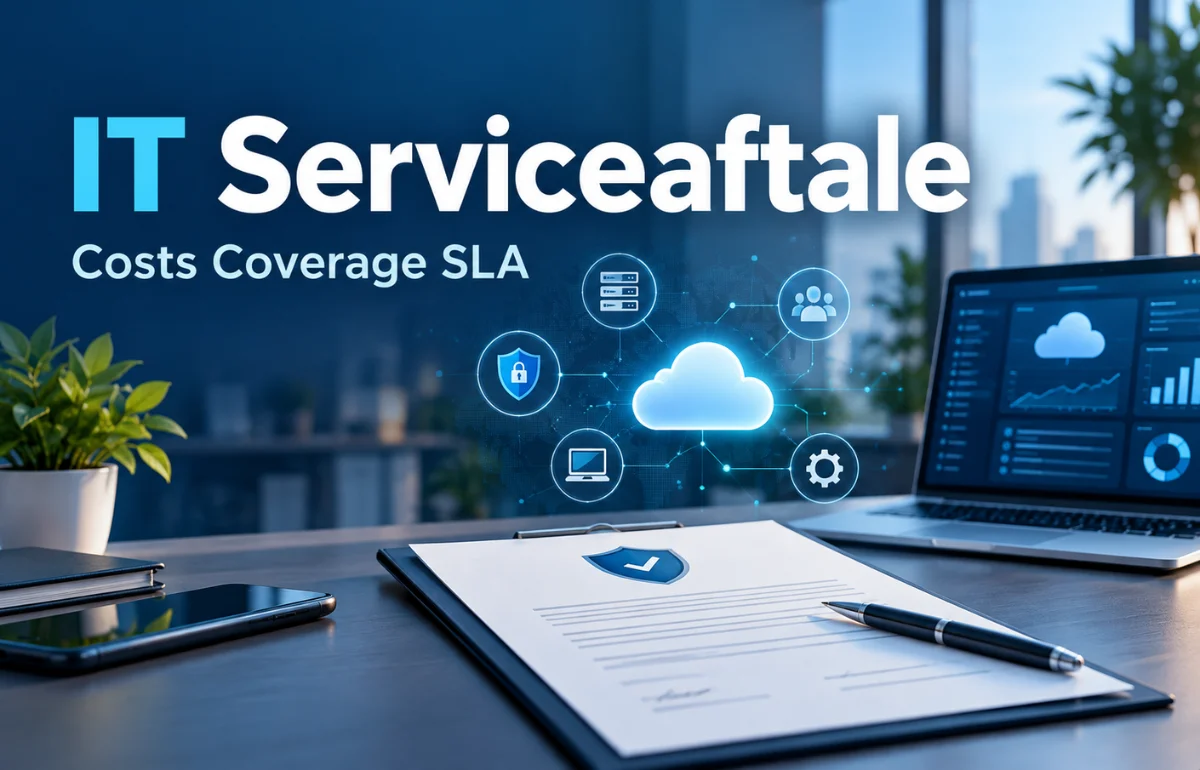
An IT serviceaftale is a written IT service agreement between a business and a technology provider. The Danish term roughly means “IT service contract.” It defines which systems receive support, what the provider must do, how quickly problems should be addressed, what the service costs, and who is responsible when something goes wrong. Depending on the arrangement, it may include help desk support, device management, network monitoring, cybersecurity, cloud administration, backups, and ongoing maintenance.
I think of an IT serviceaftale as a practical operating plan, not just a signature on a contract. A strong agreement gives employees a reliable place to get help and gives management a way to measure whether the service is working.
A weak one leaves both sides guessing during an outage. The difference becomes obvious when an important application stops working on a busy Monday morning.
Why Businesses Need an IT Serviceaftale
Most companies depend on several connected technologies even when they do not consider themselves technology businesses. Email, payroll, customer records, point-of-sale systems, cloud storage, and employee laptops all need attention. A failure in one area can interrupt another.
Without a formal IT support agreement, work often becomes reactive. Someone calls a technician after a problem appears, the technician investigates without much documentation, and the business pays an unpredictable bill.
That approach may suit a very small operation with simple systems, but it becomes harder to manage as the company grows.
With a defined service arrangement, I can evaluate support against clear expectations rather than vague promises. The main gains are predictable responsibilities, planned maintenance, documented escalation, and better visibility into recurring problems.
None of these outcomes is automatic; they depend on what the contract actually includes.
What Does an IT Serviceaftale Typically Include?

There is no universal package. The right scope depends on business size, critical applications, internal IT skills, operating hours, and risk tolerance. Still, I would expect a serious proposal to address the following areas.
Help Desk and Employee Support
This is the daily point of contact for password issues, software errors, printer problems, access requests, and malfunctioning devices.
The contract should list support channels, operating hours, supported languages, authorized users, and any limits on the number or type of requests.
Device, Network, and Cloud Management
Many agreements cover laptops, servers, Wi-Fi, firewalls, Microsoft 365, and other business platforms. Coverage should be tied to a current asset inventory rather than an undefined phrase such as “all company IT.”
I would also check who handles software updates, device replacements, license renewals, and configuration changes. Those tasks may be included, billed separately, or assigned to the customer.
Monitoring, Maintenance, and Backups
Proactive monitoring can detect low disk space, service interruptions, or failed backup jobs before users report them. Maintenance may include patch deployment, health checks, and scheduled changes.
However, “backup included” does not necessarily mean “recovery guaranteed.” The agreement should say what is backed up, how frequently, how long copies are retained, who monitors failures, and how restoration is tested.
Cybersecurity and Reporting
Depending on the plan, security work may involve endpoint protection, multi-factor authentication, vulnerability management, account reviews, and incident coordination.
Monthly reports should show more than ticket totals. I want to see recurring causes, unresolved risks, missed service targets, and actions agreed for the next period.
IT Serviceaftale vs. SLA vs. Break-Fix Support
These terms overlap, but they are not interchangeable. An IT serviceaftale is the overall commercial and operational agreement.
A service level agreement (SLA) is usually a section or attachment that defines measurable performance targets. Break-fix support is an alternative buying model in which a provider is called when something fails.
| Arrangement | Main purpose | Typical payment structure | Best fit |
|---|---|---|---|
| IT serviceaftale | Defines ongoing services, responsibilities, and contract terms | Monthly fee, usage-based fee, or hybrid | Businesses needing regular IT support |
| SLA | Sets service targets such as response times and availability | Usually part of a broader agreement | Teams that need measurable accountability |
| Break-fix support | Addresses individual incidents as requested | Per incident or hourly | Simple, low-dependency environments |
A managed IT services contract may combine the first two. The important question is not which label a vendor uses; it is whether the written commitments match the services your business relies on.
The Contract Clauses I Would Review First
A Precise Scope and Responsibility Matrix
Every supported service needs an owner. For example, if a cloud application fails, is the IT provider responsible for troubleshooting the integration, contacting the software vendor, or only confirming that the local internet connection works?
I recommend a simple responsibility matrix identifying what the provider handles, what the customer handles, and what a third-party vendor controls.
It prevents expensive “not our issue” conversations.
Response Times, Restoration Targets, and Escalation
A response time measures how quickly the provider acknowledges or starts handling an issue. A restoration target concerns how quickly normal service or an agreed workaround should return. They are different promises.
A meaningful SLA defines when the clock starts, whether it runs outside business hours, which incidents qualify as critical, how updates are delivered, and what happens when a target is missed.
Here is an illustrative priority model, not an industry-wide standard or a promise that every provider can meet:
| Priority | Example incident | Initial response target | Communication expectation |
|---|---|---|---|
| P1 — Critical | Company-wide system unavailable | 15 minutes during contracted P1 coverage | Update every 30 minutes |
| P2 — High | Key department unable to work | 1 hour during support hours | Update every 2 hours |
| P3 — Normal | One employee has a noncritical issue | 4 business hours | Update by next business day |
I would negotiate restoration or workaround goals separately and require a named escalation path when progress stalls.
If the provider advertises 24/7 support, confirm whether that means full technical resolution, emergency triage only, or a voicemail service.
Ownership, Access, and Exit Rights
The contract should confirm who owns business data, documentation, domain registrations, software subscriptions, and administrative accounts.
It should specify how credentials are handed over securely and how access is revoked after termination.
I prefer an agreement that treats departure as a planned operational task. A new provider should be able to receive configuration records, asset lists, and necessary access without an avoidable interruption.
Cybersecurity, GDPR, and Danish Regulatory Considerations
An IT service agreement can support security, but signing one does not transfer all cybersecurity responsibility to the vendor.
The customer still needs to approve risk decisions, assign internal owners, and verify that promised controls are operating.
For organizations handling EU personal data, I would first determine the provider’s role. If the IT supplier processes personal data on the customer’s behalf, GDPR Article 28 requires a binding controller-processor arrangement with specified safeguards and duties.
That agreement may be integrated with other contract documents, but a generic support SLA is not automatically sufficient. The European Commission explains these controller and processor responsibilities in its GDPR guidance.
Denmark’s NIS2 Act entered into force on July 1, 2025. It introduces cybersecurity and incident-reporting obligations for organizations within its scope, not for every company simply because it uses an IT provider.
Covered organizations should confirm how their service contracts support supplier risk management, incident escalation, and evidence collection. The Danish Agency for Digital Government provides an overview.
For incident planning more broadly, the NIST SP 800-61 Revision 3 guidance emphasizes integrating response with cybersecurity risk management.
In contract terms, that means defining who detects an event, who can isolate affected devices, who authorizes recovery, and who contacts leadership.
How Much Does an IT Serviceaftale Cost?
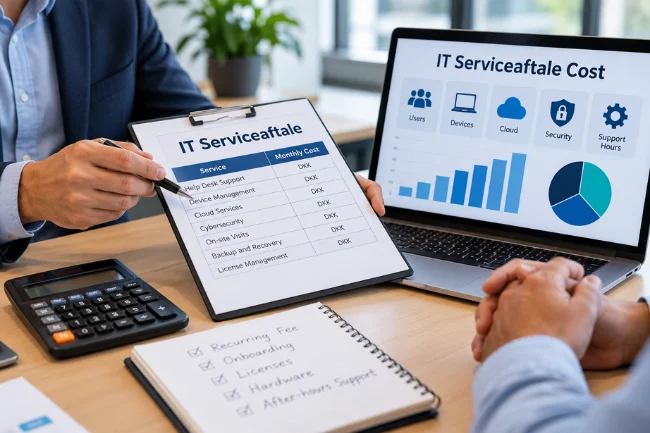
There is no trustworthy single price because the scope can range from basic remote help to round-the-clock management of complex infrastructure.
Danish providers may quote in Danish kroner per user, per device, per month, or through a custom fixed-fee contract.
The biggest pricing factors are the number of users and devices, required support hours, complexity of the network, cloud workloads, security coverage, on-site visits, and promised service levels.
A business with ten standard laptops and cloud email has different needs from a manufacturer running specialized equipment overnight.
I would ask for a proposal that separates the recurring fee from one-time onboarding, licenses, hardware, project work, after-hours visits, and incident recovery.
Otherwise, a low advertised monthly rate can hide significant additional charges.
Compare the total expected cost over twelve months, not just the headline subscription. Include predictable items such as license renewals, planned upgrades, and backup storage, while acknowledging that serious security incidents remain uncertain.
How I Would Choose the Right IT Service Provider
I would begin with the business’s actual dependency map: which systems must work for sales, customer service, payroll, and operations to continue? That determines the level of support worth buying.
Then I would look for a provider that can explain its services without relying on phrases like “complete peace of mind” or “unlimited IT.”
Clear providers can identify exclusions, describe their ticket process, and show what reports customers receive.
Five questions reveal a lot:
- Which devices, locations, cloud tenants, and applications are specifically covered?
- What happens when our most critical system fails outside normal office hours?
- Who is responsible for backup restoration tests and where are results documented?
- Which subcontractors or third-party tools will have access to our systems or data?
- What information and assistance do we receive if we change providers?
I also recommend requesting a sample monthly report and a sample incident timeline with sensitive details removed.
Marketing claims are easy to write. A coherent record of detection, escalation, communication, and corrective action is much more useful.
A Practical Example: Two Agreements, One Outage
Imagine a 35-person distribution company whose inventory application becomes unavailable at 8:15 a.m. The following scenarios are hypothetical, but they illustrate why contract details matter.
Under a vague arrangement, employees email a generic mailbox. The technician responds later, checks the network, and discovers that the application vendor needs to investigate.
No one knows who should coordinate the case, and managers repeatedly ask for updates.
Under a well-defined IT serviceaftale, the issue is classified according to an agreed priority. The service desk opens a case, calls the designated contact, starts a documented escalation, and coordinates with the application vendor because that responsibility is explicitly assigned.
The provider gives scheduled progress updates and records the cause after service returns.
The second agreement does not prevent every outage or guarantee a quick fix. It reduces ambiguity, which can be just as valuable when a problem involves several vendors.
Hidden Details That Make an Agreement More Useful
I would add three practical safeguards that smaller contracts often overlook.
First, maintain a service boundary register. For each critical system, record its business owner, technical owner, key dependencies, data sensitivity, and whether the provider is responsible for monitoring, fixing, or escalating problems.
Review it whenever a new application is introduced.
Second, require recovery evidence, not just backup success messages. Record the date of the latest restoration test, what was restored, how long it took, what failed, and what was corrected.
A backup report proves little if the business cannot recover what matters.
Third, establish an exit readiness check. At least annually, confirm that the company can access its own domain, cloud tenant, administrator accounts, backup data, and configuration documentation independently of the provider.
This reduces vendor lock-in and gives management greater control.
Common Mistakes to Avoid Before Signing
The first mistake is purchasing support based only on the lowest monthly fee. If a company requires urgent evening assistance but buys business-hours coverage, the apparent savings may disappear during one major outage.
The second is assuming “unlimited support” covers anything technology-related. New office installations, cybersecurity investigations, specialist software, and major migrations may be excluded.
Define the boundary before a disagreement occurs.
The third is treating the SLA as a substitute for operational review. Even a provider that consistently meets its response target can leave persistent issues unresolved.
I would review repeat incidents, security exceptions, employee experience, and restoration results alongside response metrics.
Finally, I would never overlook renewal and termination language. Check the minimum term, notice period, automatic renewals, price adjustments, and the cost of exporting data or transferring administration.
What Should Happen During the First 90 Days?
A new agreement is only useful if the provider can deliver it. In the first month, I would expect an asset inventory, access review, baseline security assessment, and agreement on support priorities.
The customer should nominate decision-makers for urgent incidents and change approvals.
During the second month, the provider should complete monitoring setup, document backup coverage, resolve immediate risks, and test the escalation process.
By the third month, management should receive a meaningful service report and review unresolved issues against the contract.
This schedule is a practical recommendation, not a regulatory deadline. Complex environments may take longer, but onboarding milestones should always be documented rather than assumed.
Frequently Asked Questions About IT Serviceaftale
What does IT serviceaftale mean in English?
It is a Danish term for an IT service agreement or IT support contract defining services, responsibilities, pricing, and support expectations.
Is an IT serviceaftale the same as an SLA?
No. The service agreement covers the overall relationship; an SLA establishes measurable standards such as response and availability targets.
How much does an IT serviceaftale cost per month?
Pricing depends on users, systems, coverage hours, security requirements, and included services. Request an itemized quote for an accurate comparison.
Does an IT serviceaftale include backups and cybersecurity?
It can, but neither is automatically included. Check the specific controls, testing responsibilities, exclusions, and incident procedures in writing.
Can I cancel an IT serviceaftale?
Usually according to the contract’s termination terms. Review notice periods, renewal clauses, exit fees, and data handover requirements before signing.
Final Thoughts
The best IT serviceaftale is not necessarily the longest contract or the cheapest package. It is the one that identifies essential systems, makes responsibilities unmistakable, and turns support promises into services you can verify.
Before signing, I would map critical technology, compare the proposed scope against actual business needs, and ask the provider to demonstrate how it handles a serious outage.
If those answers are clear, the agreement is much more likely to support reliable daily operations.

Noah Sterling is a technology research writer with 8+ years of experience covering emerging technologies, software trends, digital tools, and innovation. He creates practical, research-based articles to help readers understand the evolving technology landscape.