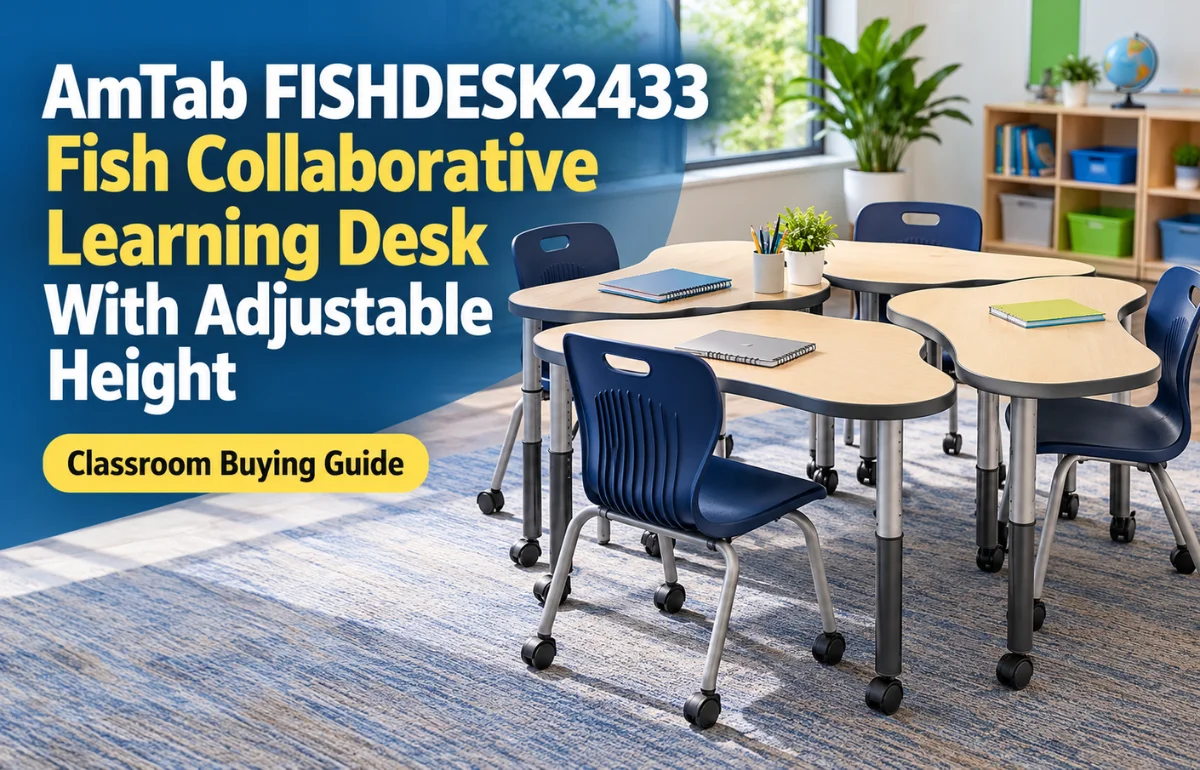
The AmTab FISHDESK2433 fish collaborative learning desk with adjustable height is a school desk with a distinctive curved, fish-shaped work surface and legs that can be set at different heights. Made by AmTab for educational environments, it works as an individual student workstation but can also be arranged alongside matching desks for group activities.
Retail listings describe a desktop approximately 33 inches wide and 23 inches deep, with a common height range of 22–34 inches. AmTab also offers other height configurations.
Unlike a conventional fixed-height desk, this model is intended to help schools change both seating fit and classroom layouts without replacing the furniture. Its main attraction isn’t the unusual outline alone; it’s the option to move between independent work and collaboration as lessons change.
What Makes the FishDesk2433 Different?
A Shape Designed Around Classroom Activity
The name comes from the asymmetrical, rounded desktop. Instead of four straight edges, the Fish Desk has a profile that can be turned toward other desks to form different groupings.
A teacher might use separate desks for a writing assessment, paired desks for peer feedback, or a clustered arrangement for a science discussion.
I see the strongest argument for this shape in classrooms that change activities throughout the day. The furniture doesn’t dictate one permanent seating plan.
That said, the exact way the curves meet depends on desk orientation and space between chairs. I would never order an entire room based only on a promotional photo; I would request a layout drawing or test a sample first.
An Individual Desk, Not One Large Group Table
Each Fish Desk remains a separate workstation. That’s useful when students need their own notebooks, devices, and writing space even while sitting in a team.
A single large activity table offers a shared surface, but it cannot be divided into individual desks when the lesson changes.
Separate units may take more time to reposition and align. I would choose between flexibility and simplicity based on actual lessons.
AmTab FishDesk2433 Specifications at a Glance
Published configurations vary, so I separate the manufacturer’s available choices from one retailer’s standard listing.
| Feature | Published detail | What buyers should check |
|---|---|---|
| Model identification | FishDesk2433; retailer SKU FISHDESK2433 | Match the written quote to the actual configuration |
| Desktop dimensions | Approximately 33 in. wide × 23 in. deep in a retailer listing | Request a measured top drawing and overall footprint |
| Adjustable heights | AmTab lists 17–24, 22–34, and 30–38 in. options | Confirm which range is supplied |
| Work surface | High-pressure laminate over a particleboard core, per retailer | Confirm finish and cleaning instructions |
| Edge | DynaRock sprayed polyurethane-resin edge | Select the desired edge color |
| Frame | Metal legs with powder-coated upper sections and adjustable inserts | Ask about frame configuration |
| Optional equipment | 3-inch wheels, felt glides, bookbox, bag hook, support-frame choices | Don’t assume these are included |
| Listed weight | Around 46 lb in one retailer description | Confirm configured and shipping weights |
| Delivery | Listed as ready to assemble | Confirm assembly and installation costs |
Sources: AmTab’s official Fish Desk configurator and the Today’s Classroom product listing.
A detail that can confuse buyers is the model number. Some related listings and catalogs use different number combinations or dimensions.
Treat “2433” as a way to identify the family, not as a substitute for a dimensioned specification sheet.
A curved desktop also has less usable surface area than a full 33-by-23-inch rectangle, even if those numbers describe its outside limits. That’s an often-overlooked detail when planning room capacity.
How the Adjustable Height Works in Practice
Choose a Range Before Choosing a Color
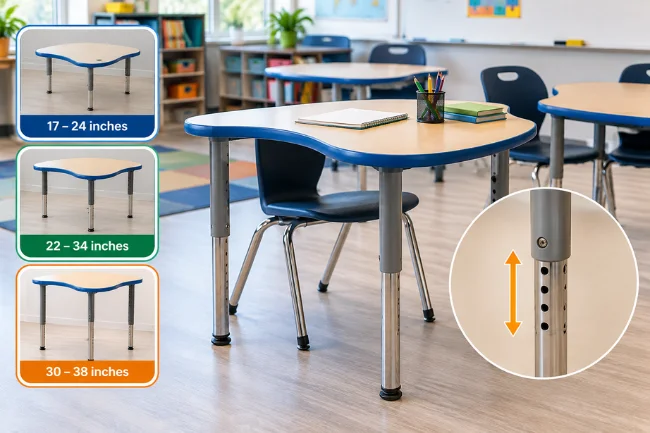
AmTab’s current product configurator presents three height-range choices: 17–24 inches, 22–34 inches, and 30–38 inches.
The 22–34-inch version is the standard selection shown by one major retailer; its listing also offers a higher 30–38-inch option.
Those ranges are different configurations, not a promise that every desk adjusts continuously from 17 to 38 inches.
The retailer describes adjustable-height leg inserts, rather than a motorized lift. I would confirm the adjustment increments, tools required, and whether staff should perform the adjustment before buying.
A 30–38-inch configuration should not automatically be marketed as a full sit-stand desk. Whether it suits standing work depends on the student’s height, the activity, and the manufacturer’s intended setup.
Match the Desk to the Student and Chair
I wouldn’t assign desk heights using grade level alone. Children of the same age can have very different proportions.
A better starting point is to seat the student with feet supported, shoulders relaxed, and forearms able to rest comfortably on the work surface without reaching upward.
Check that knees have adequate clearance beneath the top and any optional bookbox.
If the desktop must be raised so high that a child’s feet dangle from the chair, the seating arrangement needs another look. An adjustable desk is only one part of an ergonomic classroom setup.
For mixed-age schools, I would make a height-and-chair compatibility chart before ordering.
Materials, Durability, and Everyday Maintenance
A Laminate Top Built for Routine School Use
The retailer specifies high-pressure plastic laminate with a backing sheet over an industrial particleboard core.
This construction is familiar in institutional furniture because it creates a practical surface for writing, reading, and using school devices.
Laminate is relatively straightforward to wipe down, but it is not indestructible. Sharp objects, repeated impact, excessive moisture, and harsh chemicals can still damage a work surface.
I would ask for the approved cleaning guide rather than assuming any disinfectant is suitable.
The DynaRock edge is another distinguishing feature. Today’s Classroom describes it as sprayed solid polyurethane resin, designed to help protect the desktop perimeter.
That matters because desk edges receive constant contact from backpacks, chairs, and moving supplies. Protection reduces exposure; it doesn’t make the desk immune to misuse.
Understructure and Accessories Matter
AmTab offers leg-only construction and welded support-frame options, including a three-sided arrangement with an open front.
There are also choices for wheels, felt glides, a bookbox, and a bag hook. These details may seem secondary, but they can change how the desk feels and functions during a typical school day.
For example, storage under the top can keep books off the writing surface while reducing available knee space.
Wheels may make room changes easier, yet I would verify braking or locking arrangements rather than assuming all caster options lock.
Felt glides can be useful where floor protection and quieter movement are priorities.
The frame deserves as much attention as the finish.
How Fish Desks Can Support Collaborative Learning

The practical value of flexible classroom furniture is that it allows teachers to align the room with the task. It doesn’t automatically improve grades or teamwork.
A scoping review of flexible learning spaces found potential benefits for classroom movement and sedentary behavior, while emphasizing the importance of teaching approaches and the need for further research on learning outcomes.
Those findings concern flexible spaces generally, not a clinical or educational trial of this particular desk.
Three Layouts Worth Planning For
Independent work: Face desks toward the teaching wall and leave enough room for teachers to circulate. The individual tops keep assignments and devices within each student’s space.
Partner work: Turn adjacent desks so two students can compare notes or share a small project. Check whether the curved edges create any awkward reach across the boundary.
Small-group pods: Arrange three or four desks in a cluster for discussion, experiments with lightweight materials, or collaborative problem-solving. Leave clear paths around the outside so a pod doesn’t block access to another.
I would check all three arrangements on a floor plan. Transitions should remain manageable without sacrificing sightlines and walkways.
A Practical 24-Student Classroom Example
Imagine a class of 24 students that alternates between quiet writing and six groups of four.
With 24 individual Fish Desks, the teacher can retain separate workstations and reorganize them into six pods as needed.
With six large group tables, the group layout is ready immediately, but individual separation is less flexible.
This is a planning example, not a claim that every room can hold six pods. Actual capacity depends on room dimensions, doorways, chair movement, accessibility requirements, and where the teacher needs to stand.
I would tape out a proposed pod footprint on the floor and walk the routes before ordering.
A numbered pod diagram can also reduce rearrangement time between lessons.
Benefits and Limitations I Would Weigh
Where This Design Earns Its Place
I see four meaningful strengths.
First, the fish-shaped top provides more arrangement possibilities than fixed rows.
Second, adjustable-height options let a school specify furniture for different users and rooms.
Third, the laminate surface and edge treatment are intended for daily institutional use.
Fourth, optional storage, mobility, and frame configurations allow the desk to match the school’s priorities.
I’d prioritize durable finishes over striking colors.
Where a Conventional Desk Could Be Easier
The curved top isn’t ideal for every task. Large posters, oversized equipment, or multiple spread-out textbooks may be easier to accommodate on a wide rectangular surface.
The shaped edge can also make a neat wall-to-wall row more complicated.
At approximately 46 pounds, according to one retailer, this isn’t something I would expect younger children to carry or repeatedly lift.
The shape and weight make teacher-supervised movement a sensible default. Height changes may also demand staff time rather than happening instantly between activities.
Finally, optional upgrades can complicate purchasing. Two schools may discuss the same model while pricing very different combinations of frames, feet, storage, and finishes.
FishDesk2433 vs. Other Classroom Desk Styles
| Desk style | Best suited to | Main advantage | Main compromise |
|---|---|---|---|
| AmTab FishDesk2433 | Mixed independent and small-group lessons | Curved shape and selectable height ranges | Requires layout planning and configuration checks |
| Standard rectangular student desk | Mostly individual tasks and straight rows | Simple alignment and familiar surface | Less distinctive group arrangements |
| Trapezoid collaborative desk | Grouped activities with geometric clusters | Straight edges can fit together predictably | Arrangement depends on angles and size |
| Large shared activity table | Groups that stay together for longer tasks | One continuous work surface | Harder to separate into personal stations |
I wouldn’t call the Fish Desk universally better than these alternatives.
I would choose it when frequent changes between individual and group tasks are central to the teaching plan. For a classroom that rarely changes arrangement, a simpler desk may offer better value.
A mixed room with standard desks and a smaller collaborative zone may be more sensible than full replacement.
What to Check Before Placing an Order
Confirm the Exact Configuration in Writing
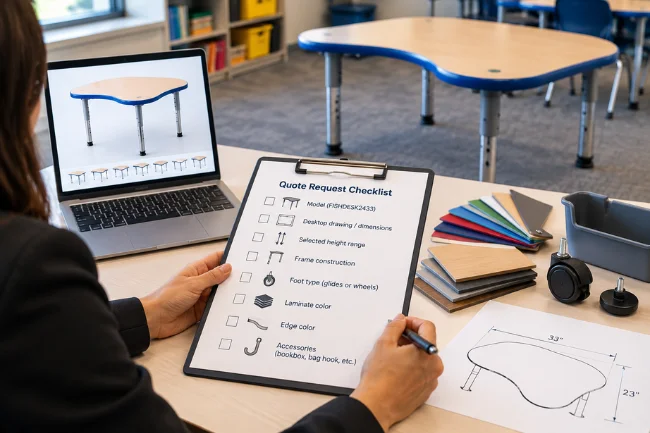
My first request would be for a quote that lists the model, desktop drawing, selected height range, frame construction, foot type, laminate, edge color, and accessories.
I would also ask whether a sample or detailed installation photograph is available. Product-page images often show upgrades that are not part of the base price.
Budget Beyond the Advertised Unit Price
One retailer has displayed this model at approximately $357 against a higher list price, but prices and available options can change.
I wouldn’t use a displayed discount percentage as proof of long-term value.
Instead, compare delivered cost: the furniture itself, optional extras, freight, assembly, taxes where applicable, and any replacement parts or ongoing maintenance.
A large order should also include a realistic delivery schedule and a plan for handling damage on arrival.
Check Accessibility, Warranty, and Service
Ask the supplier for current warranty documents and the coverage of tops, edges, adjustment components, and casters.
Request applicable product testing or emissions documentation for the precise configuration rather than treating general marketing claims as proof of universal certification.
LEED, for example, is a building rating system, not a simple standalone product approval.
Accessible clearance should be checked against the relevant local standards and the needs of actual users.
Having an adjustable height range does not by itself establish that every configuration is accessible to every wheelchair user.
Try One Desk in the Intended Space
If I had to recommend only one purchasing safeguard, it would be a sample evaluation.
Have an adult responsible for furnishing and a representative group of users check reach, chair clearance, stability, movement, writing comfort, and storage access.
Then test a group arrangement, return it to individual stations, and record what created friction.
That small exercise can reveal issues a specification sheet cannot, without pretending that a short demonstration measures long-term durability.
Care and Long-Term Value
A school desk’s value is measured over years of use, not only at checkout.
I would set a simple care routine: wipe surfaces using manufacturer-approved products, clean spills promptly, inspect edges for damage, and check that leg fasteners and optional wheels remain secure.
Staff should be shown how to change heights correctly. Students shouldn’t improvise adjustments or climb on a desk.
For wheeled configurations, verify stability before activities begin and follow the supplied movement instructions.
Keep a record of the purchased parts and finishes. That makes future repairs, replacements, or classroom expansions easier because staff won’t have to guess which version is already installed.
Is the AmTab FishDesk2433 Worth Considering?
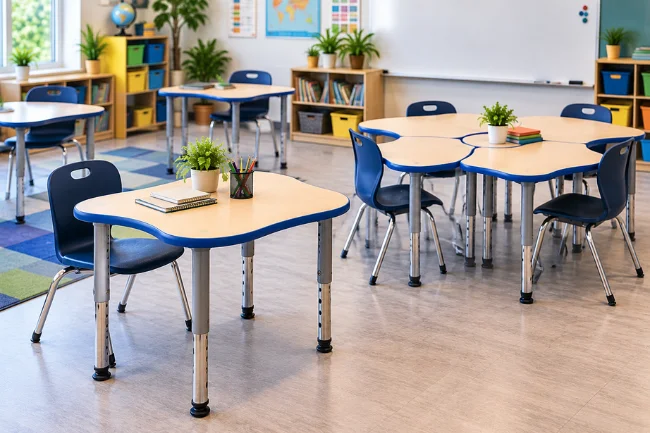
I consider the AmTab FISHDESK2433 fish collaborative learning desk with adjustable height a sensible candidate for schools that deliberately switch between solo assignments and small-group lessons.
Its curved surface, configurable height, and institutional materials address real classroom needs, provided the selected version suits the students and the room.
The next move is straightforward: compare the official configuration choices, request a detailed delivered quote, and test a layout before making a bulk purchase.
I would spend more time on ergonomics, access, and everyday classroom transitions than on the fish shape itself.
Frequently Asked Questions
What are the dimensions of the AmTab FISHDESK2433?
A major retailer lists a desktop about 33 inches wide by 23 inches deep. Confirm the exact footprint with the seller, especially for configured versions.
What height settings are available for the FishDesk2433?
AmTab lists 17–24, 22–34, and 30–38 inches as separate adjustable-height options. Check the range selected on your quote.
Can multiple AmTab Fish Desks be arranged together?
Yes. The curved tops are intended for flexible classroom arrangements, including pairs and small-group clusters.
Does the FishDesk2433 come with wheels or a bookbox?
AmTab lists 3-inch wheels, a bookbox, and a bag hook as configuration choices. They should not be assumed to be standard.
Is the AmTab Fish Desk suitable for every classroom?
Not automatically. It’s most useful where layouts change often; confirm room clearance, student fit, and the full delivered price before buying.

Olivia Parker is a home improvement research writer with 8+ years of experience covering home design, renovation ideas, maintenance tips, and practical living solutions. She creates easy-to-follow content to help readers make informed decisions about improving their homes.