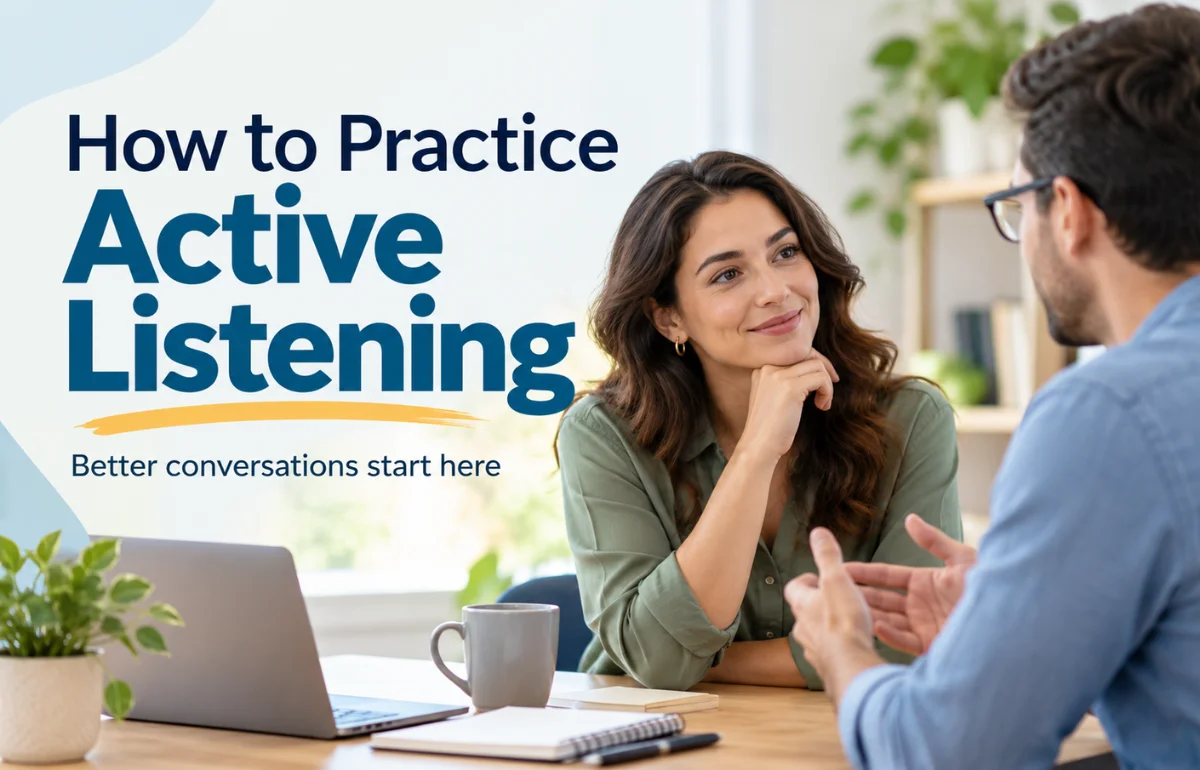
Learning how to practice active listening starts with one decision: focus on understanding the other person before preparing your reply. Active listening is a communication skill in which I give someone my attention, notice both their words and feelings, ask questions when something is unclear, and check that I understood correctly. It is more than staying quiet while someone talks. To practice it, put distractions aside, let the speaker finish, summarize their main point in your own words, and ask, “Have I got that right?” These small actions can reduce misunderstandings and make everyday conversations more useful, whether I am talking with a friend, a colleague, or a family member.
The challenge is resisting the urge to interrupt, defend, or offer solutions before the other person feels understood.
What Is Active Listening, and Why Does It Matter?
Hearing is noticing sound. Active listening is deliberately working out what a message means to the person delivering it. That includes facts, emotions, expectations, and sometimes what they are struggling to say.
The Center for Creative Leadership identifies six core practices: pay attention, withhold judgment, reflect, clarify, summarize, and share. I find that sequence useful because it puts understanding before my own opinion.
At work, careful listening can reveal the cause of a missed deadline. At home, it can keep a complaint from becoming an argument.
Active listening does not require me to agree. I can understand someone’s feelings, recognize their perspective, and still have a different view or a firm boundary. In fact, separating understanding from agreement makes difficult conversations easier to navigate.
How to Practice Active Listening in Everyday Conversations

I think of the following techniques as habits to combine, not a rigid script to perform. The aim is a natural exchange in which the other person can tell whether I actually understood them.
1. Start With the Intention to Understand
Before an important conversation, I ask myself, “Am I here to understand, or am I waiting for my turn?” That question catches a common problem: mentally drafting a rebuttal while the other person is still speaking.
If someone says, “I’m exhausted by this project,” I need to discover what “exhausted” means to them. Are deadlines unrealistic? Do they feel unsupported?
Curiosity improves the next question. Judgment usually narrows it.
2. Remove Distractions You Can Control
A phone face up on the table can compete with even the most interesting conversation. I put it away, silence notifications, and stop typing unless I have explained why notes are necessary.
If my mind keeps returning to an unfinished task, I make a note or arrange a better time. Five attentive minutes beat half an hour of divided attention.
On video calls, I close unrelated tabs and avoid checking incoming messages. In person, I turn toward the speaker without making my posture feel staged.
3. Let the Person Finish, Then Leave a Little Space
Interrupting can make a speaker abandon the detail I most need to hear. I try to let a thought reach its natural ending before answering, especially when the subject is emotional.
A short pause can help. Sometimes a person adds the most revealing part after saying, “That’s all.” I don’t need to count seconds or make silence awkward; I simply avoid racing to fill every gap.
If time is limited, I say so respectfully and suggest a time to continue.
4. Listen for Three Layers: Facts, Feelings, and Needs
Here is a simple framework I use to organize what I hear:
- Facts: What happened, according to the speaker?
- Feelings: How does the person seem to experience it?
- Needs: What are they hoping will change or be understood?
Suppose a coworker says, “Nobody told me the client meeting moved, and I looked unprepared.” The fact is a schedule change. The feeling may be embarrassment or frustration. The need could be reliable updates, not sympathy or a lecture about checking calendars.
These layers are working hypotheses, not mind-reading. I check them instead of declaring, “You’re angry because you need respect.” A gentler response is, “Was the hardest part not getting the update in time?”
5. Show Attention Without Overdoing Body Language
Small signals help a speaker know I am following: a relaxed expression, an occasional nod, and brief responses such as “I see” or “Go on.” Tone matters as much as words.
Eye contact can be helpful, but it is not a universal test of attention. Some people look away to think, communicate differently because of disability or neurodivergence, or come from cultures with different eye-contact norms. I focus on responsiveness rather than insisting on a particular gesture.
One gesture rarely tells the whole story. I ask rather than assume.
6. Paraphrase the Meaning, Not Every Sentence
Paraphrasing means restating the speaker’s point in my own words to check accuracy. It is one of the most useful active listening techniques because it reveals misunderstandings while they are still easy to fix.
If a friend says, “You keep making plans without checking whether I’m available,” I might respond, “You want me to include you before the plan is settled. Is that right?”
That is more helpful than repeating their sentence word for word. I use a paraphrase after a meaningful section, not after everything the person says. Otherwise, the conversation can sound like an interview or a counseling exercise.
If they correct me, I say, “Thanks. Tell me what I missed.”
7. Ask Open-Ended Questions That Move the Conversation Forward

Open-ended questions invite explanation rather than a simple yes or no. I prefer “What happened next?” to “Were you upset?” and “What would help now?” to “Do you want me to fix it?”
Too many questions can feel like interrogation. I ask one, listen, and reflect before asking another.
This is also a central idea in the OARS communication approach described by the U.S. Agency for Healthcare Research and Quality: open questions, affirmations, reflective listening, and summaries can support constructive conversations. It is a useful model beyond clinical settings, provided I adapt it to the relationship.
8. Validate Feelings Without Automatically Agreeing
Validation means acknowledging that a feeling or concern makes sense from the speaker’s perspective. It does not mean approving every conclusion or behavior.
I can say, “I understand why that felt unfair,” even if I have a different account of what happened. Compare that with “You’re overreacting” or “At least it wasn’t worse,” which can shut down the conversation.
When I cannot tell how someone feels, I ask: “What has been the hardest part for you?”
9. Ask Before Switching Into Problem-Solving Mode
Advice is tempting because it gives me something concrete to do. But a person describing a problem may want to vent, think aloud, compare options, or request help. Those are different needs.
I use a simple permission question: “Would you like me to listen, help you think it through, or suggest an option?” This avoids turning every conversation into an unsolicited consultation.
When the speaker does want ideas, I connect my response to what I heard: “You said the biggest problem is the late notice. Could a shared calendar help?” That makes the suggestion relevant rather than generic.
Listening may be enough, or it may lead to a decision.
10. Summarize, Confirm, and Follow Through
Toward the end of a longer conversation, I bring together the main issue and any next action: “You’re concerned about the changing deadline, and you’d like an update by Thursday. Have I understood?”
This separates what was discussed from what was agreed.
If I promise to call, send information, or change a habit, I follow through. Listening loses credibility when nothing changes afterward. The Center for Creative Leadership’s research discussion highlights that responding with appropriate action can matter greatly to whether employees feel heard.
Active Listening Examples: What to Say Instead
Good listening often comes down to replacing a reflexive response with one that invites clarity. These examples are useful starting points, but I adapt the wording to sound like myself.
| Situation | Less helpful response | Active listening response |
|---|---|---|
| A friend feels ignored | “You’re being too sensitive.” | “When did you start feeling left out?” |
| A coworker reports a delay | “Why didn’t you finish it?” | “What got in the way of the deadline?” |
| A partner raises a recurring issue | “Here we go again.” | “I hear that this is still bothering you. What am I missing?” |
| A child says school was awful | “It can’t be that bad.” | “What made today so difficult?” |
| Someone criticizes my decision | “That’s not what happened.” | “Which part of my decision concerned you most?” |
None promises agreement; each invites clarity.
Common Active Listening Mistakes and How to Fix Them
Active listening can become performative if I focus more on looking attentive than on understanding. I watch for these habits in particular:
| Mistake | Why it backfires | Better habit |
|---|---|---|
| Repeating every sentence | Sounds mechanical and slows the exchange | Reflect only meaningful points |
| Finishing another person’s thought | Risks replacing their meaning with mine | Wait, then invite them to continue |
| Guessing an emotion as fact | Can feel intrusive or inaccurate | Use “It sounds like…” and check |
| Asking several questions at once | Overloads the speaker | Ask one clear question |
| Turning the story toward myself | Shifts attention away from their concern | Share my experience only if it helps |
| Treating understanding as surrender | Makes difficult topics feel threatening | Separate empathy from agreement |
“I hear you” means little unless my next sentence demonstrates understanding. A precise reflection gives the speaker something to confirm or correct.
How to Listen When the Conversation Gets Difficult

When I Disagree
I try to summarize the other person’s position fairly before offering mine: “You believe the change was made too quickly because the team wasn’t consulted. I see the timing differently, but I understand your concern.”
Fair summarizing reveals what the disagreement actually is. When emotions rise, I focus on one issue.
When Someone Is Upset
I avoid telling them to calm down. Instead, I acknowledge what I can hear and ask what would help. If I am unsure whether they want to continue, I offer a choice: “Would you rather talk now or take a break?”
Listening also has limits. I can say, “I want to understand, but I can’t continue while we’re shouting. Let’s return to this when we can both speak respectfully.” Active listening should never require accepting threats, insults, or unsafe behavior.
When We Are Talking by Text or Video
Digital conversations remove some of the cues I rely on in person. In text, I avoid assuming a short reply signals anger. For sensitive issues, I may ask, “Am I reading your message correctly?” or suggest a call.
On video, I summarize decisions aloud and confirm them afterward in a concise message. This can prevent two people from leaving the same meeting with different understandings.
A Seven-Day Active Listening Practice Routine
If I want to improve my listening skills, I make the practice small enough to repeat. Here is a one-week routine that fits ordinary conversations without requiring a class or special equipment.
- Day 1 — Notice interruptions. During one conversation, pay attention to how often you want to jump in. The aim is awareness, not a perfect score.
- Day 2 — Remove one distraction. Put your phone away for a ten-minute exchange and notice whether you remember more detail afterward.
- Day 3 — Ask one open question. Try “What was that like for you?” and let the answer develop before changing topics.
- Day 4 — Reflect one key point. Say, “So the main issue is…” and invite the other person to correct you.
- Day 5 — Listen for the underlying need. Separate the event from what the person wants, then check your interpretation instead of guessing.
- Day 6 — Ask before advising. Find out whether the person wants emotional support, brainstorming, or a recommendation.
- Day 7 — Review and repeat. Think about which conversation felt clearer, what distracted you, and which single habit deserves another week.
One behavior at a time makes progress easier to notice.
How Can I Tell Whether My Listening Is Improving?

I do not measure active listening by how long I stay silent or how frequently I nod. I look for evidence of shared understanding:
- Can I accurately summarize the speaker’s concern without adding my interpretation?
- Does the speaker correct or expand on my summary comfortably?
- Have I asked what kind of response they want before offering advice?
- Can both of us name any decision or next action at the end?
A practical check is to ask someone I trust, “When we discuss something important, do you feel I understand you before I respond?” I listen to that answer without defending my intentions.
One correction can teach me more than ten conversations in which I simply assumed I had listened well.
Frequently Asked Questions About Active Listening
What are the five basic steps of active listening?
Pay attention, allow the person to finish, ask clarifying questions, paraphrase the main point, and confirm your understanding before responding.
What is an example of active listening in a conversation?
If someone says they feel overlooked at work, I might respond, “You feel your contributions aren’t being recognized. Is that what concerns you most?”
How can I practice active listening by myself?
Listen to a short interview, pause it, summarize the speaker’s viewpoint aloud, and check whether your summary preserves the original meaning.
What is the difference between active listening and passive listening?
Passive listening mainly receives information; active listening deliberately checks meaning through attention, questions, reflection, and appropriate responses.
How do I practice active listening when I disagree with someone?
Restate their position fairly, ask whether you understood it correctly, and then explain your own view without dismissing their experience.
Make One Conversation Better Today
Learning how to practice active listening is less about perfect phrases and more about sustained curiosity. I begin by giving the speaker my attention, checking meaning instead of guessing, and waiting to offer my perspective until theirs is clear.
For your next meaningful conversation, choose just one habit: put away your phone, ask an open question, or summarize what you heard. Then ask, “Did I understand you correctly?” A better conversation can begin with that simple check.

Emily Carter is a personal growth writer with 9 years of experience creating practical content about confidence, mindset, productivity, habits, goal setting, and self-improvement. She focuses on helping readers build positive routines, develop self-awareness, and make meaningful changes through simple, actionable strategies.