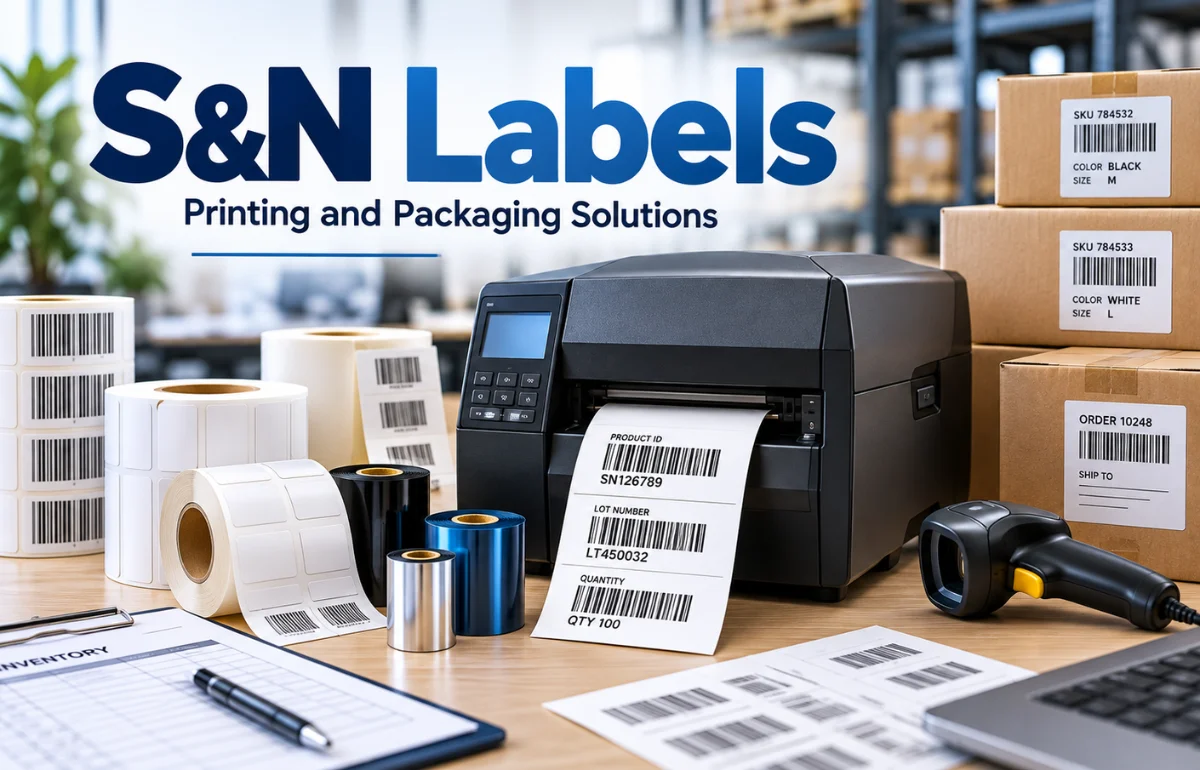
S&N Labels is a South African manufacturer and supplier of self-adhesive labels, barcode labels, thermal transfer ribbons, price-marking systems, and related printing equipment. The company provides labelling solutions for businesses in retail, food and beverage, healthcare, logistics, manufacturing, and other industries. Its products include custom-printed labels, blank labels, barcode printing supplies, and specialised identification materials.
S&N Labels became part of the Bidvest Labels brand, which brought together S&N, Rotolabel, and Spec Systems in 2025. Today, its expertise contributes to a wider range of commercial and industrial labelling solutions across Southern Africa. For businesses looking for reliable product identification, professional packaging, and efficient inventory tracking, understanding these solutions can make choosing the right labels much easier.
What Is S&N Labels, and How Has the Company Evolved?
S&N Labels developed its reputation by supplying practical labelling products and printing technologies to businesses across Southern Africa.
Its original operations in Spartan, Kempton Park, near Johannesburg, focused on providing everything from standard adhesive labels to sophisticated barcode identification systems.
The company also established relationships with recognised printing and identification brands, including Zebra, Honeywell, TSC Printronix, ARMOR-IIMAK, and Meto.
One significant development came in 2025, when Bidvest introduced Bidvest Labels, combining the capabilities of S&N Labels, Rotolabel, and Spec Systems.
This consolidation expanded the combined business’s product portfolio, technical expertise, and geographical coverage.
I think this development matters for anyone researching the company today. Some online information still appears under the original S&N name, while its current operations are represented within Bidvest Labels.
The change also reflects an important trend in commercial printing: businesses increasingly prefer suppliers that can provide labels, printers, software, and technical support together rather than sourcing everything separately.
What Products and Services Does S&N Labels Offer?
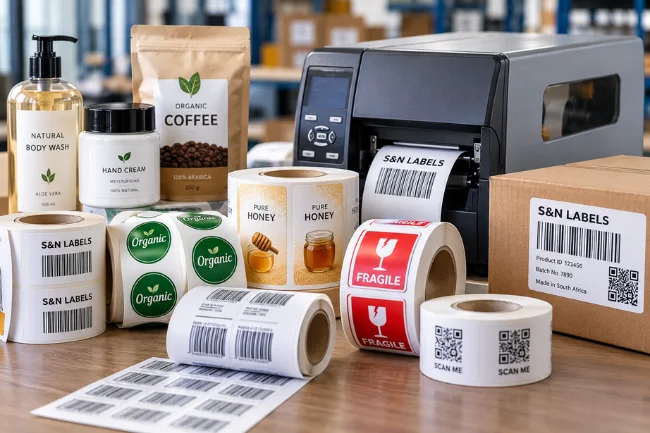
One of the company’s distinguishing features is its extensive product range. Instead of focusing exclusively on decorative stickers, it offers solutions for packaging, identification, retail pricing, and supply chain operations.
1. Self-Adhesive and Custom-Printed Labels
Self-adhesive labels are among the company’s core products. They feature a printable surface, an adhesive layer, and a backing material that is removed during application.
Businesses use these labels for product branding, nutritional information, instructions, identification, and regulatory details.
Custom label printing also allows companies to select specific dimensions, shapes, colours, finishes, and materials.
For example, a cosmetics manufacturer might require an elegant waterproof label, while a warehouse may need a simple, highly readable identification sticker.
2. Barcode and Variable Data Labels
Barcode labels help businesses identify products, track inventory, and manage stock movements.
S&N Labels offers barcode-related printing solutions, including labels containing fixed information and variable data.
Variable data printing allows each label to carry information such as a different serial number, batch number, or sequential identifier.
I consider this particularly useful for businesses handling thousands of items because it connects physical products with digital inventory records.
3. Blank and Thermal Labels
Not every business needs preprinted artwork. Some require blank labels that can be printed whenever new information becomes available.
The company’s range includes direct thermal labels, thermal transfer labels, inkjet and laser label sheets, and continuous labels for compatible printers.
These options support shipping operations, retail counters, warehouses, and offices where information changes frequently.
4. Price-Marking and Tagging Equipment
Retailers often need to update prices quickly without redesigning their product packaging.
S&N Labels has supplied Meto hand labellers, price-marking labels, and tagging tools designed for retail environments.
Such equipment is useful for supermarkets, clothing shops, discount stores, and stockrooms.
5. Printing Hardware and Software
The company’s offering also extends to barcode scanners, industrial label printers, desktop printers, mobile computers, and printing software.
This broader approach helps businesses connect label production with inventory management and product identification systems.
Understanding the Different Label Materials
Choosing the correct material is just as important as designing an attractive label.
A label that looks excellent when first applied may become unsuitable if exposed to moisture, chemicals, excessive heat, or repeated handling.
I would always begin by considering the environment in which the product will be used.
Comparison of Common Label Materials
| Label material | Main advantages | Typical applications |
|---|---|---|
| Paper | Economical and easy to print | Retail pricing, dry goods, packaging |
| Polypropylene (PP) | Moisture-resistant and durable | Beverages, cosmetics, personal care |
| Polyethylene (PE) | Flexible and suitable for squeezable containers | Shampoo bottles, lotions, healthcare |
| Polyester (PET) | Strong dimensional stability and durability | Electronics, industrial identification |
| Direct thermal paper | Convenient printing without ribbons | Shipping labels, temporary identification |
| Metallised facestock | Decorative metallic appearance | Premium product packaging |
S&N Labels and Bidvest Labels describe several paper and film facestocks, including polypropylene, polyethylene, thermal paper, and metallised materials.
For short-term indoor applications, paper may be sufficient.
However, products stored outdoors or frequently exposed to liquids generally require more durable materials.
The correct choice depends on the entire label construction, including its adhesive, printing method, and protective finish.
Direct Thermal vs. Thermal Transfer Printing
These two printing technologies are widely used in commercial labelling, but they work differently.
Direct thermal printers create images by applying heat to specially coated, heat-sensitive labels. They do not require an ink ribbon.
Thermal transfer printers use heat to transfer pigment from a ribbon onto the label surface.
This additional ribbon can provide greater print durability when paired with suitable materials.
| Feature | Direct thermal | Thermal transfer |
|---|---|---|
| Ink ribbon | Not required | Required |
| Common use | Shipping and short-term labels | Product and industrial labels |
| Durability | Generally lower | Potentially higher |
| Consumables | Heat-sensitive labels | Compatible labels and ribbons |
| Maintenance considerations | Printer and label condition | Printer, label, and ribbon compatibility |
| Long-term identification | Often unsuitable | Frequently preferred |
For an ordinary delivery label, direct thermal printing can be perfectly adequate.
For an industrial asset label that must remain readable for years, I would investigate thermal transfer printing with a durable synthetic facestock.
The application should determine the technology, not simply the initial printer price.
Why Adhesive Selection Matters
Adhesives are sometimes overlooked when businesses order labels.
However, even a beautifully printed label is ineffective if it peels away from its container.
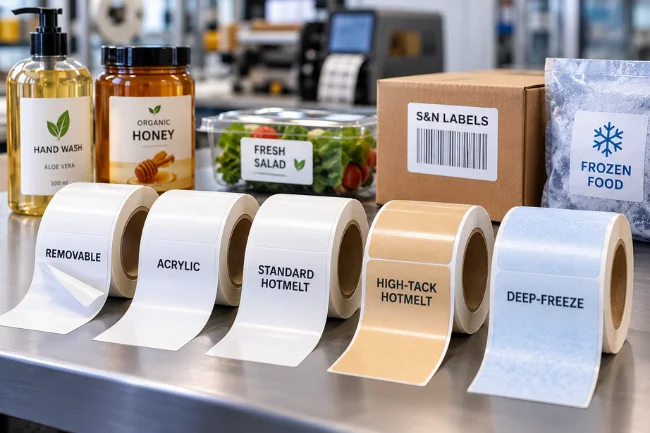
S&N Labels’ published product information describes several adhesive options, including removable, acrylic, standard hotmelt, high-tack hotmelt, and deep-freeze formulations.
Permanent and Removable Adhesives
Permanent adhesives are intended to maintain attachment throughout the label’s required life.
Removable adhesives are useful when customers need to remove labels without excessive difficulty or residue.
Neither option is universally better.
The decision depends on whether the label should remain attached or be removed later.
Freezer and Cold-Storage Adhesives
Cold-storage labelling requires special attention.
An important distinction is the difference between application temperature and service temperature.
Application temperature describes the conditions when the label is attached. Service temperature describes the conditions it must withstand afterward.
A label applied to a room-temperature carton before freezing may need a different adhesive from one applied directly to an already frozen carton.
The company’s deep-freeze adhesive information describes formulations intended for low-temperature application. Actual suitability should be confirmed against the current product specification.
Industries That Benefit from S&N Labelling Solutions
Labelling requirements vary considerably between industries.
A retailer may prioritise price visibility, while a pharmaceutical manufacturer may focus on traceability and long-term readability.
Food and Beverage
Food packaging commonly requires product identification, ingredients, nutritional information, batch details, and expiry dates.
Labels may also encounter condensation, refrigeration, oils, and frequent handling.
I would prioritise moisture resistance, adhesive performance, and compliance with applicable food-labelling requirements.
Retail and E-Commerce
Retailers rely on price tags, barcode stickers, promotional labels, and stock identification systems.
E-commerce businesses use shipping labels, returns labels, and warehouse location identifiers.
Consistent label printing can reduce fulfilment errors and improve everyday stock handling.
Healthcare and Pharmaceuticals
Healthcare applications may involve laboratory samples, medicine packaging, medical devices, and patient identification.
These labels often require clear printing and reliable identification.
Material selection should reflect the application, including possible exposure to disinfectants, refrigeration, or repeated handling.
Manufacturing and Logistics
Manufacturers use labels for production batches, equipment identification, safety information, and component tracking.
Logistics companies rely on barcodes to identify cartons, pallets, and shipments.
In these environments, durability and scanning performance often matter more than decorative appearance.
S&N Labels has historically served these sectors through its label materials, thermal ribbons, and identification equipment.
Choosing the Correct Thermal Transfer Ribbon
A thermal transfer ribbon must be compatible with both the printer and the label material.
The three main ribbon categories are wax, wax-resin, and resin.
Wax Ribbons
Wax ribbons are generally economical and work well with many paper labels.
They are suitable for ordinary warehouse identification, shipping, and retail applications where extreme durability is unnecessary.
Wax-Resin Ribbons
Wax-resin ribbons combine characteristics of both materials.
They typically provide better resistance to scratching and smearing than standard wax ribbons.
These properties make them useful for coated papers and certain synthetic materials.
Resin Ribbons
Resin ribbons are designed for more demanding applications, including exposure to abrasion, moisture, chemicals, and challenging temperatures.
S&N Labels has supplied the inkanto thermal transfer ribbon range from ARMOR-IIMAK, covering different durability requirements.
I would never assume that purchasing the most expensive ribbon guarantees better results. Ribbon chemistry, label coating, printer settings, and application conditions must work together.
Barcode Quality and Product Traceability
A barcode that looks sharp to the human eye does not necessarily meet scanning requirements.
Poor contrast, incorrect sizing, inadequate clear space, and printing defects can affect barcode readability.
For products entering formal retail supply chains, barcode verification may be required.
According to GS1 South Africa, its verification service evaluates factors such as size, colour, print quality, numbering, and compliance with relevant standards.
I recommend testing finished labels rather than relying entirely on digital artwork.
A printed barcode should also be checked after exposure to the conditions it will encounter in storage and transportation.
This can reveal problems that are difficult to identify during the initial design process.
Quality Standards and Sustainability
Quality assurance is another consideration when evaluating a label supplier.
S&N Labels’ published company information identifies ISO 9001:2015 quality management certification, FSC Chain of Custody certification, and Level 4 B-BBEE contributor status.
These credentials relate to different areas of business practice.
ISO 9001 addresses quality management systems, while FSC Chain of Custody concerns the tracking of eligible forest-based materials through supply chains.
B-BBEE status is relevant to South African procurement and transformation requirements.
However, certification does not automatically mean every individual product meets every environmental or performance requirement.
I would request current certificates, check their scope, and confirm which products qualify before making procurement or sustainability claims.
What Should Businesses Check Before Ordering Labels?
I find it more practical to evaluate a label against its working conditions than to select one based on appearance alone.
Five questions can make the purchasing process much clearer.
1. Where Will the Label Be Applied?
Glass, cardboard, plastic, metal, and textured surfaces have different adhesion requirements.
A sample that works on a smooth carton may not perform equally well on a flexible container.
2. How Long Must It Remain Readable?
Temporary shipping labels have different requirements from equipment identification labels intended to last several years.
Expected lifespan should influence both material and printing choices.
3. What Environmental Conditions Will It Face?
Consider moisture, sunlight, refrigeration, freezing, heat, cleaning chemicals, and abrasion.
Test the complete printed label, not just the unprinted material.
4. Will It Be Applied Manually or Automatically?
Automatic labelling equipment may require specific roll directions, core sizes, label spacing, and winding configurations.
An otherwise suitable label could disrupt production if these specifications are incorrect.
5. Is Variable Information Required?
Some products need unique serial numbers, dates, or batch codes.
Confirm whether that information will be printed by the supplier or added later using in-house equipment.
I would document the answers before requesting quotations. This reduces misunderstandings and makes competing offers easier to compare.
Understanding Label Costs Beyond the Quoted Price
The cheapest label is not always the least expensive option over its working life.
Businesses should consider material costs, printing consumables, production waste, equipment downtime, and replacement labels.
For instance, a lower-priced material may create additional expense if it frequently tears during application or becomes unreadable in storage.
I prefer comparing suppliers using the total cost per successfully applied, readable label.
That approach accounts for performance rather than treating every label as identical.
Order volumes, artwork complexity, finishing requirements, and delivery schedules can also affect pricing.
Requesting quotations for several realistic order quantities can help identify the most economical purchasing arrangement.
How to Contact S&N Labels in 2026
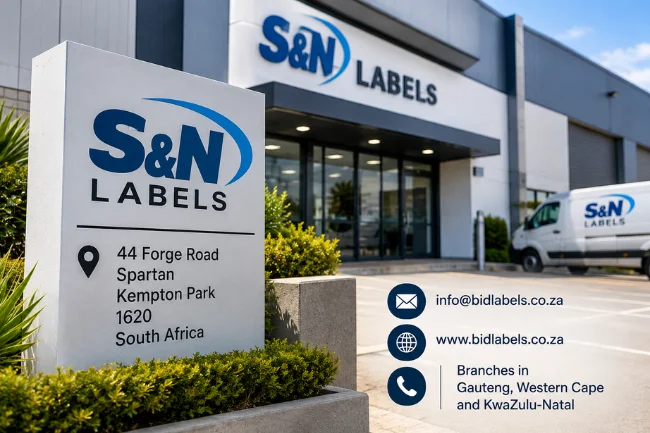
Businesses looking for the original S&N Labels operation can now contact Bidvest Labels through its official channels.
The current Gauteng branch is listed at 44 Forge Road, Spartan, Kempton Park, 1620, South Africa.
The company also lists branches in the Western Cape and KwaZulu-Natal.
Its central email address is info@bidlabels.co.za, and its official website is www.bidlabels.co.za.
For a useful quotation, I suggest providing label dimensions, estimated quantities, substrate preferences, application conditions, artwork files, and printer details.
Buyers should confirm current availability, delivery arrangements, and technical specifications directly with the supplier.
Final Thoughts
S&N Labels has contributed to commercial labelling through its range of adhesive materials, barcode solutions, thermal transfer ribbons, and printing technologies.
Its integration into Bidvest Labels has placed that expertise within a broader South African labelling business.
For anyone selecting a labelling solution, my advice is straightforward: prioritise compatibility, durability, and readability before price or appearance.
Start by identifying your application requirements, request suitable samples, and contact the supplier for a specification-based quotation.
Frequently Asked Questions About S&N Labels
1. What is S&N Labels?
S&N Labels is a South African commercial labelling business known for self-adhesive labels, barcode supplies, thermal transfer ribbons, and printing equipment.
2. Is S&N Labels part of Bidvest Labels?
Yes. S&N Labels was brought together with Rotolabel and Spec Systems under the Bidvest Labels brand in 2025.
3. What industries use S&N Labels products?
Its labelling solutions serve retail, food and beverage, healthcare, logistics, manufacturing, and industrial businesses.
4. Does S&N Labels provide custom barcode labels?
Yes. Its product offering has included custom barcode labels, variable data printing, and compatible thermal labelling solutions.
5. Where is S&N Labels located?
Its established Gauteng operation is located at 44 Forge Road, Spartan, Kempton Park, South Africa, now listed as a Bidvest Labels branch.

Ethan Caldwell is a business research writer with 9+ years of experience covering entrepreneurship, market trends, business strategies, and industry insights. He focuses on creating clear, data-informed articles that help readers understand modern business concepts.