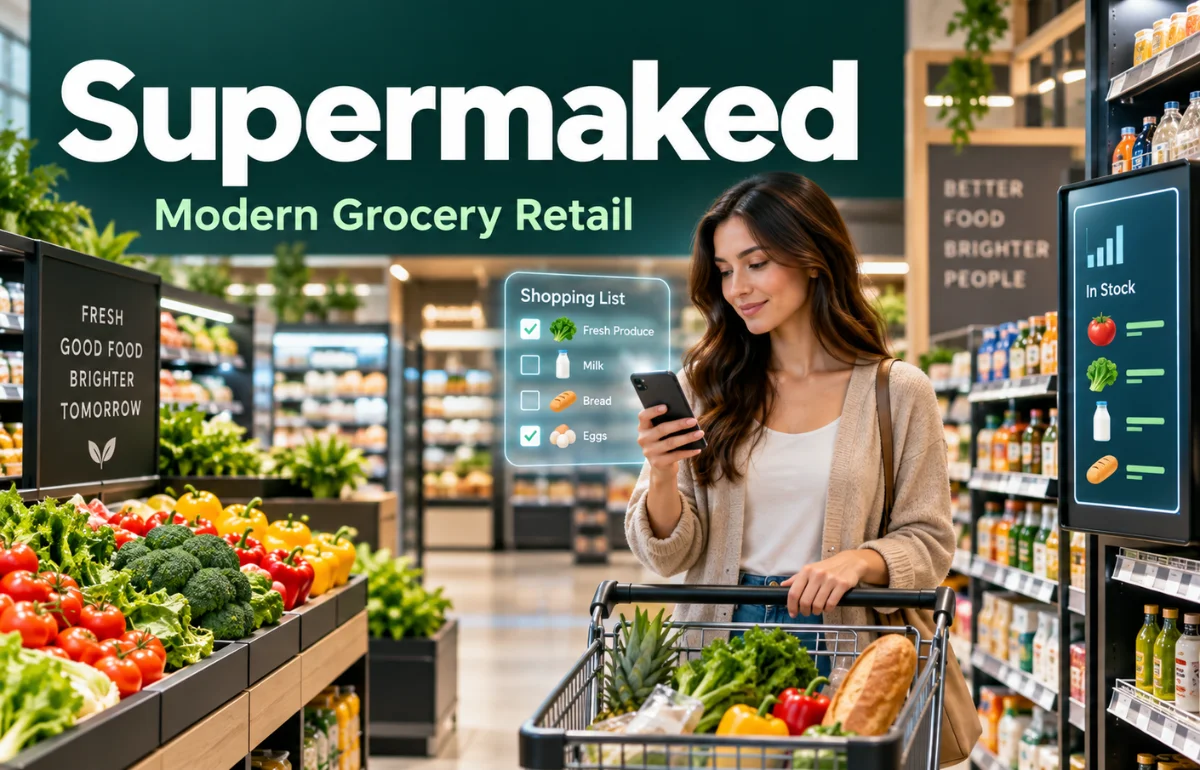
Supermaked is a term used to describe a modern grocery-retail model that combines organized physical stores, digital shopping tools, accurate inventory tracking, faster checkout, and flexible delivery or pickup options. In plain language, the goal is to make grocery shopping easier to plan, quicker to complete, and more reliable for both shoppers and retailers.
There is an important distinction behind the keyword. Supermaked is not clearly established as one verified supermarket chain, mobile app, or software company. The available public explanation presents it as a retail concept rather than a confirmed brand with a named owner, headquarters, or official launch. I therefore treat Supermaked as a model of modern grocery retail, not as a specific service that shoppers can automatically download or visit.
When I reviewed the term, I could not honestly describe a store visit or app test because no verified service was identified.
That distinction prevents invented company details and helps readers compare the concept with online grocery stores, curbside pickup, delivery marketplaces, and supermarkets using digital inventory.
What does Supermaked mean?
Supermaked refers to a connected approach to grocery shopping. It brings together the physical store, the customer’s digital experience, and the retailer’s internal operations.
A traditional supermarket may focus mainly on stocking products and serving people who walk through its aisles. A Supermaked-style operation goes further. It may let customers browse products before visiting, create a shopping list, check whether an item is available, choose delivery or pickup, and move through checkout with less waiting.
Behind the scenes, the retailer uses better inventory data and demand information to keep popular products available. Staff can spend less time on repetitive stock checks and more time helping customers, handling orders, and solving problems.
The term should not be confused with a guarantee that every modern feature is available in one location. Some descriptions of Supermaked mention possible tools rather than confirmed products. That is why I would describe it as a framework for smarter grocery retail instead of promising that every Supermaked-style store has the same technology.
How does Supermaked work?
I find it easiest to understand Supermaked through three connected layers. Each layer supports the others; a digital shopping list is not very useful if the inventory data is wrong, and an organized store cannot fully solve long checkout queues on its own.
The customer experience
A typical Supermaked-style visit may begin before the shopper enters the store. The customer checks a product online, adds items to a digital list, and looks for an available pickup or delivery window. If the shopper chooses to visit in person, clear categories and shelf labels reduce the time spent searching.
At checkout, contactless payments or other faster payment options can reduce queues. After the purchase, a digital receipt may make it easier to keep a record without using paper.
These features are not valuable simply because they are digital. They are valuable when they remove friction. If the inventory says an item is available but the shelf is empty, the technology has created frustration rather than convenience.
The retailer’s side
The retailer needs a connected view of products, sales, orders, and stock movement. When a product sells quickly, the system should help staff identify the shortage and replenish it. When demand falls, better data can prevent the store from ordering too much stock.
This is especially useful for products with limited shelf life. Accurate demand planning can reduce unnecessary waste, although the size of that benefit depends on the quality of the retailer’s data and processes.
Main features of Supermaked
Organized store layout
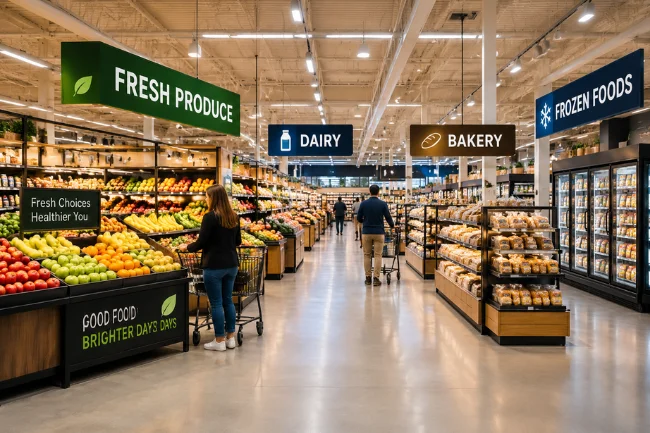
A well-organized store places related products in logical sections and uses clear signs to guide shoppers. This sounds basic, but layout has a direct effect on the time and effort required to complete a purchase.
The best layout helps customers compare similar items and find everyday essentials without confusing or poorly labeled aisles.
Digital product browsing
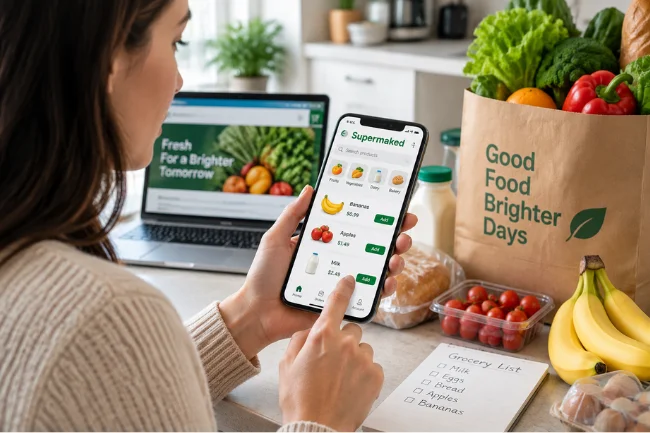
Digital browsing allows customers to review products before reaching the store. Useful information may include price, size, ingredients, brand, current availability, and possible substitutes.
A digital shopping list can also help shoppers stay focused. For families, busy professionals, or people buying a large number of items, the ability to prepare a list in advance can make the visit more predictable.
Real-time inventory management
Inventory management is one of the most important parts of the model. Retailers need to know what has arrived, what has sold, what has been reserved for pickup, and what is no longer available.
More accurate stock information can reduce empty shelves and prevent customers from making unnecessary trips. It can also help staff reorder popular products before they run out.
The phrase “real-time” should be treated carefully. Stock data is only as accurate as the systems and staff updates behind it. A product can be sold, damaged, misplaced, or reserved before the central system reflects the change.
Faster checkout
Long checkout lines are one of the clearest sources of shopping frustration. Supermaked-style retail may use contactless payments, self-checkout, mobile payment, or better queue management to shorten the process.
Faster checkout does not mean that every store should remove staffed lanes. Many shoppers still need assistance, prefer human service, or have accessibility needs that make some automated systems difficult to use.
Flexible delivery and pickup
The concept may include several purchasing options:
- In-store shopping
- Online ordering
- Home delivery
- Same-day delivery
- Curbside pickup
- Scheduled collection
Flexibility is useful, but convenience can come with delivery fees, minimum order requirements, limited time slots, or product substitutions. A strong service should show those conditions clearly before the shopper pays.
Customer-focused service
Technology should support service rather than become an excuse to remove it. Helpful employees still matter when a customer cannot find an item, needs a substitute, has a delivery problem, or wants advice about a product.
In my view, the strongest version of Supermaked combines efficient systems with accessible human support. Automation can handle repetitive tasks, but it cannot replace judgment in every situation.
Benefits of Supermaked for shoppers
The main customer benefit is reduced friction. Shoppers may spend less time searching, waiting, and checking whether a product is available.
The model can also make grocery planning easier. A customer may compare products at home, create a list, select pickup, and avoid an unnecessary store visit. For someone with limited mobility, a reliable delivery option may be more than a convenience; it may determine whether grocery shopping is manageable at all.
Better stock information can prevent disappointment, but only when the information is updated accurately. A digital “in stock” label is not an absolute guarantee that the item will still be available when the shopper arrives.
Digital receipts and order histories can also help shoppers track spending. That benefit becomes more useful when the platform shows substitutions, refunds, delivery charges, and discounts clearly instead of hiding them in a final total.
Benefits of Supermaked for retailers
Retailers can gain better visibility into what customers buy, when demand changes, and which products require faster replenishment.
That information can support better purchasing decisions. A store may reduce over-ordering, plan promotions more carefully, and identify items that frequently go out of stock. It may also improve staff scheduling by showing when the store is busiest or when online orders require additional preparation.
Operational efficiency is another potential benefit, but it is not automatic. A retailer may need new hardware, software integrations, staff training, and ongoing maintenance. A poorly implemented system can increase work instead of reducing it.
Supermaked compared with other grocery models
Supermaked is best understood as an operating model that can include both physical and digital retail. It is not necessarily a completely separate category.
The difference is integration. A traditional supermarket may offer one or two digital services without connecting them well. A Supermaked-style operation aims to make the entire shopping journey feel connected, from product search to fulfillment and customer support.
Technology, data, and privacy
A Supermaked-style system may depend on point-of-sale software, barcode scanning, inventory databases, order-management tools, digital payment systems, and customer accounts. Larger retailers may also use demand forecasting, warehouse automation, or RFID-based tracking.
Those tools create useful data, but they also create responsibility. Customers may share names, addresses, payment information, order histories, shopping preferences, and location data. Retailers need strong access controls, secure payment processing, sensible data retention, and clear privacy policies.
A convenient shopping experience is not successful if customers cannot understand how their information is used. I would look for straightforward explanations of account security, marketing permissions, delivery tracking, refunds, and data deletion.
Accessibility deserves equal attention. Digital shopping tools should work with screen readers, offer readable text, support keyboard navigation, and provide alternatives for customers who cannot use self-checkout or smartphone-only services.
Sustainability and waste reduction
Supermaked is often associated with more sustainable retail operations because better stock planning may reduce food waste. Digital receipts can reduce paper use, while efficient lighting, cooling, and delivery planning may lower resource consumption.
These benefits are possible, not guaranteed. Home delivery can create additional packaging and transport emissions. A customer who makes several small delivery orders may create more impact than someone who combines purchases into one trip.
For that reason, a credible sustainability claim should include evidence. Retailers should explain how they measure food waste, packaging, energy use, delivery efficiency, and unsold inventory rather than using sustainability as a vague marketing label.
Challenges and limitations
The biggest challenge is system reliability. If a website, payment tool, inventory database, or delivery system fails, the customer experience can break down quickly.
Employee training is another requirement. Staff need to understand how to update stock, prepare online orders, handle substitutions, and help customers who are unfamiliar with digital tools.
Privacy and cybersecurity risks increase as more shopping activity moves online. Retailers must protect payment information and customer accounts while also preparing for fraud, phishing, and unauthorized access.
Cost can be a barrier for smaller retailers. A connected retail model may require point-of-sale upgrades, inventory software, handheld scanners, website development, delivery partnerships, and ongoing technical support.
There is also a human risk: too much automation can make shopping feel impersonal. Customers still need clear answers, fair refunds, accessible support, and a real person when an order goes wrong.
What Supermaked is not
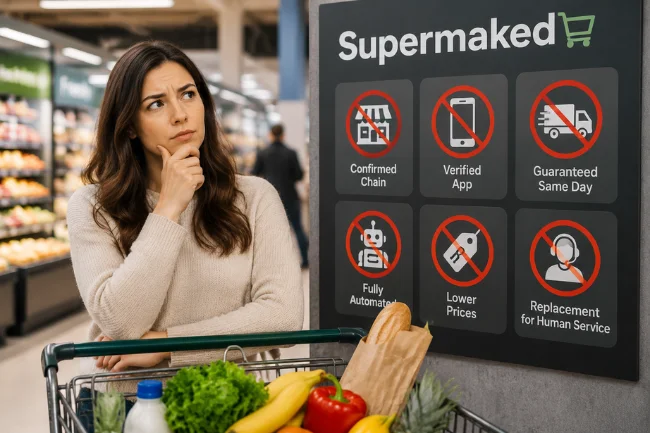
Supermaked should not automatically be treated as:
- A confirmed supermarket chain
- A verified mobile application
- A guaranteed same-day delivery service
- A fully automated store
- A promise of lower prices
- A replacement for human customer service
The term describes a collection of retail practices. The actual features, quality, pricing, and availability would depend on the specific store or platform using the model.
How to evaluate a Supermaked-style service
Before using any service described with this kind of modern-retail language, I would check six things.
First, confirm the operator. Look for an official website, business address, support contact, and clear ownership information. Do not rely on a polished landing page alone.
Second, check the total cost. Compare product prices, delivery charges, service fees, minimum orders, memberships, tips, and substitution policies.
Third, test inventory accuracy with a small order. A platform that repeatedly lists unavailable products will waste time even if its interface looks modern.
Fourth, read the privacy policy before saving payment details or granting location access. The convenience of a digital shopping list is not worth unclear data practices.
Fifth, examine customer support. Look for a clear refund process, a reachable support channel, and a policy for missing, damaged, or substituted items.
Finally, check accessibility and alternatives. A service should not force every customer into one app, one payment method, or one form of checkout.
The future of Supermaked
The broader direction behind Supermaked is clear: grocery retail is becoming more connected. Customers expect accurate product information, convenient fulfillment, faster payment, and a smooth relationship between online and in-store shopping.
Future systems may use better demand forecasting, smarter recommendations, more accurate substitutions, automated fulfillment, and personalized promotions. Artificial intelligence may support these functions, but the useful question is whether the tool improves accuracy, fairness, affordability, and customer control.
The strongest retailers will probably be the ones that combine digital convenience with dependable physical operations. A clever app cannot compensate for poor product quality, inaccurate stock, late orders, or unhelpful support.
Frequently asked questions
Is Supermaked a real company?
Supermaked is currently better understood as a modern grocery-retail concept. The term does not, by itself, confirm a specific company, chain, app, or official service.
What are the main features of Supermaked?
Common features include organized stores, digital product browsing, real-time inventory, faster checkout, delivery, curbside pickup, and customer-focused support.
Does Supermaked offer online grocery shopping?
The concept can include online browsing, digital shopping lists, home delivery, and pickup, but the exact services depend on the retailer using the model.
How does Supermaked help retailers?
It can improve inventory visibility, demand planning, order management, replenishment, productivity, and customer satisfaction when the systems are implemented properly.
Is Supermaked cheaper than a traditional supermarket?
Not necessarily. Digital convenience may involve delivery fees, service charges, memberships, or higher online prices, so shoppers should compare the complete cost.
Final take
Supermaked is best viewed as a blueprint for connected grocery retail. It brings together organized stores, digital planning, reliable inventory information, flexible fulfillment, faster checkout, and human support.
The concept has real potential, but the name alone does not prove that a verified company or app exists. If you are researching a specific service, confirm its operator, location, pricing, privacy practices, and customer-support process before trusting it with payment or personal information.
For retailers, the next useful step is to identify the biggest source of customer friction—stockouts, queues, poor delivery, confusing layouts, or weak support—and improve that area first. Modern retail works when technology quietly makes shopping easier, not when technology becomes the product.

Ethan Caldwell is a business research writer with 9+ years of experience covering entrepreneurship, market trends, business strategies, and industry insights. He focuses on creating clear, data-informed articles that help readers understand modern business concepts.