Pasonet is a name used in different contexts, including the PASONET.org publishing website, a business called PASONET Technologies, and a communication setting in PASO audio equipment. Its meaning depends on where you encounter it. The sources I reviewed do not establish Pasonet as one universal internet service, app, or networking standard. To identify it correctly, check the website address, company name, or equipment model attached to the term.
When I researched this keyword, the useful discovery was how easily those separate references could be blended into one misleading description. A reader looking for articles needs a different answer from someone configuring an audio device.
Here, I explain the documented uses, the similarly spelled terms, and the practical checks that help you reach the right destination.
Why Pasonet Needs a Contextual Definition
An unfamiliar name can look more technical than it really is. Add “net” to a word, and it becomes tempting to assume that it describes an internet network, a cloud platform, or a connectivity service.
I avoid making that jump. A name tells me what to investigate; it does not prove what a product does.
For this article, I separate three kinds of evidence: what a website visibly offers, what a business says about its services, and what a manufacturer documents for a particular device. Each answers a different question.
That distinction also explains why searching only for “Pasonet features” can be frustrating. Before comparing features, you need to know whose features you are comparing.
A Quick Comparison of the Documented Uses
| Reference | What the evidence shows | Best next action |
|---|---|---|
| PASONET.org | A website publishing articles across several categories | Check the relevant article and its sources |
| PASONET Technologies at pasototal.com | A business website advertising technology and related services | Confirm the provider and request a specific proposal |
| PASONET SETUP in the SOURCE1000 manual | Settings for a device’s RS485 communication bus | Use the manual for the exact equipment model |
These references establish different uses of the name. They do not, by themselves, establish common ownership or a shared technology platform.
Pasonet as a Publishing Website
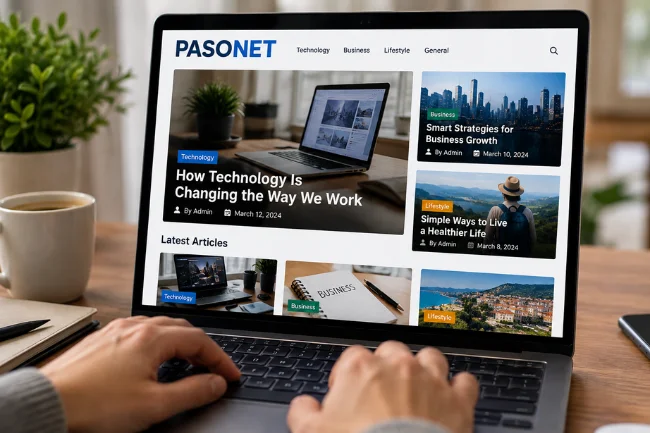
PASONET.org presents article categories including technology, business, lifestyle, and general blog content. Its public homepage resembles a digital publication, with headlines, author labels, dates, and article links.
My interpretation is that readers should initially approach it as an information source. Calling it a collaboration application would require additional evidence, such as documented workspaces, account controls, or shared project tools.
What Readers Should Look For
If you arrive through a search result, evaluate the individual article. Does it answer your question directly? Does the writer cite a manufacturer, original research, or another source that actually supports the explanation?
A clear headline is useful, but the evidence inside the page matters more. For a software article, I want the product version and relevant documentation. For a comparison, I want the criteria behind the recommendation.
I also check whether the publication date matches the information being discussed. An updated date alone does not tell me which claims were checked or changed.
What a Broad Site Description Does Not Prove
The site describes itself using language about learning, collaboration, and growth. That describes an ambition; it does not demonstrate a particular software feature.
For example, publishing educational content and providing an interactive learning platform are different activities. The second would need evidence of courses, progress tracking, assessments, or another defined learning experience.
This is where I draw the line between a useful interpretation and an unsupported promise. Readers should not have to create an account to discover that the service they expected was never documented.
Pasonet Technologies as a Business Name
The website at pasototal.com identifies PASONET Technologies and advertises cloud computing, cybersecurity, software development, and IT consulting. It also lists service areas such as revenue cycle management, medical billing, and medical transcription. These are the provider’s own descriptions, rather than independent verification of its performance.
If your search started with a quotation, job advertisement, or business introduction, this may be the context you need. The relevant question becomes whether the provider can deliver your specific requirement.
How I Would Assess a Service Offer
I would begin with a concrete outcome. For a development project, that might mean an application with defined functions, a delivery schedule, and clear ownership of the source code.
Then I would ask who performs the work, how progress is reviewed, and what support remains after delivery. A general services page cannot answer those project-specific questions.
For a proposed cloud migration, I would want a written plan for access, backups, testing, and rollback. For an ongoing support arrangement, I would ask what incidents are covered and how response times are measured.
Those are examples of questions to ask any provider. They are not claims that this business already supplies those arrangements.
Keep Business Identity Separate From Branding
I noticed that the reviewed homepage includes KAT-TECH wording alongside PASONET Technologies branding. That inconsistency warrants clarification before relying on the site to identify a contracting party. It does not establish misconduct. [Source: 2]
A useful next move is to request the exact legal business name and confirm that it matches the proposal, invoice, and agreement. If those documents name different entities, ask how they relate.
I would apply the same approach to an internship or recruitment offer. Confirm the employer through independently located contact details before treating a familiar-looking brand name as proof of authenticity.
PASONET in PASO Audio Equipment
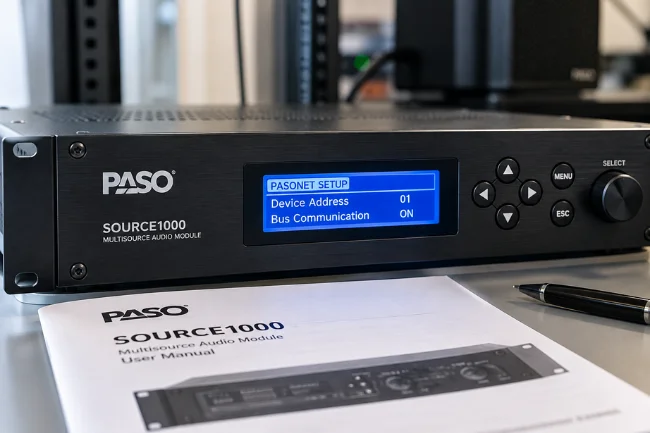
There is also a specific technical use. The PASO SOURCE1000 manual includes a PASONET SETUP menu for its RS485 bus. It lets the user set a device address and enable or disable bus communication.
PASO’s product page identifies SOURCE1000 as a multisource audio module. This places the term in sound-system equipment rather than a general consumer internet service.
A Detail Worth Understanding: Addresses Versus Capacity
The reviewed manual offers device addresses from ID 1 through ID 60, while its connection section specifies a maximum of 32 SOURCE1000 modules per RS485 port. These describe different limits: selectable identifiers and connected-device capacity. An address range should not be read as permission to connect that many modules.
For troubleshooting, I would record the equipment model, current settings, and installation layout before making changes. Those details give technical support something useful to investigate and reduce the chance of changing an unrelated setting.
The lesson extends beyond this product: when a familiar-looking term appears inside a configuration menu, the surrounding manual is usually more useful than a broad keyword definition.
Is Pasonet the Same as PisoNet or PESONet?
The spellings are close enough to confuse a search, but the documented meanings are different. I would check the original spelling before following instructions intended for another service.
PisoNet: Coin-Operated Internet Access
PisoNet is associated with coin-operated computer and internet access in the Philippines. Reporting from Rest of World describes machines where inserting coins buys short periods of computer use.
That is a different context from a publishing website or an audio-device setting. If your question mentions a coin slot, a timed session, or a neighborhood computer kiosk, search for PisoNet alongside those details.
For a local access problem, the operator’s instructions are the useful starting point. A general article cannot establish the correct login address, session controls, or rates for every installation.
PESONet: Electronic Fund Transfers
PESONet is a Philippine electronic fund transfer system. The Bangko Sentral ng Pilipinas describes it as a batch EFT crediting system that facilitates transfers between accounts at supervised financial institutions.
If you encountered the word while sending money, check the spelling inside your bank’s official application or documentation. A result about Pasonet would not explain the payment service you are using.
Comparing the Similar Names
| Term | Relevant context | Clues in your original question |
|---|---|---|
| Pasonet | A website, business name, or equipment-specific label | Domain name, service proposal, or SOURCE1000 menu |
| PisoNet | Coin-operated computer or internet access | Coins, timed access, computer kiosks |
| PESONet | Philippine electronic fund transfers | Bank accounts, transfer instructions, payments |
This comparison is a way to identify the topic, not evidence that the names are connected.
How to Identify the Pasonet You Actually Need
My preferred approach starts with the place where you first saw the word. That original context often resolves the ambiguity faster than reading several broad explanations.
Start With the Original Reference
Save the full website address, message, document title, or device label. A screenshot can help preserve the wording, but include enough surrounding information to identify what is being discussed.
For example, “Pasonet login” is an incomplete request. “The login link supplied by this employer on this domain” gives you an identifiable page and an organization to verify.
Likewise, “PASONET SETUP on a SOURCE1000” points toward product documentation. The equipment model is the useful part of the search.
Add One Distinguishing Search Term
I would pair the keyword with the strongest clue available: the exact domain, company name, model number, or task. That might mean searching for an article title, a named service, or a manual section.
Avoid adding assumed features too early. Searching for “Pasonet cloud storage pricing,” for instance, builds in the assumption that a cloud storage product exists. First locate a documented product page; then investigate its pricing.
Match the Evidence to Your Decision
Different decisions need different evidence. Reading an article requires checking its claims and sources. Hiring a provider requires confirming deliverables and business identity. Configuring equipment requires model-specific instructions.
Suppose a business owner wants a customer portal. A provider’s statement that it develops software is a starting point, but the owner still needs a demonstration or proposal addressing that portal’s requirements.
Now suppose a technician sees the name on an audio module. A polished business website would offer little help. The relevant evidence is the equipment documentation and installation record.
These hypothetical examples show why there is no useful universal onboarding process for every reference called Pasonet.
What Can You Verify About Features, Pricing, and Access?
Questions about cost and registration become answerable only after identifying the relevant website, business, or product. I would not publish a universal claim that “Pasonet is free” or “Pasonet requires a subscription.”
Instead, I would connect each claim to an observable action or a specific document.
Features Need More Than Descriptive Language
If a page promises collaboration, look for an explanation of what users can actually do together. If it mentions analytics, ask which data is measured and what the output looks like.
The same applies to integrations, mobile access, and account management. A feature description should help you understand the function, its limits, and any conditions required to use it.
I find a small, working demonstration more informative than a long list of broad benefits. It gives a reader or prospective customer something concrete to assess.
Pricing Should Match the Scope
For any quoted service, establish what the price covers. Setup, ongoing support, third-party subscriptions, and future changes may need separate treatment in the agreement.
As a hypothetical example, two software proposals can have the same initial price but include different support periods. Comparing the headline amounts alone would miss a meaningful difference.
For equipment, the question may involve hardware and installation rather than a subscription. The context determines what costs you should ask about.
A Login Page Does Not Establish an Affiliation
If someone sends you a Pasonet login link, confirm the exact address through the organization you intended to contact. Similar spelling or a matching logo is not enough to connect two domains.
My practical rule is to verify the destination before entering credentials, especially when the link arrived unexpectedly. If the connection between the page and the organization is unclear, obtain clarification through an independently verified contact channel.
How I Judge the Reliability of a Pasonet Explanation
While researching, I found that the strongest answers were the ones attached to identifiable evidence. A manufacturer’s menu description establishes a device function. A company website establishes what that company advertises. Neither answers every question about the name.
I also noticed example.com links and inconsistent newsletter branding on the reviewed PASONET.org contact page. These are observable publishing-quality issues. They justify checking links and claims carefully, but they do not prove that every article is inaccurate. [Source: 7]
My assessment rests on three questions:
- Does the explanation identify the exact website, business, or product?
- Does its source support the particular claim being made?
- Does it distinguish documented facts from interpretation?
An explanation that passes those checks helps you act. One that merely promises efficiency, connectivity, and growth may leave you with the same unanswered question you started with.
Choose the Right Reference Before Your Next Move
Pasonet makes sense once you connect the name to its original context. I would begin with the exact URL, business identity, or equipment model, then use evidence suited to the task.
Your next move is straightforward: return to where you first encountered the term and capture that identifying detail. It will help you find the right article, ask the right provider questions, or open the correct manual.
Frequently Asked Questions
What is Pasonet?
Pasonet is a context-dependent name used by a publishing website, a technology business, and a setting documented for PASO audio equipment.
What is Pasonet used for?
Its use depends on the reference: reading online content, finding advertised business services, or configuring communication settings on specific equipment.
Is Pasonet free to use?
There is no universal pricing answer. Identify the exact website, service, or product, then check its access terms or request a quotation.
Is Pasonet safe?
The name alone cannot establish safety. Verify the exact destination, operator, and requested action before sharing information or entering credentials.
Is Pasonet the same as PisoNet?
No. PisoNet refers to coin-operated computer or internet access in the Philippines; Pasonet has separate documented uses.

Noah Sterling is a technology research writer with 8+ years of experience covering emerging technologies, software trends, digital tools, and innovation. He creates practical, research-based articles to help readers understand the evolving technology landscape.