Kracensoft.com is an online publication about software and technology. It publishes articles on apps, programming, WordPress, Windows tools, artificial intelligence, and related digital topics. You can browse it like a blog: choose a category, open a story, and read an explanation or guide.
Despite the word “soft” in its name, the public-facing site is not presented as a single app you install or a subscription software platform you must join. If you found the domain while researching a product or trying to solve a computer problem, the useful question is whether its particular article gives you enough accurate, current information to act on.
I examined the site’s publicly indexed categories, author profile, contact listing, and article listings in October 2026. I did not submit its contact form or install software. Here is what readers can expect, what remains uncertain, and how I would use the site.
What kind of site is Kracensoft.com?
The simplest description is a technology blog or digital magazine. Its own homepage describes a place for tech insights, reviews, and updates. The categories include App, Programming, WordPress, All Software, Windows Tools, and Other. Its pages display article titles, an author name, and dates, and readers can move through category archives.
The name can produce different expectations. Someone may think “Kracen Soft” develops a program or offers a Windows download. I found evidence of a publication, not a clearly advertised flagship product, app store, account dashboard, or software pricing page. A post about another company’s tool does not make Kracensoft.com its seller or support provider.
The site’s scope is also wider than its name suggests. Alongside conventional software news, the author archive shows pieces about AI glasses and online entertainment. Indexed articles include subjects as varied as B2B contact lists and headshot photographers in San Antonio. I would therefore read the site as a broad publication with a technology center of gravity, rather than assume every page is written for developers.
| What you may be looking for | What the site appears to provide | Where to go for a final answer |
|---|---|---|
| An explanation of an app or software trend | Articles, reviews, and news summaries | The product maker’s current documentation for specifications |
| Help with a Windows or WordPress task | Guides and background reading | Microsoft or WordPress documentation for critical changes |
| A Kracensoft product to download | No clear flagship download or software catalog established by the pages I reviewed | The site’s own product or contact pages, if a specific offer appears |
| A service quote or corporate credentials | An author profile and contact page, but limited public company detail | Ask the operator directly and verify any business claim separately |
What does it publish?
Software and app coverage
The All Software and App sections are natural starting points if you are comparing programs or keeping up with releases. App listings I reviewed included stories about ChatGPT Voice, Google Translate, an internet radio app called Farwave, an iOS calendar-alarm utility, and messaging apps. These examples show that “app coverage” means both product-specific articles and reporting on changes to larger platforms.
An article can help you learn the vocabulary before visiting a vendor’s site. It may explain what a feature is meant to do, who might benefit, or what changed in a release. For a buying decision, I would still check the vendor’s present-day price, supported devices, trial conditions, refund policy, and privacy terms. Those details can change long after a review is published.
Programming, AI, and platform news
Programming coverage reaches beyond coding tutorials. The archive includes security and software-industry stories, while the broader site discusses AI tools, automation, cloud services, and digital products. That mix suits a curious reader who wants a plain-language orientation, but it also means a highly technical claim deserves its own source check.
Consider a story about a security patch. The title and summary may tell you that an update exists; they cannot by themselves tell you whether your particular device is affected. For that, I would look up the vendor’s advisory, exact software version, release date, and recommended action. The same rule applies to AI launches: distinguish an announced feature from one currently available in your country, account tier, or device.
WordPress and Windows topics
The site has dedicated WordPress and Windows Tools categories. The former is relevant to site owners researching plugins, development, or platform changes. The latter is useful for people looking into desktop utilities, updates, repair, and everyday computer problems.
These are areas where a readable article is helpful but where a wrong instruction can cost time. Before changing a setting, replacing a system file, or installing a plugin, I check the publication date, the software version mentioned, and whether the instruction matches the current interface. For WordPress security updates, official release notes and plugin pages are stronger evidence than an undated roundup. For Windows troubleshooting, Microsoft’s documentation and a backup are sensible companions to any third-party guide.
The broader “Other” section
The Other category is worth a look because it reveals the site’s actual editorial boundaries. The author archive lists pieces on anonymous VPS hosting, AI in classrooms, AR and VR glasses, basketball puzzles, and interactive entertainment. Other indexed pages reach into online business and personal topics.
I see that breadth as a navigation cue. But it does not establish expertise in every field. If a piece moves into legal, financial, medical, or security-sensitive advice, I would demand specific sourcing and relevant qualifications before relying on it.
Who writes for the site, and how much can you verify?
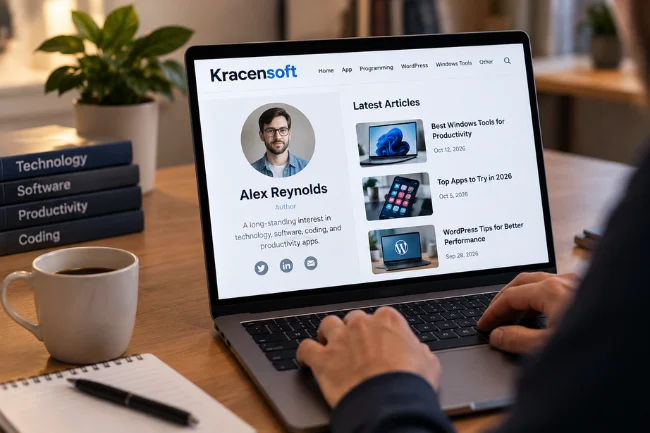
The public author page identifies Alex Reynolds as the face behind KracenSoft. Its biography describes a long-standing interest in technology, software, coding, and productivity apps. The archive attaches that name to many posts and shows dated entries. Those are useful accountability signals: a reader has a name and a body of work to inspect.
They do not settle every identity question. An author biography is a statement made on a website; it is not independent confirmation of legal ownership, professional credentials, or hands-on testing for each review. I did not find a clearly established corporate entity or a transparent testing policy in the pages available to me. I would avoid describing the site as a registered software company without documentation.
The contact page gives visitors a way to reach the site. I did not submit a message, so I cannot speak to response times. If you are considering a business arrangement, ask for the legal business name, the person responsible for the work, a written scope, and an invoice or agreement. A working contact form is a starting point for a conversation, not a substitute for those details.
Is Kracensoft.com legitimate and safe to use?
“Legitimate” can mean several things. Does the domain exist and publish readable content? Yes: its indexed category and author pages show an active publication, including entries dated in September 2026. Does that prove every claim is correct, every link is safe, or every possible business offer is trustworthy? No. Those require separate evidence.
A third-party domain record reports registration on April 12, 2024, with Hosting Ukraine LLC as registrar, and detects HTTPS. That is useful background, not a quality score. Domain age does not verify authorship. HTTPS encrypts a browser connection; it does not certify the accuracy of an article or the safety of an unrelated file linked from it. Registration details can change, so I would use ICANN’s current lookup if the date or registrar is material to a decision.
For ordinary reading, I would treat the site as I treat other independent publications: browse the articles, inspect their sources, and keep my browser updated. I would be more cautious at the point where reading becomes an action. A link asking for a login, payment, browser extension, executable file, or personal information creates a new decision involving another page or service. Confirm the destination domain and use the provider’s official site when possible.
| Reader action | What the page can tell you | Extra check I would make |
|---|---|---|
| Read a technology explainer | Terminology and a general overview | Compare consequential claims with a primary source |
| Follow a setup or repair guide | A possible route to solve the problem | Match steps to your device and current software version; back up first |
| Buy a product mentioned in a review | Possible features and drawbacks | Confirm live pricing, compatibility, and seller identity |
| Submit a contact form | A channel for reaching the publisher | Read the current privacy policy; share only what is necessary |
| Download something linked in an article | A route to a third-party file or site | Verify the publisher, URL, file origin, and digital signature where available |
Privacy deserves its own check
The site’s indexed footer shows links to a Privacy Policy and Cookie Policy, as well as a cookie notice. Their presence is a positive sign of basic disclosure, but I would read the current policy before sending information. In particular, look for what the form collects, why it is collected, whether analytics or advertising partners receive data, and how to request deletion or contact the operator.
There is rarely a reason to put a password, recovery code, payment card number, or confidential work file into a general inquiry. If a reply later asks you to move to another site or messaging channel, verify that it actually came from the operator before proceeding.
Is it free, and is it a software company?
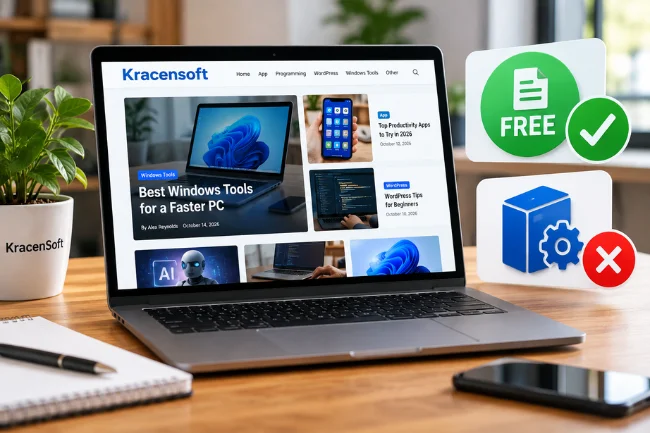
The public article and category pages I examined can be read as normal web pages. I found no clear evidence that a reader needs an account or paid membership for ordinary articles. That is a narrower statement than claiming every service connected with the domain is free; a new offering or a third-party link could have its own terms.
Likewise, the available pages support “publication” much more strongly than “software company.” The author profile calls KracenSoft a hub for software and applications, but that describes its subject matter as well as its brand. If you see a specific claim that it develops an app, offers consulting, or sells a subscription, judge that offer on its own published terms rather than inferring it from the domain name.
This distinction can save you a frustrating search. If you need support for a program discussed in one of its posts, go to that program’s developer. If you want to ask about the article itself, use the publication’s contact page. Those are two different conversations.
How I decide whether a particular article is worth trusting
I would not give an entire domain one permanent pass-or-fail grade. A short news item, a product review, and a system-repair tutorial carry different risks. The fastest useful test is to open the exact page that brought you there and answer five questions.
First, what is the claim? A statement that a feature exists is easier to verify than a broad promise that a tool is “the best.” Separate reported facts from opinion, predictions, and promotional language.
Second, when was it written or updated? A guide can be well written and still describe an old interface. Look beyond the year in the title: compare the page date with the product’s latest release and check whether the body names the version it covers.
Third, where did the information come from? For release news, I look for an announcement or release note. For a comparison, I want the products tested, the criteria, and enough detail to understand a recommendation. An article without these may still introduce a topic, but it should not be the final source for a purchase or security decision.
Fourth, does it acknowledge limits? A credible guide tells you who its advice applies to and when the result may differ. Instructions that assume every reader has the same operating system, permissions, region, or subscription are easy to misapply.
Fifth, what happens if it is wrong? A mistaken description of an entertainment app is an inconvenience. A mistaken instruction about backups, passwords, investments, or vulnerabilities can be costly. As the stakes rise, I move closer to official documentation and qualified specialists.
I would use Kracensoft.com as a possible first explanation, with verification matched to the action I plan to take. A familiar-looking website does not make every article authoritative; limited company detail does not make every article worthless.
Who is likely to find it useful?
If you are an everyday user, its app news and accessible explainers may give you the basic context to ask better questions. If you run a WordPress site or troubleshoot a Windows PC, the category pages may help you discover terms and possible solutions before you consult official instructions.
Developers can skim its programming and AI coverage for subjects to investigate, while recognizing that architecture decisions and security changes need primary technical sources. Readers following consumer technology can use the site as one more publication in a wider reading mix.
The fit is weaker if you need audited research, confirmed corporate records, guaranteed compatibility, or direct support from a product maker. In those cases, the site may point you toward a topic, but it cannot replace the relevant documentation or a direct answer from the responsible organization.
Frequently asked questions
What is Kracensoft.com used for?
It is primarily used to read articles about software, apps, programming, AI, WordPress, Windows, and other digital subjects.
Is Kracensoft.com a software download site?
The pages I reviewed present it as a publication. Do not assume a product discussed there is made or distributed by the site.
Who owns Kracensoft.com?
Its author page names Alex Reynolds as the face behind KracenSoft. That does not independently establish the legal owner of the domain or a company.
Is Kracensoft.com free to read?
Its ordinary indexed articles appear publicly readable. Check any separate offer or external service for its own terms and charges.
Can I trust Kracensoft.com for technical advice?
Judge the specific article’s date, evidence, and applicability. Confirm security-sensitive instructions with the relevant developer’s official documentation.
The practical takeaway
Kracensoft.com is best understood as a broad technology publication with software at its core. I would use it to explore a topic, learn the right terms, and discover a possible solution. Before buying, downloading, changing an important setting, or sharing personal data, I would check the exact claim against the original provider. Start with the article that interests you, then follow its evidence—not just its headline.

Noah Sterling is a technology research writer with 8+ years of experience covering emerging technologies, software trends, digital tools, and innovation. He creates practical, research-based articles to help readers understand the evolving technology landscape.