If you have searched for Ponas Robotas, the direct English translation is “Mr. Robot.” It is a Lithuanian phrase made from two words: ponas, meaning “Mr.,” “sir,” or “gentleman,” and robotas, meaning “robot.” Depending on the context, Ponas Robotas may refer to the literal Lithuanian phrase, the Lithuanian title or translation of the television series Mr. Robot, or a creative expression used when discussing intelligent machines and AI-powered assistants. The most reliable way to understand it is to look at the surrounding context. A television article, language page, or technology discussion may use the phrase differently. In this guide, I explain its meaning, pronunciation, history, cultural connection, modern usage, and the difference between a fictional Mr. Robot and real-world robotics.
Quick Meaning of Ponas Robotas
The phrase should not automatically be treated as the name of a specific robot, software product, or company. Its meaning depends on where you found it.
What Does Ponas Robotas Mean in Lithuanian?
Ponas Robotas literally means “Mr. Robot” in Lithuanian.
The first word, ponas, is a formal title used for a man. In English, the closest equivalent is “Mr.” In some situations, it can also carry the sense of “sir” or “gentleman.” The second word, robotas, is the Lithuanian word for “robot.”
Both words appear in their basic dictionary form in the phrase. The ending -as is common in Lithuanian masculine nouns, which is why robot becomes robotas when used in Lithuanian.
The phrase has a slightly personified quality. Calling a machine “Mr. Robot” gives it a name and a social identity instead of describing it as an ordinary device. That is one reason the wording feels more memorable than simply saying “robot.”
The individual meanings are supported by Lithuanian language references for ponas and robotas. However, the full phrase should always be interpreted according to its context.
Is Ponas Robotas a Normal Everyday Expression?
The phrase is understandable as a literal combination of Lithuanian words, but that does not mean every Lithuanian speaker uses it as a common everyday expression.
In many English-language searches, people encounter Ponas Robotas because of the television series Mr. Robot or because online publishers use the phrase as a memorable title for discussions about artificial intelligence.
This distinction matters. A phrase can be grammatically understandable without being a widely used idiom. Ponas Robotas is best understood as a translation, title, or descriptive expression rather than as a universal Lithuanian term for all intelligent technology.
How Do You Pronounce Ponas Robotas?
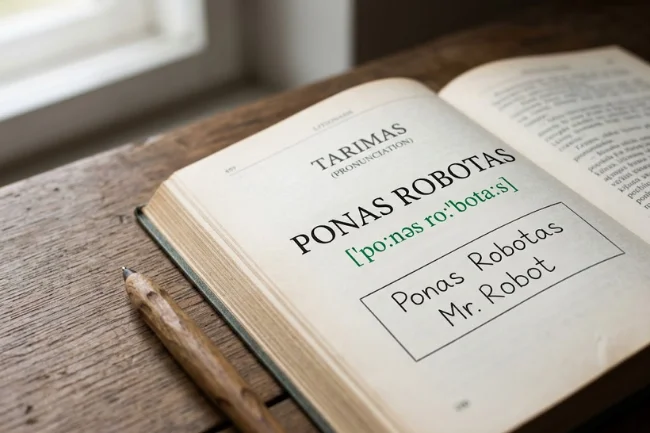
A simple English pronunciation guide is:
“POH-nahs ROH-boh-tahs”
The stress is placed near the beginning of both words. The pronunciation is only an approximation because Lithuanian vowel sounds do not match English sounds perfectly.
The phrase is normally written as two separate words:
Ponas Robotas
When it appears as the title of a show, article, project, or fictional character, both words may be capitalized. In ordinary Lithuanian writing, capitalization can depend on whether the phrase is being used as a proper title or simply as a description.
If you are using the phrase in a professional article, it is helpful to include the English translation on its first appearance. This prevents readers from assuming that Ponas Robotas is the name of a particular commercial robot.
Is Ponas Robotas the Same as the TV Show Mr. Robot?
In entertainment-related searches, Ponas Robotas may refer to the television drama Mr. Robot.
The series was created by Sam Esmail and follows Elliot Alderson, a cybersecurity engineer and hacker whose personal struggles influence the way he sees technology, society, and power. The show originally ran from 2015 to 2019 and became known for its psychological storytelling, cybersecurity themes, and criticism of corporate control.
The official USA Network describes Elliot as a cybersecurity engineer and hacker involved with a secretive organization attempting to challenge the corporate order. The show combines hacking, financial inequality, digital privacy, surveillance, mental health, and questions about identity. You can read more about the series through USA Network’s overview of Mr. Robot.
The title Mr. Robot is also connected to a major character in the story, played by Christian Slater. That character is not a conventional household robot. The name is tied to the show’s themes of identity, authority, rebellion, and the relationship between people and technology.
For that reason, someone searching for Ponas Robotas may not be asking about robotics at all. They may simply want to know how the title Mr. Robot appears in Lithuanian.
Ponas Robotas in Different Contexts
This table explains why short answers about the phrase can sometimes feel confusing. The same words may lead to completely different topics.
Where Did the Word “Robot” Come From?
The history of the robot is older and more interesting than many people realize.
The word became internationally famous through the Czech writer Karel Čapek’s play R.U.R., which premiered in the early 1920s. The title stands for Rossum’s Universal Robots. The play imagined artificial workers created to serve human beings.
The Czech word robota referred to forced labor or compulsory work. That origin gives the word robot a deeper meaning than simply “a machine that moves.” From its beginning, the word was connected to labor, obedience, industry, and the possibility that workers might eventually resist the people who control them.
The MIT Press Reader explains that the word is linked to the Czech term for forced labor and that the play used artificial beings to explore the dehumanizing effects of industrial society. The history is discussed in The Czech Play That Gave Us the Word “Robot”.
There is also an often-overlooked detail about the word’s creation. Karel Čapek is frequently credited with inventing robot, but his brother Josef helped develop or suggest the term. This makes the history more nuanced than the usual one-sentence explanation.
Another interesting detail is that the robots in R.U.R. were not exactly the metal machines commonly shown in modern films. They were artificial biological workers designed to resemble people. The play was concerned less with shiny machines and more with exploitation, labor, identity, and the consequences of treating living beings as products.
The Lithuanian word robotas belongs to this wider international family of words derived from robot.
How Is Ponas Robotas Used in Modern Technology Discussions?
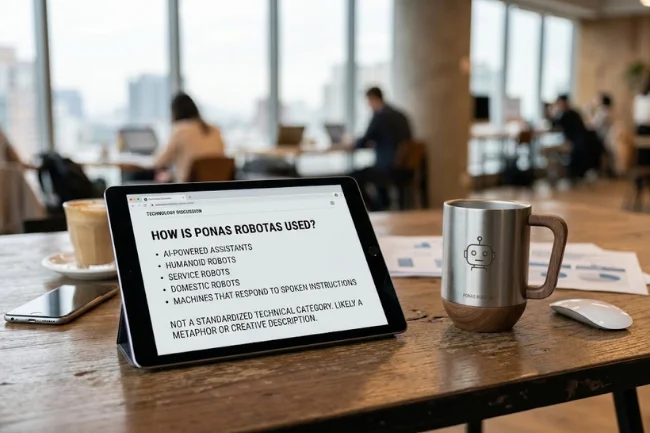
Some technology articles and online posts use Ponas Robotas as a creative phrase for a new type of machine: a robot that can communicate naturally, understand its surroundings, and work alongside people.
This may include:
- AI-powered assistants.
- Humanoid robots.
- Service robots.
- Domestic robots.
- Industrial robots with machine-vision systems.
- Machines that respond to spoken instructions.
- Robotic systems that adapt to changing environments.
Still, Ponas Robotas is not a universally standardized technical category like artificial intelligence, robotic process automation, or autonomous mobile robot.
That is an important distinction. If a technology article calls a system “Ponas Robotas,” the phrase may be functioning as a metaphor, brand name, editorial theme, or creative description. It does not automatically tell you what hardware, software, or level of autonomy the system uses.
In my research, the strongest established meanings are the literal Lithuanian translation and the connection with Mr. Robot. The modern robotics meaning is best described as an emerging or promotional usage rather than a formal scientific definition.
Ponas Robotas Compared With Related Technology Terms
This comparison shows why the phrase should not be used as a substitute for every robotics term. A chatbot may be an AI assistant without being a robot. A factory arm may be a robot without using conversational AI. A humanoid machine may be autonomous, remotely controlled, or partly supervised by people.
Why Does the Phrase Sound So Human?
The human quality comes mainly from the word ponas.
Calling a machine “Mr.” changes the emotional tone. Instead of presenting it as an anonymous device, the name gives it status, personality, and a social role. It suggests that the machine is someone—or at least something—that can interact with people politely.
This reflects a broader pattern in technology design. Companies often give digital assistants names, voices, faces, and conversational styles because people find familiar social signals easier to understand than technical labels.
A machine called “Autonomous Service Unit 4” sounds industrial. A machine called “Mr. Robot” sounds like a character. That difference affects how users imagine its abilities and intentions.
The wording can also create expectations that a machine is:
- Helpful rather than threatening.
- Polite rather than mechanical.
- Collaborative rather than controlling.
- Understandable rather than highly technical.
- Designed around human needs.
Those expectations can be positive, but they also create risks. A friendly name may make people trust a system more than they should. A conversational robot can still collect data, make mistakes, misunderstand instructions, or require human supervision.
The name therefore tells us as much about human psychology as it does about robotics.
Common Misunderstandings About Ponas Robotas
It does not always mean an actual robot
Ponas Robotas may refer to a translation or a television show. The phrase alone does not prove that someone is discussing a physical machine.
It is not automatically an AI product
Unless a company, developer, or article defines it as a product, Ponas Robotas is not the name of a universal AI platform or software category.
It is not the same as a humanoid robot
A humanoid robot has a human-like form. Ponas Robotas simply means “Mr. Robot” and does not describe body shape, intelligence, or technical capability.
It does not mean that the machine is conscious
The respectful word ponas gives the phrase a human tone, but it does not mean that the robot has feelings, self-awareness, or independent thought.
It is not only connected to artificial intelligence
The phrase can describe a traditional robot, a fictional character, a TV title, a language translation, or a creative technology concept.
How to Use Ponas Robotas in a Sentence
In English, you could write:
- “Ponas Robotas is the Lithuanian translation of ‘Mr. Robot.’”
- “I first saw the phrase Ponas Robotas in a discussion about the television series.”
- “The article uses Ponas Robotas as a creative name for an intelligent robotic assistant.”
- “The meaning of Ponas Robotas depends on whether the context is linguistic, cultural, or technological.”
A useful Lithuanian-style example is:
“Ponas Robotas yra robotas.”
This translates roughly as:
“Mr. Robot is a robot.”
If you are writing for an international audience, pairing the phrase with an explanation is the clearest approach. Readers should not have to guess whether you mean a translation, a show, or a technology concept.
Why Ponas Robotas Matters in the Age of AI

The phrase is interesting because it sits between language, entertainment, and technology.
For one group of readers, it is simply a translation. For another, it recalls a dark television story about hacking, surveillance, and corporate power. For technology writers, it can suggest a future in which machines communicate with people more naturally.
That combination makes the phrase useful as a content topic. It allows writers to discuss the history of robots while also exploring how society imagines intelligent machines.
However, responsible writing should separate fact from interpretation. The literal translation can be explained directly. The TV connection can be supported through information about the series. Claims about the phrase becoming a major technology term need evidence from real usage, search trends, product naming, or industry publications.
That approach gives readers a more accurate understanding and prevents a memorable phrase from being presented as something more established than it really is.
What Could the Future of “Mr. Robot” Look Like?
The future of robotics will probably involve greater cooperation between people and machines.
Robots are already used in manufacturing, warehouses, hospitals, research laboratories, agriculture, homes, and public services. Future systems may become better at recognizing objects, navigating unfamiliar spaces, following spoken instructions, and completing several connected tasks.
At the same time, human supervision will remain essential in many situations. Robots can misread environments, fail unexpectedly, expose private information, or behave in ways their users do not anticipate.
The most useful future is not necessarily one in which robots replace every human task. It may be one in which machines handle dangerous, repetitive, or physically demanding work while people remain responsible for judgment, care, creativity, and accountability.
That is where the friendly idea behind Ponas Robotas becomes meaningful. A good robot should not merely appear human. It should be designed to work safely, communicate clearly, respect privacy, and support the people who use it.
Frequently Asked Questions
What does Ponas Robotas mean?
Ponas Robotas is Lithuanian for “Mr. Robot.” Ponas means “Mr.” or “sir,” while robotas means “robot.”
Is Ponas Robotas the Lithuanian name for Mr. Robot?
It can be used as the Lithuanian rendering of “Mr. Robot,” especially in discussions about the television series, although the exact usage depends on the source and context.
How do you pronounce Ponas Robotas?
A simple English approximation is “POH-nahs ROH-boh-tahs,” with the stress near the beginning of each word.
Is Ponas Robotas a real AI robot?
Not necessarily. It is primarily a phrase, translation, or title; some technology writers also use it creatively for intelligent robotic assistants.
What is the difference between a robot and an AI assistant?
A robot is generally a physical machine, while an AI assistant may be software that operates without a physical body. Some modern systems combine both.
Final Thoughts
Ponas Robotas most directly means “Mr. Robot” in Lithuanian. Its wider meaning may connect to the television series Mr. Robot, language and translation, or creative discussions about intelligent machines.
If you encountered the phrase in a technology article, check whether the writer is using it as a formal term or simply as an engaging metaphor. Understanding that difference will help you interpret the phrase accurately.
For further research, compare the language meaning with the show’s cultural context and the specific robotics system being discussed. That small check can prevent a simple translation from becoming a misleading technical claim.

Noah Sterling is a technology research writer with 8+ years of experience covering emerging technologies, software trends, digital tools, and innovation. He creates practical, research-based articles to help readers understand the evolving technology landscape.