Merfez is an emerging online term with no single, universally accepted definition. In current web usage, it is most often described as a flexible idea built around simplicity, focus, intentional choices, warmth, and bringing related things into a clear center. Some writers apply Merfez to home design and creative living, while others use the word for productivity, digital systems, or branding. That variation matters: Merfez is not yet a standardized lifestyle philosophy or dictionary-defined English concept.
When I researched the term across current search results, I found something more useful than a neat one-line origin story: the internet is actively shaping its meaning. That makes Merfez interesting, but it also means readers should separate documented facts from interpretations that newer websites have repeated.
What Does Merfez Mean?
The simplest way I would explain Merfez is this: it describes a preference for creating a clear center around what matters and removing unnecessary friction, clutter, or noise.
In lifestyle and design writing, that often translates into intentional spaces, meaningful objects, focused creative work, natural materials, and fewer distractions. In productivity or digital contexts, the same idea may be expressed as centralization, organization, or simplifying a complicated system.
The key distinction is that these are emerging uses, not a formal definition backed by a widely recognized dictionary or academic framework. Current websites define Merfez differently, which suggests that the term is still fluid rather than settled.
Is Merfez a Real Word?
Merfez is certainly a real search term and a name that appears on active websites, but that is different from being an established dictionary word with a fixed meaning.
For example, Merfez is also the name of an active multi-topic publishing website rather than exclusively the name of a lifestyle philosophy.
The Turkish Language Association’s online dictionaries are authoritative references for contemporary Turkish vocabulary. During my research, I found no authoritative linguistic evidence establishing Merfez itself as a standard Turkish word or proving that it directly developed from the Turkish word “merkez.”
That distinction matters because several recent articles repeat a Turkish-origin explanation without providing a traceable linguistic source.
Where Did Merfez Come From?
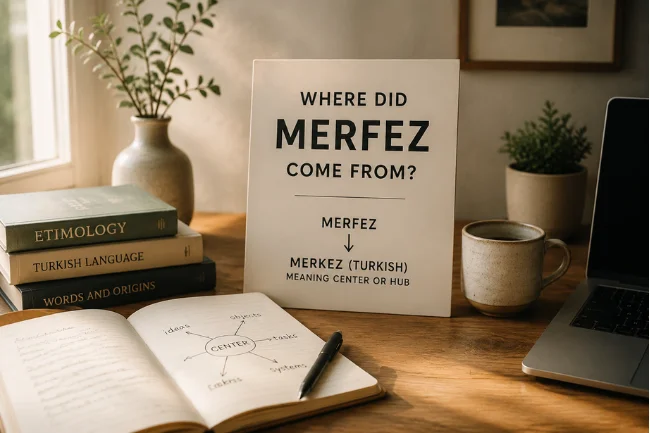
There is currently no well-documented origin story that I would present as settled fact.
A common online claim connects Merfez with the Turkish word “merkez,” commonly translated as “center” or “hub.” The resemblance is easy to notice, and it fits the way many recent articles describe Merfez as a point where ideas, objects, tasks, or systems come together.
But similarity is not proof of etymology.
Until there is a traceable early usage, dictionary record, named creator, or credible linguistic source, I would describe the “merkez” connection as a possible interpretation rather than the confirmed origin of Merfez.
Why Does Merfez Have So Many Different Meanings Online?
This is the part that many explanations skip.
When I compared current pages, I found Merfez described as a creative-lifestyle philosophy, a system for efficiency, an AI-related platform, a design idea, and the name of a multi-niche publishing website. Those definitions cannot all be treated as one established meaning.
The most reasonable explanation is that Merfez is functioning as an emerging or coined digital term. Uncommon words can acquire meaning as publishers, communities, brands, or websites begin using them in particular contexts.
Context therefore matters. A “Merfez home” may refer to a warm, uncluttered aesthetic, while a company may simply use Merfez as a brand name. In productivity writing, the emphasis may shift toward centralization and efficiency.
A Useful Evidence Check for Merfez Claims
When I come across an unfamiliar term like this, I find it useful to separate claims into three levels rather than treating every search result equally.
This prevents a repeated online claim from quietly turning into “fact” simply because several websites have copied, expanded, or paraphrased it.
Merfez as a Lifestyle and Design Idea

The lifestyle interpretation is currently one of the most coherent ways the word is being used.
In that context, Merfez is less about owning as little as possible and more about reducing what competes for attention. A room can still have texture, handmade objects, books, textiles, artwork, and personality. The point is that those things feel chosen rather than accumulated without thought.
I find that distinction useful because many people like the clarity associated with minimalism but do not necessarily want their homes to feel bare or impersonal.
A Merfez-inspired space, as the concept is currently described online, might include natural fabrics, useful handmade pieces, open surfaces, a restrained number of decorative objects, and materials that age well.
The goal is not visual emptiness. It is visual calm with character.
Merfez vs. Minimalism, Slow Living, and Intentional Living
Merfez overlaps with better-established ideas, which is one reason its meaning can feel familiar even when the word itself is new.
The biggest difference is that Merfez does not yet have a stable body of literature, recognized founders, or widely agreed principles. Minimalism and related intentional-living philosophies have much broader histories and established communities.
For that reason, I would use Merfez as a descriptive lens rather than a rigid philosophy.
What Merfez Can Look Like at Home
I would start by identifying the visual or practical center of a space.
In a living room, that might be the place where people actually sit and talk. In a kitchen, it may be the preparation area. In a home office, it is usually the desk and the tools used every day.
Then I would look at what constantly competes with that purpose.
A Merfez-style approach might mean keeping one handmade bowl you genuinely use instead of displaying several decorative pieces you barely notice. It could mean choosing linen, wood, ceramic, wool, stone, or other tactile materials because they add warmth without creating visual chaos.
This does not require throwing away possessions simply to own less.
The more useful question is: “Does this support the way I want this space to feel and function?”
That question changes decluttering from a numbers exercise into a design decision.
How Merfez Applies to Work and Productivity
The “center” interpretation becomes particularly practical when applied to work.
Many messy workflows are not messy because people need another app. They are messy because information, tasks, files, messages, and decisions live in too many places.
A Merfez-inspired workflow would create a clear home for each important type of information.
That could mean one project dashboard instead of five overlapping task lists, one agreed folder structure instead of documents scattered across devices, or a smaller set of digital tools with clearly defined purposes.
During my research into this interpretation of Merfez, I kept coming back to one distinction: simplification only works when it actually reduces decisions.
Moving clutter from a physical desk into six digital platforms is not genuine simplification.
The strongest version of the Merfez idea is functional: centralize what benefits from being centralized, eliminate duplicate steps, and preserve enough flexibility for real work.
Merfez and Creative Work
Merfez also fits naturally with creative practice because creative spaces tend to collect possibilities.
Fabric, paints, notebooks, brushes, camera equipment, samples, saved references, unfinished projects, and software can all be useful. The problem begins when every possibility demands attention at the same time.
A practical Merfez approach would be to make the current project more visible than future projects.
That might mean keeping only the materials for one active piece on the work surface, placing frequently used tools within easy reach, storing experiments elsewhere, and creating a deliberate place for unfinished work.
The same principle can apply digitally.
A writer might keep current research in one organized location rather than dozens of browser tabs. A designer might separate active client assets from inspiration files. A photographer could build a clear workflow from import to selection, editing, delivery, and archive.
The exact system is less important than having a recognizable center.
What Merfez Is Not
Because the term remains vague, defining its limits is almost as useful as explaining its possibilities.
Merfez is not a recognized scientific theory, established mental-health treatment, documented historical movement, or universally standardized design school. It should not be presented with that level of authority unless stronger evidence emerges.
It is also not automatically another word for minimalism.
The current lifestyle interpretation generally places more emphasis on warmth, meaningful objects, natural texture, handmade character, and focused attention than on reduction alone.
And Merfez is not limited to interiors. Current online usage reaches into productivity, creativity, digital organization, branding, technology, and publishing.
That range is exactly why context is necessary.
How to Use the Merfez Idea Without Following a Trend Blindly
If you like the concept, I would use Merfez as a question rather than a rule.
Ask what the center of a room, project, routine, or system should be. Then look for things that support that center and things that distract from it.
For a home, the answer may be comfort and connection.
For a studio, it may be finishing creative work.
For a business process, it may be making information easier to find.
For a personal routine, it may be protecting uninterrupted attention.
You can then make small decisions around that priority rather than trying to imitate a particular aesthetic.
That gives the Merfez concept practical value even if the word eventually fades from online conversation. The label matters less than the habit of identifying what deserves attention and designing around it.
Is Merfez Just an Internet Trend?
Possibly, at least in its current form.
The term attracted visible online coverage during 2026, and current search results show publishers assigning substantially different meanings to it. That pattern is more consistent with an emerging digital term than with a concept that already has a settled definition.
The better question is whether Merfez contributes something useful to ideas we already have.
Its strongest contribution may be the image of a “center”: bringing attention, objects, systems, and choices back around a clear purpose.
That idea can work whether you are organizing a room, building a creative practice, simplifying a digital workflow, or reconsidering how much attention you give to things that do not matter.
FAQs About Merfez
What is Merfez in simple terms?
Merfez is an emerging online term commonly associated with simplicity, focus, intentional choices, and creating a clear center around what matters.
What does Merfez mean in home design?
In current design-related usage, Merfez describes warm, intentional spaces with less visual noise, meaningful objects, natural textures, and practical organization.
Is Merfez a Turkish word?
A Turkish origin is often claimed online through comparison with “merkez,” but I found no authoritative evidence confirming Merfez itself as a standard Turkish word.
Is Merfez the same as minimalism?
No. The ideas overlap, but Merfez is generally described with more emphasis on warmth, meaningful objects, centralization, and intentional focus rather than reduction alone.
Why is Merfez trending?
Merfez gained attention as multiple 2026 websites used the unusual term for lifestyle, design, productivity, technology, and branding topics, creating curiosity about what it means.
A Practical Way to Think About Merfez
For now, the most accurate way to understand Merfez is as an emerging, flexible internet term rather than a formally established philosophy.
Its most useful interpretation centers on clarity: decide what matters, reduce competing noise, and organize your environment or workflow around that purpose.
If the idea appeals to you, choose one space, project, or routine and test it there. Remove one source of friction, give the important thing a clearer place, and see whether the result feels easier to use, calmer to look at, or simpler to maintain.
That practical result matters far more than following a new label perfectly.

Emily Carter is a personal growth writer with 9 years of experience creating practical content about confidence, mindset, productivity, habits, goal setting, and self-improvement. She focuses on helping readers build positive routines, develop self-awareness, and make meaningful changes through simple, actionable strategies.