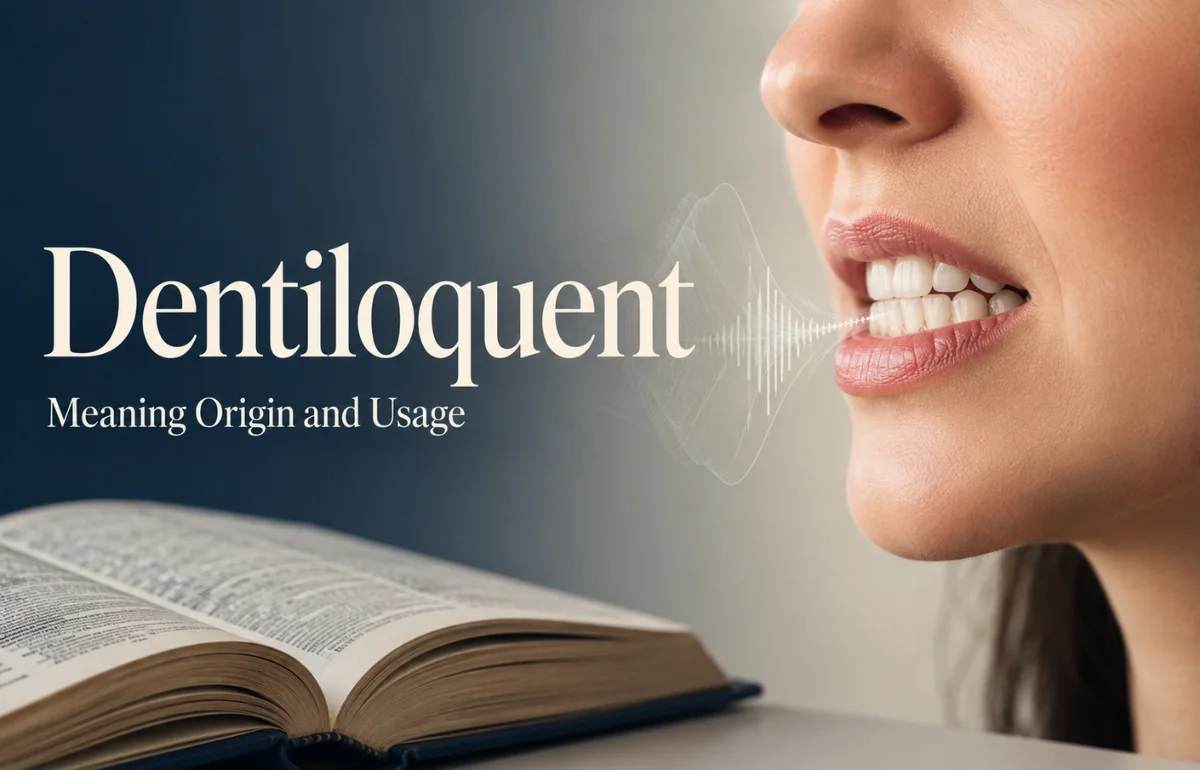
Dentiloquent means speaking through one’s teeth, usually with the teeth held close together or the jaw relatively tight. It is a rare English word connected with dentiloquy, the act or habit of speaking through the teeth. Rather than describing ordinary conversation, Dentiloquent points to a particular manner of speaking—one that may sound restrained, tense, muffled, controlled, or emotionally charged depending on the situation.
When I come across an uncommon word like this, I find that a short dictionary definition rarely answers everything a reader actually wants to know. The more useful questions are how the word developed, whether people still use it, what speaking through the teeth sounds like, and how it differs from genuine dental articulation in phonetics. That is where Dentiloquent becomes much more interesting than its one-line definition suggests.
What Does Dentiloquent Mean?
The simplest definition of Dentiloquent is:
“Speaking or talking through one’s teeth.”
Collins currently lists Dentiloquent as a monitored new-word suggestion with that meaning rather than as an established mainstream dictionary entry.
The related noun dentiloquy has stronger historical documentation. Etymonline defines it as the act or practice of speaking through the teeth or with the teeth closed and dates the word to 1737.
In everyday terms, imagine someone trying to speak while barely separating the upper and lower teeth. The voice may still be understandable, but jaw movement is restricted.
That physical description is important because Dentiloquent should not be treated as a general synonym for good speaking, smiling while talking, persuasive communication, or expressive body language. Its core idea is much narrower: speech produced through or between relatively closed teeth.
Dentiloquent at a Glance
| Feature | Meaning |
|---|---|
| Basic meaning | Speaking through one’s teeth |
| Related noun | Dentiloquy |
| Related person noun | Dentiloquist |
| Main idea | Speech produced with limited separation of the teeth |
| Usage level | Rare and uncommon |
| Likely context | Literary writing, unusual vocabulary, descriptions of restrained speech |
| Not the same as | Eloquence, ordinary articulation, body language, or dental speech therapy |
I would therefore use the word carefully. Because it is unfamiliar to most readers, context usually needs to make its meaning obvious.
Where Does the Word Dentiloquent Come From?
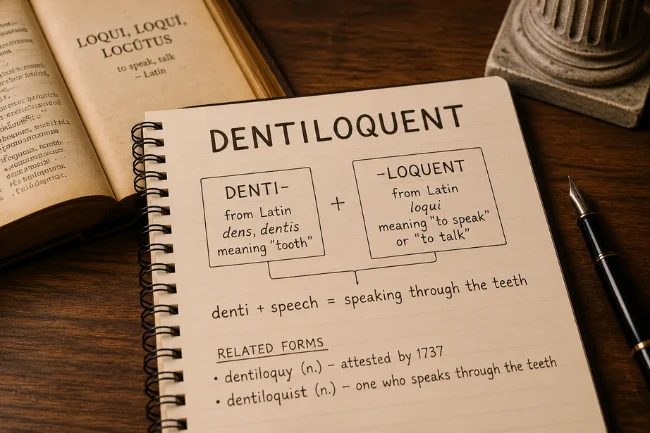
The word makes much more sense when it is divided into its two classical elements.
The first part comes from Latin dens, with the genitive form dentis, meaning “tooth.” That same dental root appears in familiar English words such as dentist, dental, dentition, and denture.
The second element belongs to the family of words derived from Latin loqui, meaning “to speak” or “to talk.” Merriam-Webster traces words including eloquent, loquacious, soliloquy, and related speech terms back to loqui.
Put the ideas together and the construction is remarkably literal:
denti + speech = speaking through the teeth.
The documented noun dentiloquy appears by 1737 according to Etymonline, which also identifies dentiloquist as a related form.
That historical detail is useful because it prevents a common misunderstanding. Dentiloquence is sometimes presented online as though it were a modern communication technique involving smiling, facial expressions, confidence, or public speaking. The older word family points instead to the much more specific physical act of speaking through closed or nearly closed teeth.
How Do You Pronounce Dentiloquent?
One published pronunciation source gives the IPA pronunciation as /dˈɛntɪ.lɑːkwənt/ and represents it approximately as “denti-lah-quuhnt” in American English. Because Dentiloquent is exceptionally rare, pronunciation can vary slightly among speakers who encounter it primarily in writing.
A practical way to say it is:
den-ti-lo-quent
The ending should feel familiar because it resembles words such as eloquent and grandiloquent.
I would not worry excessively about forcing an unfamiliar pronunciation. With rare vocabulary, saying the word clearly and giving enough context is more useful than pretending there is one universally familiar spoken form.
What Does Speaking Through Your Teeth Actually Mean?
Speaking through your teeth is more than a colorful phrase.
Physically, it can mean producing speech while keeping the jaw relatively closed and allowing only limited movement between the upper and lower teeth.
Emotionally, however, writers often use the idea of speaking through clenched teeth to suggest something happening beneath the words.
A character might speak that way because of:
- restrained anger
- frustration
- pain
- determination
- nervous tension
- an attempt to remain polite
- an effort to hide a stronger emotional reaction
Consider the difference between these two descriptions:
“She told him to leave.”
“She told him through clenched teeth to leave.”
The spoken message is almost identical. The emotional information is not.
The second version tells me that the speaker is controlling something—probably anger, tension, or distress. That is why a word such as Dentiloquent can be particularly useful in descriptive or literary writing.
Is Dentiloquent the Same as Dental Articulation?
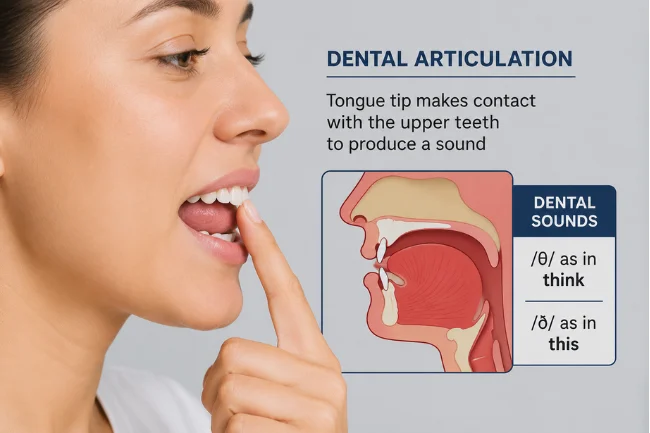
No. This distinction is one of the most useful things to understand about the word.
Dentiloquent describes speaking through the teeth. Dental articulation is a phonetic concept describing sounds formed when the tongue interacts with the teeth.
In articulatory phonetics, dental sounds involve the tongue tip making contact with the upper teeth to create a constriction. The University of Sheffield describes dental articulation in precisely those physical terms.
English provides familiar examples in the two “th” sounds heard in words such as “think” and “this.”
Those sounds naturally involve the teeth, but producing them does not make someone Dentiloquent.
Dentiloquent vs. Dental Speech Sounds
| Term | What it describes | Example |
|---|---|---|
| Dentiloquent | A manner of speaking through relatively closed teeth | A tense character speaking without fully opening the jaw |
| Dentiloquy | The act or practice of speaking through the teeth | The general behavior itself |
| Dental consonant | A speech sound formed with the tongue at or against the teeth | The “th” sound in “think” |
| Labiodental sound | A sound involving the lower lip and upper teeth | “f” or “v” |
| Eloquence | Fluent, effective, persuasive expression | A powerful public speech |
This distinction matters because the physical role of teeth in ordinary speech is real, but Dentiloquent does not mean “speech involving teeth.”
If it did, nearly everyone would be Dentiloquent whenever they pronounced common consonants.
How Teeth Really Affect Speech
Although Dentiloquent is not a technical speech-therapy term, teeth genuinely contribute to speech production.
Different speech sounds depend on carefully controlled relationships among the tongue, lips, teeth, palate, jaw, and airflow.
For example, dental consonants are produced when the tongue interacts with the upper teeth, while labiodental sounds involve contact between the lower lip and upper teeth.
Dental changes can also affect pronunciation. Research examining dentures and speech has found that dental prostheses can influence the articulation of certain phonemes, especially while a person adapts to changes inside the mouth.
That does not change the meaning of Dentiloquent, but it helps explain why teeth appear in vocabulary related to speech in the first place.
Our mouths are acoustic instruments. Small changes in tongue position, tooth contact, airflow, or jaw opening can noticeably change the sounds we produce.
How to Use Dentiloquent in a Sentence

Because the term is so uncommon, I prefer using it in sentences that provide built-in clues.
Here are some natural examples:
“The detective gave a Dentiloquent reply, barely separating his teeth as he spoke.”
“Her Dentiloquent warning made it obvious that she was trying to control her anger.”
“The actor adopted a Dentiloquent delivery to make the villain appear tense and restrained.”
“His unusual Dentiloquent manner made every sentence sound compressed and deliberate.”
“The character’s Dentiloquent speech suggested irritation even before the dialogue revealed it.”
Notice that each example describes how the person speaks. That is much clearer than using the word as a vague synonym for articulate or expressive.
For general audiences, I would also avoid placing an obscure word like this where readers have no contextual help. Rare vocabulary works best when it adds precision rather than forcing readers to stop unnecessarily.
Dentiloquent vs. Similar-Sounding Words
Rare words ending in -loquent or related speech forms can easily blur together, but they do not mean the same thing.
Dentiloquent vs. Eloquent
Eloquent describes fluent, persuasive, or effective expression.
A speaker can be eloquent without speaking through the teeth, and someone speaking through clenched teeth can be Dentiloquent without being eloquent.
Dentiloquent vs. Loquacious
Loquacious means very talkative or inclined to talk a great deal. Merriam-Webster traces it to the same Latin loqui family.
Dentiloquent concerns how speech is physically delivered; loquacious concerns how much someone talks.
Dentiloquent vs. Grandiloquent
Grandiloquent refers to speech that is lofty, pompous, or extravagantly impressive. It also belongs to the loqui word family.
A grandiloquent speaker may use elaborate language. A Dentiloquent speaker may simply keep the teeth tightly positioned.
Dentiloquent vs. Ventriloquent
The two can look confusing because both relate to unusual ways of producing or perceiving speech.
Ventriloquism involves creating the illusion that a voice is coming from somewhere other than the speaker, traditionally while minimizing visible mouth movement.
Dentiloquy specifically refers to speaking through the teeth.
Is Dentiloquent a Real Word?
This question deserves a careful answer.
Yes, Dentiloquent exists in rare-word usage, but it is not a common everyday English word. Collins currently presents it as a new-word suggestion being monitored for evidence of usage rather than giving it the status of an ordinary established headword.
The related word dentiloquy has a considerably older recorded history, with a documented date of 1737.
That difference is worth knowing.
A word appearing online does not automatically mean it is widely standardized, commonly spoken, or recognized by every major dictionary. For writers, the safer approach is to treat Dentiloquent as rare vocabulary and provide context whenever the audience may not know it.
When Is Dentiloquent Actually Useful?
I see its strongest value in descriptive writing.
Instead of writing several words to explain that a person speaks while barely opening the jaw, Dentiloquent can compress that idea into one unusual term.
It may fit:
- fiction and character description
- vocabulary articles
- linguistic discussions
- word games and rare-word collections
- historical-language research
- descriptions of restrained or clenched-teeth speech
I would be more cautious in business communication, medical writing, instructions, or everyday conversation. There, clarity usually matters more than novelty.
A useful word is not automatically the most suitable word.
Sometimes “he spoke through clenched teeth” will communicate more quickly than “he was Dentiloquent.” The rare term becomes valuable when the reader either knows it already or can understand it naturally from the surrounding sentence.
A Better Way to Remember Dentiloquent
The easiest memory trick is to recognize its two ideas:
denti = teeth
loquent = speaking
Think of “dental speech.”
That does not provide the complete technical definition, but it is a quick mental bridge to “speaking through the teeth.”
I also connect it with eloquent. Once I remember that eloquent belongs to the Latin loqui “to speak” family, Dentiloquent becomes much easier to decode.
The difference is simple:
eloquent tells us about the quality of expression.
Dentiloquent tells us about the physical manner of speaking.
Why This Rare Word Is Easily Misunderstood
Dentiloquent looks technical enough that it is tempting to attach a complicated theory to it.
That is where definitions can drift.
The word does not inherently describe smiling, body language, persuasive communication, confidence, dental health, public-speaking ability, or facial expression.
Those topics may interact with speech, but they are separate concepts.
For an obscure word, I prefer the narrowest historically supported meaning first. Only after establishing that definition does it make sense to discuss related ideas such as phonetics, teeth, articulation, emotional delivery, and literary usage.
That approach keeps a fascinating rare word from turning into something it was never meant to describe.
FAQs About Dentiloquent
What does Dentiloquent mean?
Dentiloquent means speaking through one’s teeth, usually with the teeth close together or the jaw relatively restricted.
Is Dentiloquent a real English word?
Yes, but it is extremely rare. Collins currently lists it as a monitored new-word suggestion, while the related noun dentiloquy has documented historical usage.
How do you pronounce Dentiloquent?
A published pronunciation gives approximately “denti-lah-quuhnt,” although minor variation is unsurprising because the word is rarely spoken.
What is the noun form of Dentiloquent?
Dentiloquy is the related noun referring to the act or practice of speaking through the teeth.
Is Dentiloquent the same as eloquent?
No. Eloquent means fluent or persuasive in expression, while Dentiloquent refers specifically to speaking through the teeth.
Final Thoughts
Dentiloquent is a small word with a surprisingly specific image behind it: someone speaking while keeping the teeth close together. Its roots connect teeth with speech, its related noun dentiloquy has been documented for centuries, and its meaning is much narrower than general communication or public-speaking skill.
If you plan to use Dentiloquent in your own writing, give readers enough context to understand it immediately. Try it in a character description or sentence involving restrained speech, then compare the result with the simpler phrase “through clenched teeth.” The better choice is the one that makes the meaning clearer while adding exactly the tone you want.

Emily Carter is a personal growth writer with 9 years of experience creating practical content about confidence, mindset, productivity, habits, goal setting, and self-improvement. She focuses on helping readers build positive routines, develop self-awareness, and make meaningful changes through simple, actionable strategies.