Anonib Azn generally refers to the /azn/ section associated with Anon-IB-style anonymous imageboards, rather than a person, influencer, or mysterious online identity. In this context, “AZN” is internet shorthand for “Asian,” while Anon-IB was the name of an anonymous image-sharing board that became notorious for adult material, including content reportedly shared without the subjects’ consent. Archived pages show an /azn/ board identified as “Azn Chikz,” which helps explain why people continue to search for the phrase Anonib Azn today.
That distinction matters because I found several explanations online that blur together the board, the Anon-IB name, and the idea of an anonymous “persona.” The documented history points somewhere much more specific.
What Does Anonib Azn Actually Mean?
The easiest way to understand the term is to separate it into two parts.
Anon-IB refers to an anonymous imageboard format where people could create threads and post images without presenting a conventional social-media identity.
“AZN,” meanwhile, has long been used in texting and internet slang as an abbreviated spelling of “Asian.” The term was especially visible in Asian-American internet culture during the late 1990s and 2000s and has also been associated with phrases such as “AZN Pride.”
Archived AnonIB pages make the connection much clearer. A preserved 2013 page points to an anonib.com/azn/ URL and identifies the section as “Azn Chikz.” Later archived versions of AnonIB-branded sites also contain an /azn/ board using the same label.
So, based on the available evidence, Anonib Azn is best understood as a search term connected with an Asian-themed category or board within the broader AnonIB imageboard ecosystem.
It should not automatically be interpreted as the name of an individual.
Anonib Azn at a Glance
| Term | What it generally refers to | What it does not necessarily mean |
|---|---|---|
| Anon-IB | An anonymous imageboard historically associated with user-posted images and discussion threads | A single person or social-media influencer |
| AZN | Internet shorthand for “Asian” | A unique company, platform, or individual |
| /azn/ | An archived AnonIB board associated with Asian-themed material | Proof that every modern site using the name is connected to the original |
| Anonib Azn | A search phrase commonly interpreted as referring to the AnonIB AZN board/category | A documented anonymous celebrity or online persona |
This distinction solves much of the confusion surrounding the keyword.
Where Did Anon-IB Come From?
Anon-IB belonged to the broader culture of anonymous imageboards: websites built around image-led discussion threads where traditional profiles, follower counts, and real-name identities were largely absent.
That design made participation easy and reduced the social friction found on conventional networks. It also created serious accountability problems.
Anon-IB eventually became widely known not simply as an anonymous discussion site, but as a destination where stolen and non-consensual intimate images were reportedly traded and requested.
Contemporary reporting described the platform as notorious for material obtained through hacking and for intimate photos distributed without permission. Dutch authorities investigated the operation for more than a year before seizing its server in April 2018. Three administrators were arrested, according to reporting at the time.
That history is essential when discussing Anonib Azn. Describing it only as an online community for Asian culture, memes, or anonymous conversation leaves out the context that made the Anon-IB name controversial in the first place.
Why Anonymity Changed the Nature of the Platform
Anonymous posting is not automatically harmful. Many legitimate communities use pseudonyms or anonymous submissions to discuss sensitive issues.
The problem appears when anonymity is combined with weak moderation and content involving people who never agreed to have their images published.
On an ordinary social network, accounts can at least provide moderators with a persistent identity to investigate. On anonymous boards, users may appear under generic names, temporary identifiers, or no meaningful public identity at all.
That can make accountability much harder.
When I examine platforms built around this model, I therefore separate two questions: “Can users remain anonymous?” and “What safeguards exist when that anonymity is abused?” They are not the same issue.
Why Is There So Much Confusion About Anonib Azn?
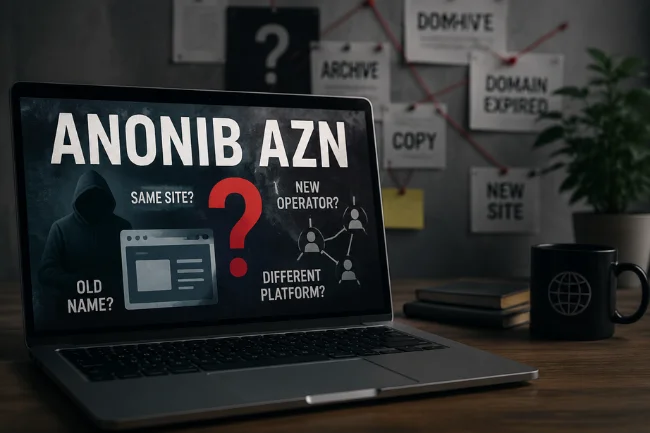
One reason is that the internet rarely preserves platforms neatly.
Domains disappear. Copies emerge. Archives preserve fragments. New operators adopt old names. Search engines continue indexing phrases long after the original community has changed or vanished.
Anon-IB illustrates that problem particularly well.
The original operation targeted by Dutch authorities was taken down in 2018. Reporting in 2020 then documented attempts by other people to revive the Anon-IB name and concept.
That means a website carrying “AnonIB” branding years later should not automatically be treated as the same operation that existed before the police seizure.
This is one of the most useful things I found while researching the term: there is a difference between name continuity and operator continuity.
A familiar logo, board name, or URL structure does not prove common ownership.
Was “AZN” Really a Board on AnonIB?
Archived evidence says yes, although the exact content and operators varied across different periods and AnonIB-branded domains.
A preserved page from November 2013 links directly to an /azn/ location on anonib.com and labels the board “Azn Chikz.” Archived pages from later AnonIB-style sites show the same /azn/ naming convention.
That is stronger evidence than simply guessing what the keyword means from its spelling.
It also explains why someone searching Anonib Azn today may be looking for an old board, trying to understand a reference they encountered elsewhere, or attempting to determine whether a similarly named community still exists.
Original Anon-IB and Later AnonIB-Branded Sites Are Not Necessarily the Same
This distinction deserves its own comparison because it is easy to miss.
| Point | Historical Anon-IB | Later AnonIB-branded sites |
|---|---|---|
| Historical status | Established anonymous imageboard associated with major privacy controversies | Various later domains or attempted revivals |
| 2018 police action | Server was seized during the Dutch investigation | A later site should not automatically be assumed to be the seized operation |
| AZN terminology | Archived /azn/ pages existed | Similar category names have appeared on later versions |
| Ownership continuity | Historical operators were investigated | Ownership may differ and should be independently verified |
| Safety assumption | Had significant documented abuse concerns | A familiar brand name provides no guarantee of safety or legitimacy |
For readers, the practical rule is simple: do not assume that an active domain using an old community’s name is the official continuation of that community.
Why Anon-IB Became Controversial
The central controversy surrounding Anon-IB was not ordinary internet trolling.
Reports connected the platform with non-consensual intimate imagery, hacked private photographs and requests for material involving identifiable people. The harm in those situations goes beyond embarrassment because a person’s private image can be duplicated repeatedly and distributed across multiple websites without meaningful control.
This type of conduct is increasingly described as image-based abuse.
The language matters. Calling everything “revenge porn” can be misleading because the person distributing an image does not have to be a former romantic partner, and revenge does not have to be the motivation.
An image might be stolen through account compromise, taken without permission, manipulated digitally, or obtained consensually but distributed without consent.
The common factor is the absence of permission for publication.
Is Anonib Azn Safe to Visit?
I would not treat an unfamiliar AnonIB-branded site as safe simply because it appears in search results.
There are several separate risks to consider.
First, anonymous imageboards may contain material uploaded without the subject’s consent. Viewing, downloading, redistributing, or reposting questionable material can create ethical problems and, depending on the material and jurisdiction, potentially serious legal ones.
Second, old communities frequently attract copycat domains. A recognizable name does not tell you who operates a current website or what security practices it follows.
Third, sites built around anonymous file sharing can expose visitors to aggressive advertising, redirects, tracking, malicious downloads, impersonation, or phishing attempts.
I also avoid using the existence of HTTPS or a professional-looking design as proof that an unknown site is trustworthy. Encryption protects a connection; it does not certify the intentions of the site’s operators.
Anonib Azn and Privacy: The Bigger Lesson
The history behind Anonib Azn highlights a problem that is much larger than one imageboard.
Once a private image is uploaded to a public or semi-public community, copies may move beyond the original website. Screenshots, downloads, mirrors, private messages, cloud folders, and reposting can make complete removal difficult.
That is why consent has to apply to distribution, not merely to the creation of an image.
Someone agreeing to take or privately share a photograph does not automatically agree to have it posted publicly.
Anonymous platforms can make this distinction even more important because the uploader may be difficult to identify after the material begins spreading.
A Major 2026 Update: U.S. Removal Rights Have Changed
For readers in the United States, the legal environment is now different from the period when the original Anon-IB was operating.
The TAKE IT DOWN Act was signed into federal law on May 19, 2025. It addresses intentional disclosure of certain non-consensual intimate visual depictions and creates requirements for covered online platforms.
The Federal Trade Commission began enforcing the platform-removal provisions in May 2026.
Covered platforms must provide a process for requesting removal of qualifying non-consensual intimate images. After receiving a valid request, platforms generally must remove the reported material and known identical copies within 48 hours. The rules also cover certain digitally altered or AI-generated intimate images.
This is particularly relevant when discussing communities descended from the anonymous imageboard model. The conversation is no longer only about moderation policies; specific legal removal obligations may apply.
Laws vary outside the United States, so anyone dealing with an actual case should check the rules in their own jurisdiction.
What Should You Do If Your Image Is Shared Without Consent?
If you discover intimate material involving you on an online platform, avoid engaging publicly with anonymous posters if doing so could increase harassment or spread the material further.
Preserve useful evidence such as the page address, date, platform name, screenshots of the listing, and any information needed to identify the content.
Then use the platform’s official reporting or removal procedure.
For U.S. users, the FTC states that covered platforms must make a removal-request mechanism available. If a platform fails to remove qualifying content and known identical copies within 48 hours after a valid request, the problem can be reported to the FTC.
Depending on the circumstances, victims may also need legal advice or law-enforcement assistance, particularly when hacking, threats, extortion, stalking, or material involving a minor is involved.
Is Anonib Azn Still Active?
The safest answer is to distinguish the historic platform from websites currently using similar names.
The Anon-IB operation investigated by Dutch authorities was seized in April 2018. Later attempts to revive the brand were reported, and archived pages show that AnonIB-style boards continued appearing under other domains.
That does not establish that every modern AnonIB-branded site has the same owners, infrastructure, moderation practices, or history.
Because anonymous-board domains can appear, disappear, or change operators quickly, I would avoid treating “Is AnonIB online?” and “Does the original Anon-IB still exist?” as the same question.
They are not.
What I Found Most Useful When Researching Anonib Azn
The most revealing evidence was not a modern description of the keyword. It was the archived URL structure.
Seeing /azn/ connected to an archived board labeled “Azn Chikz” provides a straightforward explanation for a term that some newer articles make unnecessarily mysterious.
It also demonstrates a useful rule for researching old internet communities: archived navigation, historical reporting, and dated records are generally more valuable than an unsourced modern article that tries to reverse-engineer a forgotten keyword.
In this case, those sources point toward a board/category interpretation, not a secret internet personality.
FAQs About Anonib Azn
What is Anonib Azn?
Anonib Azn generally refers to an `/azn/` Asian-themed board associated with AnonIB-style anonymous imageboards, rather than a specific individual.
What does AZN mean in Anonib Azn?
AZN is internet shorthand for “Asian,” a usage that has existed in texting and Asian-American internet culture for decades.
Is Anonib Azn a person?
There is no credible evidence that Anonib Azn is the name of a mysterious person or influencer; archived records instead show `/azn/` as an AnonIB board.
Was the original Anon-IB shut down?
Yes. Dutch authorities seized the original site’s server in April 2018 following a cybercrime investigation, and three administrators were arrested.
Does Anonib Azn still exist today?
The historic Anon-IB operation was shut down, although later sites have reused AnonIB branding and similar board names. Those sites should not automatically be considered the original platform.
What to Take Away
Anonib Azn is best understood through the history of anonymous imageboards, not as an unexplained online persona. Archived evidence connects the term with an /azn/ Asian-themed AnonIB board, while the broader Anon-IB name carries a documented history involving privacy violations, non-consensual intimate imagery and a 2018 law-enforcement shutdown.
If you encountered the term because you are researching an old website, focus on archived and dated sources rather than assuming a current domain represents the original community.
If your concern involves private material posted without consent, prioritize documentation and official removal channels instead of trying to track anonymous uploaders yourself. In the U.S., the 2026 enforcement of the TAKE IT DOWN Act now gives affected people an additional formal route for holding covered platforms accountable.

Ava Bennett is a social media strategy writer with 7+ years of experience covering social platforms, content trends, audience engagement, and digital communication strategies. She creates practical insights to help readers understand the evolving social media landscape.