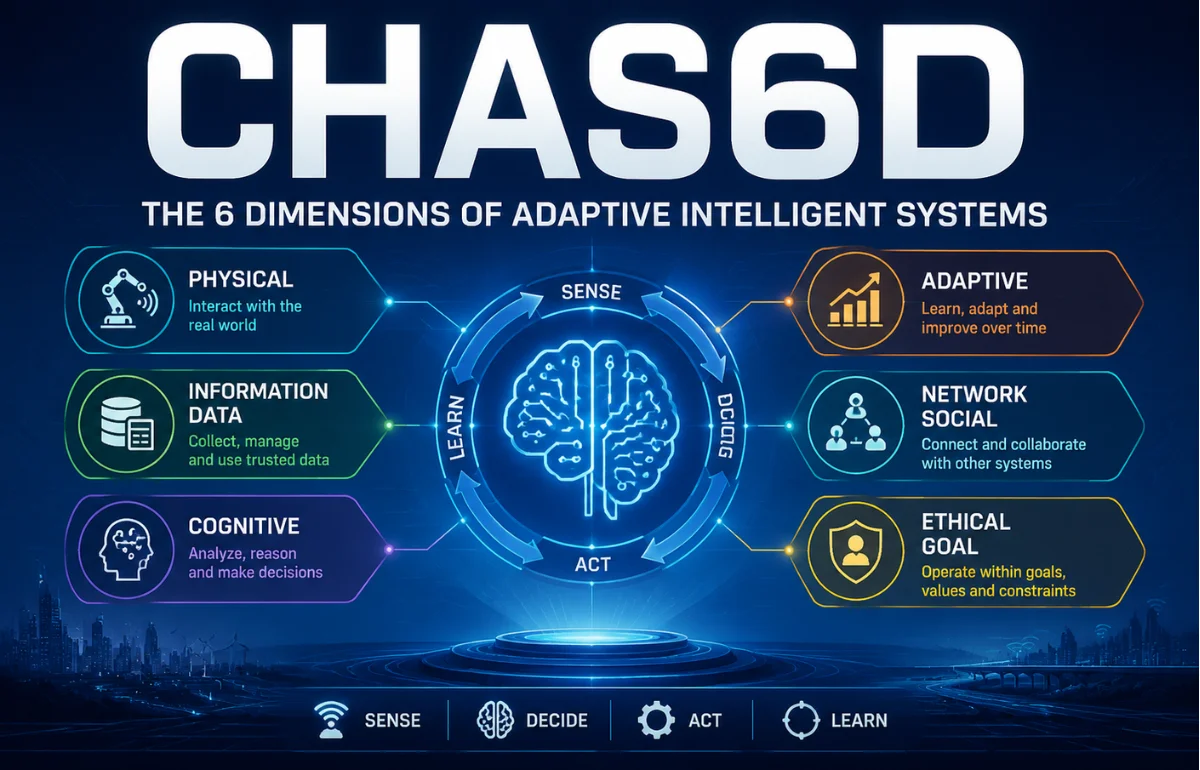
CHAS6D is commonly described as “Cybernetic Hierarchical Adaptive Systems in Six Dimensions,” an emerging conceptual model for designing systems that can sense conditions, process information across layers, make decisions, learn from feedback, and adjust their behavior over time. In plain English, the idea is to treat an intelligent system as more than a single AI model: it becomes a connected, adaptive structure with physical or digital inputs, data processing, decision logic, learning mechanisms, interactions with other systems, and higher-level goals.
I would not present CHAS6D as an established engineering standard, however. As of 2026, I could not verify a formal specification, peer-reviewed foundational paper, recognized standards document, or authoritative technical body that defines CHAS6D consistently. Current online explanations describe it as a framework or six-dimensional model, but even those descriptions acknowledge that interpretations can differ.
What Does CHAS6D Stand For?
The most common expansion is:
Cybernetic Hierarchical Adaptive Systems in Six Dimensions.
Each word points to a familiar systems idea.
“Cybernetic” refers to feedback and control. A system observes what is happening, compares the result with a desired state, and changes its actions when necessary.
“Hierarchical” means decisions can happen at more than one level. A lower layer may react quickly to local conditions, while a higher layer may set priorities, policies, or long-term goals.
“Adaptive” means the system is expected to change its behavior when conditions, data, or performance change.
“Systems” reminds us that the concept is not limited to one algorithm. It can involve sensors, software, models, networks, people, policies, and actuators working together.
The “six dimensions” are where the definition becomes less settled. One widely circulated explanation uses physical, information/data, cognitive, adaptive, network/social, and ethical/goal dimensions. The same source also says interpretations may differ, which is a useful warning for anyone treating CHAS6D as a fixed technical specification.
The Six Dimensions of CHAS6D
I find it more useful to treat the six dimensions as an architectural checklist than as six mysterious “dimensions” in a mathematical sense. That keeps the idea practical and avoids claiming a formal model where none has been clearly documented.
| Dimension | Practical meaning | Questions I would ask |
|---|---|---|
| Physical | Hardware, devices, sensors, infrastructure, or operating environment | What can the system observe or control in the real world? |
| Information/Data | Data collection, storage, movement, quality, and context | What data enters the system, and can it be trusted? |
| Cognitive | Analysis, reasoning, prediction, prioritization, and decisions | How does the system decide what an input means and what to do? |
| Adaptive | Learning, tuning, feedback, and behavioral change | What changes after success, failure, drift, or new conditions? |
| Network/Social | Interaction with users, services, agents, organizations, or other machines | Which external actors can influence the system? |
| Ethical/Goal | Objectives, constraints, policies, risk limits, and human values | What is the system optimizing, and what is it not allowed to do? |
An adaptive system is only as strong as the links between its dimensions. Better reasoning does not help if data is unreliable, and fast adaptation can be dangerous when constraints are weak. That is why I would evaluate CHAS6D as a whole-system design idea rather than another name for machine learning.
How CHAS6D Works in Practice
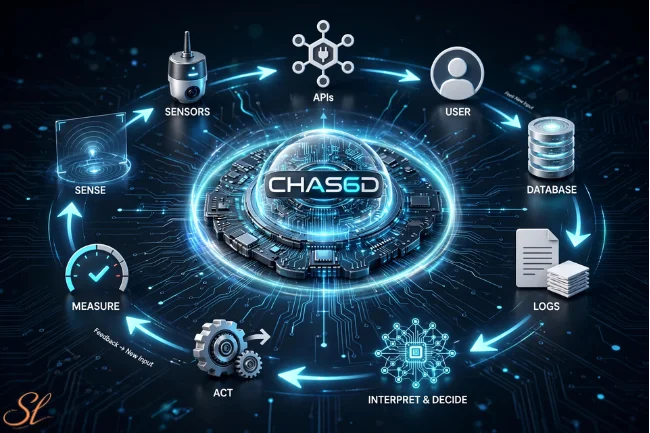
A practical CHAS6D-style system can be understood as a closed feedback loop.
First, the system senses signals from APIs, sensors, users, logs, databases, or other sources. It then interprets the data and decides what response is appropriate.
After the decision, it acts and measures the outcome. That result becomes new input for the next cycle, allowing thresholds, models, policies, or strategies to change when performance or conditions shift.
This general pattern is not unique to CHAS6D. IBM’s autonomic-computing work, for example, describes the established MAPE-K loop: Monitor, Analyze, Plan, Execute, with shared Knowledge. That is a useful comparison because it shows that closed-loop, self-managing architectures have a documented history independent of the newer CHAS6D label.
CHAS6D vs. Established Adaptive-System Concepts
The comparison below is where CHAS6D becomes easier to understand.
| Concept | Main focus | Feedback/adaptation | Governance or goals | Standardization |
|---|---|---|---|---|
| CHAS6D | Six-part view of an adaptive intelligent system | Central to the concept | Often treated as one dimension | Emerging and inconsistently defined online |
| MAPE-K | Runtime self-management loop | Explicit monitor-analyze-plan-execute cycle | Policies can guide planning | Well documented in autonomic-computing literature |
| Conventional ML system | Prediction or generation from learned patterns | May retrain or update, but not always continuously | Usually external to the model | Mature methods and tooling |
| Rule-based automation | Predefined actions for known conditions | Usually limited unless rules are changed | Explicit rules and policies | Mature and widely implemented |
I would therefore avoid saying that CHAS6D “replaces traditional AI.” A modern AI system can already include online monitoring, human feedback, retraining, reinforcement learning, policy constraints, and post-deployment controls.
What CHAS6D potentially contributes is a way of forcing the designer to look beyond the model and ask whether the surrounding system is observable, adaptive, connected, governed, and aligned with a purpose.
Where CHAS6D Could Be Useful
Adaptive Cybersecurity
Cybersecurity is a natural fit for the concept because threat conditions change quickly.
A CHAS6D-style security platform might collect endpoint and network signals, analyze anomalies, rank threats, adjust monitoring, recommend containment, and learn from incident outcomes. The ethical/goal layer would define what the system is permitted to block automatically and when a human must approve the action.
This is more realistic than describing the platform as “self-evolving security.” The difficult part is not simply learning; it is learning without creating new vulnerabilities or locking out legitimate users.
Robotics and Autonomous Machines
A robot already sits at the intersection of sensing, decision-making, control, and feedback.
Using the six-dimension lens, I would examine its physical sensors and actuators, data pipeline, planning logic, adaptation method, communication with humans or other robots, and safety constraints. That creates a much clearer engineering discussion than saying the robot “thinks in six dimensions.”
Smart Infrastructure
Traffic management, energy systems, industrial equipment, and connected buildings can all benefit from feedback-based control.
The value here is coordination. A local controller may react to immediate conditions, while higher-level software balances cost, reliability, demand, and safety across the broader network.
Healthcare and Decision Support
Healthcare is often mentioned in discussions of adaptive systems, but I would apply particular caution here. A system may update recommendations as patient information changes, yet adaptation still needs validation, privacy controls, human oversight, and clear responsibility.
AI Agents and Complex Software
CHAS6D also maps neatly onto AI-agent architectures.
An agent can observe an environment, use stored context, reason about tasks, choose tools, act, receive feedback, and operate under policies. The six-dimension model can help teams identify where an agent lacks safeguards or where adaptation is happening without adequate monitoring.
The Biggest Misunderstanding: CHAS6D Is Not Clearly a Formal Mathematical Model

Some online articles call CHAS6D a “mathematical model,” but I have not found a public formalism that defines its state variables, equations, transition functions, objective functions, or six-dimensional coordinate system. One prominent explanation uses the mathematical-model label while describing the framework mainly through conceptual layers and feedback processes.
That distinction matters.
A framework can be valuable without being mathematical. But if we call something a mathematical model, readers should be able to inspect the mathematics and reproduce its behavior.
For now, I think “conceptual architecture,” “design framework,” or “systems-thinking model” is more defensible language unless a primary CHAS6D specification becomes available.
How I Would Evaluate a Real CHAS6D Implementation
If a vendor, developer, or research team says it has built a CHAS6D system, I would ask for evidence in six areas.
First, show the architecture. Which components belong to each dimension, and how do they communicate?
Second, define the feedback loop. What is monitored, how often is it measured, and what triggers change?
Third, identify the adaptation mechanism. Does the system retrain a model, update rules, change parameters, reallocate resources, or simply produce new recommendations?
Fourth, define boundaries. Which decisions are autonomous, and which require human approval?
Fifth, measure outcomes. Accuracy alone is rarely sufficient; latency, reliability, safety, false-positive rates, resource use, and recovery behavior may matter just as much.
Sixth, document governance. NIST’s current AI risk-management guidance emphasizes ongoing monitoring because deployed AI performance and trustworthiness can shift over time, including through drift and changing real-world conditions. It also recommends processes for incident response, feedback, recovery, and decommissioning when risk tolerances are exceeded.
Those questions turn CHAS6D from a futuristic label into something testable.
Benefits of Thinking in Six Dimensions
The biggest benefit is completeness. Teams often focus too heavily on the “intelligence” layer and under-design everything around it.
A six-dimensional view forces architects to consider hardware, data quality, decisions, adaptation, connectivity, and goals together. It can expose failures such as model drift, unreliable dependencies, poor optimization targets, or decisions that conflict with policy.
NIST’s AI Risk Management Framework guidance reflects the broader concern behind this point: deployed AI systems need ongoing monitoring for performance, trustworthiness, drift, unexpected behavior, and changing real-world conditions.
Limitations and Open Questions
CHAS6D still has a credibility problem that good writing should not hide.
I could not verify a recognized standards body, canonical research paper, stable official specification, or universally accepted list of six dimensions. Search results are dominated by explanatory web articles rather than primary technical documentation, and the former chas6d.com currently resolves to a domain-for-sale page rather than an official framework specification.
There is also a risk of renaming established ideas such as feedback control, adaptive systems, hierarchical control, runtime monitoring, and autonomous management.
For CHAS6D to mature into a serious engineering framework, I would want a stable vocabulary, reference architecture, measurable evaluation criteria, security guidance, and independent technical validation.
Until then, it is best treated as an emerging way to organize familiar ideas rather than a proven new branch of computer science.
Is CHAS6D Worth Paying Attention To?
Yes, but for the right reason.
I do not think the interesting part is the acronym itself. The useful idea is that intelligent systems should be designed across multiple interacting layers and should not separate learning from feedback, infrastructure, external relationships, and governance.
That principle matters as software moves toward AI agents, autonomous workflows, robotics, and adaptive decision systems. If CHAS6D becomes a documented framework, its value will depend on whether it makes those systems easier to design, test, govern, and compare.
FAQs About CHAS6D
What does CHAS6D stand for?
CHAS6D is most commonly expanded as Cybernetic Hierarchical Adaptive Systems in Six Dimensions, although online definitions are not fully standardized.
What are the six dimensions of CHAS6D?
A common interpretation uses physical, information/data, cognitive, adaptive, network/social, and ethical/goal dimensions.
Is CHAS6D an AI technology?
Not exactly. It is better understood as a conceptual systems framework that can include AI, machine learning, feedback controls, networks, and governance.
Is CHAS6D a proven scientific framework?
I could not verify a canonical peer-reviewed specification or recognized standard for CHAS6D as of 2026, so claims about it should be treated carefully.
How is CHAS6D different from traditional AI?
CHAS6D emphasizes the wider adaptive system around intelligence—feedback, hierarchy, interactions, operating environment, and goals—rather than focusing only on a trained model.
What to Take Away
CHAS6D is a useful lens for thinking about adaptive, interconnected intelligent systems, but its current online definition is still fluid. I would use it as an architectural checklist, not as a settled scientific standard.
If you are evaluating a CHAS6D product or planning a system around the concept, the next step is simple: ask for the architecture, feedback mechanism, adaptation rules, measurable outcomes, and governance controls. Those details tell you far more than the label alone.

Noah Sterling is a technology research writer with 8+ years of experience covering emerging technologies, software trends, digital tools, and innovation. He creates practical, research-based articles to help readers understand the evolving technology landscape.