Woeken is a non-standard term appearing in online searches, articles, usernames, and digital discussions, but it does not currently have one established English definition. In practical terms, Woeken should be treated as a context-dependent word: it may be a misspelling of “woken,” a distinctive name used for branding, or an internet-created term whose meaning changes from one website or community to another.
When I researched the term, I found something more useful than another confident-sounding definition: different websites describe Woeken in completely different ways. Some associate it with intense focus, others with online hype, while another describes it as an AI-related video concept.
That inconsistency tells us something important. Woeken is attracting attention, but its meaning has not yet stabilized.
What Does Woeken Mean?
The safest definition of Woeken is this:
Woeken is an emerging or non-standard digital term with no single, widely accepted English meaning. Its interpretation depends on where it appears and how it is being used.
That distinction matters because several online articles present highly specific definitions as though they are settled facts. I found pages describing Woeken as a state of distraction-free productivity, a word for excitement or viral activity, a possible digital brand, and even a method of creating short videos with artificial intelligence.
Those meanings cannot all be treated as the established definition of the same word.
For a reader who encounters Woeken in a sentence, username, search query, or website, the surrounding context is therefore more valuable than any single online definition.
Is Woeken a Real English Word?
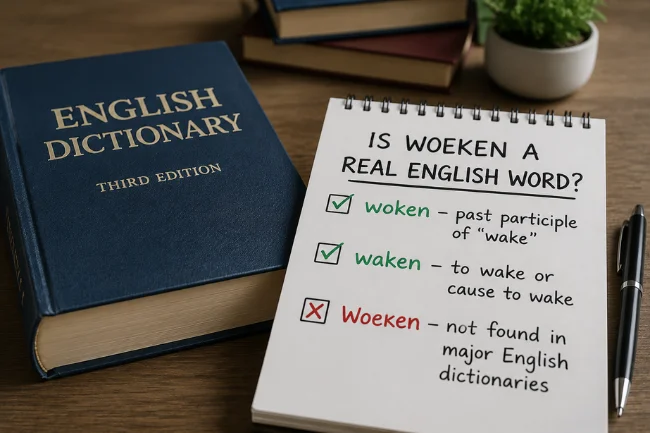
Based on the dictionary and language checks I carried out, I would not treat Woeken as a standard English vocabulary word.
Established English dictionaries do recognize closely spelled words. Cambridge Dictionary, for example, defines “woken” as the past participle of “wake.” It also recognizes “waken,” meaning to wake or cause someone to wake.
The exact spelling “Woeken,” however, does not have the same established English dictionary status.
That does not mean nobody can use it. New words, product names, usernames, slang terms, and brand names regularly exist before—or without ever—becoming dictionary entries.
It simply means writers should not present Woeken as a standard English word with a universally agreed definition unless they can identify the specific community, product, or source using it that way.
Why Is There So Much Confusion Around Woeken?
The unusual thing about Woeken is not merely that its definition is unclear. The search results themselves appear to be creating additional meanings.
During my research, I found recent articles that assign noticeably different concepts to the term:
| Source interpretation | Meaning assigned to Woeken | How established is it? |
|---|---|---|
| Productivity interpretation | Deep focus or creative immersion | Claimed online, but not a standard definition |
| Internet slang interpretation | Excitement, hype, or something trending | Claimed by some websites |
| Technology interpretation | AI-assisted short-video creation | Claimed by another website |
| Typo interpretation | Possible variation of “woken” or another word | Plausible depending on context |
| Branding interpretation | Invented name, username, product, or digital identity | Possible and context-dependent |
The contradiction is more informative than any one definition.
If a word genuinely has a settled meaning, independent sources normally begin converging around the same basic concept. With Woeken, many recent pages instead appear to be interpreting the term independently.
That is why I would avoid saying things such as “Woeken definitely means deep focus” unless the sentence comes from a particular community that demonstrably uses it that way.
Could Woeken Simply Be a Misspelling of Woken?
In some situations, yes.
“Woken” is a legitimate English word and the past participle of “wake.” Cambridge gives the straightforward grammatical meaning of the word.
For example:
“She had woken before the alarm.”
If somebody instead writes:
“She had woeken before the alarm,”
the intended word is almost certainly “woken.”
The same assumption would not necessarily apply if Woeken appeared as a website name, social username, business name, gaming handle, or title. In those situations, unusual spelling may be deliberate.
The rule I use is simple: check the function of the word before correcting it.
Woeken vs Woken, Waken, Weken, and Wekken
Several real words look similar enough to create confusion.
| Word | Language/context | Meaning |
|---|---|---|
| Woeken | Non-standard/online usage | Meaning depends on context |
| Woken | English | Past participle of “wake” |
| Waken | English | To wake or cause someone to wake |
| Weken | Dutch | Can relate to soaking; also appears as the plural of “week” in Dutch |
| Wekken | Dutch | To wake, awaken, or arouse |
Cambridge confirms the English meanings of “woken” and “waken.” Its Dutch-English dictionary also defines “weken” as soaking or steeping and “wekken” as waking or awakening.
Dutch-language reference material also records “weken” as the plural form of “week.”
This comparison is useful because the “oe” in Woeken makes the spelling look linguistically intentional. That visual resemblance, however, is not evidence that Woeken itself comes from Dutch.
I found no reliable linguistic source establishing that origin.
Where Did the Word Woeken Come From?
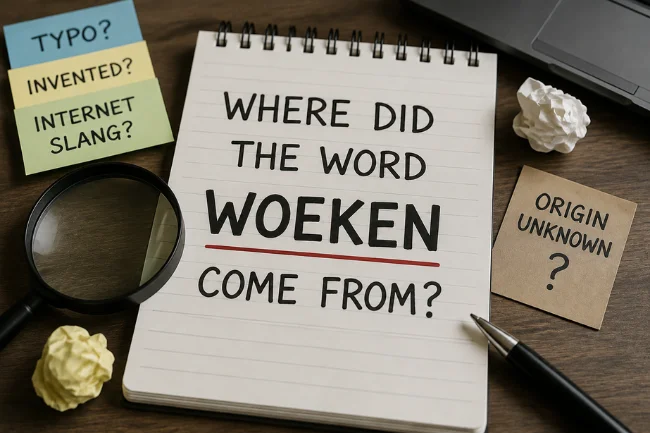
At the moment, there is no well-documented origin story that I can confidently trace to a specific creator, community, publication, or historical language source.
Several theories circulate online.
One is that Woeken began as a typo. Another suggests that it was deliberately invented because unusual spellings work well for usernames, domains, brands, and digital identities. Other articles frame it as recently developed internet slang.
All are possible. None should automatically be presented as fact.
This is one area where current online coverage is weaker than it first appears. Many pages discuss the “origin” of Woeken but then provide theories rather than an identifiable first use.
For an origin claim to be convincing, I would want to see something concrete: an early dated post, archived website, trademark record, product launch, community discussion, or linguistic reference.
Without that evidence, “origin unknown” is the more accurate answer.
Is Woeken Internet Slang?
It can function like internet slang if a particular online community gives it a shared meaning, but there is not enough consistency to call it universally recognized slang.
Slang normally becomes understandable because a group repeatedly uses a word in roughly the same way.
That is where Woeken currently becomes difficult. One article connects it with focus and productivity, while another describes excitement and online popularity.
Those are substantially different concepts.
A term can certainly develop multiple meanings over time, but genuine slang usually leaves evidence in conversations, posts, videos, comments, memes, or community-specific usage.
A handful of explanatory articles repeating definitions is weaker evidence than seeing ordinary users naturally employ the word.
How Should You Interpret Woeken When You See It?
Rather than searching for one universal definition, I recommend looking at the sentence or platform where the word appears.
If Woeken appears in ordinary English writing
Check whether “woken” makes grammatical sense.
If the sentence concerns waking up, becoming awake, or having already awakened, Woeken is probably a spelling error.
If Woeken appears as a username
It may have no dictionary meaning at all.
Distinctive spellings are common in usernames because familiar words are often unavailable or because users simply want memorable identities.
If Woeken appears as a company or product name
Treat it as a proper name until the company itself explains what it represents.
Brand names do not need to function as ordinary vocabulary.
If someone uses Woeken as slang
Read the surrounding sentence and, ideally, several examples from the same community.
Context may reveal a local meaning even when mainstream dictionaries do not recognize it.
If an article gives Woeken a very specific definition
Look for evidence.
Does the article quote real users, trace the term to an identifiable source, provide dated examples, or link to an organization responsible for the term?
If not, the definition may simply be that publisher’s interpretation.
Why Is Woeken Appearing in Search Results?
Woeken is a good example of how modern search behavior can amplify an unfamiliar term.
A person encounters a strange word and searches for it. Publishers notice that people are searching. More websites produce articles answering the query. Those new pages make the term more visible, which can lead even more people to wonder what it means.
The result is unusual: a keyword can develop a substantial online footprint even before it develops an agreed meaning.
I noticed exactly that pattern while reviewing current Woeken content. Recent pages confidently connect the same spelling to productivity, slang, branding, online trends, and AI technology.
That does not prove the term is meaningless. It does mean search visibility should not be confused with linguistic authority.
Can Woeken Become a Recognized Word?
Yes, in principle.
English constantly absorbs new vocabulary from technology, entertainment, communities, other languages, brands, and changing social habits.
Dictionary inclusion generally follows established usage rather than creating it. If enough people begin using Woeken consistently with the same meaning over a long enough period, lexicographers may eventually have something worth documenting.
The key word is consistently.
Right now, the competing meanings make Woeken look less like an established neologism and more like an unsettled digital expression.
That could change.
A creator, platform, game, company, meme, or online community could eventually popularize one interpretation strongly enough that it becomes the dominant meaning.
Should You Use Woeken in Your Own Writing?
For formal writing, I would avoid using Woeken as ordinary vocabulary unless I first define it.
A reader should not have to leave the page to understand a term that has no stable conventional meaning.
If you are referring to a brand, username, project, or community where Woeken is the official name, keep the spelling exactly as that source uses it.
If you mean “woken,” use “woken.”
If you intentionally want to use Woeken as a newly coined term, explain what you mean the first time it appears. That gives readers a clear reference point instead of assuming they already know an unsettled definition.
What Woeken Tells Us About Internet Language
To me, this is the most interesting part of the story.
Woeken shows how search engines can become part of language formation rather than merely tools for looking words up.
Historically, someone encountering an unfamiliar term might consult a dictionary and discover either an established definition or no entry.
Online, the process is messier.
A search for an undefined word can produce dozens of pages attempting to explain it. Those explanations can then influence later writers, who repeat them until a speculative interpretation begins to look established.
Woeken provides a useful reminder to separate three different things:
what people are searching for,
what websites are saying,
and what reliable evidence actually supports.
Those are not always the same.
The Most Accurate Way to Define Woeken Today
Based on the evidence available to me, I would define Woeken this way:
Woeken is a non-standard, context-dependent term found mainly in online content and searches. It does not currently have one verified, widely accepted English definition and may represent a misspelling, coined expression, username, brand name, or community-specific term.
That definition is less dramatic than claiming that Woeken represents a revolutionary productivity mindset or a new technology.
It is also far more useful because it tells readers what we actually know.
If stronger evidence emerges later—a documented creator, widespread slang usage, a major platform, or recognized dictionary entry—the definition should be updated accordingly.
FAQs About Woeken
What does Woeken mean?
Woeken has no single established English meaning. It may be a typo, invented digital term, brand name, username, or context-specific expression.
Is Woeken a real English word?
Woeken is not currently established in the same way as standard English words such as “woken” or “waken,” so its meaning depends on usage.
Is Woeken a typo for woken?
It can be. If the sentence relates to waking from sleep or becoming awake, “woken” is usually the correct English spelling.
Where did Woeken originate?
No reliable source currently identifies a confirmed creator or first use. Claims about its origin should therefore be treated as theories unless evidence is provided.
Why is Woeken trending online?
Interest appears to be driven partly by curiosity and conflicting online explanations. As more pages discuss the term, additional people search for its meaning.
Final Thoughts
Woeken is interesting precisely because the evidence is still incomplete. Rather than forcing it into one definition, I find it more useful to treat it as an evolving, context-dependent digital term and verify what it means wherever it appears.
If you have encountered Woeken in a post, website, app, message, or product, save the original sentence or screenshot and examine that context before accepting a definition from a search result. As usage develops, that real-world evidence will tell us far more about the future meaning of Woeken than speculation will.

Noah Sterling is a technology research writer with 8+ years of experience covering emerging technologies, software trends, digital tools, and innovation. He creates practical, research-based articles to help readers understand the evolving technology landscape.