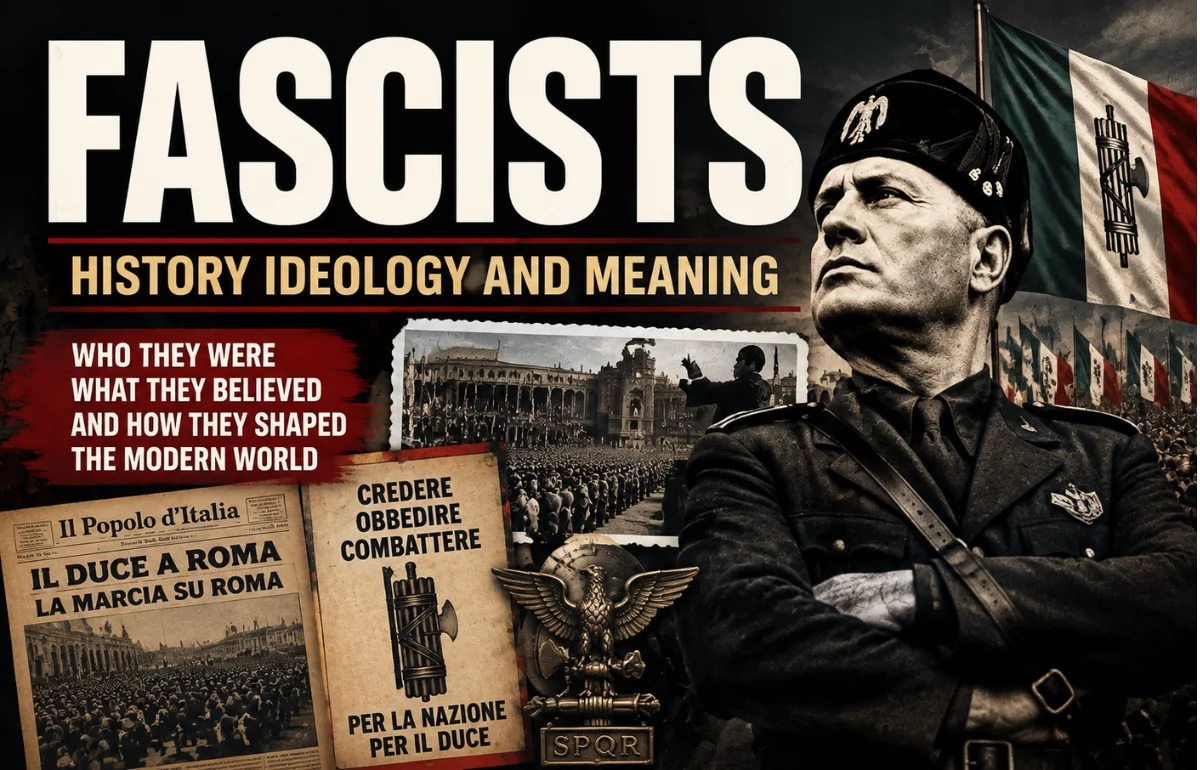
Fascisterne is a Danish word meaning “the fascists.” It refers to people who support fascism, not to the ideology itself. In Danish, fascist means one fascist, fascister means fascists, and fascisterne means the fascists. The ideology is called fascisme. That distinction matters because many English-language pages use Fascisterne as though it were another name for fascism, which can confuse readers before the history even begins. Den Danske Ordbog defines a fascist as a supporter of fascism and gives the noun endings that produce the definite plural fascisterne.
When I research political terms, I start by separating the word, the people, and the ideology. That simple habit prevents a common mistake here: Fascisterne names a group of people, while fascism describes the political movement and system they support.
What Does Fascisterne Mean in Danish?
Fascisterne is the definite plural form of fascist in Danish. English normally adds “the” as a separate word, while Danish often adds a definite ending to the noun.
| Danish form | English meaning | How it is used |
|---|---|---|
| fascist | a fascist | One person who supports fascism |
| fascisten | the fascist | One specific fascist |
| fascister | fascists | More than one fascist |
| fascisterne | the fascists | A specific or previously identified group |
| fascisme | fascism | The ideology or political movement |
| fascistisk | fascist or fascistic | An adjective describing ideas, actions, or systems |
This language detail is more than grammar. A sentence about Fascisterne should normally discuss people, parties, followers, or historical actors. A sentence about fascisme should discuss beliefs, institutions, political methods, or government.
The word fascism ultimately relates to the Latin fascis, a bundle of rods associated with authority in ancient Rome. Danish dictionary material connects fascisme to that origin, while the modern political meaning developed around Benito Mussolini’s movement in Italy.
Who Were the Original Fascists?
The original Fascisterne were members and supporters of the Italian fascist movement that emerged after the First World War.
Benito Mussolini founded Fasci Italiani di Combattimento in Milan on March 23, 1919. The early movement attracted war veterans and presented itself as nationalist, anti-democratic, anti-socialist, activist, and willing to use violence for political power.
Postwar social conflict, economic disruption, and fear of revolution gave fascist squads room to grow. They attacked socialist organizations, trade unions, and political opponents while presenting themselves as defenders of order.
Mussolini became prime minister in October 1922 after the March on Rome. His rule was not instantly a complete dictatorship.
Over the following years, Fascisterne weakened representative government, suppressed opponents, restricted the press, and consolidated a one-party state. Mussolini ruled as dictator from 1925 until 1943.
The process was gradual: fascists entered institutions, normalized intimidation, and then removed the checks that could force them from power.
What Did Fascisterne Believe?
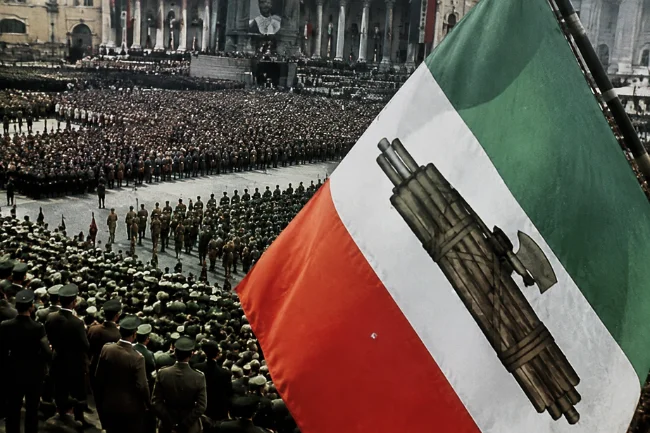
Historical fascist movements differed by country, but they shared a recognizable political pattern.
Fascism placed the nation above the individual and rejected pluralist democracy, political equality, socialism, and liberal individual rights. It favored authoritarian leadership, social discipline, militarism, and an exclusive idea of national belonging.
The Nation Above the Individual
For Fascisterne, citizens did not primarily exist as independent people with rights against the state. They were expected to serve a larger national community.
That community was often described as organic: one people with one destiny, one culture, and one political will. Anyone portrayed as outside that unity could be treated as a threat rather than a legitimate neighbor or political opponent.
A Leader Who Embodies the Nation
Fascist politics typically centers power around a commanding leader. The leader is presented not merely as an elected administrator but as the voice, will, and symbol of the nation.
Politics then shifts from debate among citizens to loyalty toward authority, while courts, legislatures, and the press lose independence.
Political Violence as a Legitimate Tool
Fascisterne did not treat violence only as an unfortunate emergency. Fascist movements frequently celebrated force, sacrifice, discipline, and combat as ways to renew the nation.
Paramilitary groups helped intimidate opponents and made public violence appear normal. The United States Holocaust Memorial Museum identifies paramilitarism and the acceptance of violence as recurring fascist characteristics.
Propaganda and Mass Participation
Fascism was not simply rule by secret police from above. It also sought active public participation through rallies, uniforms, youth groups, symbols, radio, film, sports, and organized leisure.
Propaganda becomes especially powerful when politics is turned into an identity and social community, not merely a set of policies.
Exclusion and the Politics of Belonging
Fascist movements define who belongs to the nation and who does not. The excluded group may be identified through ethnicity, religion, race, political belief, nationality, or another status.
Italian Fascism and German Nazism did not begin with identical racial doctrines. Italy introduced antisemitic laws in 1938, after years in which Jews could participate in the Fascist Party.
Nazi racial ideology, by contrast, made racial hierarchy and antisemitism central from the beginning and ultimately drove systematic persecution and genocide.
Fascisterne, Nazis, and Authoritarian Rulers: What Is the Difference?
Political labels lose meaning when every harsh ruler is called a fascist. I compare systems by defining features rather than emotional force.
| Political type | Main source of legitimacy | Typical defining features | Is it automatically fascist? |
|---|---|---|---|
| Fascism | A supposedly unified nation embodied by a leader | Ultranationalism, anti-democracy, mass mobilization, hierarchy, political violence, exclusion | Yes, when the full ideological pattern is present |
| Nazism | A racialized national community under Hitler’s leadership | Fascist authoritarianism plus extreme racial hierarchy, antisemitism, expansionism, and genocidal policy | Usually treated as a radical form of fascism, though distinctions matter |
| Military dictatorship | Control by armed forces | Rule by generals, suspension of political rights, security-centered government | No; it may lack a fascist mass movement or national-rebirth ideology |
| Absolute monarchy | Hereditary dynastic rule | Authority based on royal succession and tradition | No |
| Personalist authoritarianism | Loyalty to one ruler | Weak institutions, patronage, repression, leader-centered power | Not necessarily |
| Populism | Claim to represent “the real people” against elites | Anti-establishment rhetoric and direct leader-to-public appeals | No; populism can exist across ideologies and within democracies |
Nazism is closely related to fascism, but the terms should not be used as perfect synonyms.
Mussolini’s Italy provided Hitler with a model of political violence, dictatorship, propaganda, and mass mobilization. Nazi Germany then developed a far more systematic racial state in which antisemitism, “Aryan” supremacy, territorial conquest, and annihilation were central.
The distinction does not make Italian Fascism harmless: Mussolini’s regime destroyed democracy, persecuted opponents, pursued empire, adopted racial laws, and allied with Nazi Germany.
Were There Fascisterne in Denmark?
Yes, Denmark had fascist- and Nazi-inspired organizations, although they remained much weaker electorally than their counterparts in Germany and Italy.
The best-known was Danmarks Nationalsocialistiske Arbejderparti, or DNSAP, founded in 1930. It followed German National Socialism more directly than Italian Fascism and promoted authoritarian, nationalist, and antisemitic politics.
At the 1935 parliamentary election, DNSAP received 16,257 votes, or 0.99 percent, and won no seats. It first entered parliament in 1939 with three seats.
Denmark’s response also offers a useful lesson in democratic self-defense. In 1933, the Danish parliament adopted a ban on political uniforms.
Further measures in 1934 tightened weapons rules and prohibited militarily organized political groups. The stated purpose was to prevent violent organizations from destabilizing democracy in the way paramilitary movements had damaged the Weimar Republic.
The Danish example moves the discussion beyond famous dictators. It shows how a democracy can confront anti-democratic movements early while still facing difficult questions about expression, association, and state power.
How Should the Word Fascist Be Used Today?
Today, fascist is often used as a general insult for someone seen as controlling, intolerant, or politically extreme.
Danish dictionaries also record a broader transferred meaning for an aggressively authoritarian or strongly nationalist person. Yet that wider usage should not replace historical precision.
Before I describe a movement as fascist, I look for a cluster of traits rather than one offensive statement or one strict policy:
- Does it reject democratic competition or accept elections only when it wins?
- Does it describe the nation as a single, pure community threatened by internal enemies?
- Does it demand loyalty to a leader above laws and institutions?
- Does it normalize political violence, paramilitary action, or intimidation?
- Does it seek to remove equal rights from groups defined as outsiders?
- Does it promise national rebirth through struggle, purification, or conquest?
No single answer settles the question. Nationalism, a strong executive, censorship, or populist rhetoric may become authoritarian, but none alone establishes the full fascist pattern.
This careful approach protects the term from becoming meaningless while still allowing people to identify genuinely dangerous similarities.
Why the History of Fascisterne Still Matters
The history matters because Fascisterne did not gain influence through ideology alone. They succeeded where political crisis, weakened institutions, elite miscalculation, propaganda, organized violence, and public fear came together.
Hitler’s appointment as German chancellor on January 30, 1933, did not make him an absolute dictator that same day.
The Nazis used legal opportunities, emergency powers, violence, propaganda, and political maneuvering to transform a democracy into a dictatorship. Their rise was not inevitable, which means it should be studied as a chain of choices rather than a mysterious historical accident.
The warning is not that every modern dispute resembles the 1930s. It is that democratic decline can appear ordinary as people grow accustomed to dehumanizing language, intimidation, and attacks on independent institutions.
Understanding Fascisterne therefore requires more than memorizing Mussolini and Hitler.
It means learning to distinguish patriotism from exclusionary ultranationalism, leadership from leader worship, public order from political repression, and democratic disagreement from the attempt to eliminate legitimate opposition.
A Practical Way to Read the Term in Context
Whenever you encounter Fascisterne in a Danish sentence, ask three questions.
First, who are “the fascists” in that passage? The word may refer to Mussolini’s followers, members of a local party, wartime collaborators, or people being labeled by an opponent.
Second, is the writer using the term historically or rhetorically? A history book may use it as a classification, while a political argument may use it loosely as condemnation.
Third, what evidence supports the label? Look for ideology, organization, methods, and goals—not merely an angry tone.
That three-part check combines language knowledge with historical judgment. It is also the clearest way to avoid repeating the common online error of treating Fascisterne as the name of an ideology.
FAQs About Fascisterne
What does Fascisterne mean in English?
Fascisterne is Danish for “the fascists,” meaning a specific group of people who support fascism.
Is Fascisterne the same as fascism?
No. Fascisterne refers to people, while the Danish word for the ideology is fascisme.
Were all fascists Nazis?
No. Nazism was a German movement with an especially central racial and antisemitic ideology; other fascist movements differed, although they shared authoritarian and ultranationalist features.
Did Denmark have a fascist party?
Denmark had several anti-democratic right-wing currents, and DNSAP was the main Danish Nazi party. It remained electorally marginal and won three parliamentary seats in 1939.
Does fascism still exist today?
Neo-fascist movements exist, but the label should be applied through evidence of ultranationalism, anti-democracy, exclusion, leader worship, and acceptance of political violence—not as a synonym for every extreme view.
Closing Thoughts
Fascisterne means “the fascists,” but understanding the word properly opens a larger historical question: how do political movements persuade people to trade pluralism and individual rights for unity, authority, and exclusion?
The next useful action is to examine any use of the term in its linguistic and historical context. Check who is being described, which fascist characteristics are actually present, and whether the source supports its claim.
Accurate language is the first defense against both historical confusion and careless political labeling.

Ava Bennett is a social media strategy writer with 7+ years of experience covering social platforms, content trends, audience engagement, and digital communication strategies. She creates practical insights to help readers understand the evolving social media landscape.