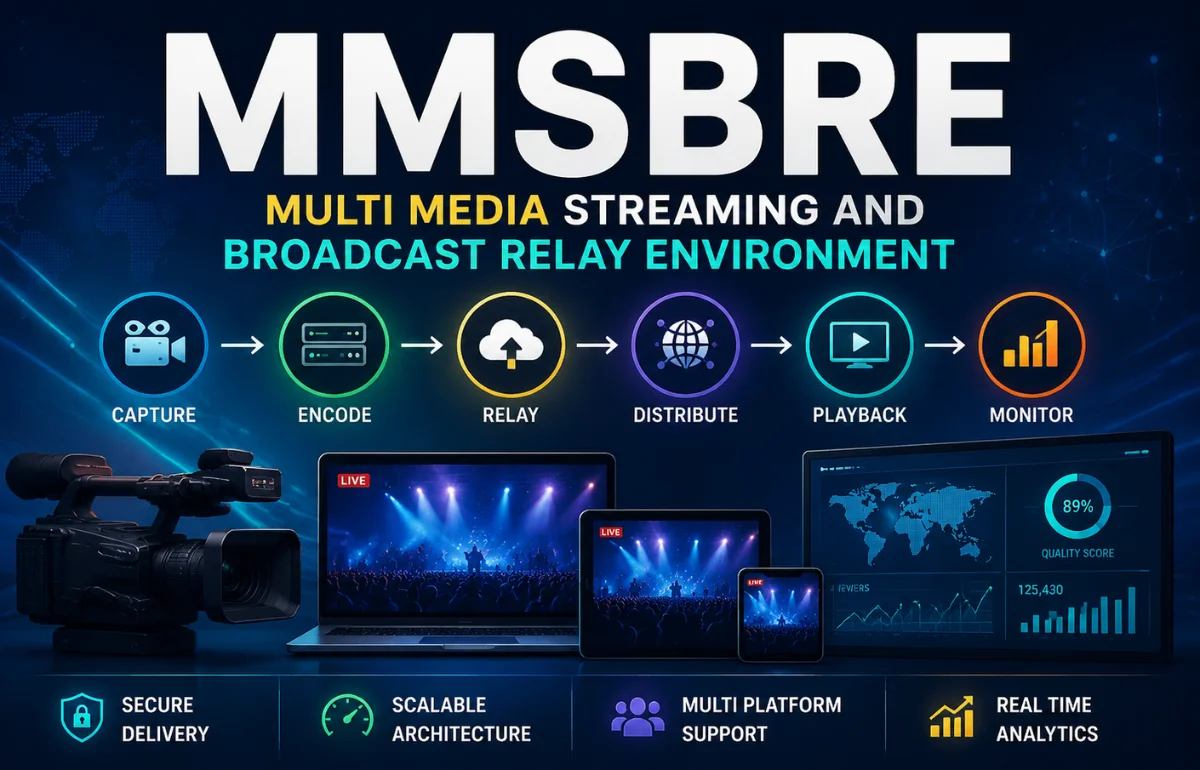
MMSBRE is an emerging digital term most often expanded as Multi-Media Streaming and Broadcast Relay Environment. In practical terms, it describes a coordinated setup that receives audio or video, processes it, sends it to one or more destinations, and monitors delivery from start to finish. It is not a single app, protocol, or officially standardized product. I use MMSBRE as an architectural label for the complete media-delivery environment: ingest, encoding, packaging, relay, distribution, playback, security, analytics, and operational control.
That distinction matters. Several recent websites use the same expansion, but the term does not have the established standards status of technologies such as HLS or MPEG-DASH. The safest way to understand MMSBRE is as a useful umbrella concept, not a replacement for recognized streaming standards.
What Does MMSBRE Mean?
The commonly used full form is Multi-Media Streaming and Broadcast Relay Environment:
- Multi-Media covers video, audio, captions, graphics, metadata, and interactive content.
- Streaming means delivering media continuously rather than waiting for a complete download.
- Broadcast Relay means receiving one feed and forwarding or transforming it for several channels.
- Environment includes the connected services, people, policies, and monitoring tools that keep delivery running.
I would not describe MMSBRE as a formal protocol. HLS is a defined technology for delivering live and on-demand media over HTTP, while MPEG-DASH is a documented international adaptive-streaming standard. MMSBRE sits above these technologies and describes how protocols, encoders, origins, content delivery networks, players, and control systems can work together.
Is MMSBRE an Official Industry Standard?
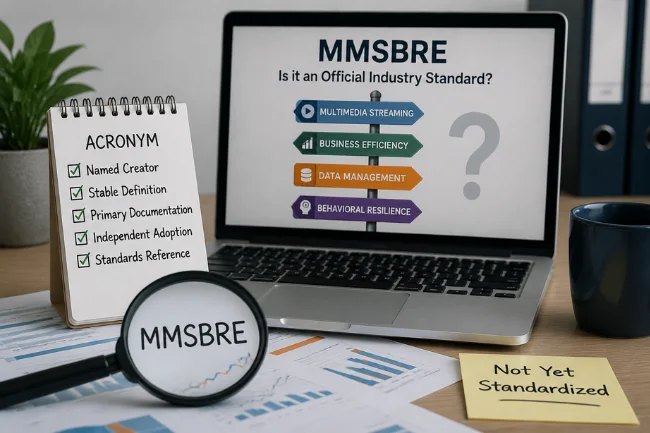
MMSBRE should currently be treated as a non-standardized, emerging term. Its meaning is inconsistent across the web. Some pages connect it with multimedia streaming; others use it for business efficiency, data management, behavioral resilience, or general digital communication.
When I assess a new acronym, I look for a named creator, stable definition, primary documentation, independent adoption, and a standards or vendor reference. MMSBRE does not yet have that level of public verification.
This does not make the term useless. It means publishers and technology teams should define their chosen interpretation and avoid presenting it as a universally accepted technology.
How an MMSBRE Architecture Works
A practical MMSBRE workflow is a chain. Each stage has a clear job, and a weakness in one stage can affect the viewer’s experience.
Media Capture and Ingest
The workflow starts with a camera, microphone, screen share, studio feed, recorded file, or remote contribution link. The ingest layer receives that content and transports it into the processing environment.
Professional systems may use redundant feeds so operations can switch to a backup when the primary source fails. AWS documentation describes live video transport, secure stream sharing, monitoring, and stream replication as connected parts of a professional media workflow.
Encoding and Transcoding
An encoder converts the source into compressed formats suitable for delivery. It may create several quality levels so a player can move between them as network conditions change.
This adaptive approach helps viewers on different connections receive a usable stream without forcing everyone to download the highest-quality version.
Packaging and Origin
Packaging prepares encoded media for delivery through formats such as HLS, MPEG-DASH, or CMAF. The origin serves manifests, media segments, captions, and metadata.
A packager may also support encryption, ad insertion, time shifting, and live-to-video-on-demand workflows. A common cloud architecture sends adaptive outputs from an encoder to a packaging origin before a CDN delivers them to viewers.
Relay and Distribution
The relay layer forwards the processed feed to destinations such as websites, mobile apps, smart-TV apps, social platforms, partner broadcasters, private portals, and internal channels.
A content delivery network distributes media through edge locations closer to viewers. This reduces pressure on the origin and supports audiences in multiple regions.
Playback, Security, and Access
The media player selects an appropriate quality, displays captions, enforces access rules, and recovers from short network interruptions.
Security may include authentication, authorization, signed links, encryption, digital rights management, and activity logging. The correct controls depend on whether content is public, paid, confidential, regulated, or time-limited.
Monitoring and Operational Control
Monitoring should cover the full route, not only the webpage. Useful signals include input availability, encoding errors, segment delivery time, startup delay, buffering, playback failures, viewer concurrency, and regional performance.
In my assessment, monitoring is what separates a collection of streaming tools from a managed MMSBRE environment. The team must know where a failure occurred, who owns the response, and which fallback should activate.
MMSBRE Components at a Glance
| Component | Main role | Common failure to prevent |
|---|---|---|
| Ingest | Receives and transports source media | Lost or unstable source feed |
| Encoder | Compresses media and creates quality variants | Poor quality or incompatible output |
| Packager and origin | Produces stream formats and serves segments | Missing manifests or delayed segments |
| Relay or CDN | Distributes media across destinations and regions | Congestion or regional outage |
| Player | Delivers media to the viewer | Buffering, device, or caption failure |
| Monitoring layer | Detects faults and measures experience | Hidden degradation and slow response |
| Security layer | Controls access and protects content | Unauthorized viewing or leakage |
Where MMSBRE Can Be Used
Live Events and Sports
One production feed may need to reach a website, app, broadcast partner, highlights team, and social platform. A coordinated environment creates suitable outputs without rebuilding the production for every destination.
Education and Corporate Communications
Universities and businesses can use the architecture for classes, town halls, product launches, training, captions, restricted access, recording, and post-event reporting.
News and Public Information
Newsrooms and public agencies may need to relay one verified source to several channels quickly. Reliability, source control, accessibility, and clear operational ownership are essential in this setting.
Creator and Commerce Platforms
Creators and brands can combine live video with chat, product data, moderation, analytics, and replay. The stream must exchange data with other services without introducing unnecessary delay.
MMSBRE Compared With Related Technologies
| Term | What it is | How it differs from MMSBRE |
|---|---|---|
| HLS | An HTTP-based streaming technology | A delivery method used inside the environment |
| MPEG-DASH | A standardized adaptive-streaming format | A formal standard, not the complete architecture |
| CDN | A distributed delivery network | Handles distribution, not the full source-to-viewer workflow |
| OTT platform | A service delivering video over the internet | May contain an MMSBRE-style architecture |
| Broadcast automation | Tools controlling scheduled broadcast output | Focuses on playout rather than the entire digital chain |
| Video conferencing | Real-time interactive communication | Designed for participation rather than large-scale broadcasting |
This comparison prevents a common mistake: calling every streaming component MMSBRE. The term is most useful when it describes the complete coordinated environment.
Benefits of a Well-Designed MMSBRE
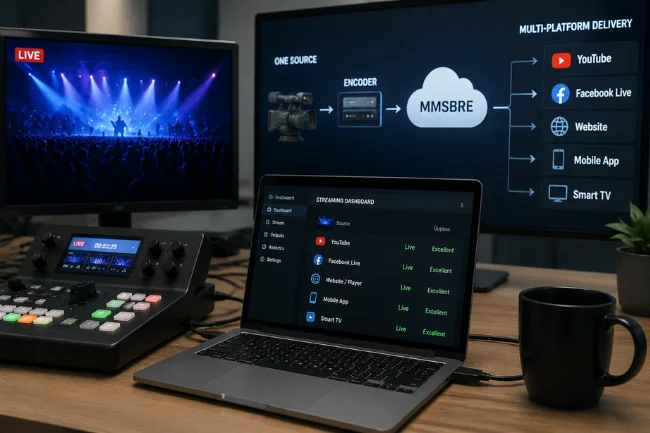
Consistent Multi-Platform Delivery
A centralized workflow can create several outputs from one source. This reduces duplicated production work and makes captions, branding, timing, and metadata easier to control.
Better Reliability and Scalability
Redundant inputs, backup encoders, alternate origins, and diversified delivery paths can reduce the effect of individual failures. Separating processing from distribution also makes it easier to serve a larger audience.
Redundancy must be tested. A backup that uses the same failing network, credentials, or power source may not provide meaningful protection.
Measurable Viewer Experience
A complete environment connects technical metrics with viewer outcomes. Teams can measure whether users started playback, experienced buffering, watched to completion, or left after an error.
Stronger Operational Control
Documented ownership, alerts, access policies, and recovery procedures give teams a repeatable way to manage live and on-demand delivery.
Limitations and Risks
MMSBRE is not a magic label for a weak streaming system. A connected architecture can create more dependencies and higher costs for encoding, storage, data transfer, CDN use, monitoring, licensing, and support.
Vendor lock-in is another concern. A workflow built around proprietary interfaces may be difficult to migrate. I prefer designs that document data flows, expose operational metrics, and use recognized media formats where practical.
The name itself creates risk. Because MMSBRE is not consistently defined, it should not appear in contracts, technical specifications, or procurement documents without a precise definition and scope.
Best Practices for Planning an MMSBRE Environment
Define the Viewer and Service Target
Identify the audience, devices, regions, expected concurrency, acceptable delay, accessibility needs, security rules, and availability target before selecting tools.
Draw the Complete Signal Path
Map the route from source to viewer, including credentials, DNS, APIs, captions, analytics, and backup paths. This often reveals hidden single points of failure.
Choose Standards Before Vendors
Set requirements for ingest, packaging, captions, delivery, and playback. Then compare vendors against those requirements rather than redesigning the workflow around one product.
Test Failure, Not Only Success
Disconnect an input, stop an encoder, block an origin, expire a token, and simulate a delivery problem. A recovery plan becomes credible only after the team observes it working.
Measure the Viewer’s Experience
Track startup delay, buffering, playback errors, average bitrate, device failures, and regional performance. Infrastructure uptime alone does not prove that viewers had a successful session.
Maintain a Concise Runbook
The runbook should identify owners, alert thresholds, fallback actions, escalation contacts, and recovery checks. During a live incident, a short verified procedure is more useful than a large architecture document.
A Practical MMSBRE Readiness Check
Before describing a workflow as an MMSBRE environment, I would expect clear answers to these questions:
- Can one source be processed for every required destination?
- Is there a tested backup for the source, encoder, origin, and delivery path?
- Are captions, metadata, and access rules preserved across outputs?
- Can the team locate a failing stage within minutes?
- Are viewer metrics available by device and region?
- Can another trained operator run the documented system?
- Are costs predictable at normal and peak audience levels?
Several “no” answers usually mean the organization has a streaming workflow, but not yet a resilient, managed environment.
The Future of MMSBRE
The acronym may evolve, gain adoption, or disappear. The underlying architecture remains relevant because media systems are becoming more modular, cloud-connected, measurable, and multi-platform.
Future environments are likely to emphasize automated quality control, low-latency delivery, real-time captions, content authenticity, personalized streams, and policy-based routing. Strong implementations will still rely on established standards and transparent operating practices rather than the acronym alone.
Frequently Asked Questions
What does MMSBRE stand for?
MMSBRE is most often expanded as Multi-Media Streaming and Broadcast Relay Environment, although it is not governed by a widely recognized standard.
Is MMSBRE a software product?
No. It is better understood as an umbrella term for a connected multimedia streaming and relay architecture.
Is MMSBRE the same as a CDN?
No. A CDN distributes media, while an MMSBRE environment also includes ingest, encoding, packaging, playback, security, and monitoring.
Which protocols can an MMSBRE system use?
It may use HLS, MPEG-DASH, CMAF, SRT, RTMP, or WebRTC, depending on latency, compatibility, and interaction needs.
How do I start planning an MMSBRE setup?
Define the audience and targets, map the signal path, choose recognized formats, add monitoring, and test every backup route before launch.
Final Takeaway
MMSBRE is best treated as a descriptive architecture term for coordinating multimedia capture, processing, relay, delivery, and monitoring. It is not currently a formal standard, so clarity matters more than the acronym itself.
Start by mapping one real media workflow from source to viewer. Mark every dependency, failure point, security control, and measurable outcome. That map will show whether you need a coordinated MMSBRE-style environment or a smaller improvement to the streaming stack you already use.

Noah Sterling is a technology research writer with 8+ years of experience covering emerging technologies, software trends, digital tools, and innovation. He creates practical, research-based articles to help readers understand the evolving technology landscape.